Candidate assessment checklist for fair, effective hiring

Inconsistent candidate evaluations are costing European organisations more than they realise. A single mis-hire can set a team back months, drain budgets, and create compliance headaches that nobody wants. Many hiring teams still rely on gut instinct and informal conversations, which opens the door to unintended bias and wildly different outcomes from one interviewer to the next. The good news? A well-built candidate assessment checklist changes all of that. This guide gives you a practical, research-backed blueprint for creating a structured, compliant assessment process that consistently surfaces the right people for the right roles.
Table of Contents
- Why use a candidate assessment checklist?
- What every checklist needs: Key mechanics and compliance
- Step-by-step: Building your candidate assessment checklist
- Innovations and pitfalls: AI, bias, and current trends
- Verification: Reviewing and updating your assessment process
- How We Are Over The Moon enables smarter candidate assessment
- Frequently asked questions
Key Takeaways
| Point | Details |
|---|---|
| Structure reduces bias | Using a disciplined checklist delivers more consistent and fair hiring results. |
| Legal compliance is essential | A good checklist protects against risk by integrating GDPR, EU AI Act, and equality requirements. |
| Culture add boosts innovation | Assess for diversity and fresh perspectives, not just alignment, to improve team performance. |
| AI tools require validation | Only use AI-driven assessments that are validated for fairness and legal compliance. |
Why use a candidate assessment checklist?
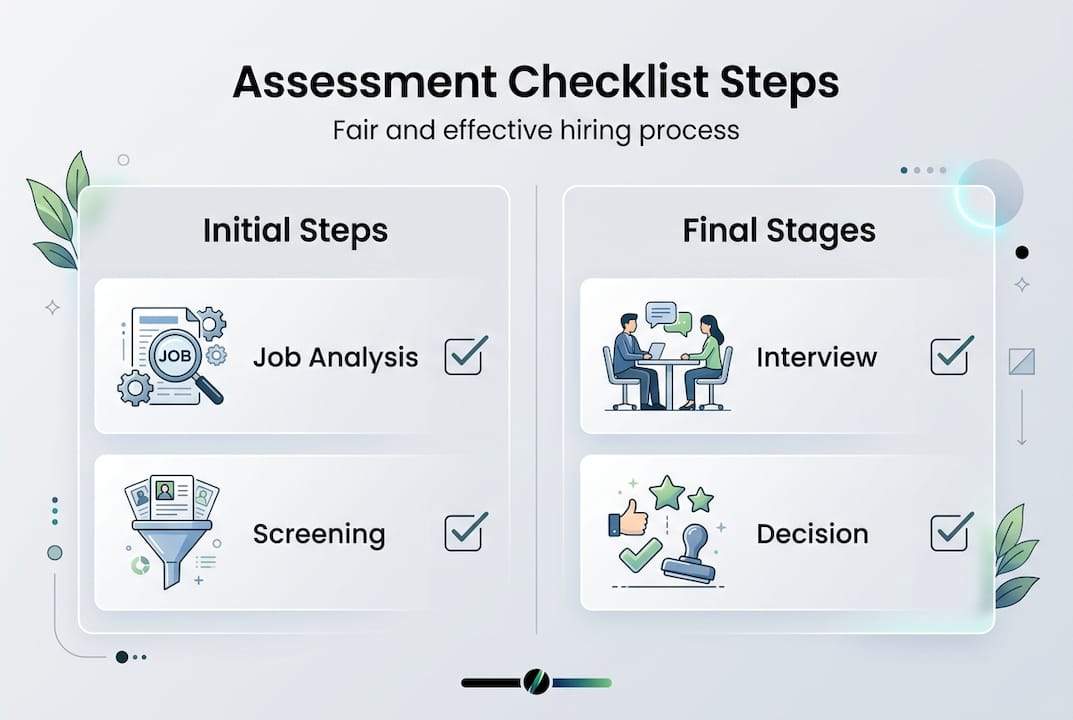
A candidate assessment checklist is a structured framework that guides every stage of your hiring process, from job analysis through to final decision. It standardises how you evaluate candidates, ensuring every applicant is measured against the same criteria in the same way. That consistency is not just good practice; it is the foundation of fair, defensible hiring.
The evidence is compelling. Structured interviews significantly outperform unstructured methods in predictive validity, scoring 0.51 compared to 0.38 for unstructured approaches. That gap translates directly into better hires and fewer costly mistakes. We also know that candidate funnel passthrough rates are declining, which means every stage of your process needs to work harder.
Without a checklist, hiring teams fall into well-documented traps. Contrast effects skew judgements when one strong candidate makes the next look weaker by comparison. Affinity bias nudges interviewers towards people who remind them of themselves. Resources get wasted on candidates who were never a realistic fit. A checklist eliminates much of this noise.
Here is what a solid checklist delivers:
- Reduced bias at every evaluation stage
- Consistent scoring across all interviewers and panels
- Easier compliance with GDPR and EU employment law
- Faster decisions backed by structured data
- Better candidate experience through clear, predictable processes
When assessment tools improve hiring efficiency, the whole talent funnel benefits. And when you layer in AI to enhance recruitment quality, you gain even sharper insights at scale. The checklist is your anchor point for all of it.
What every checklist needs: Key mechanics and compliance
Knowing why checklists matter, next is ensuring every component is present and legally watertight. A robust checklist covers six core stages, and each one carries its own compliance considerations.
| Checklist stage | Key actions | Compliance note |
|---|---|---|
| Job analysis | Define competencies and requirements | Ensure criteria are objective and non-discriminatory |
| CV screening | Apply consistent scoring criteria | GDPR: retain data only as long as necessary |
| Skills and psychometric assessments | Use validated tools | EU AI Act: validate automated tools for fairness |
| Structured interviews | Use standardised questions and rubrics | Equality Act: avoid protected characteristic questions |
| Reference checks | Verify employment history and conduct | Right-to-work verification required |
| Decision making | Panel consensus with documented rationale | OTM-R: open, transparent, merit-based process |
The key checklist mechanics include job analysis, scoring rubrics, skills assessments, structured interviews, reference checks, and panel evaluation, all working together to reduce bias and improve consistency. For European organisations, EU HR compliance requires attention to GDPR, the EU AI Act, OTM-R principles, right-to-work verification, and cultural localisation.
Common compliance pitfalls to avoid:
- Storing candidate data longer than your stated retention period
- Using AI screening tools that have not been validated for bias
- Asking questions that touch on protected characteristics
- Failing to document the rationale behind hiring decisions
- Skipping right-to-work checks for cross-border European hires
Building a modern screening workflow into your checklist from the start saves significant time and legal risk later. The unbiased interview checklist from SHRM is also a useful reference for structuring your interview stage.

Pro Tip: Create a scoring rubric for each checklist stage before you begin hiring. Rubrics force evaluators to define what “good” looks like in advance, which dramatically reduces post-hoc rationalisation and keeps your process defensible.
Step-by-step: Building your candidate assessment checklist
Having the mechanics in place, let us build your checklist from scratch using practical, bias-minimising steps.
- Conduct a thorough job analysis. Identify the core competencies, technical skills, and behavioural traits the role genuinely requires. Use input from current high performers and line managers.
- Map competencies to assessment methods. Decide which competencies will be tested through skills assessments, which through structured interviews, and which through work samples or challenges.
- Design your CV screening criteria. Apply consistent, objective filters based on your competency map. Avoid criteria that inadvertently screen out diverse candidates.
- Select and validate your skills and technical tests. Choose tools that are reliable, relevant, and compliant with the EU AI Act. Cognitive tests, coding challenges, and video pitches all have their place.
- Build your structured interview guide. Use the STAR method (Situation, Task, Action, Result) with 8 to 12 questions covering 4 to 6 core competencies. The CIPD recruitment process recommends this approach for behavioural interviewing.
- Conduct reference checks. Verify employment history and gather structured feedback using consistent questions.
- Run a panel consensus scoring session. Bring evaluators together to compare scores, discuss evidence, and reach a documented decision.
One of the most important decisions you will make is whether you are hiring for culture fit or culture add. Here is how they compare:
| Approach | Benefit | Risk |
|---|---|---|
| Culture fit | Faster onboarding, team cohesion | Risk of homogeneity, reduced innovation |
| Culture add | Diversity of thought, fresh perspectives | Requires more onboarding support |
Culture add encourages diversity and innovation, whereas culture fit can risk homogeneity over time. We recommend building culture add criteria directly into your competency framework.
For remote or volume hiring, adapt your checklist by:
- Replacing in-person assessments with asynchronous video pitches or AI interviews
- Using automated scoring for initial skills screens to manage volume
- Scheduling structured panel reviews at set intervals rather than ad hoc
AI interview examples show how technology can maintain structure at scale, and AI and cultural fit tools are making it easier to assess values alignment without relying on gut feel. The candidate screening toolkit from SHRM offers additional templates to support your build.
Pro Tip: Calibrate your panel before interviews begin. Run a short session where all evaluators score the same sample response independently, then compare. This surfaces scoring inconsistencies before they affect real candidates.
Innovations and pitfalls: AI, bias, and current trends
Now, leverage the very best of HR technology while sidestepping new and classic pitfalls. AI is genuinely exciting for candidate assessment, but it brings risks that your checklist must address head-on.
“Contrast effects from prior candidate sequences can distort assessments by up to 40%, making sequential evaluation one of the most underestimated sources of bias in hiring.”
That is a striking figure. It means that if you interview a brilliant candidate first thing on a Monday, the person who follows them is statistically likely to be rated lower, regardless of their actual performance. Your checklist must account for this.
AI-powered checklists must be validated for bias, fairness, and compliance with the EU AI Act. This is not optional. Under the Act, high-risk AI systems used in recruitment must meet strict transparency and accuracy standards.
How to train your team to spot and mitigate key risks:
- Contrast effect: Randomise interview order where possible and score each candidate independently before group discussion
- Affinity bias: Use structured scoring rubrics that anchor evaluators to evidence, not impressions
- Automation bias: Treat AI scores as one data point, not the final word
- Anchoring bias: Avoid sharing candidate scores between evaluators before independent scoring is complete
- Confirmation bias: Require evaluators to document counter-evidence for every positive impression
Stay current with AI in recruitment developments, understand the role of AI in recruitment agencies, and keep an eye on AI in recruitment for 2026 as regulations and capabilities continue to evolve rapidly.
Verification: Reviewing and updating your assessment process
With implementation complete, regular verification keeps your checklist sharp, compliant, and competitive. Assessment drift is real. Without scheduled reviews, even the best checklist gradually loses its effectiveness as roles evolve, regulations change, and team composition shifts.
Structured, regularly audited hiring processes consistently outperform those that drift from benchmarks. Here is a practical review cycle to embed into your annual HR strategy:
- Collect feedback quarterly. Gather input from hiring managers, interviewers, and candidates about what is working and what is not.
- Audit for regulatory changes. Check for updates to GDPR guidance, the EU AI Act, and local employment law at least twice a year.
- Retrain evaluators annually. Bias awareness and scoring calibration training should be refreshed every year, not just at onboarding.
- Recalibrate scoring rubrics. Compare your rubric scores against actual performance data for recent hires. If high scorers are underperforming, your rubric needs adjustment.
- Report metrics to leadership. Present time-to-hire, pass-through rates, and quality-of-hire data to demonstrate the checklist’s business value.
The metrics that matter most are time-to-hire (efficiency), pass-through rates by stage (where candidates drop off), and quality of hire (performance ratings at 6 and 12 months). Together, these tell you whether your checklist is doing its job. Using AI for process reviews can surface patterns in your data that manual analysis would miss. Keep an eye on European talent acquisition trends to ensure your process stays ahead of the curve.
How We Are Over The Moon enables smarter candidate assessment
For HR leaders ready to streamline their process and raise hiring quality, expert help is within reach. We Are Over The Moon is built for exactly this challenge. Our platform replaces traditional CV screening with real, skills-based assessments: AI interviews, company challenges, cultural matching, cognitive tests, and video pitches. Every tool is designed to give you structured, comparable data at every stage of your checklist, so your decisions are grounded in evidence rather than impression.
We are genuinely excited about what a well-structured assessment process can do for your team. Whether you are hiring at volume or filling a single critical role, our skills-first hiring platform brings compliance, innovation, and cultural insight together in one place. Explore our AI validation tools to see how automated, bias-aware assessments can slot seamlessly into your checklist. And if you want to know more about the people behind the platform, our story is worth a read. We would love to help you build a hiring process you are truly proud of.
Frequently asked questions
What is the STAR method in candidate assessment?
The STAR method guides candidates to answer interview questions by describing the Situation, Task, Action, and Result, making competency evaluation clearer and more comparable across candidates.
How often should we review our candidate assessment checklist?
Best practice is quarterly or at least annually, incorporating feedback from evaluators and candidates alongside any new regulatory guidance to prevent assessment drift.
How can we avoid bias in our assessments when using AI tools?
Use only validated, compliant AI systems and monitor for contrast and selection bias with regular evaluator training, as EU AI Act and GDPR require validation of AI tools for fairness and compliance.
What is the difference between culture fit and culture add?
Culture fit aims for alignment with current values, while culture add seeks candidates who bring new, diverse perspectives that strengthen the team over time.