Assess candidates with AI and cultural fit for better hiring

You post a role, receive 200 applications, and spend three weeks sifting through CVs that all look suspiciously similar. Sound familiar? Traditional candidate assessment is exhausting, slow, and riddled with unconscious bias. The good news is that a new generation of tools, from AI-powered interviews to structured cultural matching, is changing everything. This guide walks you through exactly how to modernise your assessment process, reduce bias, and hire people who genuinely thrive in your organisation. We are genuinely excited to share what works.
Table of Contents
- Why rethinking candidate assessment matters today
- Essential tools and requirements for modern assessment
- Structured step-by-step candidate assessment process
- Mitigating bias and ensuring fairness in assessments
- Measuring outcomes and refining your assessment process
- Enhance your hiring with expert solutions
- Frequently asked questions
Key Takeaways
| Point | Details |
|---|---|
| Blend AI with human insight | The most predictive assessments use a hybrid of AI-driven and human-evaluated methods. |
| Mitigate bias proactively | Regular audits, structured interviews, and diverse panels help minimise assessment bias. |
| Prioritise compliance | Ensure all assessment tools and processes align with GDPR and EU AI Act regulations. |
| Focus on cultural alignment | Integrate structured tools and checklists for a more objective measure of cultural fit. |
Why rethinking candidate assessment matters today
Legacy hiring processes were built for a different era. Unstructured interviews, gut-feel decisions, and CV screening based on university names or job titles create a process that is neither fair nor particularly predictive of success. The result? High turnover, poor cultural fit, and a lot of wasted time for everyone involved.
The pain points are real and well-documented. Bias creeps in at every stage. Time-to-hire stretches on. And candidates who look brilliant on paper turn out to be a poor match for your team’s values and ways of working. These are not small problems. They cost mid-sized companies significant money and momentum.
Modern alternatives are genuinely exciting. Candidate assessment tool efficiency has improved dramatically thanks to structured approaches and digital platforms. AI candidate screening now handles the heavy lifting of initial evaluation, freeing your team to focus on the human moments that matter most.
Here is what AI-driven screening actually does in practice:
- Parses CVs automatically to surface relevant skills and experience
- Conducts chat-based or one-way video interviews at scale
- Applies gamified assessments to measure cognitive ability
- Flags candidates for human review based on structured criteria
AI-driven screening uses techniques like resume parsing, chat-based interviews, one-way video interviews, and gamified assessments to automate initial evaluation. That is a significant shift from the old way of doing things.
“The organisations winning at hiring are not the ones with the biggest budgets. They are the ones with the smartest, most structured processes.”
Of course, AI assessment challenges do exist, and we will cover those honestly later in this guide. The key is knowing how to use these tools well.
Essential tools and requirements for modern assessment
Before you redesign your process, it helps to know what is actually available and what each tool does best. The landscape has expanded rapidly, and not every platform suits every organisation.
Here is a quick comparison of traditional versus AI-enhanced methods:
| Assessment method | Traditional approach | AI-enhanced approach |
|---|---|---|
| CV screening | Manual, time-consuming | Automated parsing, instant shortlisting |
| Initial interview | Phone screen by recruiter | One-way video or chat-based AI interview |
| Skills testing | Paper or basic online tests | Adaptive cognitive and skills assessments |
| Cultural fit | Gut feel or informal chat | Structured cultural matching tools |
| Reference checks | Phone calls, slow | Automated reference platforms |
AI-driven techniques automate initial screening and save considerable time for mid-sized companies, which is exactly where the efficiency gains are most felt.
The tools you will want to consider include:
- Resume parsers that extract structured data from unstructured CVs
- Video interview platforms that allow asynchronous candidate responses
- Cognitive and psychometric tests for objective skills measurement
- Cultural matching tools that align candidate values with your organisation’s
- Assessment centre software for structured group or individual exercises
Understanding AI interview features helps you choose the right platform for your team’s needs. And the AI assessment benefits go beyond speed, they include consistency, auditability, and reduced interviewer fatigue.

Your team will also need some preparation. Digital literacy is essential, as is training on how to interpret AI outputs fairly. Structured assessment practices from CIPD offer a solid foundation for building this capability.
Pro Tip: Before purchasing any tool, run a pilot with a small cohort of real candidates. This reveals integration issues and bias risks before they affect your wider hiring pipeline.
Structured step-by-step candidate assessment process
With your toolkit ready, follow these steps to run a robust, compliant assessment process that combines the best of AI and human judgement.
- Conduct a thorough job analysis. Define the skills, behaviours, and values the role genuinely requires. This is your foundation for everything that follows.
- Select your tools. Match each stage of assessment to the right platform, whether that is an AI interview tool, a cognitive test, or a cultural matching questionnaire.
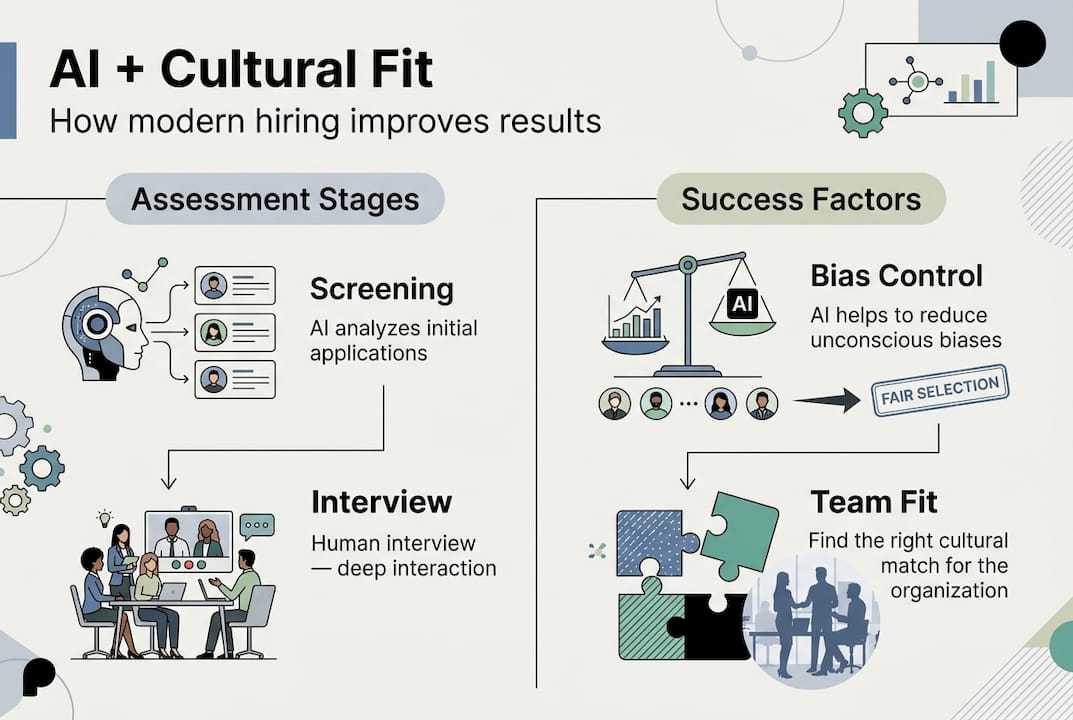
- Run an automated initial screen. Use AI to parse applications and conduct first-stage video or chat interviews. This saves hours and ensures consistency.
- Conduct structured interviews. Use pre-set questions tied to your job analysis. Structured interviews and assessment centres deliver far more reliable results than unstructured conversations.
- Test soft skills and cultural fit. Use validated tools for this stage. Our guide on cultural fit assessment steps walks you through the specifics, and the cultural fit checklist is a brilliant practical resource.
- Complete a compliance check. Ensure your process meets GDPR-compliant assessment standards and aligns with the EU AI Act, particularly around transparency and candidate data rights.
Here is a quick reference for each stage:
| Stage | Primary tool | Human involvement |
|---|---|---|
| Job analysis | Internal HR | High |
| Initial screen | AI platform | Low |
| Structured interview | Video platform | Medium |
| Soft skills and culture | Psychometric tools | Medium |
| Final decision | Panel review | High |
Pro Tip: Always give candidates a clear explanation of how AI is used in your process. Transparency builds trust and improves candidate experience significantly.
Mitigating bias and ensuring fairness in assessments
Even a structured process needs safeguards. Bias does not disappear just because you have introduced technology. In some cases, it can become harder to spot.
The main types of bias to watch for include:
- Proxy bias: AI trained on historical data may replicate past hiring patterns, favouring certain demographics without explicit intent
- Cultural bias: Assessment tools designed in one cultural context may disadvantage candidates from different backgrounds
- Procedural bias: Inconsistent application of criteria across candidates, even within a structured process
AI bias from proxies is a genuine risk, and continuous audits alongside diverse panels are the most effective way to mitigate it. This is not a one-time fix. It requires ongoing attention.
Practical steps to keep your process fair:
- Blind the early stages by removing names, photos, and demographic information from initial screening
- Use diverse interview panels to reduce individual bias in final decisions
- Audit your AI outputs regularly to check for patterns that suggest unfair filtering
- Demand explainability from your AI vendor so you understand why candidates are ranked as they are
Our resource on reducing AI bias in hiring goes deeper on practical techniques. And our commitment to AI ethics in recruitment means we take this seriously ourselves.
“Fairness is not a feature you add at the end. It is a design principle you build in from the start.”
For European HR teams, mitigating AI bias is also a legal obligation under the EU AI Act, not just a best practice.
Measuring outcomes and refining your assessment process
Once your process is in motion, the work is not done. The best HR teams treat assessment as a living system, one that improves with every hiring cycle.
Key metrics to track include:
- Quality of hire: Are the people you are bringing in performing well at six and twelve months?
- Retention rates: Are new hires staying? High early attrition often signals a cultural fit problem at the assessment stage.
- Diversity impact: Is your process attracting and progressing a broader range of candidates?
- Time to hire: Has your new process actually saved time compared to the old approach?
- Candidate experience scores: How do applicants feel about your process? This affects your employer brand.
Reduced predictive validity for chatbots versus psychometrics is a real finding, which is why hybrid AI and human solutions consistently outperform either approach alone. Do not rely on any single tool.
Use candidate feedback and hiring manager input to refine your questions, tools, and criteria each quarter. The future of AI recruitment points firmly towards continuous improvement loops, where data from each cohort informs the next.
Soft skill measurement remains one of the trickiest areas to get right, but structured assessment centres and validated psychometrics give you the best chance of accuracy.
| Metric | What it tells you | Review frequency |
|---|---|---|
| Quality of hire | Long-term fit and performance | Every 6 months |
| Retention rate | Cultural and role alignment | Quarterly |
| Diversity data | Fairness of process | Quarterly |
| Time to hire | Process efficiency | Monthly |
| Candidate NPS | Experience and brand impact | Per hiring round |
Enhance your hiring with expert solutions
We are over the moon about what modern assessment can do for your team, and we want to help you get there. If this guide has shown you anything, it is that the right combination of AI tools, structured processes, and cultural matching can genuinely transform your hiring outcomes.
At WAOTM, we have built a platform around exactly these principles. From skills-first matching that goes far beyond the CV, to AI interviews, cognitive tests, video pitches, and company challenges, everything is designed to help you find people who will truly thrive. Our assessment expertise is grounded in fairness, transparency, and real results. Ready to see it in action? Explore AI candidate validation and book a demo today. Your next great hire is closer than you think.
Frequently asked questions
What are the main benefits of using AI in candidate assessment?
AI streamlines initial candidate screening, saving significant time and improving consistency for HR teams in mid-sized companies. Automated techniques like video interviews and gamified assessments also reduce the manual burden on recruiters.
How can bias be reduced in AI-driven assessments?
Bias is best reduced through structuring, blinding, diverse panels, and regular audits of selection processes. Bias from proxies is a known risk, so ongoing monitoring is essential rather than optional.
What compliance issues should I be aware of with AI recruitment tools in Europe?
Ensure your process meets GDPR requirements and aligns with the EU AI Act, particularly around candidate data rights and transparent decision-making. EU AI Act compliance is a legal obligation for European employers using AI in hiring.
Is it possible to assess cultural fit objectively?
Combining structured tools, validated checklists, and diverse interviewer panels makes cultural fit assessment far more consistent and objective. Structured interviews and diverse panels are the gold standard for reliable cultural fit evaluation.
Recommended
- How to Screen Without CVs for Better Hiring Results | We Are Over The Moon
- AI Interviews: Transforming Candidate Assessment in HR | We Are Over The Moon
- How to Match Company Culture with AI Assessments | We Are Over The Moon
- 6 Examples of AI Interviews for Better Candidate Assessment | We Are Over The Moon