Benefits of AI Assessment: Boosting Recruitment Quality

Every HR director knows the struggle of sifting through endless CVs only to see top candidates slip away to competitors. In fast-paced Dutch, British, and Spanish tech startups, the pressure to make accurate hiring decisions is higher than ever. By embracing AI-driven assessments in recruitment, your team can minimise bias and speed up processes, while also gaining deeper insights into cultural fit. This guide explains how advanced tools are changing recruitment for technology innovators.
Table of Contents
- AI Assessment In Recruitment Explained
- Types Of AI-Driven Assessment Methods
- How AI Improves Recruitment Outcomes
- Tackling Bias And Ensuring Fairness
- Integrating AI With Human Decision-Making
Key Takeaways
| Point | Details |
|---|---|
| AI Enhances Recruitment | Artificial intelligence improves efficiency and objectivity in the recruitment process, allowing organisations to identify top talent more effectively. |
| Reduction of Bias | AI-driven assessments help minimise human bias in candidate selection, promoting fairness in hiring decisions. |
| Data-Driven Insights | The integration of AI provides comprehensive evaluation through advanced analytics, leading to more informed hiring strategies. |
| Initial Integration Strategy | Organisations should gradually implement AI tools in recruitment to build confidence and evaluate their impact on hiring outcomes. |
AI Assessment in Recruitment Explained
Recruitment has undergone a significant transformation with the introduction of artificial intelligence technologies. Modern organisations are rapidly adopting AI-driven assessment methods to streamline their hiring processes and identify top talent more effectively.
AI assessment in recruitment involves leveraging advanced algorithms and machine learning techniques to evaluate candidate potential. Comprehensive AI recruitment strategies encompass multiple evaluation methods, including:
- Resume screening and parsing
- Candidate matching algorithms
- Video interview analysis
- Psychometric and cognitive assessment
- Predictive performance analytics
The core benefits of AI-powered recruitment assessments include enhanced objectivity, faster processing, and more comprehensive candidate evaluation. Research on applicant perceptions reveals generally positive attitudes towards these technologies, indicating growing acceptance in professional recruitment contexts.
Key advantages of implementing AI assessment tools include:
- Reduced human bias in candidate selection
- Faster screening of large applicant pools
- More precise skill and cultural matching
- Improved candidate experience
- Data-driven hiring decisions
Companies adopting these technologies can significantly reduce recruitment timelines and improve overall hiring quality. The sophisticated algorithms analyse multiple data points, providing insights that traditional recruitment methods might overlook.
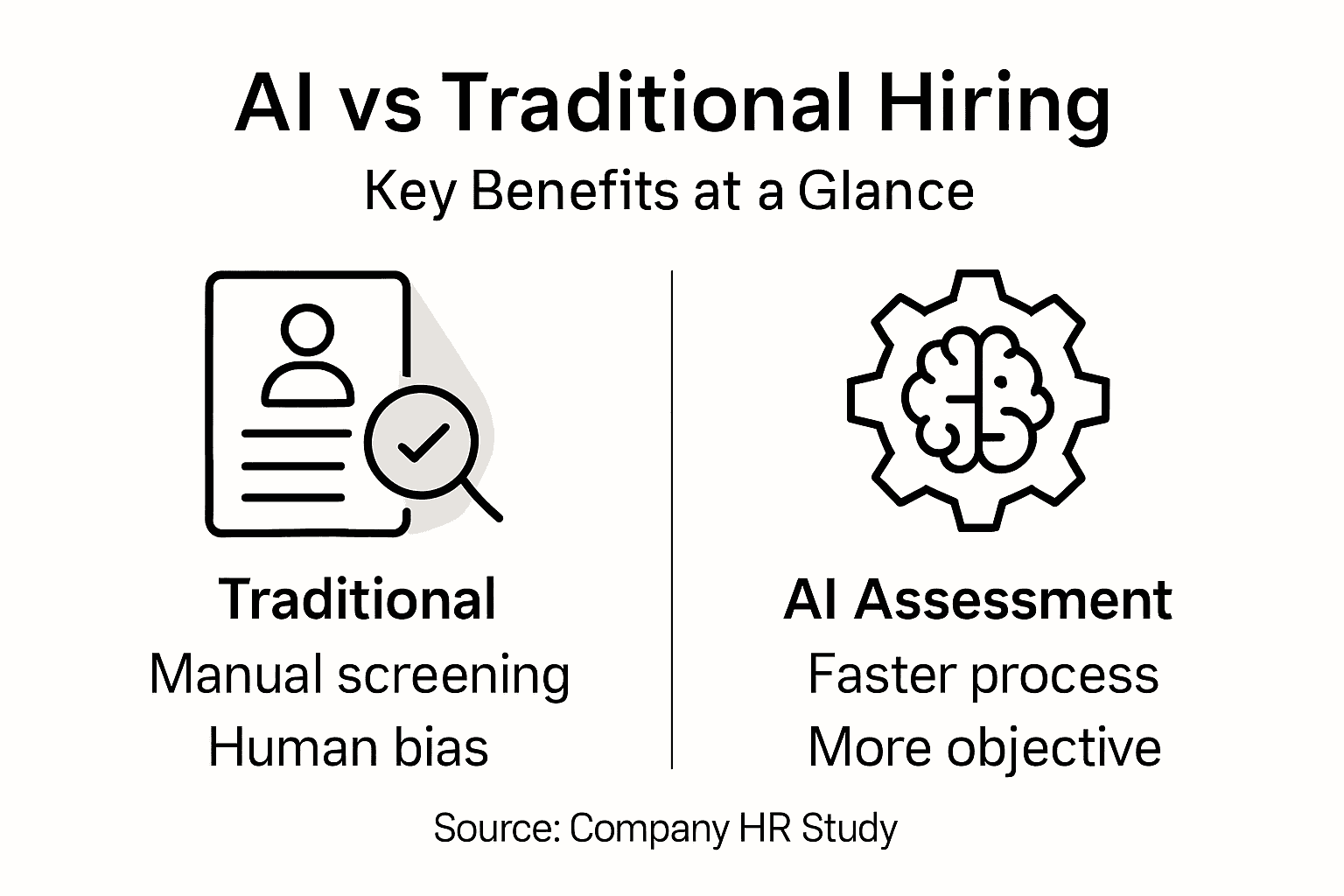
Here is a comparison of traditional versus AI-driven assessment methods in recruitment:
| Aspect | Traditional Assessment | AI-Driven Assessment |
|---|---|---|
| Speed of Screening | Often slow, manual | Automated, rapid processing |
| Objectivity | Susceptible to human bias | Enhanced fairness, reduced bias |
| Insight Depth | Limited to stated experience | Analyses nuanced patterns |
| Candidate Experience | Inconsistent feedback | More streamlined interactions |
| Predictive Capabilities | Weak or absent | Data-driven performance analytics |
Pro tip: Begin integrating AI assessment tools gradually, starting with specific recruitment stages to understand their impact and build organisational confidence.
Types of AI-Driven Assessment Methods
Artificial intelligence has revolutionised recruitment by introducing sophisticated assessment techniques that go beyond traditional screening methods. These advanced technologies enable organisations to evaluate candidates more comprehensively and objectively.
Systematic AI recruitment techniques encompass a wide range of innovative assessment approaches. The primary methods include:
- Resume screening using natural language processing
- Video interview analysis with emotion and communication assessment
- Psychometric profiling through machine learning algorithms
- Predictive performance analytics
- Skill matching using advanced pattern recognition
Each assessment method leverages unique technological capabilities to provide deeper insights into candidate potential. Comprehensive recruitment strategies highlight the versatility of these AI-driven approaches in identifying talent across various professional domains.
Moreover, these AI assessment methods offer several distinct advantages:
- Reduction of unconscious human bias
- Faster candidate evaluation processes
- More nuanced skill and personality insights
- Enhanced candidate experience
- Data-driven recruitment decision-making
AI assessment methods transform recruitment from a subjective process to an objective, data-driven approach that considers multiple candidate dimensions.
Technological innovations continue to expand the scope of AI assessment, with emerging techniques like virtual reality simulations and gamified evaluation processes providing even more sophisticated talent identification methods.
Pro tip: Implement AI assessment tools progressively, starting with less critical recruitment stages to build organisational confidence and understand their potential.
How AI Improves Recruitment Outcomes
Recruitment has historically been a complex and time-consuming process plagued by inherent human limitations. Artificial intelligence is dramatically transforming this landscape by introducing unprecedented efficiency and precision in talent acquisition strategies.
AI’s impact on recruitment efficiency reveals multiple strategic improvements across hiring processes. The key enhancements include:
- Dramatically reduced time-to-hire
- Enhanced candidate quality assessment
- Minimised human bias in selection
- More accurate predictive performance analytics
- Comprehensive candidate screening
The technological capabilities of AI extend far beyond simple automation. Systematic recruitment reviews demonstrate how machine learning algorithms can analyse candidate potential with remarkable depth and nuance.
Organisations implementing AI-driven recruitment strategies can expect significant benefits:
- Faster identification of top talent
- More objective candidate evaluation
- Reduced recruitment costs
- Improved candidate matching
- Better long-term employee retention
AI transforms recruitment from a subjective matching exercise into a data-driven, precision-targeted talent acquisition strategy.
Advanced machine learning models continuously learn and adapt, providing increasingly sophisticated insights into candidate potential and organisational fit. These technologies represent a fundamental shift in how companies approach talent acquisition.

Pro tip: Integrate AI recruitment tools gradually, starting with lower-risk hiring stages to build institutional confidence and understand their transformative potential.
Tackling Bias and Ensuring Fairness
Artificial intelligence in recruitment brings immense potential, but also significant challenges related to algorithmic bias. Ensuring fair and equitable candidate assessment requires a nuanced, multifaceted approach that addresses potential systemic discriminatory patterns.
Comprehensive bias review reveals multiple types of bias that can inadvertently infiltrate AI recruitment systems, including:
- Demographic representation bias
- Historical training data prejudice
- Algorithmic decision-making skews
- Language processing inconsistencies
- Unintentional cultural filtering
Successful bias mitigation demands collaborative strategies. HR and AI developer collaboration highlights critical approaches to creating more equitable assessment frameworks:
- Regular algorithmic auditing
- Diverse training data sets
- Transparent evaluation metrics
- Continuous bias monitoring
- Interdisciplinary oversight
Fairness in AI recruitment is not a destination, but an ongoing journey of continuous improvement and ethical vigilance.
Organisations must implement robust mechanisms to identify and counteract potential biases, recognising that technological neutrality requires active, intentional intervention. This means developing sophisticated detection tools, maintaining human oversight, and creating feedback loops that can recognise and correct subtle discriminatory patterns.
The following table summarises strategies for ensuring fairness in AI recruitment systems:
| Strategy | Purpose | Example Action |
|---|---|---|
| Algorithmic Auditing | Identify and correct hidden biases | Regularly review model outputs |
| Diverse Training Data | Improve representation and fairness | Include wide demographic samples |
| Transparent Metrics | Allow open performance evaluation | Publish key performance indicators |
| Continuous Monitoring | Detect emerging biases in real time | Track decision trends monthly |
| Human Oversight | Provide ethical review and escalation | Create cross-functional committee |
Pro tip: Establish a cross-functional AI ethics committee that includes HR professionals, data scientists, and diversity experts to regularly review and refine recruitment algorithms.
Integrating AI with Human Decision-Making
Artificial intelligence represents a powerful collaborative tool in recruitment, not a replacement for human expertise. The most effective approaches blend technological capabilities with nuanced human judgment, creating a symbiotic decision-making framework.
AI tools across employee lifecycle demonstrate multiple integration strategies that enhance rather than eliminate human involvement:
- Automated initial candidate screening
- Predictive performance analytics
- Enhanced candidate matching algorithms
- Objective skill and personality assessments
- Reduced administrative recruitment burden
AI and human decision synergy highlights critical integration principles:
- Maintaining human oversight
- Using AI as decision support
- Preserving contextual understanding
- Ensuring ethical decision frameworks
- Balancing technological efficiency
Successful AI integration requires viewing technology as a collaborative partner, not an autonomous decision-maker.
Organisations must develop clear protocols that define precise boundaries between AI-generated insights and human judgment. This means creating transparent processes where AI provides recommendations, but human professionals retain ultimate decision-making authority.
Pro tip: Develop a structured review process where AI recommendations are systematically cross-referenced with human expertise, ensuring balanced and nuanced candidate evaluation.
Elevate Your Recruitment with AI-Powered Assessments
The article highlights challenges like human bias and slow candidate screening that can undermine recruitment quality. If you aim to replace traditional CV screening with objective, data-driven evaluation methods such as AI interviews, cognitive tests, and cultural matching you need a solution that directly addresses these pain points. By embracing advanced AI assessment tools you ensure faster processing and fairer, more precise talent identification.
Experience the future of hiring with WAOTM where every step from company challenges to video pitches is designed to boost recruitment quality while reducing unconscious bias. Our platform helps transform your selection process into an efficient, insightful journey that matches candidates not only on skills but on culture fit ensuring better retention and satisfaction.
Ready to leave manual screening behind and harness the power of AI-driven recruitment assessments Try WAOTM today to see how intelligent evaluations can revolutionise your hiring process. Visit https://www.weareoverthemoon.nl now and take the first step towards smarter, faster, and fairer recruitment.
Frequently Asked Questions
What are the benefits of using AI assessment in recruitment?
AI assessment in recruitment enhances objectivity, accelerates candidate screening, reduces human bias, and allows for more comprehensive evaluation of candidates, ultimately improving hiring quality.
How does AI reduce bias in the recruitment process?
AI-driven assessment tools analyse candidates based on data rather than personal biases, utilising algorithms that focus on skills and cultural fit, thus minimising unconscious biases that may arise during traditional assessments.
What types of assessments can be done using AI in recruitment?
AI recruitment encompasses various assessment types, including automated resume screening, video interview analysis, psychometric testing, predictive performance analytics, and skill matching based on advanced algorithms.
How can organisations ensure fairness when using AI recruitment tools?
To ensure fairness, organisations should regularly audit algorithms, use diverse training data sets, maintain transparency in evaluation metrics, and establish ongoing monitoring for biases, combined with human oversight in decision-making.