Why candidate assessment tools improve hiring efficiency

Traditional recruitment processes often trap HR teams in endless cycles of manual CV screening, phone interviews, and scheduling coordination. Whilst you might spend weeks reviewing applications, the most qualified candidates slip away to faster competitors. Modern candidate assessment tools transform this reality by automating early validation stages, integrating multiple evaluation methods, and dramatically reducing time per hire. This shift allows HR professionals in the Netherlands, UK, and Spain to focus on strategic hiring decisions rather than administrative bottlenecks, ultimately improving both speed and quality of recruitment outcomes.
Table of Contents
- Understanding Hiring Inefficiencies And The Bottleneck Of Early-Stage Candidate Validation
- How Candidate Assessment Tools Enhance Recruitment With Ai-Powered Integration
- Comparing Traditional Recruitment To Ai-Driven Assessment: Efficiency And Quality Gains
- Applying Candidate Assessment Tools To Enhance Recruitment Outcomes In The Netherlands, Uk, And Spain
- Discover Tailored Candidate Assessment Solutions With We Are Over The Moon
- Frequently Asked Questions About Candidate Assessment Tools
Key takeaways
| Point | Details |
|---|---|
| Efficiency gains | Assessment tools reduce time per qualified candidate from 3.33 to 1.70 hours through automation |
| Comprehensive screening | Multi-modal evaluation combines document analysis, video assessment, and cultural fit scoring |
| Strategic focus | Automation handles early-stage bottlenecks, freeing recruiters for critical decision-making |
| Quality improvement | Enhanced cultural and technical matching reduces hiring risks and improves retention |
| Human oversight | Final hiring decisions remain with managers whilst AI handles initial validation |
Understanding hiring inefficiencies and the bottleneck of early-stage candidate validation
Traditional recruitment follows a predictable pattern: post job advert, receive hundreds of applications, manually screen CVs, conduct phone interviews, schedule assessments, and finally make hiring decisions. Each step consumes valuable time, with recruiters often spending 15-20 hours per week simply reviewing application documents. This manual approach creates significant delays between posting positions and extending offers, during which top candidates frequently accept competing opportunities.
The most critical inefficiency occurs during early-stage candidate validation. You spend disproportionate time determining basic qualifications, verifying credentials, and filtering unsuitable applicants before reaching genuine evaluation stages. Early-stage candidate validation is a major bottleneck in hiring, consuming resources that could be directed towards meaningful candidate interactions. This bottleneck limits your ability to quickly identify qualified individuals, especially when managing high-volume recruitment or specialist roles requiring specific technical expertise.
Consider the typical workflow:
- Review 200 applications for a single position
- Manually assess each CV against job requirements
- Cross-reference claimed qualifications with supporting evidence
- Conduct preliminary phone screenings with 20-30 candidates
- Schedule and complete technical assessments with shortlisted applicants
This process often stretches across 4-6 weeks, during which candidate interest wanes and competitor offers arrive. The administrative burden prevents recruiters from investing time in strategic activities like employer branding, candidate relationship building, or improving hiring manager collaboration. Automating early-stage validation can drastically improve pipeline flow, allowing your team to process larger candidate pools whilst maintaining or improving evaluation quality. Modern effective screening workflow modern recruitment systems address these challenges by handling repetitive validation tasks automatically.
“The challenge isn’t finding candidates. It’s finding the right candidates quickly enough to secure them before competitors do.”
When early-stage screening consumes 60-70% of recruitment time yet only eliminates obviously unsuitable applicants, the inefficiency becomes clear. You need systems that handle this validation automatically whilst preserving human judgement for nuanced evaluation and final decisions.
How candidate assessment tools enhance recruitment with AI-powered integration
Modern candidate assessment platforms combine multiple evaluation methods into unified workflows that analyse applications comprehensively. These tools process document submissions, video responses, public-data verification, and skills assessments simultaneously, generating composite scores that reflect both technical capabilities and cultural alignment. Rather than sequential evaluation stages, you receive holistic candidate profiles that inform decision-making from first contact.

The system integrates multiple modalities and stages of reasoning into one coherent system, allowing simultaneous analysis of written applications, video interviews, online presence verification, and standardised assessments. This integration eliminates the traditional handoffs between screening, interviewing, and testing phases. Your recruitment pipeline becomes a continuous flow where each candidate progresses based on comprehensive evaluation rather than isolated checkpoints.
Core components of integrated assessment systems include:
| Component | Function | Benefit |
|---|---|---|
| Document analysis | Extracts qualifications, experience, and skills from applications | Eliminates manual CV review |
| Video assessment | Evaluates communication skills and cultural fit through recorded responses | Provides richer candidate insight than text alone |
| Public-data verification | Cross-references claimed credentials with online profiles and databases | Reduces verification time and fraud risk |
| Skills testing | Administers role-specific assessments automatically | Standardises technical evaluation |
| Cultural matching | Scores alignment with company values and team dynamics | Improves retention and team cohesion |
| Risk scoring | Identifies potential concerns requiring human review | Balances automation with oversight |
Human-in-the-loop validation ensures balanced automation and oversight. Whilst AI handles initial screening and scoring, hiring managers retain final authority over candidate selection. The system flags candidates requiring additional review, highlights potential concerns, and presents evidence supporting its recommendations. This approach allows you to process higher volumes whilst maintaining quality control and personal judgement in critical decisions.
Pro Tip: When implementing AI in recruitment candidate screening, start with high-volume roles where efficiency gains are most visible, then expand to specialist positions once your team understands the system’s capabilities and limitations.
Tools provide explicit risk penalties to mitigate hiring risks by identifying inconsistencies between application materials, unusual career patterns, or gaps in claimed experience. Rather than simply rejecting flagged candidates, the system presents these concerns to recruiters for informed evaluation. This transparency allows you to investigate potential issues whilst avoiding false negatives that might eliminate strong candidates with unconventional backgrounds. The benefits of AI assessment extend beyond speed to include more thorough evaluation than manual processes typically achieve.
Comparing traditional recruitment to AI-driven assessment: efficiency and quality gains
The efficiency difference between conventional hiring and AI-driven assessment becomes stark when examining time investment per qualified candidate. AI-driven systems can improve hiring efficiency: 1.70 vs. 3.33 hours per qualified candidate, representing nearly 50% time reduction. This improvement stems from automating repetitive validation tasks whilst maintaining or enhancing evaluation quality through standardised, multi-dimensional assessment.
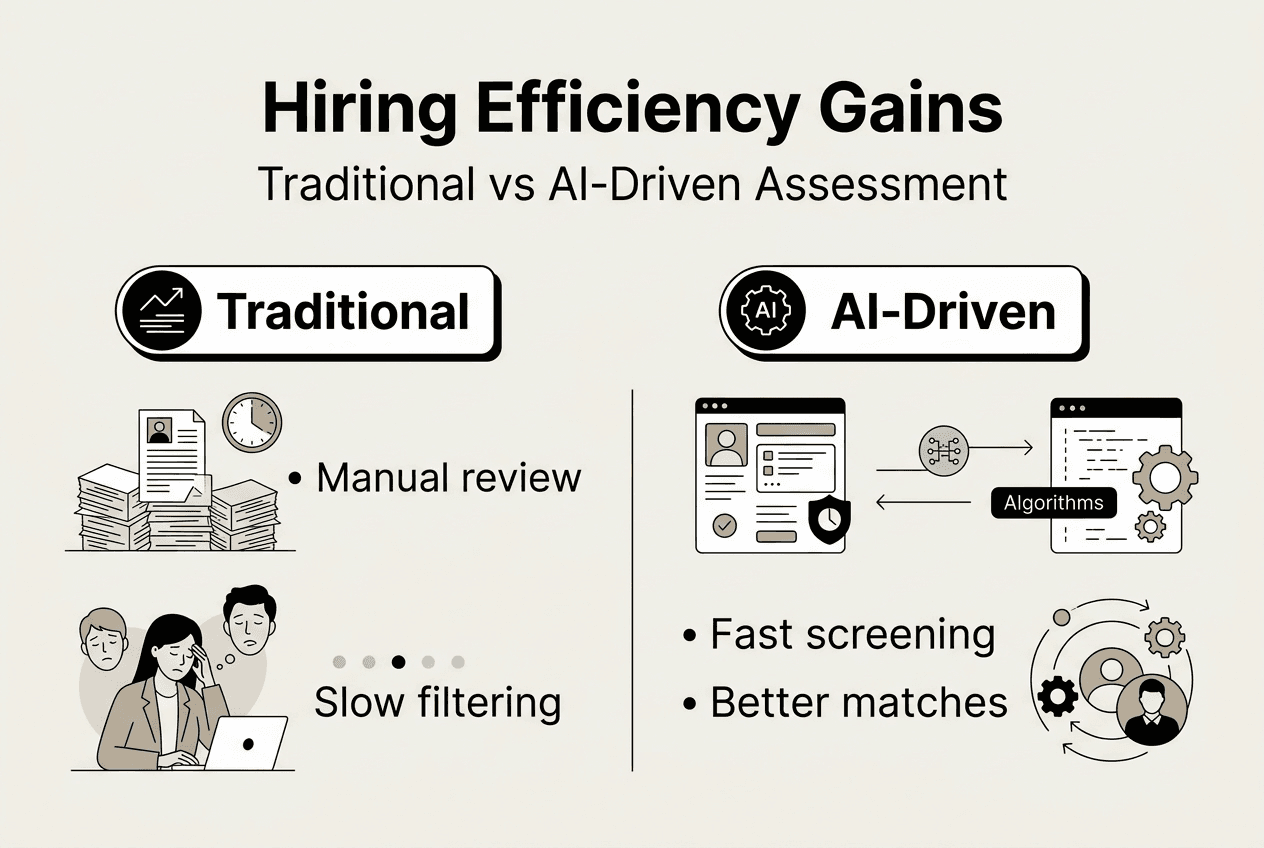
Traditional recruitment requires significant manual effort at each stage. You spend 30-45 minutes reviewing each CV, 20-30 minutes conducting phone screens, and additional time coordinating assessments and interviews. For every qualified candidate who reaches final interviews, you’ve invested hours in preliminary evaluation, much of which involves routine verification tasks. This approach works for small hiring volumes but becomes unsustainable when scaling recruitment or managing multiple concurrent positions.
AI-driven assessment transforms this workflow through systematic automation:
- Applications are processed immediately upon submission, with qualification verification completed within minutes
- Video assessments are administered automatically, allowing candidates to complete responses at their convenience
- Skills tests are scored instantly, providing objective performance metrics without manual evaluation
- Cultural fit algorithms analyse responses against company values, generating alignment scores
- Composite candidate profiles are presented to recruiters with supporting evidence and risk flags
- Human reviewers focus exclusively on qualified candidates, making final decisions based on comprehensive data
Quality of hires improves via multi-modal evaluation and cultural fit scoring that considers factors beyond CV credentials. Traditional screening often emphasises education and previous employers, potentially overlooking candidates with strong skills but unconventional backgrounds. Assessment tools evaluate actual capabilities through standardised tests, communication through video responses, and alignment through cultural matching algorithms. This comprehensive approach reduces bias whilst improving prediction of on-job performance and cultural integration.
| Metric | Traditional Recruitment | AI-Driven Assessment | Improvement |
|---|---|---|---|
| Hours per qualified candidate | 3.33 | 1.70 | 49% reduction |
| Time to first interview | 14-21 days | 3-5 days | 70% faster |
| Candidate evaluation dimensions | 2-3 | 5-7 | More comprehensive |
| Screening consistency | Variable | Standardised | Reduced bias |
| Verification accuracy | Manual, error-prone | Automated, reliable | Higher confidence |
These efficiencies translate to significant cost and productivity benefits. When you reduce time per qualified candidate by half, you can either process twice the candidate volume with existing resources or redirect saved time towards strategic initiatives. The advantages of replacing CVs AI assessments extend beyond speed to include improved candidate experience through faster feedback and reduced administrative burden on applicants. Additionally, pre-screening automation saves hours per hire by eliminating repetitive manual tasks that consume recruiter capacity without adding strategic value.
Applying candidate assessment tools to enhance recruitment outcomes in the Netherlands, UK, and Spain
Implementing candidate assessment tools across different European markets requires attention to regional cultural nuances, legal frameworks, and recruitment practices. Whilst the core technology remains consistent, successful adoption depends on configuring systems to respect local expectations around candidate communication, data privacy, and hiring processes. HR professionals in the Netherlands, UK, and Spain face distinct regulatory environments and cultural norms that influence how assessment tools should be deployed.
Cultural nuances affect candidate expectations and assessment interpretation. Dutch recruitment culture values directness and egalitarianism, making transparent assessment criteria and clear feedback essential. British candidates often expect more formal communication and detailed explanations of evaluation processes. Spanish hiring practices emphasise personal relationships and cultural fit, requiring assessment tools that capture interpersonal dynamics alongside technical skills. Configure your assessment platform to reflect these preferences through appropriate communication tone, feedback timing, and evaluation weighting.
Legal compliance around candidate data and fairness is essential, particularly given GDPR requirements across the European Union. Your assessment tools must obtain explicit consent for data processing, provide transparency about evaluation criteria, and allow candidates to access their assessment data. The system should document decision-making rationale to demonstrate non-discriminatory practices if challenged. Regular audits of algorithmic outputs help identify potential bias in scoring or recommendations, ensuring fair treatment across demographic groups.
Practical steps for adoption include:
- Pilot the system with one or two high-volume roles to build team familiarity and identify configuration needs
- Train hiring managers on interpreting assessment scores and integrating AI recommendations with their judgement
- Establish clear policies for when human review overrides automated recommendations
- Configure cultural fit algorithms to reflect your specific company values rather than generic benchmarks
- Create candidate communication templates that explain the assessment process and set expectations
- Monitor early results to identify any systematic issues with scoring accuracy or candidate experience
Blend automated screening with human judgement for final hiring decisions by treating the system aims to automate candidate screening as much as possible, with final decision left to hiring managers. AI provides data-driven recommendations and highlights relevant candidate attributes, but humans make ultimate selection decisions based on strategic considerations, team dynamics, and organisational context that algorithms cannot fully capture. This balance preserves efficiency gains whilst maintaining the personal judgement essential for successful hiring.
Pro Tip: Select assessment tools that align with company values and GDPR standards by evaluating vendors on data protection practices, algorithmic transparency, and cultural fit customisation capabilities before committing to implementation.
The improve candidate matching process benefits from regional customisation that reflects local talent market conditions and candidate expectations. What works effectively in London may require adjustment for Amsterdam or Madrid based on different communication preferences, assessment familiarity, and hiring timeline expectations. Regular feedback from candidates and hiring managers helps refine your approach to maximise both efficiency and experience quality. As AI in recruitment 2026 continues evolving, staying informed about emerging capabilities and best practices ensures your assessment strategy remains competitive.
Discover tailored candidate assessment solutions with we are over the moon
If you’re ready to transform your recruitment process from manual screening to intelligent assessment, We Are Over The Moon offers innovative tools designed specifically for HR professionals seeking efficiency without sacrificing quality. Their platform replaces traditional CV screening with comprehensive evaluations including AI interviews, company challenges, cultural matching, cognitive tests, and video pitches.
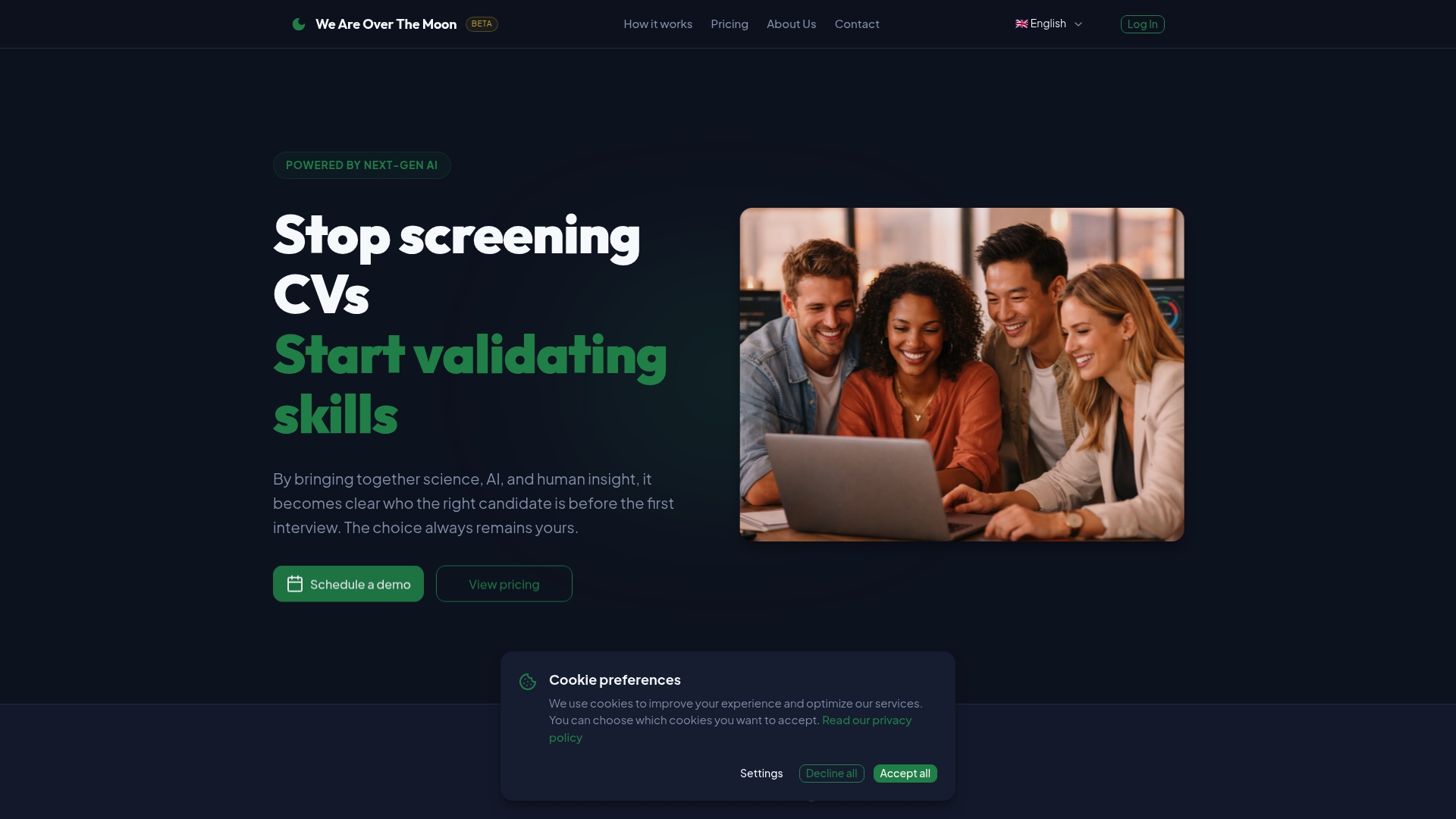
The solution balances AI-powered screening with human hiring decisions, ensuring you maintain control over final selections whilst benefiting from automated validation and comprehensive candidate insights. HR teams in the Netherlands, UK, and Spain can implement tailored assessment workflows that respect regional preferences and legal requirements whilst delivering consistent evaluation quality. Rather than choosing between speed and thoroughness, you achieve both through integrated multi-modal assessment that captures technical skills, cultural alignment, and communication capabilities simultaneously.
Explore how match on skills, not CVs transforms your recruitment pipeline by focusing on actual capabilities rather than credential proxies. Learn more about we are over the moon and discover implementation resources that guide your transition from traditional to assessment-driven hiring. Their platform adapts to your specific requirements, whether you’re hiring technical specialists, customer-facing roles, or leadership positions requiring nuanced evaluation.
Frequently asked questions about candidate assessment tools
What are candidate assessment tools?
Candidate assessment tools are integrated platforms that evaluate job applicants through multiple methods including skills testing, video interviews, cultural fit analysis, and credential verification. These systems automate early-stage screening whilst providing comprehensive candidate profiles that inform hiring decisions.
How do assessment tools improve hiring efficiency?
Assessment tools reduce time per qualified candidate by automating repetitive validation tasks, enabling simultaneous multi-dimensional evaluation, and presenting recruiters with pre-screened candidates who meet baseline requirements. This allows HR teams to focus on strategic decision-making rather than administrative screening.
Can AI replace human judgement in recruitment?
No, AI should augment rather than replace human judgement in recruitment. Whilst automated systems excel at initial screening, credential verification, and standardised assessment, final hiring decisions require human consideration of team dynamics, organisational strategy, and contextual factors that algorithms cannot fully evaluate.
Are these tools compliant with European data protection laws?
Reputable assessment tools are designed to comply with GDPR requirements including explicit consent, data transparency, access rights, and non-discriminatory processing. However, organisations must verify vendor compliance and configure systems appropriately to meet their specific legal obligations.
What kind of companies benefit most from using candidate assessment tools?
Companies with high-volume recruitment, specialist role requirements, or distributed hiring teams benefit most from assessment tools. However, any organisation seeking to improve hiring efficiency, reduce bias, or enhance candidate evaluation quality can gain value from these systems regardless of size or industry.
Recommended
- How to Improve Candidate Matching for Better Hires | We Are Over The Moon
- Advantages of replacing CVs: 74% faster hiring with AI assessments | We Are Over The Moon
- How to Screen Without CVs for Better Hiring Results | We Are Over The Moon
- Benefits of AI Assessment: Boosting Recruitment Quality | We Are Over The Moon