Master Effective Screening Workflow for Modern Recruitment

Finding the right talent in fast-moving tech teams across the Netherlands and United Kingdom means making every screening step count. Without well-defined objectives and precise assessment tools, recruiting can feel like hunting for needles in a haystack. By focusing on clarity in talent requirements and using technology to sharpen your process, you gain confidence and efficiency while building teams that match your business needs. Discover practical ways to set the foundation for smarter, fairer candidate selection.
Table of Contents
- Step 1: Assess Talent Requirements And Screening Objectives
- Step 2: Integrate Real Assessment Tools And AI Interviews
- Step 3: Customize Cultural And Cognitive Evaluation Criteria
- Step 4: Verify Outcome Accuracy And Candidate Fit
Quick Summary
| Main Message | Explanation |
|---|---|
| 1. Define clear role requirements | Collaborate with hiring managers to outline specific skills and success criteria for each position, avoiding generic job descriptions. |
| 2. Implement objective assessment tools | Use tailored assessment tools such as coding challenges or case studies to accurately evaluate candidates’ skills and fit for the role. |
| 3. Lean on AI for unbiased evaluations | Incorporate AI-driven interviews to gain standardised insights into candidate abilities while minimising bias in assessments. |
| 4. Focus on cultural and cognitive fit | Identify core cultural values and translate them into observable behaviours to ensure candidates align with your team’s dynamics. |
| 5. Regularly verify and adjust screening outcomes | Document and review hiring outcomes continuously, making necessary adjustments to improve the alignment of your hiring process with organisational needs. |
Step 1: Assess talent requirements and screening objectives
Before you start screening candidates, you need to understand exactly what you’re looking for. This foundation determines everything that follows, from the criteria you’ll use to evaluate applicants to the screening methods you’ll employ. Without clear objectives, you risk wasting time on unsuitable candidates or missing hidden talent.
Start by working with hiring managers and team leads to define the actual role requirements. Don’t simply copy what’s in the job description. Ask specific questions about the role:
- What problems will this person solve on your team?
- What skills are truly non-negotiable versus nice-to-have?
- What does success look like in the first 90 days?
- Which technical competencies matter most for this position?
- What cultural or team dynamics should influence your decision?
Once you have this information, document your screening priorities. Research shows that assessing organisational talent needs and defining clear screening objectives helps align recruitment with business goals. This clarity means you’re not screening everyone the same way. A senior engineer needs different evaluation than a junior developer.
Create a ranked list of screening criteria. Put mandatory skills at the top, then secondary skills, then potential indicators you’d like to see. For example, a tech role might prioritise Python proficiency, followed by cloud experience, then leadership potential. This ranking becomes your roadmap.
Clear screening objectives reduce manual effort and improve hiring accuracy by helping you focus on candidates who genuinely fit your needs.
Next, align your objectives with your team’s capacity. How many candidates can you realistically screen? How much time do you have? If you’re drowning in applications, your screening objectives should help you filter efficiently. Consider using AI-powered matching methods that can reduce manual screening time by up to 80% whilst ensuring you evaluate talent fairly against your defined criteria.
Document everything. Write down your talent requirements, priority criteria, and what success looks like. This becomes your screening template and ensures consistency across your team. When everyone’s working from the same definition, decisions are faster and fairer.
Pro tip: Have your hiring manager rank the top five must-have requirements, then challenge them on number five, four, and three, you might be surprised what’s actually negotiable and what expands your candidate pool.
Step 2: Integrate real assessment tools and AI interviews
Now that you know what you’re looking for, it’s time to move beyond CVs and cover letters. Real assessment tools and AI interviews give you genuine insight into how candidates actually think and perform, not just what they claim on paper.
Start by selecting assessment tools that align with your screening objectives from Step 1. Different roles need different evaluations. A software engineer might benefit from a coding challenge, whilst a product manager could complete a case study analysis. Think about what demonstrates actual capability:
- Technical assessments for hands-on skills
- Problem-solving scenarios relevant to the role
- Communication or presentation tasks
- Industry-specific knowledge tests
- Work simulations that mirror real job situations
AI interviews represent a significant shift in how you evaluate candidates. Rather than relying solely on traditional interviews where nerves and interview experience can mask true ability, real-time AI-driven evaluation methods capture consistent, standardised responses. AI interviews allow candidates to answer questions on their own schedule, reducing bias and giving everyone equal opportunity to demonstrate their strengths.
AI assessment tools provide transparent, fair evaluation whilst capturing the authentic capabilities that predict job performance.
When implementing these tools, ensure they’re transparent and equitable. Your candidates should understand what’s being assessed and why. Research on AI assessment frameworks emphasises the importance of transparency and fairness, ensuring tools adapt to various competencies whilst maintaining ethical standards.

Integrate assessment results thoughtfully into your workflow. Don’t just use a single score. Look at how candidates approached problems, what questions they asked, and where they struggled. This context matters more than the final number. Consider combining assessment results with structured interview feedback for a complete picture.
Start small if you’re new to this. Try one assessment tool with a pilot group before rolling it out across all roles. This helps you refine your process and ensures the tools genuinely predict success in your organisation.
Here’s how different assessment tools serve specific recruitment goals:
| Assessment Tool Type | Main Purpose | Typical Role Application |
|---|---|---|
| Coding Challenge | Test technical expertise | Software engineering positions |
| Case Study Analysis | Evaluate real-world decision-making | Product management roles |
| Work Simulation | Assess job-relevant behaviour | Customer service, sales |
| Game-Based Cognitive Test | Identify learning agility and problem-solving | Graduate schemes, diverse entry |
| AI-Driven Interview | Capture unbiased, standardised responses | All roles needing fairness |
Pro tip: Use assessment tools to screen early in your funnel before interviews, allowing candidates who excel on assessments to advance whilst freeing your team from reviewing hundreds of CVs.
Step 3: Customise cultural and cognitive evaluation criteria
Every organisation has its own culture and working style. This step ensures your screening captures not just technical ability, but whether candidates will thrive in your specific environment and contribute positively to your team dynamics.
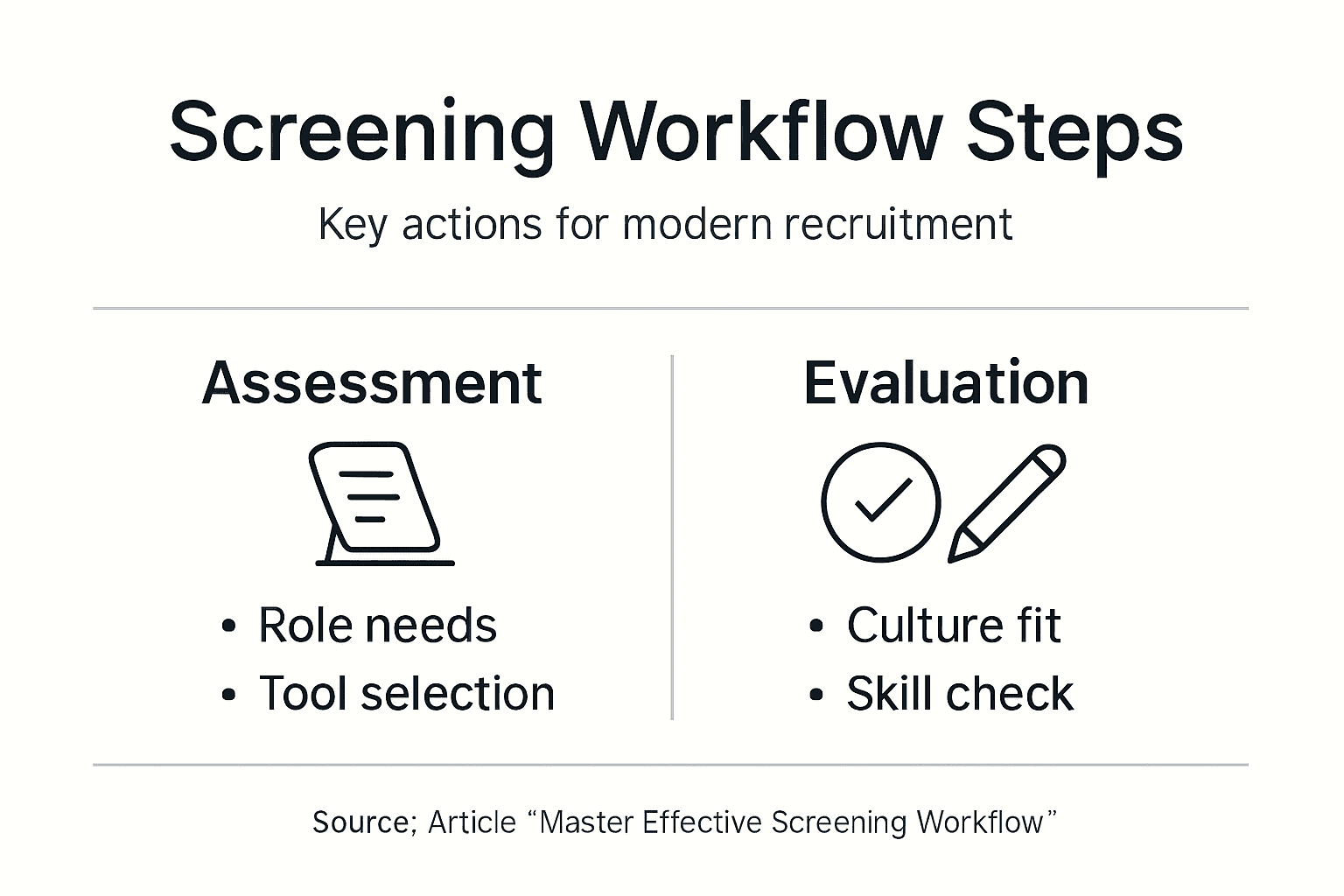
Start by defining your cultural values and team dynamics. What does your organisation actually stand for, beyond what’s written in your mission statement? Are you collaborative or independent? Fast-paced or methodical? Values-driven or results-focused? Document three to five core cultural elements that genuinely matter to how your team operates.
Next, translate these cultural qualities into observable behaviours. Instead of asking “Are you a team player?” (everyone says yes), ask about specific situations. How do candidates approach conflict with colleagues? How do they handle feedback? What motivates them to stay engaged at a company? These questions reveal cultural fit more honestly than generic ones.
For cognitive evaluation, move beyond traditional IQ tests. Modern approaches like game-based cognitive ability assessments capture problem-solving ability whilst remaining fair and engaging for all candidates. These interactive tools help identify diverse strengths whilst reducing biases that traditional testing can introduce.
Customise cognitive criteria to match your actual role needs. A software engineer needs different cognitive strengths than a customer support specialist. Consider what type of thinking matters most:
- Analytical and logical reasoning
- Creative problem-solving
- Communication clarity
- Attention to detail
- Learning agility
- Pattern recognition
Cultural and cognitive fit together predict long-term success and engagement far better than credentials alone.
Build assessment questions around real scenarios your team faces. If collaboration is crucial, present group problem-solving tasks. If autonomy matters, use scenarios requiring independent decision-making. This makes evaluation both fairer and more predictive of actual performance.
Don’t over-weight culture fit at the expense of skills. You need both. A brilliant engineer who clashes with your values creates tension. But a perfectly aligned candidate lacking essential skills won’t deliver. Balance both criteria equally in your final decision-making.
The following table contrasts technical and cultural/cognitive screening criteria:
| Screening Focus | What It Assesses | Example Outcome |
|---|---|---|
| Technical Criteria | Role-specific skills and experience | Accurate code, strong analysis |
| Cultural/Cognitive Criteria | Organisational fit, communication and reasoning style | Positive team dynamics, adaptability |
Pro tip: Have your existing high performers take the same assessments you use for candidates, then compare their results against your actual cultural and cognitive criteria to validate that your evaluation truly predicts success in your organisation.
Step 4: Verify outcome accuracy and candidate fit
You’ve assessed candidates using your tools and criteria. Now comes the critical part: verifying that your screening process actually works and that your chosen candidates genuinely fit your organisation. This verification step protects both you and your new hires.
Start by documenting your outcomes and predictions. For each candidate you’ve screened, record what your assessments predicted about their performance and cultural fit. Then track what actually happens after they join. Did they perform as expected? Did they integrate well with the team? This feedback loop is essential for refining your process over time.
Look for patterns in mismatches. If candidates who scored highly on technical assessments struggle with collaboration, your cognitive criteria might not capture team dynamics. If culturally aligned hires lack the work ethic you need, your values assessment needs refinement. These insights make your screening progressively smarter.
When using AI-driven screening tools, ensure you’re conducting continual accuracy testing and bias mitigation as recommended by regulatory authorities. Verify that your AI isn’t systematically disadvantaging certain groups or making decisions that seem fair but actually aren’t.
Incorporate human oversight into your verification process. Here’s what to check:
- Are AI recommendations aligned with your actual hiring decisions?
- Do rejected candidates represent a balanced diversity of backgrounds?
- Are assessment scores correlated with actual job performance?
- Do candidates from different demographics show similar outcome patterns?
- Are there consistent gaps between predicted and actual performance?
Build feedback from hiring managers directly into your verification. After three months on the job, ask your hiring manager simple questions about the new hire’s fit, performance, and integration. Their insights help validate whether your screening criteria genuinely predict success.
Transparency in how you screen and verify outcomes builds candidate trust and protects your organisation from discrimination claims.
Document your verification findings systematically. Create a simple database or spreadsheet tracking assessment scores, actual performance ratings, and cultural integration feedback. This data becomes invaluable for demonstrating that your screening process is fair and effective.
Run quarterly audits of your screening outcomes. Are you hiring consistently high performers? Are team members thriving? Is turnover improving? Use these insights to adjust your criteria, questions, or assessment tools before patterns become problems.
Pro tip: Schedule a “screening retrospective” meeting every six months where your recruitment team reviews hiring outcomes alongside people managers, discussing what worked, what didn’t, and what criteria need adjustment for the next hiring cycle.
Transform Your Screening Workflow with WAOTM
If you are struggling to align your recruitment process with clear screening objectives or feeling overwhelmed by manual CV reviews, it’s time to embrace smarter hiring solutions. The article highlights crucial challenges like defining precise talent requirements, integrating AI interviews, applying real assessments, and verifying candidate fit — all essential for improving hiring accuracy and efficiency.
Discover how WAOTM replaces outdated CV screening with powerful tools such as AI interviews, company challenges, cognitive tests, and cultural matching designed to mirror your unique organisational values. Stop wasting time sifting through endless resumes and try WAOTM to streamline your recruitment. Act now to reduce bias, save time, and ensure you hire candidates who truly fit your role and culture. Visit WAOTM and master effective screening with modern recruitment technology today.
Frequently Asked Questions
What are the key steps to master an effective screening workflow?
To master an effective screening workflow, you should first assess talent requirements and screening objectives, integrate real assessment tools and AI interviews, customise cultural and cognitive evaluation criteria, and verify outcome accuracy and candidate fit. Begin by documenting your screening priorities and aligning them with your team’s capacity for screening candidates.
How can I ensure I am evaluating candidates fairly during screening?
You can ensure fair candidate evaluation by using transparent assessment tools that provide objective insights beyond just resumes. Incorporate AI-driven interviews and assessments that capture standardised responses, allowing candidates to show their abilities without bias influencing their performance.
What methods can I use to define role requirements accurately?
Engage with hiring managers and team leads to establish specific role requirements through in-depth discussions. Ask targeted questions about the role’s challenges, essential skills, and what indicators of success look like within the first 90 days of employment.
How do I determine the right assessment tools for different roles?
Select assessment tools based on the specific needs of each role by identifying the skills and competencies that matter most. For instance, use coding challenges for technical roles, while case study analyses may be more appropriate for product management positions.
How can I track and verify the success of my screening process?
You can track and verify your screening process by documenting outcomes and predictions for each candidate, then comparing them with actual performance after hire. Conduct quarterly audits to analyse patterns in mismatches and adjust your criteria as needed to improve future hiring accuracy.
What should I include in my cultural evaluation criteria?
Your cultural evaluation criteria should encompass your organisation’s core values and team dynamics, translating them into observable behaviours. Focus on questions that reveal candidates’ approaches to teamwork, conflict resolution, and motivation, ensuring alignment with your organisational culture.
Recommended
- Why Replace CV Screening: Unlocking Better Hires | We Are Over The Moon
- How to Screen Without CVs for Better Hiring Results | We Are Over The Moon
- Top 4 ModernHire.com Alternatives in 2026 for Effective Candidate Assessment | We Are Over The Moon
- Step-by-Step Guide to Talent Screening for HR Success | We Are Over The Moon