Step-by-Step Guide to Talent Screening for HR Success

Sifting through endless CVs often leaves HR managers questioning whether they are truly finding the right talent for their teams. With constant evolution in the United Kingdom’s tech sector, your recruitment process demands smarter, more reliable screening methods. This guide brings together insights on tailored assessment criteria, AI-powered interviews, and cultural fit tools to help you pinpoint candidates whose strengths directly match your company’s real needs.
Table of Contents
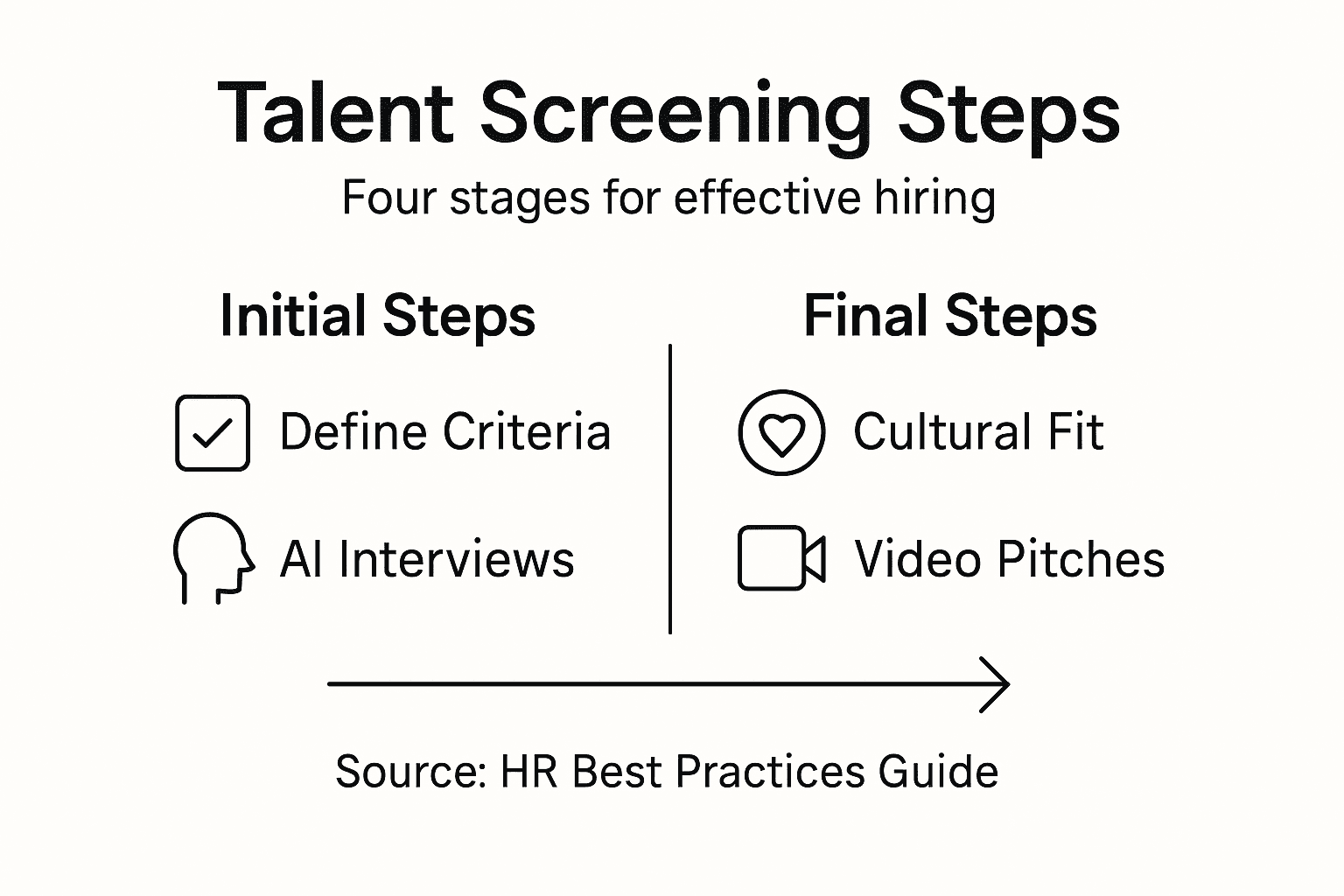
- Step 1: Set Up Tailored Assessment Criteria
- Step 2: Integrate AI Interviews And Company Challenges
- Step 3: Evaluate Cultural Fit And Cognitive Strengths
- Step 4: Verify Candidate Suitability With Video Pitches
Quick Summary
| Key Insight | Explanation |
|---|---|
| 1. Define Essential Criteria | Identify critical skills and experiences necessary for the role, separating required qualifications from preferred ones for better candidate selection. |
| 2. Implement AI Assessments | Use AI interviews and company challenges to standardise evaluations, focusing on candidates’ real capabilities rather than impressions or biases. |
| 3. Assess Cultural Fit | Evaluate candidates’ values and working styles to ensure compatibility with your organisation’s culture and teamwork dynamics. |
| 4. Use Video Pitches | Request candidates to submit video pitches to observe their communication skills and genuine enthusiasm, enhancing your assessment process. |
| 5. Review and Refine Processes | Gather feedback and adjust assessment criteria and processes regularly, ensuring ongoing improvements and alignment with hiring needs. |
Step 1: Set up tailored assessment criteria
You’re about to define the exact qualities your ideal candidate actually needs. This isn’t about listing every skill under the sun—it’s about identifying what truly matters for the role.
Start by identifying minimum job requirements. Work with your hiring team to pinpoint the knowledge, skills, and abilities that genuinely make someone successful in this position. A software engineer at a mid-sized tech firm might absolutely need strong Python skills, but do they really need 10 years of experience? Probably not.
Next, separate required from preferred qualifications. This distinction matters more than you might think. Required qualifications are non-negotiable; preferred ones are nice-to-haves. Someone with excellent problem-solving abilities and teamwork might excel even without that specific certification you wanted.
Review your criteria with fresh eyes. According to the SHRM toolkit on evaluating job candidates, it’s worth examining whether your requirements have become inflated over time. That “5+ years mandatory” expectation might be filtering out talented junior developers who could thrive with proper support.
Here’s what to assess:
- How directly does each criterion link to core job responsibilities?
- Could transferable skills from other industries work just as well?
- Are you accidentally screening out diverse candidates through overly narrow definitions?
- Does this requirement genuinely predict job performance?
Tailored criteria should reflect reality, not wishful thinking about the “perfect” candidate.
Prioritise your criteria once you’ve listed them. Not every skill carries equal weight. Your top-tier requirements should be the absolute must-haves; secondary criteria can be assessed through other stages of your screening process.
Finally, involve your team in refining these criteria. Your engineers, product managers, or whoever works closely with the role will catch assumptions that HR might miss. They’ll tell you that soft skills often matter more than you thought, or that someone self-taught in a particular framework works just as well as a certified option.
Professional tip: Build in a review cycle to refine your criteria after every 10 hires. What you learn from your first screening round will dramatically improve your second one.
Here’s a concise summary comparing key candidate evaluation approaches in modern hiring:
| Approach | Main Purpose | Objectivity Level | Typical Use Case |
|---|---|---|---|
| Tailored Criteria | Identify essential skills and experience | High (when well-defined) | Initial CV and application review |
| AI Interviews | Standardise interview questions for fairness | Very high (algorithmic) | Broad early-stage screening |
| Company Challenges | Assess problem-solving in real scenarios | High (rubric-based) | Technical or practical skills testing |
| Video Pitches | Evaluate communication and enthusiasm | Moderate (human review) | Final fit and personality assessment |
Step 2: Integrate AI interviews and company challenges
You’re now ready to bring structured, objective assessments into your screening process. AI interviews and company challenges transform how you evaluate candidates by removing guesswork and focusing on genuine capability.
Start by understanding what AI interviews actually do. They assess candidates through standardised questions, video responses, and skill-based scenarios. Unlike traditional interviews where tone of voice and first impressions can overshadow actual ability, AI-driven structured interviews provide consistent evaluation across all candidates. Every person answers the same questions in the same format, which means you’re comparing apples to apples.
Next, layer in company challenges. These are practical tasks that mirror real work. A software engineer might build a small feature. A marketing candidate could develop a campaign brief. These challenges reveal how candidates actually solve problems, not just how they talk about solving them.
Here’s how to implement this effectively:
- Choose challenges that reflect your daily work, not artificial scenarios
- Set realistic timeframes; don’t expect polished output from someone working under pressure
- Use AI to score technical aspects fairly, then review soft skills yourself
- Compare results across candidates using the same evaluation rubric
Combining structured AI interviews with practical challenges removes the “gut feeling” factor and reveals who can genuinely perform.
Design your assessment flow strategically. Most hiring teams use AI interviews first as a broad screening tool, then company challenges for shortlisted candidates. This saves everyone time whilst ensuring serious contenders prove their abilities through action.
Remember to balance automation with humanity. AI can reduce unconscious biases significantly, but your final hiring decision should still include human judgment. AI spots patterns in skills and experience; you bring context about culture fit and team dynamics.

Also consider how candidates experience your process. If your assessments feel like busywork rather than genuine evaluation, strong candidates may withdraw. Make the process feel respectful of their time and effort.
Professional tip: Start with one AI interview question and one company challenge in your first month, then refine based on feedback from both candidates and your hiring team before scaling up.
Step 3: Evaluate cultural fit and cognitive strengths
You’ve assessed skills and experience. Now it’s time to evaluate whether candidates will thrive in your specific environment and possess the cognitive capabilities your organisation needs.
Cultural fit isn’t about hiring clones of your existing team. It’s about identifying shared values and working styles that allow someone to flourish. A developer who thrives on autonomy might struggle in a tightly supervised environment, regardless of technical brilliance. Someone who loves collaboration could feel isolated in a solitary role.
Start by defining what your culture actually is. What drives decisions in your company? How do teams solve problems? What happens when someone disagrees with leadership? Document these patterns honestly. Then assess whether each candidate’s values and work preferences align with reality, not the culture you wish you had.
Cultural dimensions and adaptability profiles help you move beyond gut feelings. These frameworks measure how candidates approach teamwork, change, communication, and decision-making. They reveal whether someone will gel with your team’s dynamics.
Now focus on cognitive strengths. This isn’t just IQ testing. You’re evaluating critical thinking, problem-solving ability, and learning agility. According to SHRM’s 2025 benchmarking data, organisations prioritising critical thinking during recruitment hire talent that drives strategic success.
Here’s how to evaluate both dimensions:
- Use structured assessment tools rather than interviews alone
- Ask candidates about real challenges they’ve faced and how they approached them
- Observe how they think through problems during your company challenges
- Assess their curiosity and openness to new ideas
- Review how they’ve adapted to change in previous roles
A candidate can be brilliant at coding but destructive to team morale. Conversely, someone might fit your culture perfectly but lack the cognitive horsepower for complex technical work.
Don’t overweight cultural fit at the expense of diversity. Homogeneous teams often mistake similarity for compatibility. The best teams blend different perspectives with shared values.
Professional tip: Create a simple scoring rubric for both cultural fit and cognitive strengths before interviewing candidates, then apply it consistently to avoid letting first impressions bias your evaluation.
Step 4: Verify candidate suitability with video pitches
Video pitches give you something CVs and interviews cannot. You see candidates in action, communicating their ideas with genuine enthusiasm and clarity. This step transforms suitability assessment from guesswork into observable reality.
Video pitches work because they reveal communication ability and personality simultaneously. A brilliant developer who mumbles through explanations will struggle in client meetings. Someone who lights up when discussing challenges shows genuine engagement. These details matter far more than credentials alone.
Start by designing a clear brief. Tell candidates exactly what you want. A software engineer might pitch a technical problem they solved. A product manager could outline a feature they’d propose for your app. Keep it focused and achievable within 2-3 minutes. Generic “tell us about yourself” prompts waste everyone’s time.
According to video submissions combined with structured interviews enhance confidence in candidate fit by revealing communication skills and enthusiasm beyond written applications. You’re not just assessing what they say; you’re observing how they organise thoughts, handle pressure, and present themselves.
Here’s what to evaluate when reviewing videos:
- Can they communicate complex ideas clearly?
- Do they sound genuinely interested in your company?
- How organised and structured is their thinking?
- Do they ask thoughtful questions or seek clarification?
- Is their energy level and body language appropriate?
A five-minute video often reveals more about someone than a one-hour interview because they can’t hide behind prepared answers.
Create a scoring rubric before watching. Decide what good communication looks like, what demonstrates genuine enthusiasm, and what suggests they’ve actually researched your company. Otherwise you’ll unconsciously favour candidates who simply make good eye contact.
When reviewing, look past production quality. Someone filming on their phone in a quiet room shows humility and practicality. Overly polished videos sometimes indicate they hired a professional rather than revealing their authentic self. You want genuine, not perfect.
Also assess suitability signals. Have they followed instructions? Did they answer the actual question asked? Did they mention relevant experience? These details reveal attention to detail and ability to follow briefs—critical for any role.
To help you design an effective candidate video pitch rubric, here’s a quick reference for scoring areas:
| Evaluation Area | What to Look For | Impact on Hiring Decision |
|---|---|---|
| Communication Clarity | Articulates ideas understandably | Crucial for client and team roles |
| Authentic Enthusiasm | Shows genuine interest in your firm | Signals engagement and motivation |
| Structured Thinking | Logical flow and organisation | Predicts problem-solving ability |
| Brief Adherence | Addresses the brief as instructed | Indicates reliability and attention to detail |
Professional tip: Watch videos in batches of 3-4 candidates at a time to maintain consistent evaluation standards, then review your top candidates a second time before making comparisons.
Transform Your Talent Screening with WAOTM’s Real Assessments
The challenge of replacing traditional CV screening with tailored, objective evaluations often feels overwhelming – especially when you need to balance technical skills, cultural fit, and genuine motivation all at once. This article highlights how AI interviews, company challenges, cognitive testing, and video pitches can revolutionise your hiring process by focusing on validated abilities rather than assumptions or gut feelings. If your goal is to remove bias, save time, and hire candidates who truly excel, WAOTM offers an integrated solution designed exactly for that need.
Discover how WAOTM’s platform brings structured AI assessments, real-world company tasks, and cultural matching together in one seamless experience. Start replacing guesswork with clarity and bring your talent screening into the future. Visit WAOTM now and explore how simple it is to implement fair, engaging candidate evaluation methods that accelerate hiring success. Take the step toward smarter recruitment today with tailored assessment solutions and transform your HR process from screening to confident selection.
Frequently Asked Questions
What criteria should I consider when setting up tailored assessment criteria for talent screening?
Start by identifying minimum job requirements that link directly to job responsibilities. Separate required qualifications from preferred ones, and prioritise criteria that genuinely predict job performance by reviewing them collaboratively with your team.
How can I effectively integrate AI interviews and company challenges in the screening process?
Utilise AI interviews as a broad screening tool by asking standardised questions and assessing candidates’ responses uniformly. Follow up with company challenges that reflect real job tasks to evaluate candidates’ practical problem-solving skills.
What is the best way to evaluate cultural fit during the talent screening process?
Define your company culture honestly by identifying shared values and working styles. Assess candidates against these cultural dimensions to determine if their values and work preferences align with your environment, ensuring that diversity is not overlooked.
How can video pitches be used to enhance candidate evaluation?
Video pitches allow you to observe candidates’ communication skills and enthusiasm directly. Design a clear brief for candidates, and evaluate their pitches based on clarity, structure, and adherence to the prompt, which can reveal more about their suitability than traditional interviews.
How often should I revise my assessment criteria for talent screening?
Establish a review cycle to refine your assessment criteria after every 10 hires. Collect feedback from your hiring team and the candidates to continuously improve your screening process and adapt to new insights.