How to Screen Without CVs for Better Hiring Results

Traditional CV screening often leaves British tech startups struggling to spot genuine talent. The challenge is clear: finding candidates who not only possess technical expertise but also display qualities such as grit, teamwork, and leadership. By shifting towards effective assessment methods that reveal real-world skills and cultural fit, HR leaders gain deeper insight into candidate potential. This article guides you on how to build a robust recruitment strategy, making each hire count for both performance and innovation.
Table of Contents
- Step 1: Define Essential Skills And Cultural Traits
- Step 2: Design Real-World Assessment Tasks
- Step 3: Implement AI-Powered Interview Tools
- Step 4: Introduce Cognitive And Cultural Fit Tests
- Step 5: Review And Shortlist Top Candidates
Quick Summary
| Key Insight | Explanation |
|---|---|
| 1. Identify essential skills first | Focus on skills like grit, teamwork, and resilience to understand core competencies beyond academic credentials. |
| 2. Design real-world evaluations | Create assessment tasks that reflect actual workplace challenges; this better reveals a candidate’s true abilities. |
| 3. Implement AI recruitment tools | Use AI-driven platforms to standardise evaluations, enhancing bias control and decision-making efficiency during candidate assessments. |
| 4. Incorporate cognitive and cultural fit tests | Use innovative assessments like game-based tests to uncover candidates’ cognitive abilities and emotional intelligence aligned with your organisation. |
| 5. Conduct structured candidate reviews | Establish a systematic evaluation framework to fairly assess candidates, focusing on both technical skills and cultural fit within your team. |
Step 1: Define essential skills and cultural traits
Designing an effective skills assessment requires understanding the core competencies that truly predict success. Our goal is to map out the key individual capacities that drive performance beyond traditional academic credentials.
To build a robust skills framework, start by identifying fundamental workplace capabilities that transcend specific job roles. Research indicates that individual capacities manifest consistently through patterns of thoughts, behaviours, and emotional responses. These essential skills include:
- Grit: The ability to persist through challenges
- Teamwork: Capacity for collaborative problem-solving
- Resilience: Adapting effectively to changing circumstances
- Curiosity: Demonstrated desire to learn and explore
- Leadership: Potential to inspire and guide others
Beyond technical skills, cultural traits represent another critical dimension of candidate assessment. These traits determine how an individual will integrate with your organisation’s values and collaborative ecosystem. Look for candidates who demonstrate alignment with your company’s core principles and demonstrate potential for innovative thinking.
Cultural fit is not about uniformity, but about shared values and complementary approaches to problem-solving.
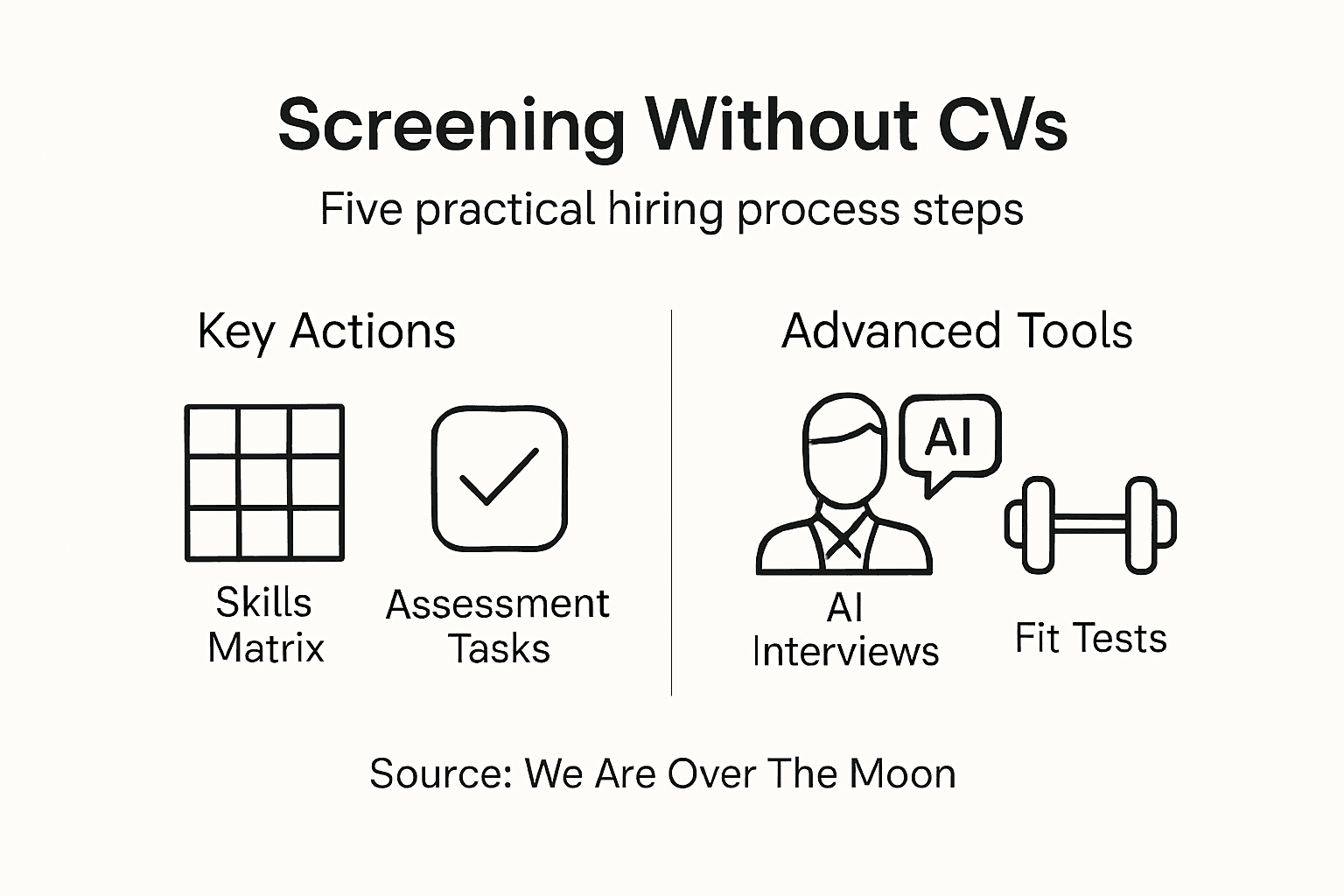
Consider developing a structured assessment matrix that scores candidates across both skill and cultural dimensions. This approach allows for a more holistic evaluation that moves beyond traditional CV screening.
Pro tip: Create a consistent rubric with clear, measurable criteria for each essential skill and cultural trait to ensure objective and fair candidate evaluation.
Step 2: Design real-world assessment tasks
Creating meaningful assessment tasks is crucial for evaluating a candidate’s true potential beyond traditional screening methods. Our goal is to develop evaluation exercises that authentically demonstrate practical skills and problem-solving capabilities.
Authentic assessment design requires crafting tasks that mirror genuine workplace challenges. These assessments should be strategically constructed to reveal a candidate’s approach to real-world scenarios. Key characteristics include:
- Open-ended problem scenarios
- Context-specific challenges
- Tasks requiring higher-order cognitive skills
- Opportunities for creative solution development
- Multiple potential solution pathways
When designing these tasks, focus on creating scenarios that demand practical application of skills. For example, instead of asking theoretical questions, present candidates with complex, multi-dimensional workplace challenges that require critical thinking, collaboration, and innovative problem-solving.
Real assessment tasks reveal more about a candidate’s potential than standardised multiple-choice examinations.
Consider developing assessment tasks across different formats such as case studies, simulated project scenarios, collaborative problem-solving exercises, and practical skill demonstrations. This approach allows you to evaluate candidates’ capabilities from multiple perspectives.

Pro tip: Design assessment tasks that are intentionally ambiguous, allowing candidates to demonstrate adaptability and creative thinking while providing clear evaluation criteria.
Step 3: Implement AI-powered interview tools
Transforming your recruitment process requires strategically integrating artificial intelligence to streamline candidate evaluation. Our objective is to leverage cutting-edge technological solutions that enhance hiring accuracy and efficiency.
AI-driven recruitment technologies offer remarkable benefits for modern organisations. These intelligent systems can systematically analyse candidate responses, providing standardised evaluation mechanisms that minimise human bias. Key implementation strategies include:
- Select AI interview platforms with proven algorithmic integrity
- Ensure transparent evaluation criteria
- Maintain robust data privacy protocols
- Integrate human oversight into AI assessment processes
- Configure tools to align with specific organisational requirements
When implementing these tools, focus on creating balanced technological approaches that complement human decision-making. The most effective AI interview systems act as sophisticated screening mechanisms, not replacement technologies. They should provide nuanced insights while preserving the essential human elements of candidate assessment.
The table below contrasts AI interview tools with traditional interview processes:
| Aspect | AI Interview Tools | Traditional Interviews |
|---|---|---|
| Bias Control | Reduces human bias | Susceptible to unconscious bias |
| Evaluation Consistency | Standardises scoring criteria | Depends on individual reviewers |
| Candidate Experience | Often faster, automated feedback | Slower, more variable scheduling |
| Human Judgement | Supports, does not replace | Fully relies on interviewer skill |
| Data Security | Requires robust privacy protocols | Less emphasis on data security |
Successful AI recruitment tools enhance human decision-making, they do not replace human judgement.
Consider conducting pilot programmes to test and refine your AI interview approach. This allows you to calibrate the system, understand its strengths and limitations, and develop a customised implementation strategy that meets your specific recruitment needs.
Pro tip: Configure your AI interview tools with multiple evaluation parameters to capture comprehensive candidate potential beyond traditional linear assessments.
Step 4: Introduce cognitive and cultural fit tests
Evaluating candidates requires a nuanced approach that goes beyond traditional screening methods. Our aim is to implement comprehensive assessment techniques that reveal a candidate’s true potential and organisational compatibility.
Game-based cognitive assessments offer an innovative approach to understanding candidate capabilities. These modern evaluation tools provide engaging alternatives that measure reasoning abilities while reducing test anxiety and inherent biases. Key components of an effective testing strategy include:
- Psychometric personality inventories
- Situational judgement scenarios
- Values alignment surveys
- Interactive problem-solving challenges
- Cognitive ability game-based assessments
When designing these tests, focus on creating holistic evaluation frameworks that capture both intellectual potential and cultural alignment. The most effective assessments provide insights into a candidate’s cognitive capabilities, emotional intelligence, and potential for seamless organisational integration.
Cultural fit is not about finding identical personalities, but identifying complementary approaches and shared core values.
Consider developing a multi-dimensional testing approach that balances objective cognitive measurements with nuanced cultural assessment. This strategy allows you to identify candidates who not only possess the required skills but also demonstrate the potential to thrive within your specific workplace environment.
Here is an overview of key candidate evaluation methods and their main focus:
| Method | Main Focus | Added Value |
|---|---|---|
| Skills Matrix | Technical and soft skills | Holistic competency mapping |
| Cognitive Testing | Reasoning and problem solving | Objective intellectual measurement |
| Cultural Fit Survey | Organisational values alignment | Enhanced team integration prediction |
| AI Interview Analysis | Response and behaviour patterns | Bias minimisation and scoring speed |
Pro tip: Design your cognitive and cultural fit tests as interactive experiences that feel more like engaging challenges than traditional assessments.
Step 5: Review and shortlist top candidates
Narrowing down your candidate pool requires a systematic and objective approach that goes beyond surface-level assessments. Our goal is to develop a robust candidate evaluation framework that identifies the most promising talent.
Structured candidate evaluation processes enable more precise and fair selection methods. Implementing a comprehensive review strategy involves creating detailed assessment criteria that capture both technical capabilities and cultural alignment. Key steps in the shortlisting process include:
- Independent scoring by multiple reviewers
- Establishing clear qualification benchmarks
- Comparing candidates against standardised criteria
- Conducting holistic performance potential assessments
- Minimising individual reviewer bias through collaborative review
When reviewing candidates, focus on developing a multi-dimensional evaluation approach. This means looking beyond traditional metrics and considering each candidate’s unique potential to contribute to your organisation’s goals and culture.
Exceptional candidates are not just qualified on paper - they demonstrate adaptability, passion, and alignment with organisational values.
Consider implementing a weighted scoring system that allows for nuanced assessment across different competency areas. This approach provides a more comprehensive view of each candidate’s strengths and potential fit within your team.
Pro tip: Create a blind review process where initial candidate assessments remove identifying information to reduce unconscious bias and focus purely on qualifications and potential.
Transform Your Hiring by Screening Beyond CVs
The article highlights the critical challenge of moving past traditional CV screening to truly identify candidates with the right skills, cultural fit and potential. You want a recruitment process that captures grit, teamwork, cognitive ability and emotional intelligence instead of relying on outdated resumes. This means embracing real-world assessment tasks, AI-powered tools and interactive cognitive tests that reveal authentic candidate strengths and values.
At We Are Over The Moon, we understand the frustration of missing exceptional talent due to conventional hiring methods. Our innovative solutions replace CV screening with AI interviews, company challenges, cultural matching, cognitive tests and video pitches. These tools are designed to uncover the qualities the article emphasises such as adaptability, passion and organisational alignment.
Challenge your hiring process today and discover candidates based on authentic competence rather than paper credentials. Explore how you can integrate real assessments and AI-driven screenings at https://www.weareoverthemoon.nl to achieve fairer, faster and more accurate hiring outcomes. Take the next step towards hiring for true potential by visiting We Are Over The Moon now.
Frequently Asked Questions
How can I define essential skills without relying on CVs?
To define essential skills, identify fundamental workplace capabilities that predict success in your organisation. Focus on traits like grit, teamwork, resilience, curiosity, and leadership. Consider involving current team members in the evaluation process to create a more diverse perspective on necessary skills.
What types of real-world assessment tasks should I design?
Create assessment tasks that reflect genuine workplace challenges, such as open-ended problem scenarios and collaborative exercises. Aim to design tasks that require candidates to demonstrate critical thinking and creative problem-solving abilities. For example, use case studies or simulated project scenarios to evaluate their practical application of skills.
How can I incorporate AI tools into my hiring process?
Implement AI-powered interview tools to streamline candidate evaluation and enhance accuracy. Select technology that allows for transparent criteria and integrates human oversight to complement the decision-making process. Conduct a pilot programme to refine your implementation and ensure it meets your specific organisational needs.
What cognitive and cultural fit tests should I use?
Utilise a combination of game-based cognitive assessments and psychometric personality inventories to evaluate candidate potential. Focus on tests that measure reasoning abilities and cultural alignment, providing a holistic view of the candidates’ fit within your organisation. Design these assessments as engaging challenges to reduce anxiety and bias.
How do I fairly shortlist top candidates?
Apply a structured candidate evaluation process by establishing clear assessment criteria that capture both technical capabilities and cultural alignment. Use independent scoring by multiple reviewers to ensure a fair evaluation, potentially implementing a weighted scoring system for nuanced assessment. This allows you to recognise exceptional candidates who align with your organisational values.
What steps can I take to minimise bias during candidate assessment?
Create a blind review process to remove identifying information from initial assessments, focusing solely on qualifications and potential. Additionally, involve multiple reviewers in the scoring process to reduce individual bias and enhance the overall objectivity of candidate evaluations.