Why Replace CV Screening: Unlocking Better Hires

Relying on traditional CV screening often leaves HR leaders facing long hours of manual review and inconsistent candidate selection. For fast-growing European tech startups, this process can undermine efforts to hire talent that aligns with both job demands and organisational values. By exploring modern recruitment methods that highlight intangible competencies and reduce unconscious bias, you can gain more accurate insights into candidate suitability and strengthen your team’s cultural cohesion.
Table of Contents
- Traditional CV Screening: Definitions And Limitations
- Modern Assessment Methods Beyond CVs
- Comparing CV Screening With AI Assessments
- Reducing Bias And Improving Diversity
- Enhancing Cultural Fit And Team Dynamics
Key Takeaways
| Point | Details |
|---|---|
| Limitations of Traditional CV Screening | Traditional CV screening is subjective, time-consuming, and often overlooks essential soft skills, leading to potential mismatches between candidates and organisational needs. |
| Emergence of Modern Assessment Methods | Modern recruitment emphasizes skills-based evaluations and cognitive assessments to provide a more comprehensive understanding of candidates beyond their CVs. |
| Advantages of AI Assessments | AI-powered assessments enhance recruitment efficiency, reduce bias, and improve the precision of skill matching by analysing a larger pool of candidate information systematically. |
| Focus on Cultural Fit | Evaluating candidates for cultural alignment is crucial for effective team dynamics, necessitating a blend of technological insights and human intuition in the recruitment process. |
Traditional CV Screening: Definitions and Limitations
Traditional CV screening represents a decades-old recruitment method where human resources professionals manually review candidate résumés to assess potential job suitability. This approach involves scrutinising documents for educational qualifications, professional experience, and basic skill indicators. However, research increasingly demonstrates significant limitations in this screening technique.
The conventional CV screening process typically involves several problematic stages:
- Manual review of paper or digital résumés
- Subjective assessment of candidate backgrounds
- Time-consuming matching of credentials against job descriptions
- High potential for unconscious human bias
Fundamental limitations in traditional CV screening methods reveal critical challenges in modern recruitment. Most significantly, this approach relies heavily on self-reported information that can be easily manipulated or misrepresented. Candidates might embellish achievements, inflate job titles, or present information strategically without genuine substantiation of their actual capabilities.
Moreover, traditional screening methods struggle to capture nuanced qualities like adaptability, problem-solving skills, and cultural fit. Intangible competencies cannot be effectively evaluated through a static document, leading to potential mismatches between candidate potential and organisational requirements. Research suggests that résumé screening remains a limited predictor of actual job performance and candidate potential.
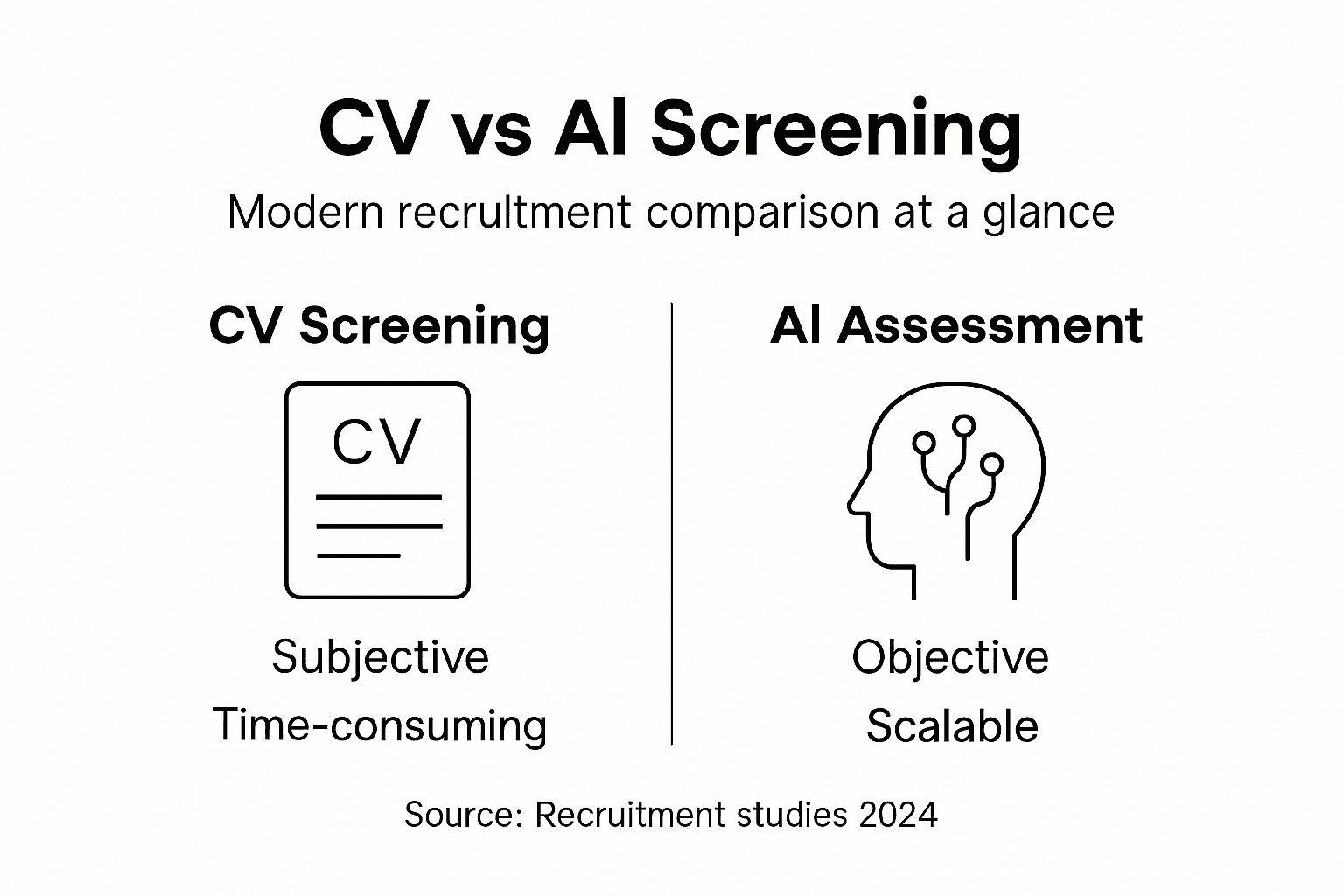
The following table summarises the critical limitations of traditional CV screening and their business implications:
| Limitation | Impact on Recruitment | Long-Term Business Effect |
|---|---|---|
| Subjective judgement | Inconsistent evaluations | Potential loss of top talent |
| Reliance on self-reporting | Inflated credentials | Increased risk of bad hires |
| Time-intensive review | Slow candidate selection | Higher operational expenditure |
| Inability to assess soft skills | Overlooks key attributes | Poor team integration |
Pro tip: Consider implementing skills-based assessments and structured interviews to complement traditional CV screening and gain more comprehensive candidate insights.
Modern Assessment Methods Beyond CVs
Modern recruitment strategies are rapidly evolving beyond traditional CV screening, embracing more sophisticated and holistic approaches to candidate evaluation. These emerging methods focus on assessing genuine skills, cognitive capabilities, and potential rather than relying solely on self-reported historical credentials.
Key modern assessment methods include:
- Skill-based practical challenges
- Cognitive ability tests
- Situational judgment assessments
- Personality and cultural fit evaluations
- Video pitch and presentation assessments
Advanced multi-agent AI frameworks are transforming candidate screening by integrating contextual analysis and dynamic information retrieval. These sophisticated systems move beyond static document review, enabling recruiters to gain deeper insights into candidate capabilities through comprehensive, nuanced evaluation techniques.
The most progressive organisations are now implementing holistic assessment strategies that combine multiple evaluation methods. These approaches typically integrate technical skills testing, behavioural interviews, psychometric assessments, and practical work simulations. By creating a multi-dimensional view of potential candidates, companies can make more informed hiring decisions that go far beyond traditional résumé parsing.
Complex recruitment methodologies now leverage technology to create more transparent, objective, and comprehensive candidate evaluations. Interactive assessments, gamified skills tests, and AI-powered screening tools allow organisations to identify talent more accurately, reducing bias and improving overall recruitment outcomes.
Pro tip: Design recruitment processes that assess candidates through multiple lenses, combining technical skills, cognitive abilities, and cultural alignment for more effective talent selection.
Comparing CV Screening with AI Assessments
Traditional CV screening and AI-powered assessments represent two fundamentally different approaches to candidate evaluation, each with distinct methodological strengths and limitations. While human-driven CV reviews have long been the recruitment standard, technological advancements are rapidly transforming talent acquisition strategies.
Key differences between CV screening and AI assessments include:
- Speed of processing
- Objectivity and bias reduction
- Depth of candidate insights
- Scalability of evaluation
- Precision of skill matching
BERT-based natural language processing techniques are revolutionising candidate screening by extracting and ranking competencies with unprecedented accuracy. These advanced systems can analyse candidate profiles far more comprehensively than traditional manual reviews, identifying nuanced skills and potential that might be overlooked by human recruiters.
AI assessment methodologies offer significant advantages over conventional CV screening. They can process vast quantities of candidate information simultaneously, apply consistent evaluation criteria, and eliminate human cognitive biases that frequently distort recruitment decisions. By leveraging machine learning algorithms, these systems can develop increasingly sophisticated understanding of candidate capabilities, creating more dynamic and intelligent recruitment frameworks.

The transformation from static CV screening to dynamic AI assessment represents a fundamental shift in talent acquisition strategies. Modern recruitment approaches now prioritise comprehensive skill evaluation, cultural alignment, and predictive performance metrics over traditional credential-based selection methods.
Here is a comparison of CV screening versus AI-powered assessment processes in modern recruitment:
| Aspect | Traditional CV Screening | AI-Powered Assessment |
|---|---|---|
| Processing speed | Slow, manual | Instant, automated |
| Bias risk | High (human subjectivity) | Lower (standardised models) |
| Skill detection | Limited to listed credentials | Uncovers nuanced skills |
| Scalability | Challenging with high volume | Effortless with large pools |
Pro tip: Integrate AI assessment tools progressively, ensuring human oversight and maintaining a balanced approach to candidate evaluation.
Reducing Bias and Improving Diversity
Recruitment technologies are increasingly focused on addressing long-standing systemic biases that have traditionally marginalised talented candidates from diverse backgrounds. The fundamental challenge lies in creating evaluation systems that assess skills and potential objectively, without perpetuating historical discrimination embedded in conventional hiring practices.
Key strategies for reducing recruitment bias include:
- Anonymising candidate information
- Using standardised assessment criteria
- Implementing multi-dimensional evaluation approaches
- Developing transparent algorithmic processes
- Continuous bias monitoring and correction
AI-based resume screening techniques offer promising mechanisms for promoting fairness by focusing on objective, competency-based criteria. These advanced methodologies can systematically evaluate candidates based on skills, experience, and potential, minimising the impact of demographic characteristics that historically influenced recruitment decisions.
Despite technological potential, organisations must remain vigilant about potential algorithmic biases. Careful design, continuous monitoring, and transparent governance are essential to ensure that AI-driven recruitment tools genuinely promote diversity rather than inadvertently perpetuating existing systemic inequalities. This requires ongoing evaluation of machine learning models, regular audits of selection criteria, and a commitment to inclusive technological development.
The future of equitable recruitment lies in creating intelligent, adaptive systems that can recognise and counteract human cognitive biases. By leveraging technological innovations with a robust ethical framework, organisations can develop more inclusive talent acquisition strategies that genuinely value individual capabilities.
Pro tip: Implement regular bias audits and diverse testing panels to ensure your AI recruitment tools maintain fairness and promote genuine inclusivity.
Enhancing Cultural Fit and Team Dynamics
Modern recruitment strategies increasingly recognise that technical skills alone cannot guarantee successful team integration. Cultural alignment has become a critical consideration in talent acquisition, requiring sophisticated approaches that evaluate candidates’ potential for collaborative and harmonious workplace interactions.
Key dimensions of cultural fit assessment include:
- Communication style compatibility
- Shared organisational values
- Problem-solving approach alignment
- Adaptability and learning orientation
- Interpersonal collaboration potential
Multi-agent AI frameworks are transforming cultural fit evaluation by enabling more nuanced, contextualised candidate assessments. These advanced systems can analyse candidates’ attributes across multiple dimensions, moving beyond traditional demographic or experience-based matching to understand deeper interpersonal dynamics.
Successful cultural integration requires a holistic approach that balances technological insights with human understanding. AI-driven tools can provide sophisticated preliminary assessments, but they must be complemented by human intuition and interpersonal expertise. This hybrid approach allows organisations to identify candidates who not only possess requisite technical skills but also demonstrate potential for meaningful team contribution.
The future of recruitment lies in creating intelligent, adaptive systems that can recognise the subtle, complex interactions that define successful team dynamics. By leveraging advanced technological capabilities alongside deep human insights, organisations can build more cohesive, innovative, and high-performing teams.
Pro tip: Design recruitment processes that balance algorithmic insights with human intuition to accurately assess candidates’ potential team alignment.
Rethink Recruitment with Real Assessments Beyond Traditional CV Screening
The article “Why Replace CV Screening: Unlocking Better Hires” highlights the frustrations with subjective judgements, inflated credentials, and the inability of traditional CV screening to capture critical soft skills and cultural fit. If you are struggling to avoid costly mismatches and want to truly assess candidates’ potential through skills-based practical challenges, AI interviews, and cognitive tests, it is time for a change.
Discover how to eliminate bias, speed up your hiring process, and gain deeper candidate insights with our innovative solutions at WAOTM. Whether you need cutting-edge assessments like video pitches or company challenges, our platform supports a holistic recruitment approach. Take control of your talent acquisition now and transform your hiring outcomes by visiting Replace CV screening with real assessments. Unlock the future of recruiting today.
Frequently Asked Questions
What are the limitations of traditional CV screening?
Traditional CV screening is often subjective, relies on self-reported information, is time-consuming, and can overlook essential soft skills and cultural fit. This can lead to inconsistent evaluations and potential mismatches in hiring.
How can modern assessment methods improve candidate evaluation?
Modern assessment methods, such as skill-based practical challenges and cognitive ability tests, provide a more comprehensive view of candidates by focusing on actual skills and potential rather than just listed qualifications, enhancing overall recruitment outcomes.
What advantages do AI-powered assessments have over traditional CV screening?
AI-powered assessments offer faster processing, reduce the risk of bias, allow for in-depth analysis of candidate skills, and can effortlessly scale to evaluate large pools of applicants, leading to more accurate skill identification.
How can organisations reduce bias during the recruitment process?
Organisations can reduce bias by anonymising candidate information, using standardised assessment criteria, implementing multi-dimensional evaluation approaches, and continuously monitoring and correcting biased outcomes.