AI in Recruitment – Transforming Candidate Screening and Fit

Selecting the right candidate often feels like searching for clarity in a sea of similar profiles. For HR leaders in rapidly evolving British tech firms, the need for innovation in recruitment is urgent. Adopting AI-driven candidate screening and cultural fit tools empowers your organisation to evaluate talent faster, reduce bias, and reveal attributes human recruiters might miss. This overview shows how advanced technologies can transform every stage of your hiring process while maintaining ethical and legal standards.
Table of Contents
- Defining AI In Recruitment Processes
- Variations And Tools In AI-Assisted Hiring
- How AI Improves Screening And Matching
- Legal Framework And Compliance Requirements
- Risks, Bias, And Common Mistakes
- Comparing AI Methods To Traditional Approaches
Key Takeaways
| Point | Details |
|---|---|
| AI Enhances Recruitment Efficiency | Artificial Intelligence streamlines candidate screening and selection processes, improving the overall efficiency of hiring workflows. |
| Bias Reduction is Essential | Implementing standardised evaluations helps mitigate biases in candidate assessments, promoting fairer hiring practices. |
| Legal Compliance is Crucial | Adhering to data protection regulations and ensuring algorithmic accountability are key to maintaining ethical hiring standards. |
| Hybrid Approaches Improve Outcomes | Combining AI-driven initial screening with human-led evaluations fosters better candidate assessments by leveraging both technological efficiency and interpersonal skills. |
Defining AI in Recruitment Processes
Artificial Intelligence (AI) in recruitment represents a transformative technological approach that automates and enhances traditional hiring processes. By leveraging advanced machine learning and natural language processing algorithms, AI enables organisations to streamline candidate screening, assessment, and selection with unprecedented efficiency.
AI recruitment technologies fundamentally operate through several core mechanisms:
- Automated resume parsing: Extracting key information from candidate documents
- Predictive candidate matching: Identifying potential job-fit using sophisticated algorithms
- Bias reduction: Standardising initial candidate evaluations
- Chatbot-driven screening: Conducting initial candidate interactions and assessments
The core purpose of AI in recruitment is to systematically improve hiring workflows, moving beyond traditional manual screening methods. These technologies analyse vast datasets to identify patterns, skills, and potential cultural alignment that human recruiters might overlook.
Machine learning algorithms enable sophisticated candidate evaluation by processing multiple data points simultaneously. This approach allows organisations to assess candidates more comprehensively, considering nuanced attributes beyond simple qualification matching.
AI recruitment technologies aim to enhance selection processes while maintaining ethical standards and transparency in candidate assessment.
Pro tip: When implementing AI recruitment tools, always validate the algorithm’s fairness and regularly audit its decision-making processes to ensure unbiased candidate selection.
Variations and Tools in AI-Assisted Hiring
AI-assisted hiring technologies encompass a diverse range of sophisticated tools designed to transform traditional recruitment processes. Advanced recruitment technologies have emerged as powerful solutions for organisations seeking more efficient and data-driven candidate selection strategies.
The primary categories of AI recruitment tools include:
- Applicant Tracking Systems (ATS): Automated screening and management of candidate applications
- Predictive Analytics Tools: Machine learning algorithms that assess candidate potential
- Chatbot Screening Platforms: Automated initial candidate interaction and assessment
- Video Interview Analysis Software: AI-powered behavioural and personality assessment technologies
These tools leverage sophisticated natural language processing and machine learning algorithms to streamline recruitment workflows. By processing large volumes of candidate data, these technologies can identify nuanced patterns and potential job matches that might escape traditional human screening methods.

Key technological capabilities in AI recruitment include:
The following table summarises key technological tools used in AI-assisted hiring and their primary business impacts:
| AI Recruitment Tool | Main Function | Business Impact |
|---|---|---|
| Applicant Tracking System | Automates application management | Reduces administrative workload |
| Predictive Analytics | Evaluates candidate potential using data patterns | Improves quality of hires |
| Chatbot Screening Platform | Facilitates candidate engagement and initial screening | Accelerates candidate response time |
| Video Interview Analysis | Assesses non-verbal cues and behaviour | Enhances assessment objectivity |
- Automated resume parsing and skills matching
- Personality and behavioural prediction
- Cultural fit assessment
- Bias reduction through standardised evaluation
Modern AI recruitment tools aim to enhance selection precision while maintaining ethical standards and candidate experience.
Pro tip: Implement AI recruitment tools gradually, conducting regular performance audits to ensure the algorithms remain fair and effective in identifying top talent.
How AI Improves Screening and Matching
Artificial Intelligence has revolutionised candidate screening by introducing unprecedented efficiency and precision to recruitment processes. Advanced predictive analytics enable organisations to transform traditional hiring methodologies, creating more sophisticated candidate evaluation approaches.
Key improvements in screening and matching include:
- Rapid Application Processing: Analysing hundreds of applications simultaneously
- Objective Candidate Assessment: Reducing human bias through standardised evaluation
- Skill Matching Algorithms: Precisely identifying candidate capabilities against job requirements
- Performance Prediction: Forecasting potential candidate success using complex data models
The core technological mechanisms driving these improvements involve sophisticated machine learning algorithms that can process extensive datasets far beyond human capabilities. These systems analyse multiple candidate attributes simultaneously, uncovering nuanced connections between skills, experience, and potential job performance.
Crucial technological capabilities in AI-enhanced screening involve:
- Comprehensive skills mapping
- Behavioural pattern recognition
- Contextual competency evaluation
- Dynamic candidate profiling
AI recruitment technologies represent a quantum leap in matching candidate potential with organisational requirements.
Pro tip: Integrate AI screening tools incrementally, establishing clear performance benchmarks and regularly validating the algorithms’ effectiveness and fairness.
Legal Framework and Compliance Requirements
The integration of Artificial Intelligence in recruitment demands rigorous legal and ethical considerations. Comprehensive legal compliance has become paramount to ensure fair, transparent, and non-discriminatory hiring practices across organisations.
Key legal compliance areas for AI recruitment technologies include:
- Data Privacy Protection: Adhering to regulations like GDPR and Data Protection Act
- Equal Employment Opportunity: Preventing algorithmic discrimination
- Candidate Consent: Ensuring transparent data usage and processing
- Algorithmic Accountability: Maintaining explainability and fairness in AI decision-making
Organisations must navigate complex regulatory landscapes that govern AI-driven recruitment technologies. This involves implementing robust governance frameworks that protect candidate rights, ensure algorithmic transparency, and mitigate potential legal risks associated with automated decision-making processes.
Critical legal compliance strategies involve:
- Regular algorithmic bias audits
- Transparent AI decision documentation
- Explicit candidate consent mechanisms
- Continuous legal and ethical training
Legal compliance in AI recruitment is not just a regulatory requirement, but a fundamental ethical obligation to protect candidate rights and maintain organisational integrity.
Pro tip: Develop a comprehensive AI governance framework that integrates legal, ethical, and technical perspectives to ensure responsible AI deployment in recruitment processes.
Risks, Bias, and Common Mistakes
Artificial Intelligence in recruitment introduces complex challenges that demand careful navigation. Critical algorithmic risks emerge from potential biases, transparency issues, and unintended discriminatory outcomes embedded within recruitment technologies.
Primary risks in AI-driven recruitment include:
- Historical Data Bias: Perpetuating historical workforce inequalities
- Algorithmic Discrimination: Unintentionally favouring certain demographic groups
- Contextual Misinterpretation: Failing to understand nuanced human capabilities
- Overreliance on Quantitative Metrics: Reducing candidate complexity to numerical scores
The most significant systemic risks arise from unchecked AI models that replicate existing societal prejudices. Machine learning algorithms trained on historical hiring data can inadvertently perpetuate discriminatory practices, systematically disadvantaging candidates from underrepresented groups.
Common mistakes organisations frequently make include:
- Neglecting regular algorithmic audits
- Assuming AI neutrality without verification
- Insufficient human oversight
- Limited diversity in training data sets
AI recruitment technologies must be continuously monitored and refined to prevent systemic biases from compromising hiring integrity.
Pro tip: Implement comprehensive bias testing protocols and maintain diverse, representative training datasets to mitigate potential algorithmic discrimination.
Comparing AI Methods to Traditional Approaches
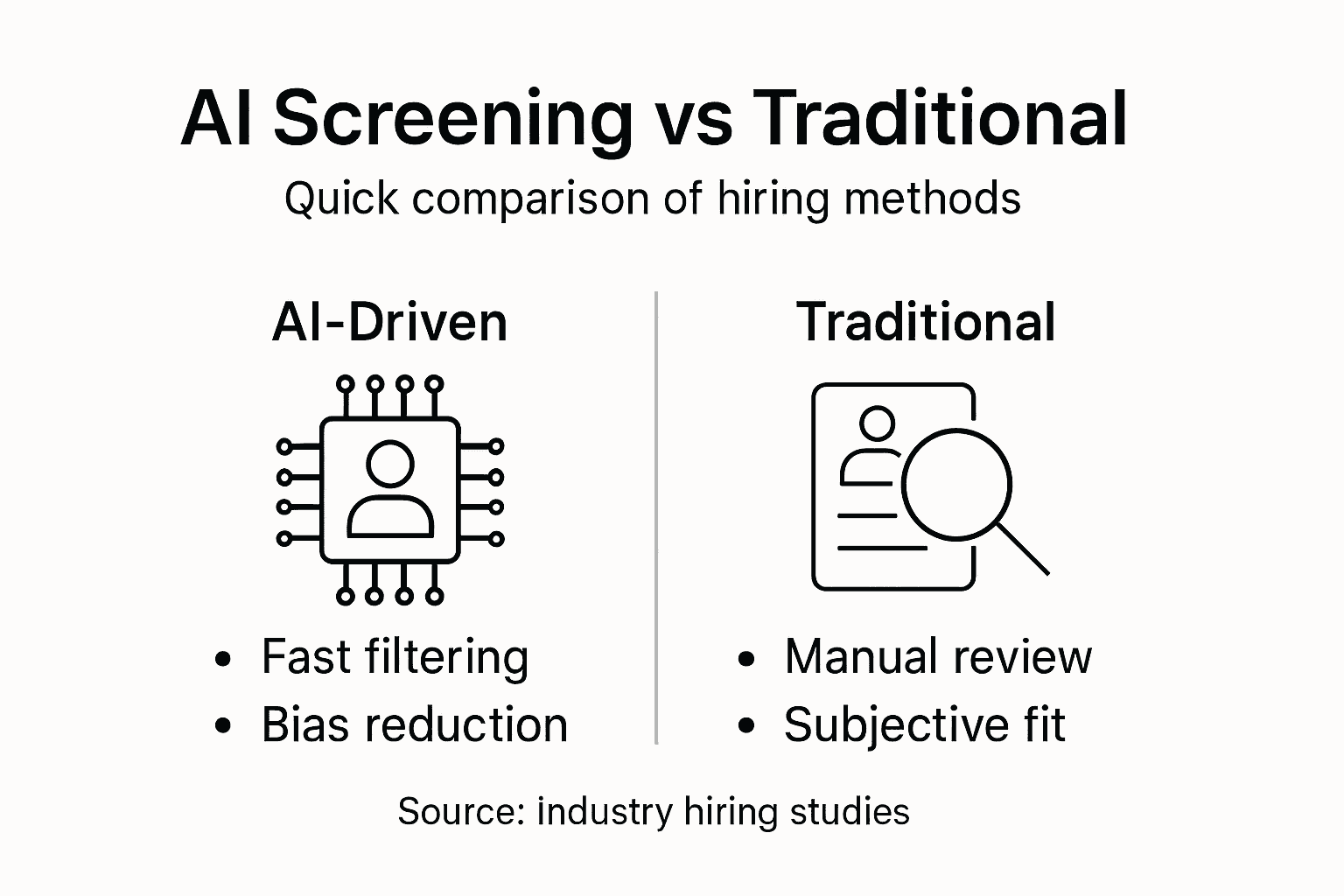
Recruitment methodologies have undergone significant transformation with the introduction of AI technologies. Comparative recruitment analysis reveals nuanced strengths and limitations in both technological and traditional approaches to candidate selection.
Key comparative dimensions between AI and traditional recruitment methods include:
This table contrasts AI-driven and traditional recruitment methods across several dimensions:
| Dimension | AI-Driven Recruitment | Traditional Recruitment |
|---|---|---|
| Screening Speed | Processes hundreds in seconds | Manual, slower review |
| Bias Mitigation | Standardises application scoring | Prone to human subjectivity |
| Data Handling | Analyses large complex datasets | Handles fewer applications |
| Human Touch | Limited contextual understanding | Strong interpersonal evaluation |
- Processing Speed: AI dramatically reduces screening time
- Bias Reduction: Algorithmic approaches offer more standardised evaluations
- Qualitative Assessment: Human recruiters excel in emotional intelligence
- Data Volume Handling: AI processes exponentially more candidate information
The technological landscape demonstrates that while AI excels in analytical processing, traditional recruitment methods retain critical advantages in understanding complex human attributes. Machine learning algorithms can efficiently analyse quantitative candidate data, but struggle to capture the subtle nuances of interpersonal dynamics and cultural fit that experienced human recruiters intuitively recognise.
Comparative evaluation strategies suggest:
- Leveraging AI for initial candidate screening
- Implementing human-led final interview stages
- Creating hybrid evaluation models
- Continuously refining algorithmic assessments
Effective recruitment strategies integrate technological efficiency with human emotional intelligence.
Pro tip: Design recruitment processes that combine AI’s analytical capabilities with human recruiters’ contextual understanding to achieve optimal candidate selection.
Unlock Smarter Hiring with AI-Driven Assessments
The article highlights critical challenges in modern recruitment such as bias reduction, objective candidate screening, and matching beyond traditional CV review. If you are tired of slow manual processes that limit insights to resumes alone and want to embrace real assessments, then discovering AI-powered recruitment tools is essential. These advanced technologies improve candidate evaluation by leveraging behavioural data, cultural fit analysis, and innovative interview techniques.
Experience a revolutionary shift by replacing outdated CV screening with AI interviews, company challenges, cultural matching, cognitive tests, and video pitches all available at We Are Over The Moon. Take control over your talent acquisition today and begin benefiting from faster, fairer, and more comprehensive hiring decisions. Start your transformation now with WAOTM and see how technology combined with human insight leads to your best hires.
Frequently Asked Questions
What is AI in recruitment?
AI in recruitment refers to the use of machine learning and natural language processing technologies to automate and enhance the hiring process, enabling organisations to streamline candidate screening and assessment with greater efficiency.
How does AI improve candidate screening and matching?
AI improves candidate screening by rapidly processing applications, standardising evaluations to reduce bias, and using advanced algorithms to match candidate skills with job requirements, enabling more accurate predictions of candidate success.
What are the primary tools used in AI-assisted hiring?
The primary tools include Applicant Tracking Systems (ATS), predictive analytics tools for assessing candidate potential, chatbot screening platforms for initial interactions, and video interview analysis software to evaluate behavioural traits and personality.
What are the risks associated with using AI in recruitment?
The risks include potential algorithmic bias stemming from historical data, discrimination against certain demographic groups, contextual misinterpretation of candidate attributes, and the overreliance on quantitative metrics, all of which can affect hiring integrity.