Cultural fit assessment guide for effective hiring success

Poor cultural fit remains one of the costliest hiring mistakes, driving turnover rates up to 50% higher and significantly reducing team productivity. Yet many HR professionals struggle to evaluate cultural alignment reliably, often relying on gut instinct rather than structured methods. This guide provides evidence-based frameworks to assess cultural fit effectively during recruitment, helping you build cohesive teams whilst maintaining diversity. You’ll discover practical assessment techniques, legal considerations for UK and Spain markets, and verification strategies that transform your hiring outcomes.
Table of Contents
- Key takeaways
- Understanding the problem: why cultural fit matters in recruitment
- Preparation: what you need for effective cultural fit assessment
- Execution: step-by-step methods to assess cultural fit effectively
- Verification and optimisation: safeguarding and enhancing your cultural fit assessments
- Discover advanced cultural fit assessment solutions
- Frequently asked questions
Key Takeaways
| Point | Details |
|---|---|
| Multimethod assessments improve fit | Using multiple structured methods improves reliability when assessing cultural alignment. |
| Value alignment boosts retention | Alignment with core organisational values correlates with higher retention and better performance. |
| Documentation supports defensible hiring | Documentation provides a defensible basis for hiring decisions. |
| Avoid lifestyle similarity bias | Overemphasising lifestyle similarity risks reducing diversity and undermining innovation. |
Understanding the problem: why cultural fit matters in recruitment
The consequences of poor cultural fit extend far beyond awkward team dynamics. Research demonstrates that value-aligned employees demonstrate higher retention and superior performance across industries. Meta-analyses confirm these employees show 30% higher organisational commitment, greater job satisfaction, and significantly lower turnover intentions. For HR professionals in competitive markets like the UK and Spain, these statistics translate directly to reduced recruitment costs and stronger team performance.
The financial impact becomes even more striking when examining productivity losses. Studies reveal that poor manager-employee value alignment reduces productivity four times more severely than gender mismatches. Cultural misalignment triggers communication breakdowns, erodes team morale, and creates friction that compounds over time. One manufacturing firm in Spain reported a 23% productivity decline in departments with high cultural misfit, costing approximately €180,000 annually in lost output.
Yet cultural fit assessment requires nuance. The goal isn’t finding candidates who share identical backgrounds or hobbies with existing staff. That approach breeds homogeneity and stifles innovation. Instead, effective cultural fit focuses on alignment with core organisational values such as collaboration style, decision-making approaches, and attitudes towards risk and accountability. Understanding cultural matching’s impact on turnover helps clarify this distinction.
“Cultural fit matters more than demographic similarity in predicting long-term employee success and organisational contribution. Values alignment, not lifestyle matching, drives sustained performance.”
The evidence establishes clear stakes for getting cultural fit assessment right. When you hire someone whose values clash with your organisation’s core principles, you’re setting up both the employee and your team for frustration. When you assess cultural fit through a values lens, you create conditions for engagement, retention, and mutual success. This understanding guides every assessment method we’ll explore, ensuring your recruitment process builds cohesive teams without sacrificing the diversity that drives innovation. Learn more about organisational culture fit fundamentals before moving to preparation.
Preparation: what you need for effective cultural fit assessment
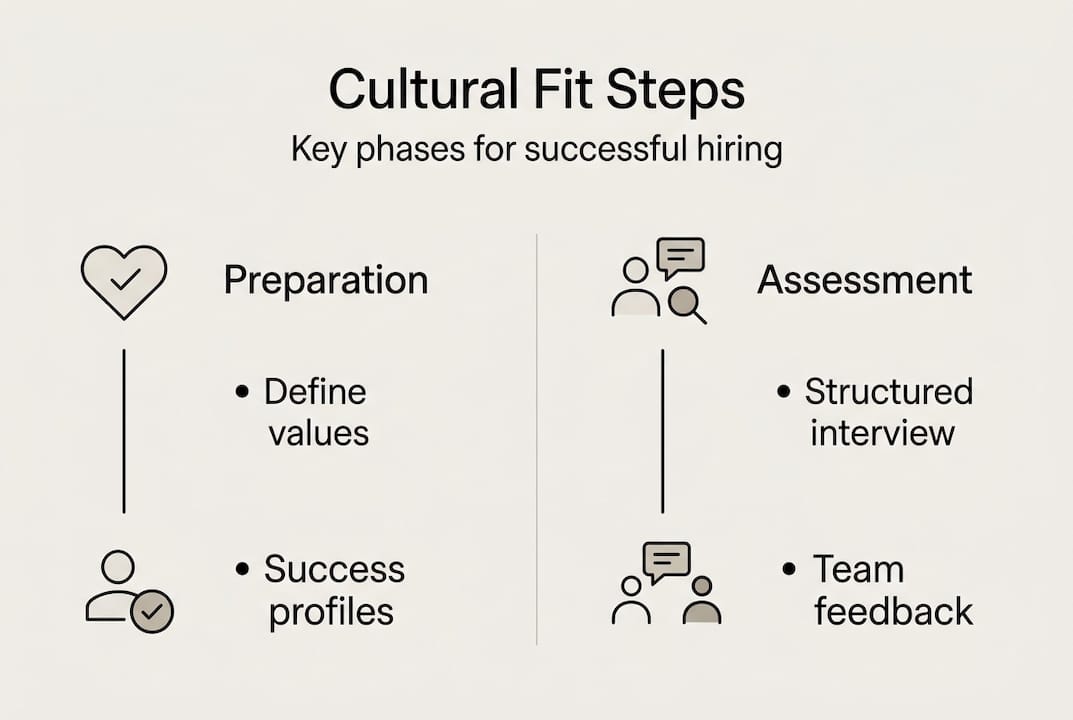
Successful cultural fit assessment begins long before candidates enter your interview room. You need clarity on what you’re actually measuring, tools to evaluate it consistently, and safeguards to ensure legal compliance. Start by defining your organisational culture through core values rather than superficial characteristics. Values like integrity, innovation, customer focus, or collaborative problem-solving provide objective assessment criteria. Lifestyle preferences such as weekend activities or personality types introduce bias and reduce diversity.
Create success profiles by analysing your highest-performing employees. Research shows that benchmarking top performers creates reliable success profiles whilst avoiding risks from value dissonance in edge cases. Interview three to five top performers in each role, identifying common values, work approaches, and decision-making styles. Document specific behaviours that demonstrate these values in action. This evidence-based approach grounds your assessments in observable reality rather than abstract ideals.
Pro Tip: When building success profiles, include diverse high performers to ensure your cultural benchmarks don’t inadvertently favour one demographic group. This preserves both cultural cohesion and workforce diversity.
Legal considerations demand attention, particularly in the UK and Spain where equality laws strictly govern hiring practices. UK behavioural assessment guides emphasise thorough documentation for legal defensibility. Every cultural fit assessment must be:
- Consistently applied across all candidates
- Based on job-relevant values and behaviours
- Documented with specific evidence
- Free from protected characteristic discrimination
- Validated against actual job performance
Before launching assessments, prepare your toolkit. You’ll need structured interview guides with values-based questions, scoring rubrics for consistent evaluation, and training materials for interviewers. Consider which assessment methods suit your context. A comprehensive cultural fit checklist helps ensure nothing falls through gaps. Technology platforms can support objectivity and scalability, particularly for high-volume recruitment.

| Preparation element | Purpose | Timeline |
|---|---|---|
| Define core organisational values | Establish assessment criteria | 2-3 weeks |
| Build success profiles from top performers | Create evidence-based benchmarks | 3-4 weeks |
| Develop structured interview guides | Ensure consistent evaluation | 1-2 weeks |
| Train interviewers on bias and legal compliance | Protect legal defensibility | Ongoing |
| Select and implement assessment tools | Enable scalable, objective evaluation | 2-4 weeks |
Finally, establish clear ownership and accountability. Designate who conducts assessments, how results are documented, and who makes final cultural fit determinations. This structure prevents inconsistent application and supports continuous improvement. With these foundations in place, you’re ready to execute reliable cultural fit assessments that strengthen your hiring outcomes. Explore talent matching principles to deepen your understanding before moving to execution.
Execution: step-by-step methods to assess cultural fit effectively
Effective cultural fit assessment combines multiple evaluation methods, each revealing different aspects of candidate alignment. Research identifies behavioural interviewing, situational scenarios, team involvement, and structured values questions as the most reliable approaches. Deploy these methods systematically throughout your recruitment process for comprehensive evaluation.
-
Conduct behavioural interviews focused on values alignment. Ask candidates to describe specific past situations that reveal their core values in action. Questions like “Tell me about a time you faced an ethical dilemma at work” or “Describe a situation where you disagreed with your team’s approach” elicit authentic responses. Listen for alignment with your organisational values, not perfect answers. Behavioural interviews in hiring provide deeper insights than hypothetical questions because past behaviour predicts future performance.
-
Use situational assessments and realistic job previews. Present candidates with scenarios they’ll actually face in your organisation, then evaluate their approach. A collaborative culture might present a team conflict scenario. An innovation-focused culture might pose a resource-constrained problem requiring creative solutions. These assessments reveal thinking patterns and decision-making styles that indicate cultural alignment.
-
Involve team members in the assessment process. Schedule candidates to meet potential colleagues in informal settings like team lunches or collaborative work sessions. Team members often detect cultural misalignment that formal interviewers miss. They observe communication styles, collaboration approaches, and interpersonal dynamics that predict daily working relationships.
-
Apply structured question frameworks consistently. Develop a standard set of values-based questions for each role, using identical questions and scoring criteria for all candidates. This consistency enables fair comparison and legal defensibility. Review interview question strategies for examples tailored to different organisational cultures.
-
Consider AI-based assessment tools for objectivity and scale. Modern platforms analyse candidate responses for values alignment, reducing unconscious bias whilst handling high application volumes. AI for cultural fit assessments combines efficiency with objectivity, particularly valuable for organisations hiring across multiple locations or roles.
Pro Tip: Record and review interview responses with your hiring team. Multiple perspectives catch nuances individual interviewers might miss and reduce the impact of personal bias on cultural fit evaluations.
| Assessment method | Best for evaluating | Implementation complexity |
|---|---|---|
| Behavioural interviews | Past demonstration of values | Medium |
| Situational scenarios | Problem-solving approach and decision-making style | Medium to high |
| Team interactions | Communication style and interpersonal fit | Low to medium |
| Structured values questions | Explicit value alignment | Low |
| AI assessment platforms | Objective evaluation at scale | Medium |
Throughout execution, maintain detailed documentation. Record specific examples of behaviours or responses that demonstrate cultural alignment or misalignment. This evidence supports hiring decisions, enables continuous improvement of your assessment process, and provides legal protection if decisions are challenged. The goal isn’t perfection but consistent, evidence-based evaluation that identifies candidates whose values align with your organisational culture whilst preserving diversity.
Verification and optimisation: safeguarding and enhancing your cultural fit assessments
Even well-designed cultural fit assessments require ongoing verification to ensure they’re delivering intended outcomes without unintended consequences. Start by establishing metrics that track assessment effectiveness. Monitor new hire retention rates, performance ratings, and engagement scores segmented by cultural fit assessment results. If candidates rated as strong cultural fits show no better retention or performance than those rated lower, your assessment criteria need refinement.
Documentation serves dual purposes: legal protection and process improvement. UK employment law requires thorough documentation of hiring decisions to demonstrate fair, consistent practices. Beyond compliance, detailed records reveal patterns that improve your assessment accuracy. Review documentation quarterly, identifying which assessment methods best predict success and which questions elicit the most revealing responses.
The greatest risk in cultural fit assessment is inadvertently creating homogeneous teams that lack diversity. Research confirms that cultural matching focused on lifestyle similarities reduces diversity whilst values-based assessment enables diverse teams united by shared principles. Regularly audit your hiring outcomes:
- Track demographic diversity of candidates rated as strong cultural fits
- Compare diversity metrics before and after implementing cultural fit assessments
- Analyse whether certain demographic groups consistently receive lower cultural fit ratings
- Review assessment criteria to eliminate lifestyle or personality preferences masquerading as values
If you detect homogeneity creeping into your workforce, revisit your success profiles and assessment criteria. Ensure you’re evaluating alignment with core values like integrity, collaboration, or customer focus rather than preferences for specific communication styles or social activities.
Pro Tip: Include a diverse panel in cultural fit assessments. Different perspectives catch biases that homogeneous interview teams miss and signal your commitment to inclusive hiring to candidates.
Continuous optimisation requires training and calibration. Schedule quarterly sessions where interviewers review recorded assessments together, discussing how they interpreted candidate responses and rated cultural fit. This calibration reduces individual bias and ensures consistent application of criteria. Training should cover unconscious bias recognition, legal hiring standards in the UK and Spain, and techniques for distinguishing values alignment from superficial similarity.
| Verification activity | Frequency | Purpose |
|---|---|---|
| Review retention and performance data by cultural fit rating | Quarterly | Validate assessment predictive accuracy |
| Audit demographic diversity of cultural fit ratings | Quarterly | Detect unintended homogeneity |
| Calibration sessions with interview teams | Quarterly | Ensure consistent assessment application |
| Update success profiles with new top performer data | Annually | Keep benchmarks current and relevant |
| Legal compliance review of documentation | Annually | Maintain defensibility under employment law |
Finally, gather feedback from new hires about their cultural fit experience. Ask whether the assessment process accurately represented your organisational culture and whether they feel their values align with daily reality. Discrepancies between assessment promises and workplace reality indicate either assessment problems or cultural inconsistencies that need addressing. Consider implementing CV-free screening methods and effective screening workflows to complement your cultural fit assessment with skills-based evaluation. This verification and optimisation cycle transforms cultural fit assessment from a static checklist into a dynamic system that continuously improves hiring quality whilst safeguarding diversity and legal compliance.
Discover advanced cultural fit assessment solutions
Implementing comprehensive cultural fit assessment requires sophisticated tools and expertise. We Are Over The Moon transforms how organisations evaluate candidates by replacing traditional CV screening with real assessments that reveal true potential. Our platform combines AI-powered interviews, company challenges, cultural matching algorithms, cognitive tests, and video pitches to provide multidimensional candidate evaluation.
Our skills-based matching platform enables you to assess cultural alignment alongside technical capabilities, creating a complete picture of candidate suitability. The technology supports behavioural assessment at scale whilst maintaining the human insight essential for cultural evaluation. Whether you’re hiring for a single role or building entire teams, our solutions adapt to your specific cultural values and assessment needs. Discover how We Are Over The Moon helps forward-thinking organisations make smarter hiring decisions. Explore our AI-powered validation platform to see how technology and expertise combine for superior recruitment outcomes.
Frequently asked questions
What is cultural fit assessment and why is it important?
Cultural fit assessment evaluates alignment between a candidate’s core values and an organisation’s cultural principles. It’s crucial because value-aligned employees demonstrate 30% higher commitment, superior performance, and significantly lower turnover rates. Effective assessment reduces costly hiring mistakes whilst building cohesive teams.
Which methods best assess cultural fit during recruitment?
Behavioural interviewing asking candidates to describe past situations revealing values, situational assessments presenting realistic scenarios, and team interactions observing communication styles provide the most reliable evaluation. Structured values-based questions applied consistently across candidates ensure fair comparison. Combining multiple methods delivers more comprehensive assessment than any single approach.
How can HR ensure cultural fit assessment does not reduce diversity?
Assess cultural fit based on core organisational values like integrity, collaboration, or innovation rather than demographic characteristics or lifestyle preferences. Benchmark diverse high performers when creating success profiles, and regularly audit whether certain groups receive consistently lower ratings. Values-based assessment enables diverse teams united by shared principles rather than superficial similarity.
What are the legal considerations for cultural fit assessments in the UK and Spain?
Document all assessment criteria, candidate responses, and hiring decisions thoroughly to demonstrate fair, consistent practices under equality laws. Apply identical evaluation methods and criteria to all candidates for each role. Ensure assessments focus on job-relevant values and behaviours rather than protected characteristics. Regular legal compliance reviews and interviewer training protect organisations from discrimination claims.
How long does it take to implement effective cultural fit assessment?
Initial implementation including defining values, building success profiles, developing interview guides, and training interviewers typically requires eight to twelve weeks. However, cultural fit assessment is an ongoing process requiring quarterly calibration sessions, annual success profile updates, and continuous refinement based on hiring outcomes. The investment delivers significant returns through improved retention and team performance.