Understanding talent matching for smarter hires in 2026

Many HR leaders believe cultural fit means hiring people who mirror existing staff. This misconception leads to homogenous teams and missed diversity. True talent matching extends beyond CVs to evaluate skills, behaviour, and cultural values alignment, delivering better hires and retention. This guide explores modern assessment methods transforming European recruitment.
Table of Contents
- Introduction To Talent Matching
- The Role Of Cultural Fit In Talent Matching
- Innovative Assessment Methods In Talent Matching
- Integrative Assessment Frameworks For Talent Matching
- Common Misconceptions About Talent Matching And Cultural Fit
- Applying Talent Matching In Practice
- Conclusion: The Future Of Talent Matching
- Enhance Your Recruitment With We Are Over The Moon
- Frequently Asked Questions
Key takeaways
| Point | Details |
|---|---|
| Holistic matching | Talent matching integrates skills, behaviour, and culture for superior hiring outcomes. |
| AI-driven precision | Innovative AI and cognitive assessments improve accuracy whilst reducing bias. |
| Structured evaluation | Structured cultural fit assessments reduce turnover and enhance team cohesion. |
| Debunking myths | Misconceptions about cultural fit lead to costly hiring mistakes and reduced diversity. |
| Practical frameworks | Balanced evaluation frameworks enable fair, effective candidate selection. |
Introduction to talent matching
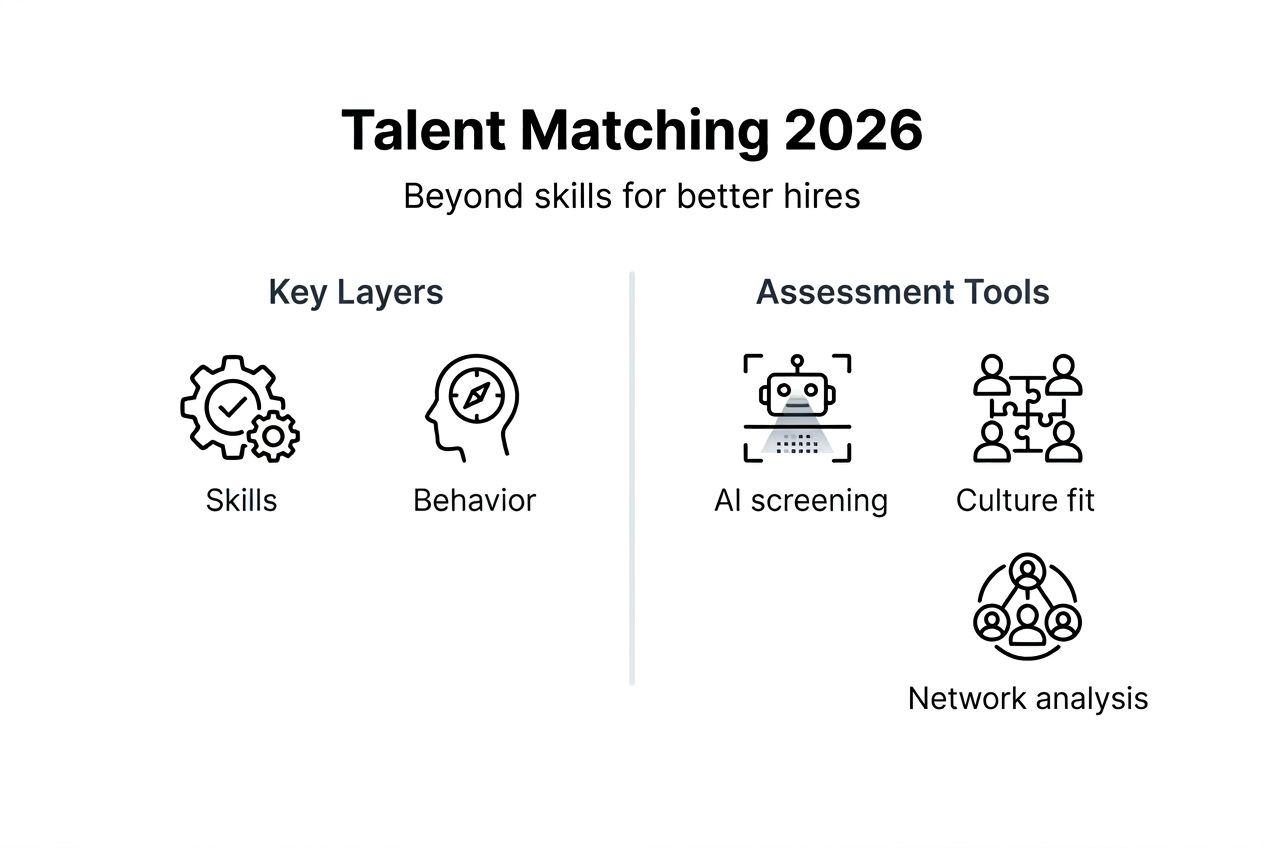
Talent matching aligns candidates’ skills, behavioural traits, and cultural values with both job requirements and organisational needs. Unlike traditional CV-focused hiring, which relies heavily on subjective judgements and often misses critical fit dimensions, talent matching employs structured, multi-dimensional assessments. This approach matters particularly in Europe’s competitive talent landscape, where securing the right candidate quickly determines success.
Research shows 83% of hiring managers prioritise culture fit, and employees with strong alignment perform 30% better than peers. Traditional screening methods focus on qualifications and experience whilst neglecting behavioural compatibility and values alignment. This narrow lens increases turnover costs and reduces team performance.
Modern talent matching addresses these gaps through:
- Objective skills evaluation using cognitive and psychometric tests
- Behavioural assessments measuring situational responses and work style
- Cultural alignment tools identifying shared values and organisational fit
- AI-powered platforms combining multiple data points for holistic profiles
By improving candidate matching beyond surface-level credentials, organisations achieve higher retention, stronger performance, and better team dynamics. The shift from resume screening to comprehensive assessment represents a fundamental evolution in recruitment strategy, particularly vital as European companies compete for limited talent pools.
The role of cultural fit in talent matching
Cultural fit describes how well a candidate’s values, behaviours, and work preferences align with an organisation’s environment and ethos. Strong cultural alignment correlates directly with reduced turnover, higher employee satisfaction, and improved team collaboration. Yet many HR teams assess fit informally through unstructured interviews, introducing bias and inconsistency.
Common mistakes include relying on gut feelings rather than evidence, confusing similarity with shared values, and using subjective criteria that disadvantage diverse candidates. These informal approaches undermine both fairness and hiring quality. Behavioural and team-based assessments improve cultural fit predictions by up to 35% compared to unstructured methods.
Structured cultural fit evaluation offers clear advantages:
- Objective scoring rubrics reduce unconscious bias
- Standardised questions ensure consistent candidate comparison
- Behavioural scenarios reveal authentic responses to workplace situations
- Team-based assessments gauge collaboration and communication styles
Pro Tip: Design cultural fit assessments around your organisation’s core values rather than personality traits. Ask candidates to describe how they’ve demonstrated these values in previous roles, then score responses against defined criteria.
Implementing cultural fit checklist methods transforms vague impressions into measurable insights. This structured approach ensures candidates align with organisational culture whilst maintaining diversity of thought, background, and perspective.
Innovative assessment methods in talent matching
AI-powered platforms revolutionise candidate evaluation by objectively measuring both technical skills and cultural alignment. These tools analyse language patterns, behavioural indicators, and response quality across standardised scenarios. European startups use AI-powered skills assessment platforms reducing recruitment cycles by 40% whilst improving hiring accuracy.

Cognitive and psychometric tests provide objective indicators of problem-solving ability, learning agility, and personality traits relevant to role success. Unlike CV credentials, these assessments measure actual capability rather than claimed experience. They predict job performance more reliably than traditional interviews alone.
Behavioural and situational judgement tests present realistic workplace scenarios, revealing how candidates approach challenges, communicate under pressure, and make decisions. These context-specific insights expose competencies invisible on resumes. Automated cultural fit assessments shorten hiring timelines by up to 50% whilst improving fairness by blinding bias-prone demographic data.
Gamified assessments and video pitches enhance candidate engagement whilst revealing communication skills, creativity, and authentic personality. These methods particularly appeal to younger talent and provide richer evaluation data than static applications.
| Assessment Type | Objectivity | Speed | Bias Risk | Candidate Insight |
|---|---|---|---|---|
| Traditional CV screening | Low | Fast | High | Minimal |
| AI-powered assessments | High | Very fast | Low | Comprehensive |
| Structured cultural fit | High | Moderate | Low | Deep |
| Cognitive tests | Very high | Fast | Very low | Specific |
| Behavioural scenarios | High | Moderate | Low | Contextual |
Pro Tip: Combine AI in recruitment screening with human evaluation for optimal results. Use AI to handle initial filtering and scoring, then involve hiring managers in final decisions with candidates who meet threshold criteria.
Exploring AI interview examples reveals practical applications from skills testing to personality assessment. These innovations deliver measurable benefits of AI assessments including faster decisions, reduced bias, and superior candidate quality.
Integrative assessment frameworks for talent matching
Comprehensive talent matching requires combining multiple assessment dimensions into coherent frameworks. The three-layer approach evaluates:
- Skills and qualifications: Technical competencies, certifications, and experience relevant to role requirements
- Behavioural and cognitive traits: Problem-solving ability, communication style, learning agility, and personality characteristics
- Cultural and values alignment: Fit with organisational mission, work environment preferences, and team dynamics
Integrating these layers dramatically improves predictive accuracy compared to single-dimension screening. Comprehensive talent assessments integrating behaviour, personality, and cultural values improve selection outcomes beyond skills testing alone.
| Approach | Objectivity | Bias Risk | Predictive Value | Implementation Cost |
|---|---|---|---|---|
| Resume screening only | Low | High | Limited | Low |
| AI-powered multi-assessment | Very high | Low | Excellent | Moderate |
| Integrative cultural fit framework | High | Very low | Superior | Moderate |
Best practices for implementing combined assessments include:
- Customise evaluation criteria to specific roles and organisational values
- Train hiring teams on interpreting assessment results objectively
- Use blinded scoring to remove demographic information during initial review
- Balance automated scoring with structured human judgement
- Gather candidate feedback to refine assessment experience continuously
Pro Tip: Weight assessment components based on role requirements. Technical positions might emphasise cognitive and skills tests (60%), whilst leadership roles prioritise behavioural and cultural alignment (60%). Avoid one-size-fits-all frameworks.
A European technology firm implemented an integrative framework combining AI skills assessment, behavioural interviews, and cultural values matching. They reduced turnover by 45% within 18 months whilst improving hiring speed by 30%. The framework particularly excelled at identifying candidates who thrived long-term despite non-traditional backgrounds.
Matching culture with AI assessments enables scalable, consistent evaluation across high-volume recruitment. This systematic approach transforms hiring from reactive gap-filling into strategic talent acquisition.
Common misconceptions about talent matching and cultural fit
Several persistent myths obstruct effective talent matching adoption. Understanding and correcting these false beliefs helps HR leaders make evidence-based decisions.
Myth 1: Cultural fit means hiring similar people
Correction: Effective cultural fit focuses on shared values and work style compatibility, not demographic or personality similarity. Diverse teams with aligned values outperform homogenous groups. The goal is complementary skills and perspectives united by common organisational principles.
Myth 2: Skills alone ensure employee success
Correction: Technical competence matters, but employees with strong cultural fit perform 30% better than peers with matched skills alone. Behavioural alignment, learning orientation, and values compatibility determine long-term contribution and satisfaction.
Myth 3: AI assessments eliminate human judgement needs
Correction: Best practice combines AI efficiency with human insight. Algorithms excel at objective scoring and pattern recognition, whilst humans interpret context, assess soft skills nuances, and make final hiring decisions. Technology augments rather than replaces human expertise.
Myth 4: Informal cultural fit assessments work fine
Correction: Unstructured approaches introduce bias, inconsistency, and legal risk. They disadvantage candidates from different backgrounds whilst failing to predict actual job success. Structured frameworks with defined criteria ensure fairness and accuracy.
“Employees demonstrating strong cultural alignment deliver 30% higher performance than peers, proving technical skills alone cannot guarantee organisational success or long-term contribution.”
These misconceptions lead to poor hiring decisions, reduced diversity, and missed talent opportunities. Evidence-based frameworks grounded in structured assessment methods deliver superior outcomes whilst supporting inclusive recruitment practices.
Applying talent matching in practice
Successful implementation requires systematic planning and stakeholder engagement. Follow these steps:
- Define organisational values and ideal candidate profiles: Articulate core principles, work environment characteristics, and success factors specific to your organisation and roles.
- Select and customise assessment tools: Choose platforms and methods aligned with your requirements, budget, and candidate volume. Tailor evaluation criteria to role-specific competencies.
- Integrate assessments into workflows: Embed tools at appropriate hiring stages with clear instructions for candidates and evaluators. Train staff on administering and interpreting results.
- Implement bias reduction measures: Use blinded scoring, diverse evaluation panels, and standardised rubrics to ensure fairness.
- Monitor outcomes and refine continuously: Track hiring quality, retention, and candidate feedback. Adjust frameworks based on performance data.
Balance objective data with human judgement throughout. Automated scores identify strong candidates efficiently, but final decisions benefit from contextual understanding and relationship assessment. Maintain positive candidate experience by:
- Communicating assessment purpose and format clearly
- Keeping evaluations concise and mobile-accessible
- Providing timely feedback regardless of outcome
- Ensuring transparency about evaluation criteria
Pro Tip: Pilot new assessment methods with a subset of roles before organisation-wide rollout. Gather data on predictive validity and candidate reactions, then refine based on evidence.
Common pitfalls include neglecting alignment between assessment criteria and actual job requirements, relying solely on gut feelings despite structured data, and implementing overly complex processes that frustrate candidates. Start simple with core competencies, then expand sophistication gradually.
Implementing a cultural fit checklist guide provides practical structure, whilst an effective screening workflow ensures efficiency. These frameworks transform talent matching from theoretical concept into operational reality.
Conclusion: the future of talent matching
Adopting innovative talent matching approaches delivers measurable benefits including enhanced hiring accuracy, reduced turnover, improved retention, and stronger team cohesion. Organisations embracing evidence-based frameworks gain competitive advantage in attracting and selecting superior talent.
Future trends point toward increased AI integration, continuous assessment optimisation, and more sophisticated cultural alignment tools. Predictive analytics will enable proactive talent pipeline development whilst real-time feedback loops refine evaluation methods constantly. European companies leading this evolution will dominate talent acquisition in increasingly competitive markets.
HR professionals should adopt structured, multi-dimensional assessment frameworks immediately. The evidence supporting comprehensive talent matching over traditional CV screening is overwhelming. Begin by evaluating current processes, identifying gaps, and implementing objective assessment tools aligned with organisational values. Success requires commitment to data-driven decisions, continuous improvement, and candidate-centric design.
Enhance your recruitment with We Are Over The Moon
Transforming recruitment from CV screening to comprehensive talent matching requires expertise and appropriate tools. We Are Over The Moon delivers AI-driven assessment solutions designed specifically for European HR teams seeking better hires faster.
Our platform combines AI interviews, cognitive tests, cultural matching, and video assessments into seamless workflows. We help you match on skills not CVs, reducing time-to-hire whilst improving candidate quality and cultural fit.
Discover how innovative assessment methods enhance your recruitment outcomes. Learn more about We Are Over The Moon and explore tailored solutions for your organisation.
Pro Tip: Partner with assessment specialists to accelerate implementation and avoid common pitfalls. Expert guidance ensures you maximise technology benefits whilst maintaining candidate experience and regulatory compliance.
Frequently asked questions
What is the difference between talent matching and traditional hiring?
Talent matching evaluates candidates across skills, behavioural traits, and cultural alignment using structured, objective assessments. Traditional hiring focuses primarily on CV credentials and unstructured interviews, often missing critical fit dimensions. This comprehensive approach leads to better hiring accuracy, improved retention, and stronger team cohesion. It also increases fairness by reducing unconscious bias through standardised evaluation criteria and blinded scoring methods.
How can AI improve talent matching accuracy?
AI automates initial screening, analyses behavioural patterns objectively, and evaluates cognitive traits without human bias. These platforms process large candidate volumes quickly whilst maintaining consistent evaluation standards. AI speeds decision-making by identifying top candidates efficiently and improves candidate experience through responsive, accessible assessment interfaces. Combined with human judgement, AI delivers superior hiring outcomes compared to manual methods alone.
Why is cultural fit important beyond skills?
Employees aligned with organisational culture demonstrate up to 30% better performance than peers with similar technical skills. Cultural fit predicts long-term success, job satisfaction, and retention more reliably than qualifications alone. It fosters engagement, collaboration, and commitment to organisational goals. Strong cultural alignment reduces turnover costs whilst building cohesive, high-performing teams that thrive together.
What are common mistakes when assessing cultural fit?
Many organisations rely on informal gut feelings rather than structured assessment tools, introducing bias and inconsistency. Hiring for demographic or personality similarity rather than shared values reduces diversity and team effectiveness. Ignoring bias risks through unstructured interviews disadvantages qualified candidates from different backgrounds. Neglecting candidate experience with poorly designed assessments damages employer brand and discourages top talent from engaging fully.