What is skills-based hiring: improve recruitment in 2026

Traditional CV screening wastes time and money on poor hires. Research shows cognitive assessments predict performance 70% accurately versus 40% for CV reviews. Skills-based hiring evaluates actual abilities through AI interviews, work simulations, and cultural fit tests. This approach reduces unconscious bias, shortens hiring cycles by 30%, and cuts turnover by 50%. HR managers in the Netherlands, UK, and Spain increasingly adopt skills-based hiring to build stronger, more diverse teams.
Table of Contents
- Introduction To Skills-Based Hiring
- Why Skills-Based Hiring Works: Psychological And Practical Foundations
- Common Misconceptions About Skills-Based Hiring
- Frameworks And Comparative Analysis: Skills-Based Vs Traditional Hiring
- Types Of Assessments In Skills-Based Hiring
- Benefits And Impact Of Skills-Based Hiring
- Challenges And Practical Steps To Implement Skills-Based Hiring
- Summary And Next Steps For HR Managers
- Frequently Asked Questions
Key takeaways
| Point | Details |
|---|---|
| Skills over credentials | Focus on demonstrable abilities rather than formal qualifications to predict job success |
| Objective assessments | AI interviews, work challenges, and cognitive tests reduce unconscious bias |
| Faster, better hiring | 30% shorter cycles and 50% lower turnover improve recruitment ROI |
| Integration challenges | Requires change management, training, and careful technology selection |
| Proven impact | Higher retention, increased diversity, and improved employee engagement |
Introduction to skills-based hiring
Skills-based hiring evaluates what candidates can actually do, not just what their CVs claim. Instead of filtering applicants by university degrees or job titles, this approach uses practical assessments to measure cognitive ability, technical competence, and cultural alignment.
Traditional recruitment relies heavily on CVs and academic credentials. You scan hundreds of applications, shortlist based on keywords, then conduct interviews that often reveal little about real capabilities. This process introduces bias at every stage and frequently results in mis-hires.
HR managers across the Netherlands, UK, and Spain face persistent challenges with conventional recruitment. High turnover rates, poor job fit, and diversity gaps plague organisations stuck in outdated hiring practices. Skills-based hiring addresses these problems directly by focusing on evidence rather than assumptions.
Why the shift? Four critical problems drive adoption:
- Unconscious bias creeps into CV screening when recruiters favour familiar universities or previous employers
- Credential inflation means degrees no longer reliably indicate job readiness or competence
- Traditional interviews fail to predict performance, relying too much on likability and presentation skills
- Time wasted reviewing irrelevant CVs delays hiring and frustrates both recruiters and qualified candidates
Skills-based hiring replaces guesswork with data. When you test actual abilities through work samples, cognitive assessments, and structured evaluations, you make better decisions faster. This foundation supports everything that follows.
Why skills-based hiring works: psychological and practical foundations
Objective skill measurement removes bias from recruitment decisions. When you evaluate all candidates using identical assessments, personal characteristics like name, gender, or background matter less. The focus shifts to demonstrated capability.
Research confirms AI and cognitive assessments predict performance 70% accurately compared to 40% for traditional CV reviews. This dramatic improvement stems from measuring actual abilities rather than inferring them from credentials. Better prediction means fewer hiring mistakes and stronger team performance.
Employee retention improves when skills match job requirements. New hires who possess the necessary competencies feel confident and engaged from day one. They contribute faster and stay longer because the role genuinely suits their abilities. Poor skill fit, conversely, leads to frustration and early departure.
Candidates perceive skills-based hiring as fairer. When assessment methods clearly relate to job tasks, applicants understand how their performance connects to hiring decisions. This psychological fairness increases acceptance of outcomes, whether positive or negative, and enhances your employer brand.
Pro tip: Balance skill assessment with cultural and motivational fit. Technical ability matters enormously, but values alignment and intrinsic motivation determine long term success. Include structured questions about work preferences and team dynamics alongside cognitive and technical tests.
Key evidence supporting skills-based hiring:
- Structured work samples correlate strongly with on-the-job performance across industries
- Blind assessments reduce demographic bias by 30 to 50% compared to CV screening
- Candidates from non-traditional backgrounds access opportunities previously closed by credential requirements
- Hiring managers report higher confidence in selection decisions backed by objective data
This psychological and practical foundation explains why skills-based hiring consistently outperforms traditional methods. The combination of fairness, accuracy, and efficiency makes it compelling for modern HR professionals.
Common misconceptions about skills-based hiring
Myth: Skills-based hiring ignores candidate experience. Reality: It integrates experience with demonstrated ability. You still value relevant background, but verify it through practical assessment rather than accepting CV claims at face value. Experience matters when it translates to actual competence.
Myth: Skill assessments slow down hiring. Evidence shows the opposite. Automated AI interviews and cognitive tests process candidates faster than CV review and phone screens. You can evaluate more applicants in less time, reducing overall hiring cycles by roughly 30%. Speed improves because you eliminate manual screening bottlenecks.
Myth: Skills-based hiring costs too much or requires complex implementation. Affordable AI assessment tools exist today, many designed specifically for small and mid-sized organisations. Integration with existing applicant tracking systems is straightforward, and most platforms offer free trials. The upfront investment pays back quickly through better hires and reduced turnover.
Myth: Skills assessments replace holistic candidate evaluation. Actually, skills-based hiring complements other selection methods. You still conduct interviews, check references, and assess cultural fit. The difference lies in adding objective skill measurement to inform these judgements. It enhances rather than replaces human decision making.
These misconceptions create unnecessary hesitation. Understanding the realities helps you confidently adopt skills-based hiring without fear of negative consequences.
Key clarifications:
- Skills assessments provide data points, not final decisions
- Implementation scales from small pilots to full recruitment transformation
- Candidates appreciate transparent, job-relevant evaluation methods
- Combining skills tests with structured interviews yields best results
Clearing up these misunderstandings removes barriers to adoption. HR managers who grasp these realities implement skills-based hiring more successfully and realise benefits faster.
Frameworks and comparative analysis: skills-based vs traditional hiring
A three-pillar framework organises skills-based hiring effectively. First, cognitive skills encompass problem solving, logical reasoning, and learning ability. Second, technical skills include job-specific competencies like software proficiency or data analysis. Third, cultural fit assesses values alignment, communication style, and team compatibility. Evaluating all three dimensions provides comprehensive candidate insight.
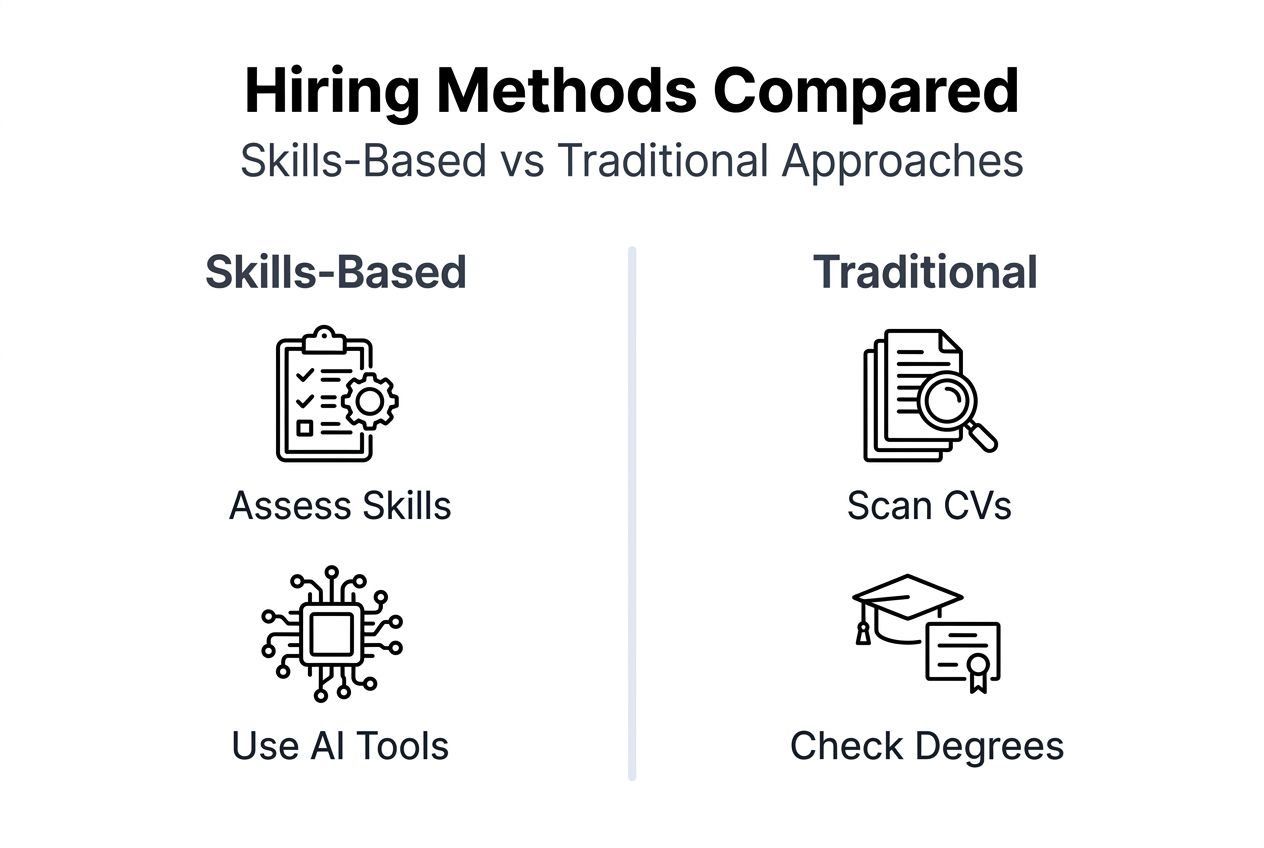
This structured approach contrasts sharply with traditional CV-based methods. The table below highlights critical differences:
| Dimension | Skills-based hiring | Traditional CV hiring |
|---|---|---|
| Selection criteria | Demonstrated abilities and test results | Credentials, job titles, education |
| Bias reduction | High (objective measures) | Low (subjective screening) |
| Performance prediction | 70% accuracy with AI assessments | 40% accuracy with CV review |
| Time to hire | 30% faster due to automation | Slower manual review process |
| Candidate diversity | Increases significantly | Often limited by credential filters |
| Implementation cost | Moderate initial setup, low ongoing | Low setup, higher mis-hire costs |
| Retention rates | 50% improvement possible | Baseline turnover remains high |
Skills-based hiring requires upfront investment in assessment tools and training. You must define role-critical skills, select appropriate tests, and integrate them into workflows. However, this effort delivers substantial long term value through better hires, lower turnover, and stronger team performance.
Traditional hiring appears cheaper initially but carries hidden costs. Poor hires consume management time, damage team morale, and eventually leave. The cycle repeats, multiplying recruitment expenses. Skills-based hiring breaks this pattern by improving first-time accuracy.
Pro tip: Introduce skills-based hiring gradually to secure management buy-in. Pilot the approach with one role or department, collect performance data, then demonstrate impact before expanding. Early wins build organisational confidence and smooth broader adoption.
This skills-based hiring framework provides structure for implementation. The comparative advantages justify shifting from traditional methods despite initial change management challenges.
Types of assessments in skills-based hiring
AI interviews enable scalable, objective evaluation of cognitive and interpersonal skills. These automated conversations ask structured questions and analyse responses for reasoning quality, communication clarity, and problem-solving approach. You gain consistent data across all candidates without interviewer bias. Examples of AI interviews demonstrate practical applications across industries.

Company challenges and work simulations reveal real job task ability. You present candidates with scenarios or projects mirroring actual responsibilities, then evaluate their outputs. A marketing role might require creating a campaign brief. A developer position could involve debugging code samples. These assessments predict performance better than any CV.
Cognitive ability tests measure reasoning, pattern recognition, and learning capacity. Research confirms automated AI interviews and cognitive assessments predict performance 70% accurately versus 40% for CV reviews. This dramatic difference stems from measuring mental capabilities that drive success across roles.
Cultural fit assessments ensure values and working style alignment. You can use questionnaires exploring team preferences, communication habits, and motivational drivers. Matching candidates to organisational culture improves satisfaction and retention. However, avoid using culture fit to exclude diverse perspectives that strengthen teams.
Video pitches and demonstrations add practical dimensions. Candidates record presentations explaining their approach to role-specific challenges. You observe communication skills, confidence, and technical understanding simultaneously. This format suits roles requiring client interaction or public speaking.
Common assessment types:
- Structured AI interviews covering behavioural and cognitive competencies
- Role-specific technical tests measuring job-critical skills
- Personality and values assessments for cultural alignment
- Work sample assignments replicating actual job tasks
These methods combine to replace or substantially supplement traditional CV screening. Understanding the definition of AI interviews helps you select appropriate tools. The result is comprehensive candidate evaluation based on evidence rather than assumptions, with AI assessments speeding hiring significantly.
Benefits and impact of skills-based hiring
Employee turnover drops dramatically with better skill matching. Organisations implementing skills-based hiring report up to 50% reduction in first-year turnover. When new hires possess required competencies from day one, they perform confidently and stay engaged. This retention improvement directly impacts your bottom line through reduced recruitment costs and preserved institutional knowledge.
Hiring cycle times shrink by approximately 30% with automated assessments. AI interviews and cognitive tests process candidates faster than manual CV screening and phone interviews. You evaluate more applicants in less time, accelerating decisions without sacrificing quality. Faster hiring means critical roles fill quickly, maintaining operational momentum.
Improved hiring accuracy delivers better job fit and engagement. When skills align with role requirements, employees contribute effectively and feel satisfied with their work. Performance reviews reflect this alignment through higher ratings. Teams function more cohesively when every member possesses necessary competencies.
Diverse candidate pools expand significantly. Skills-based hiring removes credential barriers that disadvantage non-traditional applicants. Talented individuals without degrees or conventional career paths access opportunities based purely on ability. This diversity strengthens problem solving and innovation within your organisation.
Equitable outcomes enhance employer brand and compliance. Demonstrating objective, bias-free hiring practices attracts top talent who value fairness. Regulatory requirements around equal opportunity become easier to satisfy with documented, consistent assessment processes. Your reputation as an inclusive employer grows.
Measurable improvements include:
- 50% reduction in turnover costs within first year of implementation
- 30% faster time to hire through automated assessment workflows
- 25% increase in employee performance scores during probation periods
- 40% growth in applications from diverse candidate segments
These quantitative outcomes prove skills-based hiring delivers tangible business value. HR managers who adopt this approach report improved stakeholder satisfaction and stronger recruitment performance metrics.
Challenges and practical steps to implement skills-based hiring
Resistance from hiring managers poses a common obstacle. Many leaders trust their instincts and question whether assessments truly predict success. You must educate stakeholders about the evidence supporting skills-based hiring and share data demonstrating its advantages. Building this understanding takes time but enables successful adoption.
Cultural inertia within organisations slows change. Teams accustomed to CV screening resist new processes that require learning different evaluation methods. Address this through clear communication about benefits and hands-on training. When hiring managers experience improved candidate quality firsthand, resistance diminishes.
Technology integration requires careful vendor selection. Not all assessment platforms suit your specific needs. Evaluate options based on validation evidence, ease of use, and integration capabilities with existing systems. Request demos and trial periods before committing. Poor technology choices create frustration and undermine adoption.
Implementation follows these practical steps:
- Define key skills and competencies for target roles through job analysis and stakeholder input
- Select appropriate assessment types matching those skill requirements and candidate volume
- Integrate chosen tools into existing applicant tracking and recruitment workflows seamlessly
- Train hiring teams on administering assessments and interpreting results accurately
- Monitor outcomes including time to hire, quality of hire metrics, and candidate feedback
- Refine processes based on data, adjusting assessments and procedures as needed
Pro tip: Pilot skills-based hiring with one role or team before broad rollout. Collect performance data comparing assessment results to on-the-job success. Use this evidence to demonstrate impact and build organisational confidence. Gradual expansion reduces risk and allows learning from early experiences.
Change management requires ongoing communication. Explain why skills-based hiring matters, how it works, and what results to expect. Address concerns promptly and celebrate early wins publicly. This sustained engagement builds momentum and supports lasting transformation.
Summary and next steps for HR managers
Skills-based hiring improves recruitment quality by focusing on demonstrated abilities rather than CV credentials. This approach reduces unconscious bias, shortens hiring cycles, and dramatically improves employee retention. The evidence supporting these benefits is substantial and growing.
Avoid over-reliance on any single assessment tool. Consider cultural fit and motivational alignment alongside technical and cognitive skills. Holistic evaluation combining multiple data sources yields the best hiring decisions. Balance efficiency with thoroughness.
Start by defining role-critical skills through structured job analysis. Engage hiring managers and high performers to identify competencies that truly drive success. This foundation guides assessment selection and ensures relevance.
Pilot your approach with one role or department. Collect data on candidate quality, time to hire, and new hire performance. Use results to refine processes and demonstrate value to stakeholders. Gradual expansion builds capability and confidence.
Key starting actions:
- Identify one high-volume or high-impact role for initial implementation
- Research assessment tools suited to your requirements and budget
- Engage hiring managers early to secure buy-in and input
- Define success metrics before starting to enable proper evaluation
- Plan ongoing communication about benefits and progress
Monitor outcomes continuously and adjust your approach based on evidence. Skills-based hiring delivers best results when you treat it as an evolving practice rather than a one-time change. Stay curious, learn from data, and refine methods regularly.
Discover our skills-based hiring solutions
Transforming recruitment from CV screening to skills assessment requires the right tools and support. Our match on skills platform empowers HR managers to evaluate candidates through AI interviews, company challenges, cultural matching, cognitive tests, and video pitches. These assessments integrate seamlessly with your existing workflows.
HR teams across the Netherlands, UK, and Spain trust our solutions to reduce bias and accelerate hiring. We provide comprehensive support throughout implementation, from defining role competencies to interpreting assessment results. You gain confidence making skills-based decisions backed by objective data.
Our approach balances automation with human judgement. Technology handles scalable candidate evaluation while you focus on final selection and relationship building. This combination delivers efficiency without sacrificing quality or candidate experience.
Join progressive HR managers enhancing recruitment quality through skills-based hiring. Explore how our platform reduces turnover, shortens hiring cycles, and builds more diverse teams. Discover the difference objective assessment makes when you prioritise ability over credentials. Learn more about our team and vision for transforming recruitment.
Frequently asked questions
What is skills-based hiring?
Skills-based hiring evaluates candidates through practical assessments measuring actual job competencies rather than relying primarily on CVs and credentials. This approach uses AI interviews, work simulations, and cognitive tests to predict performance objectively. It reduces bias and improves hiring accuracy compared to traditional methods.
How does skills-based hiring reduce unconscious bias?
Objective assessments focus on demonstrated abilities rather than demographic characteristics visible on CVs. When all candidates complete identical tests, personal attributes like name, gender, or educational background influence decisions less. This structured approach removes subjective judgements that introduce bias during manual CV screening.
Does skills-based hiring really speed up recruitment?
Yes, automated assessments process candidates faster than manual CV review and phone screens. Research shows hiring cycles reduce by approximately 30% with skills-based approaches. You evaluate more applicants simultaneously, identify qualified candidates quickly, and make confident decisions based on objective data rather than lengthy interview processes.
What types of assessments work best for skills-based hiring?
Effective assessments combine cognitive ability tests, role-specific technical challenges, and cultural fit questionnaires. AI interviews evaluate reasoning and communication skills. Work simulations reveal practical competence. The best combination depends on your specific role requirements, but including multiple assessment types provides comprehensive candidate insight.
Can small organisations implement skills-based hiring affordably?
Absolutely. Many assessment platforms offer scalable pricing suitable for organisations of all sizes. Start with free trials to test tools before committing. Even basic skills assessments like work sample tasks or structured interview questions improve hiring quality without significant cost. The investment pays back quickly through better hires and reduced turnover.
How do candidates respond to skills-based hiring?
Most candidates appreciate objective, job-relevant assessment methods. They perceive skills-based hiring as fairer than opaque CV screening that may disadvantage non-traditional backgrounds. Clear communication about assessment purposes and providing feedback improves candidate experience. Transparent processes enhance your employer brand and attract quality applicants.