How to Match Company Culture with AI Assessments

Selecting candidates who truly align with your team’s values can feel like navigating uncharted territory, especially within fast-changing British tech environments. For HR professionals, clarifying what makes your team unique and ensuring every hire complements your core culture has become a top priority. This guide shows how AI-driven assessments enhance cultural fit in recruitment, offering practical steps to define, evaluate, and refine your team’s DNA for better collaboration and lasting success.
Table of Contents
- Step 1: Define Key Culture Attributes For Your Team
- Step 2: Design AI-Based Cultural Assessment Tools
- Step 3: Integrate Assessments Into Recruitment Workflows
- Step 4: Analyze Candidate Responses For Culture Alignment
- Step 5: Verify Cultural Fit With Data-Driven Insights
Quick Summary
| Key Point | Explanation |
|---|---|
| 1. Define Team Culture Attributes | Establish core cultural attributes to guide behavior and collaboration within your team. |
| 2. Use AI for Cultural Assessment | Design AI tools that personalize assessments to better understand team dynamics and candidate compatibility. |
| 3. Integrate Assessments in Hiring | Incorporate AI-driven cultural evaluations into recruitment workflows for better talent acquisition. |
| 4. Analyze Candidate Responses | Evaluate candidate responses for deeper cultural alignment, moving beyond surface-level assessments. |
| 5. Verify Cultural Fit with Data | Use data-driven methods to confirm candidates’ cultural fit, ensuring informed hiring decisions. |
Step 1: Define key culture attributes for your team
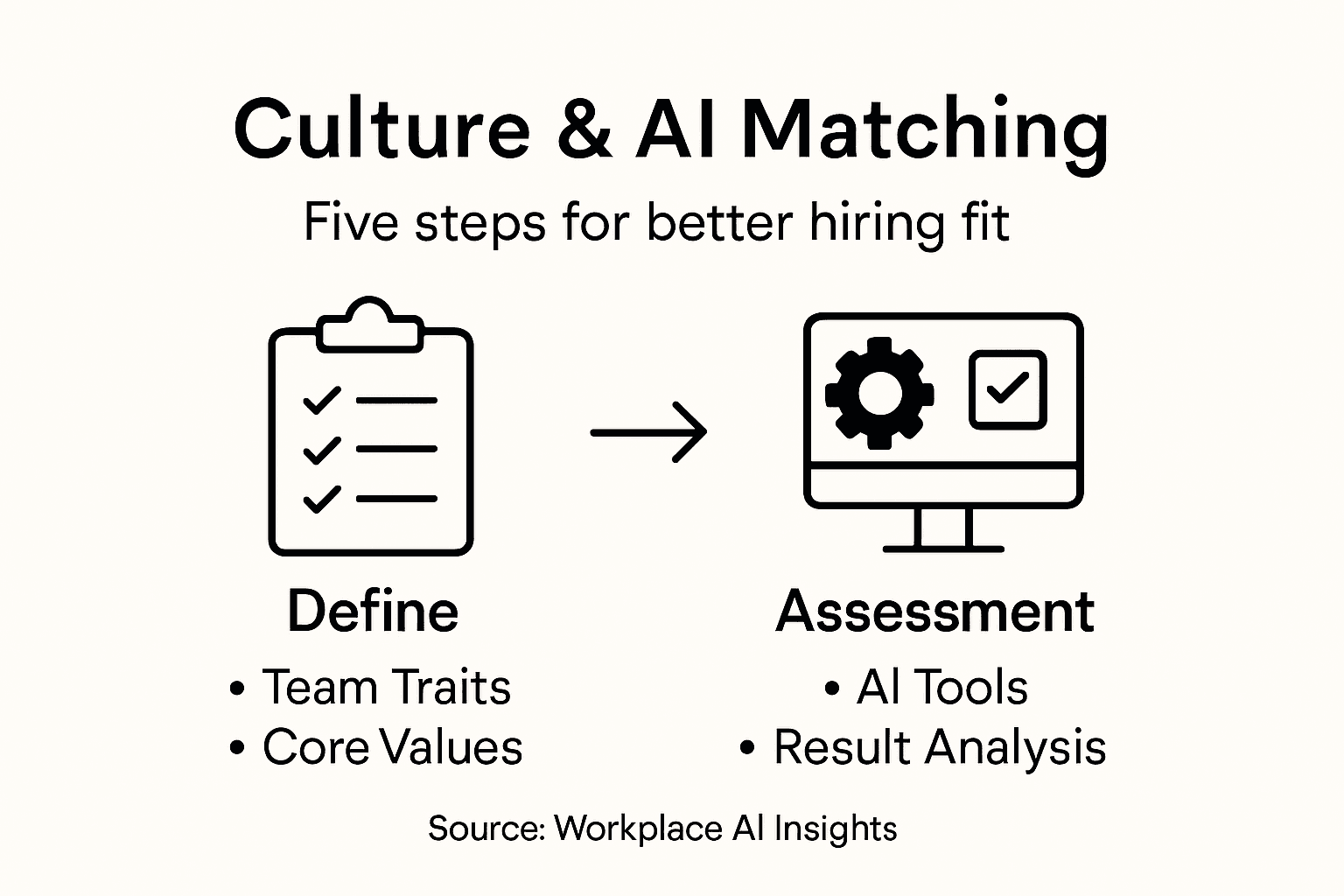
Defining your team’s core cultural attributes is like creating a unique organizational DNA that guides behavior, expectations, and interactions. This step helps you create a shared understanding of what makes your team special and how members should collaborate effectively.
To begin, leverage a structured approach like the Research Culture Framework that identifies key values and behaviors across multiple dimensions. Your goal is to develop a comprehensive picture of your team’s cultural landscape by examining several critical areas:
- Interpersonal dynamics: How team members communicate and support each other
- Management approach: Leadership styles and decision-making processes
- Shared goals: Collective objectives that unite team members
- Ethical commitments: Core principles guiding professional conduct
Start by gathering input from team members through structured conversations, surveys, and collaborative workshops. Academic institutions demonstrate that inclusive approaches help teams co-develop meaningful cultural definitions.
Consider documenting your findings in a clear, accessible format that outlines specific behavioral expectations, communication norms, and collaborative principles. This living document will serve as a reference point for current and future team members.
Successful culture definition isn’t about creating rigid rules, but establishing a flexible framework that supports growth and mutual understanding.
Pro tip: Schedule periodic reviews of your culture attributes to ensure they remain relevant and adaptable to your team’s evolving needs.
Step 2: Design AI-based cultural assessment tools
Designing AI-based cultural assessment tools empowers organizations to develop sophisticated, nuanced approaches to understanding team dynamics and potential candidate compatibility. This step transforms traditional evaluation methods by leveraging advanced technological capabilities to capture deeper insights into cultural alignment.
Begin by exploring AI-driven assessment environments that integrate cultural-historical theories into technological frameworks. Your design should focus on creating tools that can adapt and respond to diverse cultural contexts, emphasizing personalization and contextual understanding.
Key design considerations include:
- Natural language processing: Enable tools to understand subtle communication nuances
- Adaptive feedback mechanisms: Create systems that provide personalized insights
- Cultural context recognition: Develop algorithms sensitive to different cultural backgrounds
- Customization capabilities: Allow flexible assessment approaches for varied organizational needs
The most effective AI cultural assessment tools go beyond surface-level evaluations. Systematic reviews reveal that successful designs incorporate multiple assessment dimensions, including behavioral patterns, communication styles, and collaborative tendencies.
Effective AI cultural assessment tools are not about replacing human judgment, but enhancing our understanding of complex interpersonal dynamics.
Pro tip: Continuously test and refine your AI assessment tools by comparing machine-generated insights with human evaluations to improve accuracy and reliability.
Step 3: Integrate assessments into recruitment workflows
Integrating AI-powered cultural assessments into recruitment workflows transforms traditional hiring processes by creating more nuanced, data-driven candidate evaluation strategies. This step bridges technology and human decision-making to enhance the overall quality of talent acquisition.

Artificial intelligence in recruitment offers powerful tools for automating and improving candidate selection processes. Your integration strategy should focus on creating a seamless hybrid model that combines technological efficiency with human insights.
Here is a comparison of traditional vs. AI-powered cultural assessment methods in recruitment:
| Aspect | Traditional Approach | AI-Powered Assessment |
|---|---|---|
| Depth of Insight | Relies on interviews and intuition | Evaluates behavioral and language patterns |
| Speed | Manual, time-consuming | Automated, rapid evaluation |
| Bias Risk | Higher due to subjective judgment | Lower, but needs continuous monitoring |
| Adaptability | Static, slow to change | Dynamic, updates with new data |
Key workflow integration approaches include:
- Automated initial screening: Use AI to filter candidates based on predefined cultural and professional criteria
- Comprehensive candidate profiling: Develop multilayered assessment mechanisms
- Human oversight checkpoints: Ensure ethical evaluation and prevent algorithmic bias
- Continuous learning systems: Implement feedback loops that refine assessment accuracy
Research highlights the importance of maintaining transparency and consistency throughout the AI-enhanced recruitment process. This means creating clear documentation of assessment methodologies and establishing regular audit mechanisms to validate the fairness of your approach.
Effective AI integration is not about replacing human judgment, but augmenting our ability to make more informed, unbiased hiring decisions.
Pro tip: Establish a cross-functional team that includes HR professionals, technologists, and diversity experts to continuously review and optimize your AI assessment integration strategy.
Step 4: Analyze candidate responses for culture alignment
Analyzing candidate responses for cultural alignment transforms recruitment from a simple skill-matching exercise into a nuanced exploration of organizational compatibility. This critical step helps you understand how potential team members will integrate with your company’s unique cultural ecosystem.
Cultural bias in language models reveals the complexity of assessing candidate responses objectively. Your analysis should go beyond surface-level interpretations and dive deep into understanding the underlying cultural dynamics and communication patterns.
Key strategies for response analysis include:
- Contextual interpretation: Evaluate responses within broader cultural frameworks
- Linguistic pattern recognition: Identify communication styles and values
- Behavioral indicator mapping: Connect response nuances to potential workplace interactions
- Comparative cultural benchmarking: Compare candidate responses against established team norms
AI assessment tools demonstrate that candidate responses can be strategically crafted to meet perceived expectations. This means developing sophisticated analysis techniques that look beyond rehearsed answers to uncover authentic cultural alignment potential.
Effective cultural alignment analysis is an art of understanding not just what candidates say, but how and why they say it.
Pro tip: Develop a diverse panel of reviewers to cross-validate AI-generated cultural alignment assessments and mitigate potential algorithmic biases.
Step 5: Verify cultural fit with data-driven insights
Verifying cultural fit requires a sophisticated approach that goes beyond intuition and transforms subjective assessments into measurable, actionable insights. This step empowers organizations to make more informed hiring decisions by leveraging rigorous analytical techniques.
Integrating cultural context into research design provides a robust framework for understanding organizational compatibility. Your verification process should combine quantitative metrics with qualitative understanding to create a comprehensive cultural fit assessment.
Key data-driven verification strategies include:
- Value alignment mapping: Quantify candidate’s core values against organizational principles
- Performance predictive modeling: Correlate cultural attributes with potential job success
- Behavioral consistency analysis: Track response patterns across different assessment scenarios
- Comparative benchmarking: Evaluate candidates against high-performing team members
Bibliometric analysis demonstrates that systematic cultural fit assessment directly correlates with improved organizational outcomes like employee retention and performance.
Below is a summary of key strategies for verifying cultural fit using data-driven insights:
| Strategy | Purpose | Example Application |
|---|---|---|
| Value Alignment Mapping | Compare candidate values with team | Surveys and direct comparison |
| Predictive Modeling | Forecast job performance | Use hiring and performance analytics |
| Behavioral Consistency | Ensure stable responses | Check for contradictions in answers |
| Benchmarking | Compare to top performers | Analyze traits of high achievers |
Cultural fit verification is not about finding perfect matches, but understanding potential for meaningful collaboration and growth.
Pro tip: Develop a dynamic scoring system that weights cultural attributes differently based on specific team and role requirements, allowing for more nuanced and accurate assessments.
Match Your Company Culture with Precision Using AI Assessments
Struggling to verify cultural fit beyond intuition can lead to costly hiring mistakes and fragmented teams. This article reveals the power of AI-driven cultural assessments to transform recruitment by providing data-driven insights, adaptive feedback, and a comprehensive understanding of candidate alignment with your core values. Say goodbye to relying solely on CVs and intuition and embrace a smarter way to build resilient, high-performing teams.
Discover how our solutions at WAOTM replace CV screening with real-time AI interviews, company challenges, cultural matching, cognitive tests, and authentic video pitches. Our platform integrates seamlessly with your workflow to help you evaluate meaningful culture fit, reduce biases, and choose candidates who truly resonate with your organizational DNA.
Ready to elevate your recruitment process with AI-powered cultural matching Start by exploring the possibilities today at WAOTM and see how we make hiring more insightful and efficient. Don’t settle for guesswork when precision is one click away.
Frequently Asked Questions
How can I define key cultural attributes for my team?
To define key cultural attributes for your team, start by engaging team members in structured conversations and surveys. Document the findings in a clear format to create a shared understanding of behaviors, communication norms, and goals.
What are AI-based cultural assessment tools, and how do they work?
AI-based cultural assessment tools are technologies that use artificial intelligence to evaluate cultural fit between candidates and organizations. These tools analyze communication patterns and behavioral traits, providing insights that go beyond traditional hiring methods.
How can I integrate cultural assessments into my recruitment workflow?
To integrate cultural assessments into your recruitment workflow, automate the initial candidate screening based on predefined cultural criteria. This approach enhances your evaluation strategy while maintaining a balance with human oversight to ensure fairness.
What strategies should I use to analyze candidate responses for cultural alignment?
You should focus on contextual interpretation and linguistic pattern recognition when analyzing candidate responses. Look for behavioral indicators that reflect potential future interactions with your team to ensure a solid match.
How can I verify cultural fit with data-driven insights?
To verify cultural fit, employ value alignment mapping and behavioral consistency analysis. This can be done by comparing candidates’ core values against established team principles and using performance data to understand potential job success.
Why is it important to maintain a diverse review panel for cultural alignment assessments?
Maintaining a diverse review panel helps mitigate algorithmic biases in AI assessments. By cross-validating insights from different perspectives, you can enhance the accuracy and fairness of your cultural fit evaluations.