7 Essential Interview Question List Tips for HR Success

Interviewing candidates can feel overwhelming when you want to go beyond surface-level answers and select someone who truly matches your team’s needs. Generic questions rarely reveal a candidate’s actual skills, cultural compatibility, or problem-solving ability. The key is using clear, purposeful interview strategies that offer deeper, more accurate insights into each applicant.
This guide highlights practical and proven interview techniques trusted by hiring professionals in fields like academia and government. From scenario questions to assessing behavioral metrics, you’ll discover concrete steps for creating stronger, fairer interview processes. Get ready to unlock actionable tips that will help you find the right candidate—every time.
Table of Contents
- 1. Define Job-Specific Interview Questions Clearly
- 2. Use Behavioral Questions to Predict Performance
- 3. Incorporate Skills Assessments With Scenario Questions
- 4. Include Cultural Fit Questions for Team Dynamics
- 5. Ask Cognitive and Problem-Solving Questions
- 6. Leverage AI-Powered Questions for Unbiased Selection
- 7. Align Questions With Company Values and Mission
Quick Summary
| Takeaway | Explanation |
|---|---|
| 1. Define Job-Specific Questions | Craft precise questions to target essential skills relevant to the role, ensuring objective evaluation. |
| 2. Use Behavioral Questions | Inquire about past experiences to assess candidates’ real-world problem-solving and adaptability. |
| 3. Implement Scenario Assessments | Design workplace simulations to evaluate candidates’ critical thinking and decision-making abilities more effectively. |
| 4. Assess Cultural Fit | Ask questions that determine candidate compatibility with team dynamics and organizational values. |
| 5. Leverage AI for Unbiased Selection | Utilize AI-powered questioning to standardize assessments and reduce human bias during recruitment. |
1. Define Job-Specific Interview Questions Clearly
Crafting precise job-specific interview questions is the cornerstone of effective candidate assessment. When you understand exactly what skills and attributes you need for a role, you create a targeted evaluation strategy that cuts through generic screening.
In professional settings like academia and government, defining clear interview questions becomes critically important. Academic interview preparation requires understanding precise discipline-specific requirements. Similarly, government roles demand questions that reflect complex institutional needs.
Why Job-Specific Questions Matter:
- Reduce subjective hiring decisions
- Align candidate capabilities with role requirements
- Create consistent evaluation frameworks
- Minimize potential bias in candidate selection
To develop job-specific questions, start by breaking down the role into core competency areas:
- Technical skills specific to the position
- Institutional knowledge requirements
- Performance expectations
- Problem-solving capabilities
Effective interview questions transform candidate assessment from guesswork into a strategic, data-driven process.
Practical implementation involves collaborating with department heads and current role incumbents to understand nuanced job expectations. This collaborative approach ensures your questions capture the true essence of the role.
Pro tip: Create a scoring rubric alongside your job-specific questions to objectively evaluate candidate responses and maintain consistent assessment standards.
2. Use Behavioral Questions to Predict Performance
Behavioral questions are your secret weapon in uncovering a candidate’s true potential beyond their resume. By asking about past experiences and actions, you gain powerful insights into how an individual might perform in your specific work environment.
Behavioral metrics research demonstrates that past performance is an extraordinary predictor of future success. These questions transform interviews from theoretical discussions into evidence-based assessments.
Why Behavioral Questions Work:
- Reveal actual problem-solving approaches
- Demonstrate real-world skill application
- Highlight candidate adaptability
- Provide concrete performance indicators
Structuring Effective Behavioral Questions:
- Start with specific action prompts
- Request detailed past scenario explanations
- Focus on measurable outcomes
- Listen for complexity and nuance
Behavioral questions transform interviews from guesswork into strategic talent evaluation.
Key question frameworks include exploring scenarios about leadership challenges, conflict resolution, and innovative problem-solving. For instance asking “Tell me about a time you led a project that didn’t go as planned” reveals resilience and strategic thinking.
Effective behavioral interviewing requires active listening. Pay attention not just to what candidates say but how they communicate their experiences.
Pro tip: Create a standardized scoring rubric for behavioral responses to ensure consistent and objective candidate assessment across interviews.
3. Incorporate Skills Assessments With Scenario Questions
Scenario-based assessments transform traditional interviews from passive conversations into dynamic skill evaluations. By presenting candidates with realistic workplace challenges, you unlock deeper insights into their problem-solving capabilities.
Scenario-based assessment methods provide a powerful tool for understanding how candidates approach complex workplace situations. These assessments go far beyond standard interview questions by simulating real-world challenges.
Benefits of Scenario-Based Skills Assessments:
- Reveal authentic problem-solving strategies
- Measure critical thinking under pressure
- Evaluate communication and decision-making skills
- Provide context-rich performance indicators
Designing Effective Scenario Questions:
- Create scenarios matching actual workplace challenges
- Include multiple potential solution paths
- Allow candidates to explain their reasoning
- Observe both process and final recommendations
Scenario questions transform interviews from surface-level discussions into meaningful skill evaluations.
Successful scenario questions require carefully constructed workplace simulations. For instance challenging a marketing candidate to develop a campaign strategy for a product with limited budget reveals creativity and strategic thinking.
Interviewers should focus on observing candidate thought processes rather than just evaluating final answers. The journey matters as much as the destination.
Pro tip: Develop a standardized rubric with specific scoring criteria for scenario responses to ensure consistent and objective candidate assessment.
4. Include Cultural Fit Questions for Team Dynamics
Cultural fit is the secret sauce that transforms a group of individuals into a high-performing team. Understanding how a candidate will mesh with your existing team dynamic can make the difference between building an outstanding workforce or experiencing constant friction.
Cultural fit interview strategies reveal deeper insights into candidate compatibility beyond traditional skills assessment. Companies like Zappos have long understood that shared values drive exceptional team performance.
Why Cultural Fit Questions Matter:
- Reduce potential team conflicts
- Improve overall workplace collaboration
- Increase employee retention rates
- Foster a more cohesive work environment
Strategic Cultural Fit Assessment Approaches:
- Explore candidate’s collaborative experiences
- Understand their communication preferences
- Assess adaptability to team environments
- Evaluate alignment with company values
Cultural fit is about finding shared values that create meaningful workplace connections.
Effective cultural fit questions explore team interaction patterns and values. For instance asking “Tell me about a time you successfully collaborated with colleagues who had different working styles” provides rich insights into a candidate’s adaptability.
Interviewers should listen carefully not just to answers but to underlying communication patterns and attitudes. Nonverbal cues often reveal more than verbal responses.
Pro tip: Develop a consistent cultural assessment framework that allows objective evaluation while maintaining flexibility for individual team nuances.
5. Ask Cognitive and Problem-Solving Questions
Cognitive ability is the secret weapon that separates good employees from extraordinary performers. Crafting interview questions that reveal a candidate’s thinking prowess can unlock insights into their potential for innovation and adaptability.
Cognitive ability assessment techniques provide a scientific approach to understanding a candidate’s mental capabilities. These assessments go far beyond traditional skill evaluations.
Benefits of Cognitive Assessment Questions:
- Measure rapid learning potential
- Evaluate critical thinking skills
- Predict job performance accuracy
- Identify innovative problem solvers
Strategic Cognitive Question Approaches:
- Present complex hypothetical scenarios
- Request multistep problem solutions
- Explore reasoning behind answers
- Observe analytical thinking patterns
Cognitive questions transform interviews from simple conversations into strategic talent discovery.
Designing effective cognitive questions requires understanding mental processing and reasoning skills. For instance challenging a marketing candidate to develop a strategy with limited resources reveals their creative problem-solving abilities.
Interviewers should pay attention to how candidates approach challenges not just their final solutions. The thinking process matters as much as the outcome.
Pro tip: Create a structured scoring matrix that objectively evaluates cognitive responses across different candidate thinking styles and approaches.
6. Leverage AI-Powered Questions for Unbiased Selection
Artificial Intelligence represents a groundbreaking opportunity to transform recruitment by reducing human bias and enhancing candidate evaluation. AI-powered questioning techniques can revolutionize how organizations identify and select top talent.
AI-driven candidate selection techniques offer sophisticated tools to create more equitable and comprehensive interview experiences. These technologies go beyond traditional screening methods by providing objective insights.
Advantages of AI-Powered Interview Questions:
- Eliminate unconscious human biases
- Standardize candidate assessment
- Enhance diversity in candidate selection
- Improve overall recruitment efficiency
Strategic AI Question Implementation:
- Use natural language processing algorithms
- Create semantically neutral question templates
- Develop scoring mechanisms independent of demographic factors
- Continuously validate and update question sets
AI transforms recruitment from subjective guesswork into data-driven talent discovery.
Effective AI questioning requires understanding complex semantic analysis techniques. For instance using advanced NLP models can help decode candidate responses beyond surface-level answers.
Interviewers should view AI as a collaborative assessment tool that complements human judgment rather than replacing it entirely.
Pro tip: Regularly audit your AI interviewing algorithms to ensure they remain free from inherited biases and maintain robust, fair candidate evaluation standards.
7. Align Questions With Company Values and Mission
Your interview questions are more than just a screening tool. They are a strategic gateway to understanding how potential candidates will breathe life into your organization’s core principles and vision.
Company values interview techniques provide a powerful lens for evaluating candidate compatibility beyond traditional skill assessments. These targeted questions reveal deeper insights into a candidate’s potential cultural contribution.
Why Values-Aligned Questioning Matters:
- Ensures genuine organizational fit
- Predicts long-term employee engagement
- Reduces potential cultural friction
- Supports strategic organizational goals
Strategic Values Alignment Approaches:
- Develop questions reflecting specific company values
- Create scenarios testing value-driven decision making
- Listen for authentic value resonance
- Evaluate candidate’s potential cultural impact
Effective interview questions transform recruitment from transactional to transformational.
Crafting questions requires understanding deep organizational mission elements. For instance asking candidates how they would handle an ethical dilemma can reveal their alignment with company integrity standards.
Interviewers should focus on genuine value compatibility rather than scripted responses. Authentic alignment matters more than perfect answers.
Pro tip: Create a standardized values assessment rubric that objectively scores candidate responses against your organization’s specific cultural principles.
Below is a comprehensive table summarizing the strategies and recommendations discussed throughout the article about developing effective and insightful interview questions.
| Strategy | Implementation | Benefits |
|---|---|---|
| Define Job-Specific Questions | Base questions on role requirements and collaborate with team members for precision. | Reduces hiring biases and aligns candidates’ skills with the role. |
| Use Behavioral Questions | Structure inquiries around candidates’ past actions and results in specific scenarios. | Identifies problem-solving abilities and adaptability. |
| Incorporate Scenario-Based Assessments | Present realistic workplace challenges for candidates to address comprehensively. | Evaluates critical thinking and decision-making under pressure. |
| Assess Cultural Fit | Create questions that explore candidates’ interpersonal skills and alignment with company values. | Enhances team dynamics and reduces potential workplace conflicts. |
| Utilize Cognitive and Problem-Solving Queries | Challenge candidates with hypothetical scenarios requiring analytical and innovative thought. | Highlights their learning ability, reasoning, and innovative potential. |
| Leverage AI-Powered Interviewing Tools | Use artificial intelligence to create unbiased, standardized question datasets and evaluations. | Promotes equity and efficiency in the hiring process. |
| Align Questions With Company Values | Develop queries that test candidates’ compatibility with the organization’s mission through hypothetical ethical scenarios. | Ensures cultural alignment and fosters long-term engagement. |
Elevate Your Hiring Process With Targeted Assessments and AI
The article highlights critical challenges in crafting job-specific interview questions, behavioral prompts, and scenario-based assessments to reduce bias and predict candidate success. Many HR professionals struggle to implement consistent and objective evaluation methods that align with company values and measure cognitive abilities effectively. Replacing traditional CV screening with real assessments that include AI-powered interviews, cultural matching, and cognitive tests provides a powerful solution to these challenges.
Stop guessing and start knowing by integrating advanced tools designed for fair and accurate talent identification. Discover how your team can implement data-driven hiring strategies that capture true candidate potential and ensure cultural fit while reducing unconscious bias.
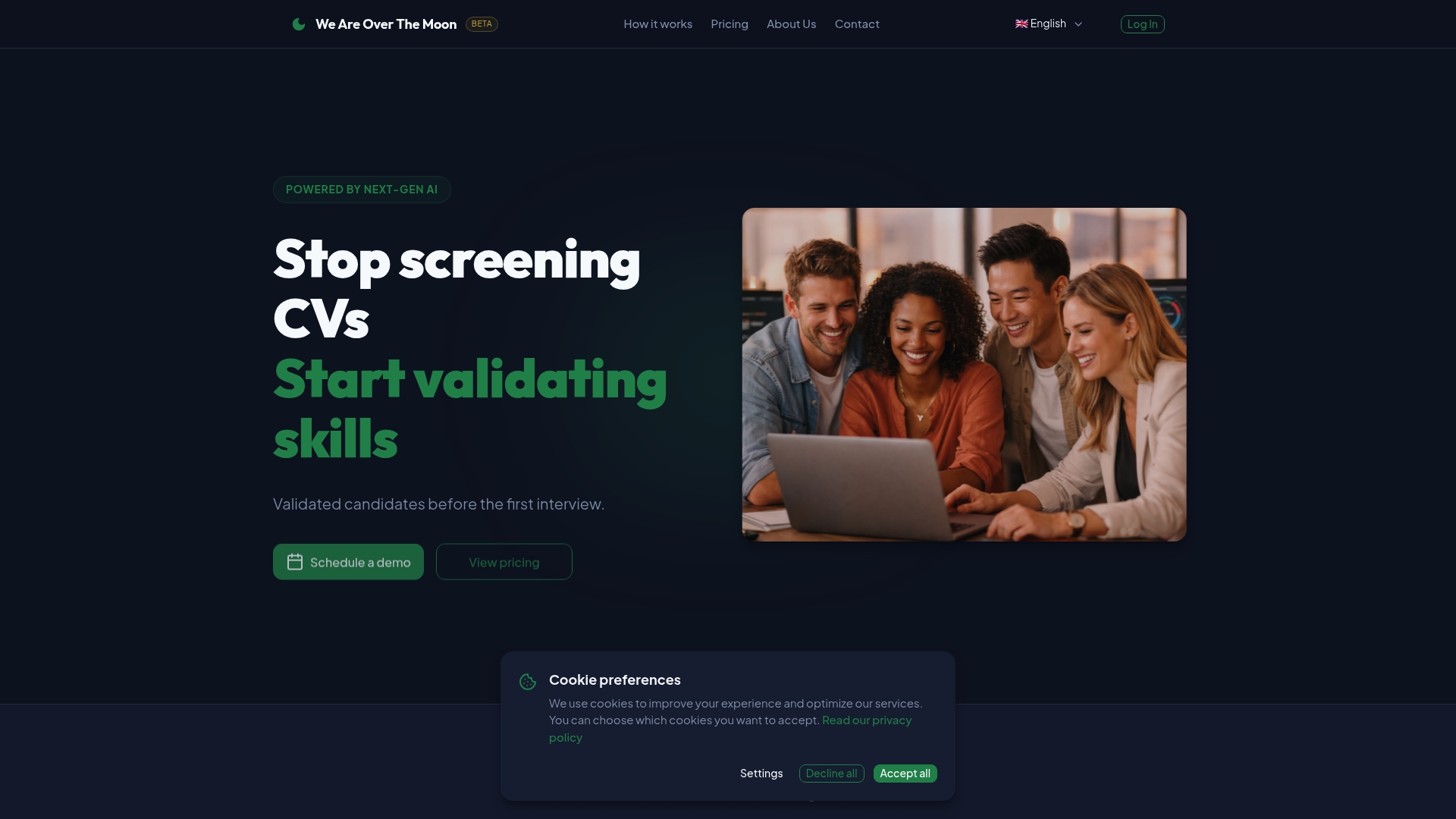
Take the next step toward smarter recruitment with WAOTM. Explore innovative solutions like AI interviews and company challenges today and transform your hiring process into a strategic advantage. Visit https://www.weareoverthemoon.nl to get started.
Frequently Asked Questions
How can I develop job-specific interview questions?
To develop job-specific interview questions, start by identifying the core competencies required for the position. Break down the role into technical skills, knowledge requirements, and problem-solving capabilities to create targeted questions that assess relevant attributes.
Why are behavioral questions important in interviews?
Behavioral questions are important because they reveal how a candidate has performed in past situations, which is a strong predictor of future performance. Focus on asking candidates to provide detailed examples that demonstrate their problem-solving and adaptability skills.
What are effective ways to incorporate scenario questions?
Incorporate scenario questions by creating realistic workplace challenges that candidates may face in the role. Allow candidates to explain their thought process and observe their problem-solving strategies, ensuring the scenarios match the actual challenges of the job.
How do I assess cultural fit during interviews?
To assess cultural fit, ask questions that explore candidates’ values and how they collaborate with others. Look for insights into their adaptability and communication styles, and ensure they align with your company’s values to promote a cohesive work environment.
What types of cognitive questions should I ask?
Ask cognitive questions that present complex hypothetical scenarios requiring multistep problem solutions. Encourage candidates to explain their reasoning and thought process, as this evaluates their critical thinking skills and potential for innovation.
How can AI-powered questions enhance the interview process?
AI-powered questions can enhance the interview process by standardizing candidate assessment and reducing human biases. Implement AI-driven techniques to create unbiased question sets, allowing for a more equitable evaluation and improved recruitment efficiency.