Role of Behavioural Interviews in Modern Hiring

Hiring the right talent can feel like navigating a maze of impressive CVs and rehearsed answers. For British and Spanish tech companies facing tough competition, finding out who candidates truly are demands more than traditional questioning. Behavioural interviews offer a powerful lens by focusing on real examples from past roles, providing insights that go beyond surface impressions. This article helps HR managers tap into structured techniques that deliver fairer, clearer, and more reliable candidate assessments.
Table of Contents
- Behavioural Interviews Defined and Debunked
- Common Techniques and Core Question Styles
- Assessing Cultural Fit and Soft Skills
- Comparing Behavioural and Traditional Interviews
- Pitfalls to Avoid in Behavioural Assessments
Key Takeaways
| Point | Details |
|---|---|
| Behavioural Interviews Predict Performance | By focusing on past behaviour, these interviews enhance prediction accuracy for future job performance. |
| Standardised Evaluation Reduces Bias | Structured questioning techniques provide a fairer and more objective assessment across candidates. |
| Cultural Fit and Soft Skills Matter | Evaluating cultural fit and soft skills is essential for team integration, beyond mere technical abilities. |
| Avoid Common Pitfalls | Be cautious of biases and over-standardisation; treat behavioural assessments as one aspect of a holistic evaluation strategy. |
Behavioural Interviews Defined and Debunked
Behavioural interviews represent a sophisticated approach to candidate assessment that moves beyond traditional resume screening. Structured interviews focus on revealing past performance patterns by examining concrete examples of how candidates have handled specific workplace scenarios.
At their core, behavioural interviews operate on a fundamental psychological principle: past behaviour predicts future performance. Unlike hypothetical questioning, these interviews require candidates to share detailed narratives about actual workplace experiences. Key characteristics include:
- Emphasis on specific, verifiable past actions
- Structured questioning techniques
- Focus on observable behavioural evidence
- Systematic evaluation of candidate responses
Behavioural interviews differ significantly from traditional interview approaches by demanding concrete examples rather than speculative answers. Academic research highlights the nuanced practitioner-academic gap in implementing these interview techniques, revealing that while behavioural interviews have gained widespread popularity, their scientific rigour varies.
However, practitioners must remain cautious. Not all behavioural interviews are created equal, and potential cognitive biases can compromise their effectiveness. Hiring managers should approach these interviews as one component of a comprehensive assessment strategy, recognising that no single interview technique provides a complete candidate evaluation.
To clarify the practical impact of behavioural interviews, here is a feature and impact summary:
| Feature | Purpose | Business Impact |
|---|---|---|
| Structured questioning | Standardises evaluation across candidates | Enhances fairness |
| Focus on past behaviour | Elicits real-world competencies | Improves prediction accuracy |
| Observable evidence | Gathers tangible examples from candidates | Informs better hiring choices |
| Systematic response review | Reduces subjective bias in assessment | Builds reliable talent pools |
Pro tip: Develop a standardised interview scorecard to objectively evaluate candidate responses and minimise subjective interpretation.
Common Techniques and Core Question Styles
Behavioural interview techniques represent a strategic approach to understanding candidate capabilities through carefully crafted questioning methods. These techniques go beyond traditional interview styles by demanding specific, evidence-based responses that reveal deeper insights into a candidate’s professional competencies.
The STAR technique emerges as a pivotal framework for structuring behavioural interview questions. This methodology breaks down candidate responses into four critical components:
- Situation: Context of the experience
- Task: Specific challenge or objective
- Action: Steps taken to address the challenge
- Result: Outcomes and learnings from the experience
Interviewers typically focus on several core competency areas when designing behavioural questions, including:
- Adaptability
- Problem-solving
- Teamwork
- Leadership
- Communication
- Conflict resolution
Core question styles often begin with specific prompts designed to elicit detailed responses. Phrases like “Tell me about a time when…” or “Describe a situation where…” encourage candidates to provide concrete examples that demonstrate their professional capabilities.
Successful behavioural interviewing requires more than just asking questions. Skilled interviewers use probing follow-up questions to uncover deeper insights, challenge inconsistencies, and validate the candidate’s narrative. This approach transforms the interview from a surface-level conversation into a nuanced exploration of professional potential.
Pro tip: Prepare a standardised question bank that covers multiple competencies, ensuring consistent and comprehensive candidate assessment across different interviews.
Assessing Cultural Fit and Soft Skills
Cultural fit and soft skills assessment represent critical dimensions of modern recruitment strategies that extend far beyond traditional technical competence evaluations. These nuanced aspects of candidate assessment help organisations determine whether an individual will seamlessly integrate into their existing team dynamics and organisational culture.
Soft skills encompass a broad range of interpersonal and emotional intelligence capabilities that are crucial for workplace success. Key soft skills include:
- Emotional intelligence
- Communication
- Adaptability
- Teamwork
- Problem-solving
- Interpersonal relationship management
- Resilience
- Active listening
Assessing these skills requires a multifaceted approach that goes beyond standard interview questions. Interviewers must create scenarios and ask probing questions that reveal a candidate’s underlying behavioural patterns and psychological attributes. Situational judgment tests can be particularly effective in uncovering how candidates might respond to complex workplace challenges.
Effective cultural fit assessment is less about finding carbon copies of existing employees and more about identifying individuals who can bring complementary perspectives while respecting core organisational values.
Successful organisations recognise that cultural alignment involves understanding both the candidate’s values and the company’s unique cultural ecosystem. This requires a holistic approach that considers not just professional capabilities, but also personal motivations, communication styles, and potential for long-term integration.

Pro tip: Develop a structured cultural assessment framework that includes multiple evaluation touchpoints, such as team interactions, values alignment interviews, and practical skills demonstrations.
Comparing Behavioural and Traditional Interviews
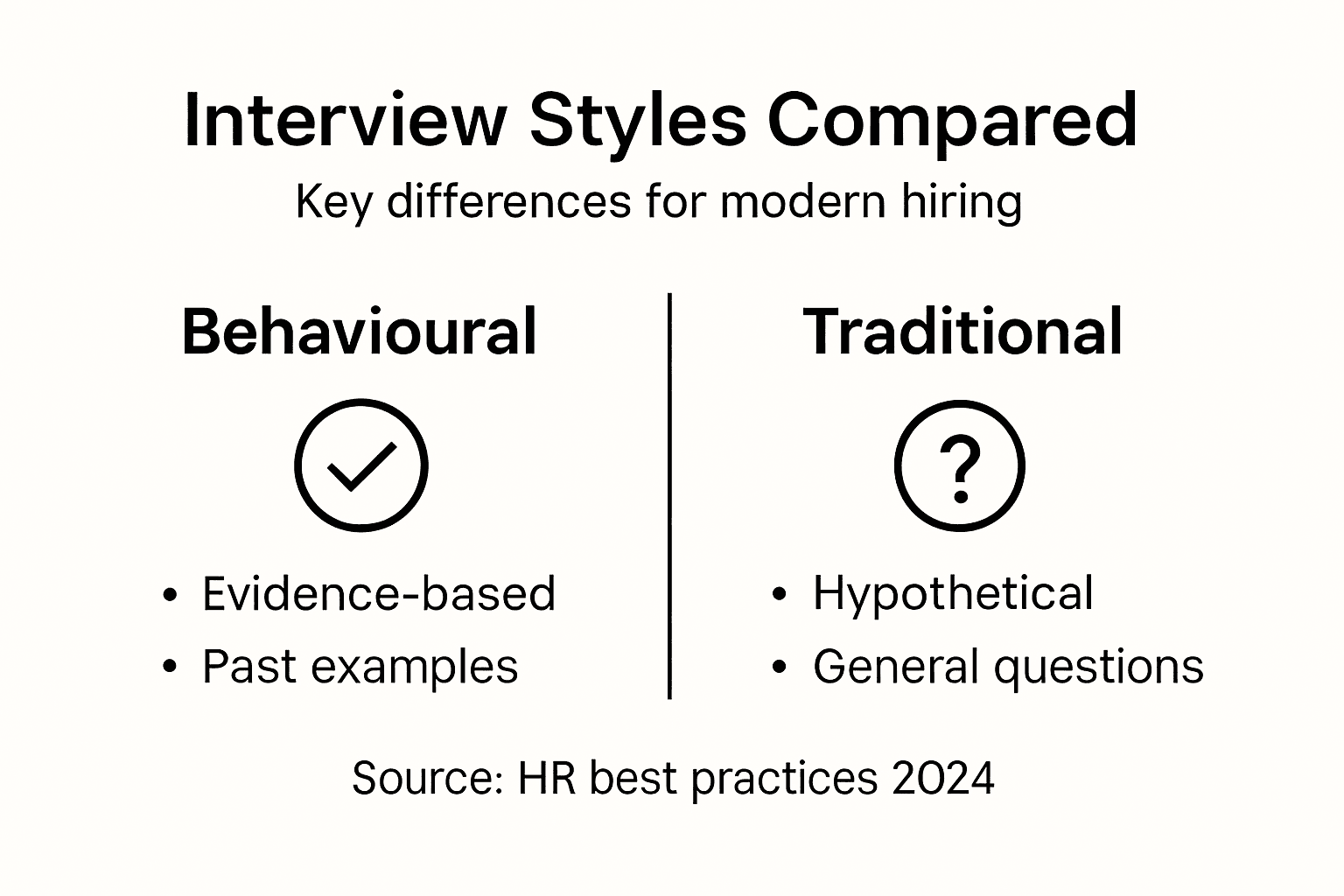
Comparative research between interview methodologies reveals significant differences in effectiveness between behavioural and traditional interviewing approaches. Traditional interviews often rely on subjective impressions and hypothetical scenarios, while behavioural interviews demand concrete evidence of past professional performance.
Key distinctions between these interview styles include:
-
Traditional Interviews:
- Rely on unstructured questioning
- Emphasise hypothetical scenarios
- More susceptible to interviewer bias
- Depend heavily on resume interpretation
-
Behavioural Interviews:
- Focus on specific past experiences
- Require evidence-based responses
- Standardised evaluation criteria
- Less vulnerable to impression management
Structured interview approaches demonstrate significantly improved candidate assessment reliability. Traditional interviews allow candidates more opportunities to manipulate perceptions, whereas behavioural interviews demand verifiable accounts of professional conduct.
Behavioural interviews transform recruitment from a speculative guessing game into a strategic, evidence-driven selection process.
The scientific evidence strongly suggests that behavioural interviews provide a more robust mechanism for predicting candidate performance. By requiring specific examples and detailed narratives, these interviews create a more transparent and objective evaluation framework that goes beyond surface-level impressions.
The table below highlights key differences in candidate evaluation reliability between interview methods:
| Aspect | Traditional Interviews | Behavioural Interviews |
|---|---|---|
| Evaluation consistency | Highly variable across panels | Largely uniform by design |
| Bias susceptibility | Prone to interviewer bias | Reduced via scoring rubrics |
| Evidence requirement | Often accepts hypothetical input | Requires verifiable examples |
| Predictive validity | Generally weak | Strong for job performance |
Pro tip: Develop a standardised scoring rubric that objectively evaluates candidate responses across multiple competency dimensions, reducing subjective interpretation.
Pitfalls to Avoid in Behavioural Assessments
Behavioural assessment methodologies reveal complex challenges that demand careful navigation during recruitment processes. Despite their potential for deep candidate insights, these assessments can introduce significant risks if not implemented with precision and scientific rigour.
Common pitfalls in behavioural assessments include:
- Confirmation bias: Seeking information that confirms preexisting assumptions
- Narrow interpretation: Oversimplifying complex behavioural patterns
- Limited context understanding: Failing to consider broader environmental factors
- Over-standardisation: Creating rigid assessment frameworks
- Insufficient cross-validation: Relying on single assessment methods
Behavioral science challenges underscore the importance of robust research design. Many assessments suffer from limited generalisability, particularly when sampling predominantly from WEIRD populations (Western, Educated, Industrialised, Rich, Democratic).
Effective behavioural assessments require nuanced understanding, recognising that human behaviour is complex, contextual, and rarely reducible to simple categorical measurements.
The most critical error is treating behavioural assessments as definitive rather than indicative. Successful practitioners understand these tools as sophisticated guidance mechanisms, not infallible predictive systems. They complement, rather than replace, holistic human judgment in candidate evaluation.
Pro tip: Implement multi-method assessment strategies that include behavioural interviews, situational judgment tests, and practical skill demonstrations to create a more comprehensive candidate profile.
Transform Your Hiring with Evidence-Driven Behavioural Assessments
Traditional CV screening often falls short of revealing a candidate’s true potential. This article highlights how behavioural interviews offer a more reliable way to predict future performance through specific past experiences and structured evaluation. Yet, many hiring teams struggle with confirmation bias and inconsistent scoring methods that leave the selection process incomplete.
At Over The Moon, we empower you to move beyond guesswork by combining AI interviews, cultural matching, and realistic company challenges within one seamless platform. This holistic approach captures not only behavioural insights but also cognitive abilities and soft skills, creating a rich candidate profile that aligns with your organisation’s unique values.
Ready to replace CV screening with truly comprehensive assessments that reduce bias and predict success with confidence? Visit Over The Moon now to explore how AI-driven behavioural interviews and tailored evaluation frameworks help you build reliable talent pools. Discover all our innovative hiring solutions at Over The Moon Solutions and start making smarter hiring decisions today.
Frequently Asked Questions
What are behavioural interviews?
Behavioural interviews are a candidate assessment approach that focuses on revealing past performance patterns through structured questioning about actual workplace experiences, as opposed to hypothetical scenarios.
How do behavioural interviews differ from traditional interviews?
Behavioural interviews require specific, evidence-based responses about candidates’ past professional experiences, while traditional interviews often rely on unstructured questioning and hypothetical scenarios.
What is the STAR technique in behavioural interviews?
The STAR technique is a framework used to structure behavioural interview questions, consisting of four components: Situation, Task, Action, and Result, which help candidates articulate their experiences effectively.
Why are soft skills important in behavioural interviews?
Soft skills such as communication, teamwork, and adaptability are crucial for workplace success, and behavioural interviews assess these skills to determine how well a candidate may fit within a company’s culture and team dynamics.