Cultural Matching Cuts Tech Turnover by 30%

Hiring for cultural fit can reduce employee turnover by up to 30% in tech companies, yet many HR teams still rely on CV screening alone. For tech firms across the Netherlands, UK, and Spain, cultural matching offers a powerful strategic advantage to retain talent and build cohesive teams. This guide covers assessment methods, frameworks, and practical steps to implement cultural matching in your recruitment process.
Table of Contents
- Understanding Cultural Matching in Recruitment
- How Cultural Matching Impacts Retention, Engagement, and Performance
- Assessment Methods and Tools for Effective Cultural Matching
- Common Misconceptions About Cultural Matching and Their Corrections
- Frameworks and Models to Structure Cultural Matching
- Real-World Examples and Case Studies from European Tech Companies
- Implementing Cultural Matching Practices in Your Recruitment Process
- Enhance Your Recruitment with AI-Driven Cultural Matching Tools
- Frequently Asked Questions
Key Takeaways
| Point | Details |
|---|---|
| Cultural matching improves retention | Strong cultural alignment reduces turnover by 30% and boosts engagement scores by 15%. |
| AI tools enhance assessment accuracy | Structured AI assessments evaluate values and behaviors consistently, reducing unconscious bias. |
| Value-based frameworks drive fairness | Focusing on shared values rather than personality traits promotes diversity and innovation. |
| Practical implementation requires training | Recruiters need education on bias mitigation and structured evaluation methods. |
| Metrics validate cultural matching impact | Track attrition rates, onboarding speed, and engagement to measure success. |
Understanding Cultural Matching in Recruitment
Cultural matching evaluates how well a candidate’s values, behaviors, and working style align with your company’s environment. Unlike skill fit, which assesses technical abilities, defining cultural matching focuses on whether someone will thrive in your specific organizational context. For multicultural tech companies operating across Europe, this distinction matters enormously.
Many recruitment teams confuse cultural fit with finding people who think alike. Instead, effective cultural matching identifies candidates who share core values while bringing diverse perspectives and problem-solving approaches. This nuance transforms recruitment from a personality contest into a strategic alignment process.
Moving beyond CV screening allows you to assess the behavioral and motivational factors that predict long-term success. Technical skills can be taught, but fundamental values and work style preferences remain relatively stable. Understanding this difference helps you build resilient, innovative teams rather than collections of identical thinkers.
Key aspects of cultural matching include:
- Alignment of core values like transparency, innovation, or customer focus
- Compatibility of communication styles and collaboration preferences
- Shared attitudes toward risk, feedback, and continuous learning
- Motivation factors that drive engagement and performance
How Cultural Matching Impacts Retention, Engagement, and Performance
The business case for cultural matching rests on measurable outcomes. Research shows that employees with strong cultural alignment stay 30% longer than mismatched hires. Engagement scores rise by approximately 15% when people feel their values match their workplace. These aren’t marginal improvements; they represent significant cost savings and productivity gains.
Impact of organisational culture fit extends beyond retention to daily work quality. Teams with high cultural alignment experience fewer conflicts and resolve disagreements more constructively. When everyone understands and embraces shared values, collaboration becomes smoother and decision making accelerates.
New hires who fit culturally onboard faster because they intuitively grasp how things work. They require less hand-holding and adapt more quickly to team dynamics. This shortened ramp-up time delivers immediate ROI on recruitment investments.
Cultural alignment transforms good technical talent into exceptional team contributors who drive innovation and maintain momentum through challenges.
Innovation metrics also improve with strong cultural matching. Diverse teams united by shared values generate more creative solutions than either homogeneous groups or disconnected individuals. The psychological safety that comes from values alignment encourages risk-taking and experimentation.
For tech companies competing for talent across European markets, these advantages compound over time. Lower turnover means preserved institutional knowledge. Higher engagement translates to better product quality. Faster onboarding reduces time to productivity. Each benefit reinforces the others, creating a virtuous cycle of organizational health.
Assessment Methods and Tools for Effective Cultural Matching
Traditional interviews often fail to reveal cultural fit because candidates perform rather than authentically engage. Modern assessment methods address this limitation through structured, multi-dimensional evaluation. AI-driven behavioural assessments analyze how candidates respond to realistic scenarios, revealing their actual values and decision-making patterns.
Company-specific challenges simulate your real work environment. Rather than abstract questions, these assessments present situations candidates will actually face. How do they prioritize competing demands? How do they communicate under pressure? Their responses illuminate cultural compatibility far better than rehearsed interview answers.
Video pitches add another dimension by capturing communication style, energy, and authenticity. You observe not just what candidates say but how they present themselves. This richer data set helps predict cultural fit more accurately than text-based applications alone.
Effective assessment combines multiple methods:
- Behavioral simulations testing values alignment in realistic scenarios
- Structured interviews with standardized questions and scoring rubrics
- Work sample tests revealing collaboration style and problem-solving approach
- Reference checks specifically probing cultural fit in previous roles
Pro tip: Always use at least three different assessment methods to evaluate cultural fit. Single-source evaluations miss important nuances and increase the risk of bias influencing decisions.
The key advantage of structured frameworks is bias reduction. When everyone evaluates candidates against the same criteria using consistent methods, subjective preferences matter less. Screening without CVs and relying instead on demonstrated behaviors levels the playing field. Following a cultural fit checklist ensures nothing important gets overlooked in the evaluation process.
Common Misconceptions About Cultural Matching and Their Corrections
Many critics argue that cultural matching reduces diversity by favoring similar personalities. This misconception conflates values with demographics or personality types. Inclusive cultural matching focuses on shared principles like transparency or continuous improvement, which people from any background can embrace. Values alignment actually enables greater cognitive diversity because team members trust each other enough to voice different perspectives.
Another myth suggests cultural fit means hiring clones who think identically. In reality, effective cultural matching seeks complementary traits within a framework of shared values. You want people who approach problems differently but agree on what matters. A team of identical thinkers innovates poorly, but a team with aligned values and diverse approaches excels.
Some recruitment professionals worry that cultural matching increases bias by giving subjective feelings too much weight. Properly implemented, the opposite occurs. Structured frameworks with clear criteria reduce reliance on gut instinct. When you evaluate candidates against defined dimensions rather than vague impressions, bias has less room to operate.
Consider these corrected perspectives:
- Cultural fit seeks value alignment, not demographic or personality uniformity
- Strong teams combine shared principles with diverse skills and thinking styles
- Structured assessment frameworks reduce rather than increase bias
- Inclusive cultural matching welcomes candidates from all backgrounds who embrace core values
Pro tip: Train your recruiters to distinguish between values and personality traits. Someone can be introverted or extroverted and still embody your company’s values. Focus assessment on principles and behaviors, not social style.
Frameworks and Models to Structure Cultural Matching
Structured frameworks transform cultural matching from art into science. The four core dimensions model evaluates candidates across values, work style, communication preferences, and motivation factors. Each dimension uses specific criteria and evidence-based assessment methods. This standardization ensures consistency across interviewers and reduces subjective judgment.
Value congruence matters most in predicting long-term fit. Does the candidate prioritize the same principles your organization holds dear? Work style compatibility comes next. Someone who thrives on autonomy will struggle in a highly structured environment, regardless of shared values.
Communication preferences influence daily collaboration quality. Mismatches here create friction even when values align. Finally, motivation factors determine engagement. Understanding what drives someone helps you provide the right environment for them to excel.
Compare common evaluation frameworks:
| Framework | Focus Area | Best For | Limitation |
|---|---|---|---|
| Four Dimensions Model | Values, work style, communication, motivation | Comprehensive cultural assessment | Requires significant time investment |
| Value Congruence Framework | Core organizational values alignment | Quick screening for fundamental fit | May miss work style incompatibilities |
| Behavioral Assessment | Past behavior patterns and decision-making | Predicting future performance | Less effective for career changers |
| Situational Judgment | Responses to realistic scenarios | Evaluating culture fit in context | Candidates can game responses if obvious |
The most effective approach combines elements from multiple frameworks. Start with value congruence to ensure fundamental alignment. Add behavioral assessment to understand how candidates actually work. Include situational judgment to test application of values in realistic contexts.
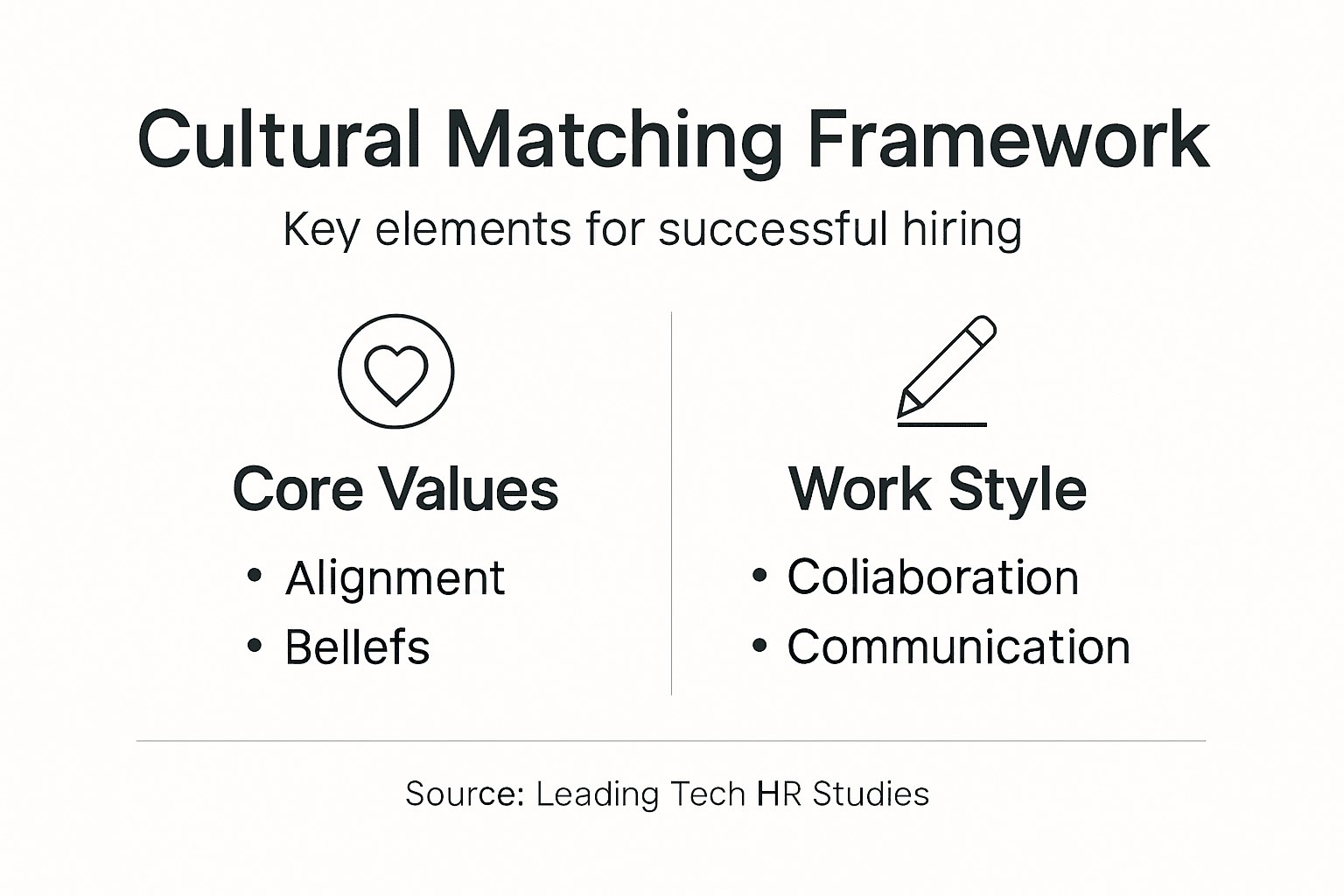
Cultural fit frameworks provide templates you can adapt to your specific company culture. The key is documenting clear criteria for each dimension you evaluate. Vague standards invite bias and inconsistency.
Real-World Examples and Case Studies from European Tech Companies
A UK fintech company struggled with 40% annual attrition among software engineers. After implementing AI-driven cultural assessments alongside technical evaluations, turnover dropped to 15% within 18 months. The key was identifying candidates whose values aligned with the company’s emphasis on rapid experimentation and customer obsession, not just technical prowess.

A Dutch scale-up reduced onboarding time by 20% using company-specific challenges during recruitment. Candidates who successfully navigated realistic scenarios arrived already understanding team dynamics and decision-making processes. They required less guidance and contributed meaningfully within weeks rather than months.
A Spanish enterprise software firm boosted innovation metrics by 15% after restructuring recruitment around cultural fit frameworks. By prioritizing value alignment over prestigious credentials, they built teams with diverse backgrounds but shared commitment to user-centric design. These teams generated more patents and shipped higher-quality features.
Common patterns across successful implementations:
- Leadership commitment to cultural matching as strategic priority
- Investment in assessment tools and recruiter training
- Clear documentation of cultural dimensions and evaluation criteria
- Regular measurement of impact through retention and engagement metrics
These examples demonstrate that cultural matching delivers results across different company sizes and tech sectors. The investment in proper assessment methods pays dividends through reduced turnover costs and improved team performance.
Implementing Cultural Matching Practices in Your Recruitment Process
Successful implementation starts with defining what matters culturally at your organization. Gather input from high performers and leadership to identify the values and behaviors that drive success. Document three to five core dimensions you’ll evaluate. Being specific here prevents cultural matching from becoming a subjective popularity contest.
Next, integrate appropriate assessment methods into your process. Choose tools that evaluate the dimensions you’ve defined. AI assessments for culture matching provide scalable, consistent evaluation. Company challenges reveal how candidates actually work, not just how they interview.
Follow these implementation steps:
- Define your core cultural dimensions with specific behavioral indicators
- Select assessment methods that evaluate each dimension objectively
- Train all interviewers on structured evaluation techniques and bias awareness
- Create scoring rubrics that standardize how you evaluate responses
- Track metrics including attrition rates, time to productivity, and engagement scores
- Gather feedback from new hires about cultural fit accuracy after six months
- Refine your approach based on data rather than assumptions
Pro tip: Start with one role or team as a pilot program. Measure results carefully before scaling across your entire organization. This approach builds internal credibility and allows you to refine methods based on real outcomes.
Recruiter training makes the difference between success and failure. Even perfect frameworks fail if interviewers apply them inconsistently. Invest in helping your team understand the difference between culture fit and personal preference. Role-playing exercises and calibration sessions improve assessment quality.
Measurement validates your approach. Track how long culturally matched hires stay compared to previous cohorts. Monitor engagement scores and manager satisfaction. Use this data to justify continued investment and identify areas for improvement. Implement cultural matching steps systematically rather than all at once.
Enhance Your Recruitment with AI-Driven Cultural Matching Tools
The methods outlined in this guide become even more powerful with purpose-built technology. AI assessments for cultural matching evaluate candidates consistently at scale, eliminating the bottleneck of manual screening. Rather than relying on CV keywords, you assess actual alignment through behavioral simulations and values-based scenarios.
Company challenges for recruitment let candidates demonstrate fit in realistic contexts. These assessments reveal how people actually work, not how they describe their work in interviews. Combined with cognitive tests and video pitches, you build a complete picture of each candidate’s potential contribution.
Following the cultural fit checklist steps ensures nothing important gets overlooked. Structured evaluation reduces bias while improving prediction accuracy. Your recruitment becomes both fairer and more effective, delivering better outcomes for candidates and your organization.
Frequently Asked Questions
What is cultural matching in recruitment?
Cultural matching evaluates alignment between candidate values, behaviors, and work preferences with your company culture. It goes beyond skills and experience to predict engagement and long-term retention. This approach helps identify people who will thrive in your specific environment.
How do AI assessments improve cultural matching?
AI analyzes behavior and values consistently across all candidates using standardized scenarios. AI assessments reduce unconscious bias by evaluating responses against defined criteria rather than subjective impressions. This structured approach delivers more reliable predictions of cultural fit.
Does cultural matching limit workforce diversity?
Inclusive cultural matching targets core values rather than personality types or demographics. This approach enables cognitive and skill diversity while ensuring team cohesion around shared principles. Strong cultural alignment actually enhances innovation by creating psychological safety for diverse perspectives.
What challenges exist in implementing cultural matching?
Common obstacles include relying on gut feelings, unconscious bias, and confusing culture with personality similarity. Solutions involve structured frameworks with clear criteria, comprehensive recruiter training, and data-driven assessment tools. Challenges and solutions require systematic approaches rather than ad hoc methods.
Recommended
- Organisational Culture Fit: Shaping Effective Hiring | We Are Over The Moon
- How to Match Company Culture with AI Assessments | We Are Over The Moon
- 7 Essential Steps for a Cultural Fit Checklist in Hiring | We Are Over The Moon
- How to Screen Without CVs for Better Hiring Results | We Are Over The Moon