Candidate assessment best practices for smarter hiring

TL;DR:
- Structured interviews and skills assessments improve prediction accuracy and reduce bias in hiring.
- Moving from culture fit to culture add promotes diversity and innovation within teams.
- Continual outcome measurement and iterative improvements ensure effective and fair recruitment processes.
Roughly 80% of employee turnover stems from poor hiring decisions, and the financial and cultural cost of getting it wrong is enormous. Yet many organisations across Europe still rely on CVs and gut-feel interviews to make some of their most consequential decisions. That is a problem we can fix together. This guide walks you through the evidence-backed candidate assessment best practices that HR leaders and talent acquisition professionals are using right now to reduce bias, improve predictive accuracy, and ultimately build stronger, more engaged teams. Expect practical frameworks, honest insights, and a few ideas that might genuinely surprise you.
Table of Contents
- Lay the groundwork: why best practices matter
- Core components of a fair and effective candidate assessment process
- Innovative techniques for skills-first and culture-add assessment
- Validating your process: measuring outcomes and avoiding common pitfalls
- Why embracing imperfection in assessment leads to lasting improvement
- Next steps: put best practices into action with We Are Over The Moon
- Frequently asked questions
Key Takeaways
| Point | Details |
|---|---|
| Structured interviews reduce bias | Clear, consistent questions improve fairness and make hiring more predictive. |
| Skills-first outperforms CVs | Assessing abilities rather than backgrounds expands your talent pool and prevents costly mistakes. |
| Culture-add drives innovation | Hiring for culture add instead of fit grows diversity and strengthens teams. |
| Continuous improvement is essential | Regularly review your process and outcomes to ensure you are hiring the best. |
Lay the groundwork: why best practices matter
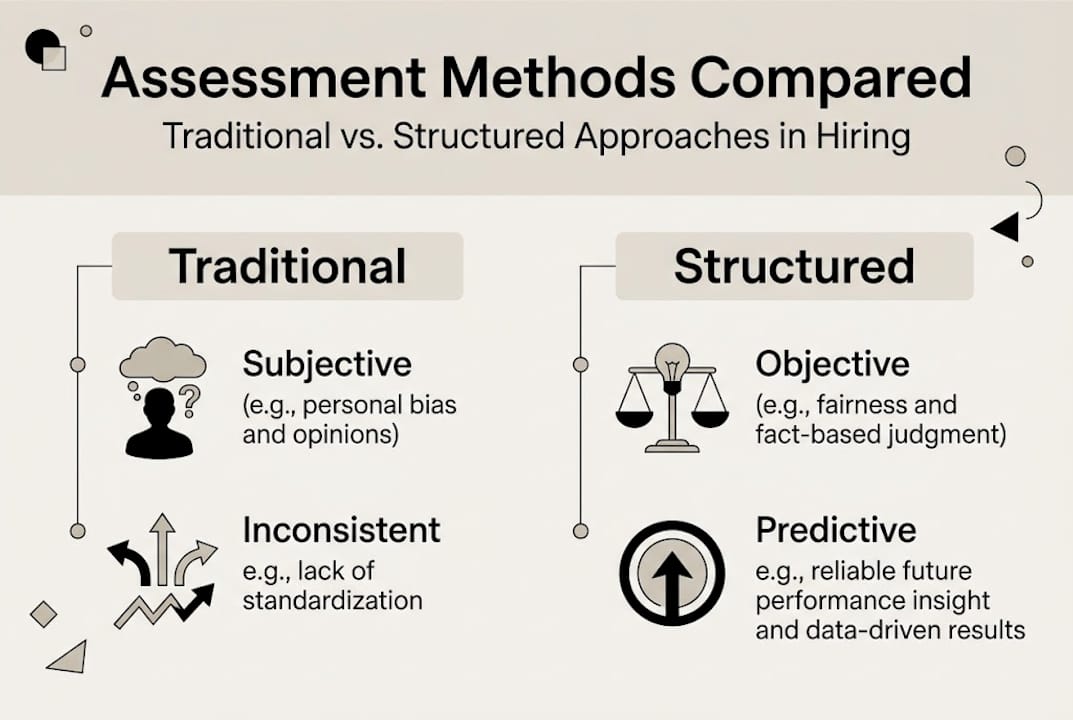
Having introduced what’s at stake, let’s look at why modern, structured assessment matters. Traditional CV screening and unstructured interviews feel familiar, but familiarity is not the same as effectiveness. CVs reward polish over performance. Unstructured interviews reward confidence over competence. Both create fertile ground for unconscious bias to thrive, often without anyone in the room realising it.
The good news is that the evidence points clearly in one direction. Structured interviews and skills assessments increase predictive validity and reduce bias, making them core best practices for candidate evaluation. When you ask every candidate the same questions, score responses against a defined rubric, and combine that with a relevant skills test, you dramatically improve your ability to predict on-the-job performance.
Understanding the risks of not modernising your approach is equally important. Here are the key dangers:
- Unconscious bias shapes decisions before a candidate says a word
- Low predictive validity means you are essentially guessing who will succeed
- Legal exposure increases when assessment processes lack documented fairness
- Candidate experience suffers, damaging your employer brand in competitive markets
- Team homogeneity grows, limiting innovation and diverse thinking
Let’s look at how traditional and structured methods compare in practice:
| Factor | Traditional approach | Structured approach |
|---|---|---|
| Consistency | Low, varies by interviewer | High, standardised questions |
| Bias risk | High | Significantly reduced |
| Predictive accuracy | Low to moderate | High |
| Legal defensibility | Weak | Strong |
| Candidate fairness | Variable | Consistent |
The contrast is striking. And the shift does not have to be painful. Exploring how AI and cultural fit assessment can support this transition shows just how accessible modern tools have become, and the assessment tool advantages for hiring efficiency are well documented.
Pro Tip: Before designing any assessment, define the three to five business-critical competencies for the role. Everything else should flow from that foundation.
Core components of a fair and effective candidate assessment process
With the importance established, here’s how to operationalise best practices through each vital assessment component. A robust process is not a single tool or a single conversation. It is a sequence of deliberate steps, each building on the last.
- Define role requirements clearly. Go beyond job titles. Identify the specific skills, behaviours, and values the role demands. Involve the hiring manager and current high performers in this step.
- Select the right assessment tools. Match tools to the competencies you have defined. Cognitive tests, work samples, and video pitches each serve different purposes.
- Run structured interviews. Use the same questions for every candidate, score responses immediately, and avoid post-interview group discussions that allow one voice to dominate.
- Conduct skills assessments. Practical tests outperform theoretical questions. Give candidates a real challenge that mirrors actual work.
- Combine evidence for decision-making. Aggregate scores across all methods before making a final call. No single data point should carry all the weight.
Here is how structured and traditional interviews compare directly:
| Element | Traditional interview | Structured interview |
|---|---|---|
| Question format | Conversational, varies | Standardised, consistent |
| Scoring | Subjective, post-hoc | Rubric-based, real-time |
| Interviewer training | Rarely required | Essential |
| Outcome reliability | Low | High |
72% of employers now prefer skills assessments over CVs because they are simply more predictive of actual job performance. That is not a trend. That is a signal worth acting on.
The most common pitfalls at each stage include skipping the competency definition step, using off-the-shelf tests without validating their relevance, and allowing interviewers to compare notes before scoring independently. Reviewing structured interview steps in detail and working through a thorough assessment checklist will help you avoid these traps and build a process that holds up under scrutiny.
Innovative techniques for skills-first and culture-add assessment
Now that the classic essentials are clear, it’s time to leverage the most innovative tools for fairness and predictive success. Skills-first hiring is not just a buzzword. It is a genuine shift in how organisations think about talent, and the results speak for themselves.

Nearly half of HR professionals now use skills-first approaches, and they report these methods to be just as effective as traditional credentialling, while opening the talent pool considerably wider. That means more diverse candidates, fewer missed opportunities, and a stronger overall pipeline.
Equally important is the shift from assessing “culture fit” to assessing “culture add.” Culture fit assessment risks reinforcing homogeneity by favouring candidates who already look and think like your existing team. Culture add, by contrast, asks what fresh perspectives and complementary strengths a candidate brings. The difference sounds subtle but the impact on team diversity and innovation is significant.
Here are the most effective innovative techniques to implement right now:
- Blind scoring: Remove names, universities, and demographic details before assessors review responses
- Standardised rubrics: Define what a strong, adequate, and weak answer looks like before the assessment begins
- Practical work tests: Assign a realistic task that mirrors actual job responsibilities
- Video pitches: Ask candidates to record a short response to a scenario, giving you consistent, reviewable data
- Asynchronous AI interviews: Allow candidates to complete interviews on their own schedule, reducing scheduling bias and improving access
Thinking about screening without CVs is a great starting point if you are new to skills-first approaches. You can also explore what top candidate qualities look like through an innovative assessment lens.
Pro Tip: Use at least two independent raters for each assessment stage, then aggregate their scores before discussion. This single change can meaningfully reduce individual bias in your process.
Validating your process: measuring outcomes and avoiding common pitfalls
The right process is only as good as the results it delivers. Here’s how to continually refine your approach. Many HR teams invest in better assessment tools and then forget to close the loop. That is a missed opportunity, because your outcome data is the most valuable feedback you have.
The three metrics that matter most are quality of hire, first-year turnover, and new hire performance ratings at the three and twelve month marks. Together, they tell you whether your assessment process is actually predicting success. Structured processes mitigate turnover from poor hires, but only when you evaluate them honestly and adjust accordingly.
Here is a simple post-hire evaluation loop to run every six months:
- Collect performance data from line managers at three and twelve months post-hire
- Compare assessment scores to actual performance ratings across your cohort
- Identify patterns where your process over or under-predicted success
- Adjust your rubrics and tools based on what the data reveals
- Repeat the cycle to build a continuously improving system
The most frequent mistakes that undermine even well-designed processes include:
- Confirmation bias: Interviewers unconsciously seeking evidence that confirms their first impression
- Over-reliance on one method: Using only interviews or only tests, rather than combining evidence
- Neglecting onboarding: Treating the hire as the finish line rather than the starting line
- Ignoring candidate feedback: Candidates who felt the process was unfair will tell others
Exploring how assessments transform hiring and learning practical strategies for improving candidate matching will give you a clearer picture of what a fully validated process looks like in action.
Pro Tip: Recalibrate your assessment rubrics at least once a year using outcome data from the previous hiring cohort. Rubrics that were accurate twelve months ago may not reflect what success looks like today.
Why embracing imperfection in assessment leads to lasting improvement
Beyond techniques and metrics, here’s a perspective that reframes what ‘best’ really means. We talk a lot about best practices, and rightly so. But there is a quiet trap hiding inside that phrase: the assumption that a perfect assessment system is both possible and necessary.
It is not. And chasing perfection can actually make your hiring worse. We have seen HR teams become so focused on designing the ideal process that they delay action, over-engineer their tools, and lose sight of the real goal, which is learning faster than the competition.
The organisations that build the strongest hiring outcomes over time are not the ones with the most sophisticated systems on day one. They are the ones who commit honestly to reviewing what went wrong after every bad hire, and what went right after every great one. A hypothetical example: a talent team introduces structured interviews, makes a few poor hires in the first quarter, reviews the data, realises their rubric did not weight collaboration skills highly enough, adjusts, and sees retention improve by the next cohort. That is the cycle that wins.
Thinking about company challenges in hiring through this lens encourages a growth mindset over rigid rule-following. Progress beats perfection every time.
Next steps: put best practices into action with We Are Over The Moon
Ready to move from insight to action? Here’s how to get started. Everything we have covered, from structured interviews to skills-first assessment and honest outcome tracking, points to one clear conclusion: the tools and methods exist right now to make your hiring dramatically better.
At We Are Over The Moon, we have built a skills-first hiring platform that replaces CV screening with real assessments: AI interviews, company challenges, cultural matching, cognitive tests, and video pitches. Our expert team works with HR leaders across Europe to design and validate assessment processes that genuinely predict performance. If you are ready to stop guessing and start hiring with confidence, we would love to show you what that looks like in practice.
Frequently asked questions
What is the most effective candidate assessment method?
Structured interviews combined with skills assessments are proven to reduce bias and deliver better hiring results than unstructured or CV-only approaches.
How can HR teams prevent bias in the assessment process?
Using structured rubrics and blind scoring, alongside multiple independent raters, helps to minimise bias and create fairer, more consistent assessments for every candidate.
What is skills-first hiring and why is it important?
Skills-first hiring assesses candidates on demonstrated abilities rather than credentials, expanding your talent pool and reducing the risk of bad hires significantly.
How do you measure the success of your assessment process?
Track quality of hire, turnover rates, and new employee performance at three and twelve months, then use that outcome data to adjust and improve your process continuously.