Structured interview process steps: 35% better retention

HR managers face a persistent challenge: unstructured interviews that feel more like casual chats than rigorous assessments. The result? Poor hires, wasted resources, and costly turnover. Unstructured interviews increase poor hire risk by 2.5 times compared to structured methods. This guide walks you through the essential steps to implement structured interviews that enhance candidate assessment accuracy and cultural fit, reducing bias and improving retention across your organisation.
Table of Contents
- Introduction To Structured Interview Processes
- Prerequisites And Tools Needed
- Step-By-Step Structured Interview Process
- Common Mistakes And How To Avoid Them
- Expected Outcomes And Success Metrics
- Advanced Integration: AI And Real Assessments
- Discover Advanced AI Tools To Transform Your Hiring
- Frequently Asked Questions About Structured Interview Process Steps
Key takeaways
| Point | Details |
|---|---|
| Bias reduction | Structured interviews reduce hiring bias by up to 25% compared to unstructured formats. |
| Scoring reliability | Interviewer training improves scoring reliability from 0.65 to over 0.85, ensuring consistent evaluations. |
| Retention impact | Integrating cultural fit questions leads to 35% higher retention over the first 12 months. |
| Common pitfalls | Over 40% of organisations fail to prepare standardised questions before interviews begin. |
| Measurement matters | Track bias audits, scoring reliability metrics, and retention rates to validate success. |
Introduction to structured interview processes
Structured interviews use predetermined, standardised questions paired with consistent scoring criteria to evaluate all candidates fairly. Unlike unstructured interviews where interviewers ask random questions based on instinct, structured formats ensure every candidate answers identical questions, scored against the same rubric. This objectivity reduces bias, improves reliability, and predicts job performance more accurately.
The process involves six sequential steps: job analysis, question design, interviewer training, standardised interview delivery, behavioural scoring, and feedback provision. Each step reinforces fairness and consistency. Structured interviews reduce hiring bias by up to 25% compared to unstructured approaches, making them the gold standard for talent acquisition in 2026.
HR leaders in the UK and Spain increasingly adopt these methods to meet legal compliance standards and improve candidate experience. The benefits extend beyond bias reduction. Structured interviews deliver consistent scoring, better cultural fit assessments, and defensible hiring decisions. They also integrate seamlessly with modern interview question list tips and digital assessment tools.
Key components include:
- Standardised questions based on job analysis
- Behavioural and situational prompts tied to competencies
- Scoring rubrics with anchored rating scales
- Interviewer training and calibration sessions
- Documentation protocols for audit trails
Research confirms that cultural fit impact on retention is substantial, making structured interviews a strategic priority for organisations seeking long-term workforce stability.
Prerequisites and tools needed
Before launching structured interviews, HR managers must secure essential resources and organisational support. Interviewer training stands as the foundation. Training improves scoring reliability from 0.65 to over 0.85, ensuring interviewers apply rubrics consistently and mitigate unconscious bias.
You need several core tools. First, develop or purchase validated question banks aligned with your competency models. Second, create behavioural anchored rating scales (BARS) that define performance levels for each competency. Third, implement digital scoring software to standardise evaluations and generate audit trails. Many organisations use applicant tracking systems with built-in structured interview modules.
Process standards matter equally. Document your interview protocol, including question sequences, time allocations, and scoring procedures. Schedule regular calibration meetings where interviewers score sample responses together, discuss discrepancies, and align on standards. This practice prevents score drift over time.
Securing organisational buy-in ensures adherence. Present data showing structured interviews reduce bias and improve retention to gain executive support. Train hiring managers on why consistency matters, even when it feels rigid. Emphasise that structure enhances fairness without sacrificing candidate rapport.
Essential preparation checklist:
- Conduct interviewer training sessions on structured methods and bias mitigation
- Develop or purchase competency based question banks
- Create behavioural anchored rating scales for key competencies
- Implement digital scoring and documentation tools
- Establish calibration meeting schedules
- Document interview protocols and standards
- Secure executive and hiring manager commitment
Pro tip: Start with incremental training. Train a pilot group of interviewers first, refine your process based on their feedback, then roll out organisation wide. Leverage AI interviews in HR to supplement human interviews and reduce workload during the transition. Explore additional interview question tips to refine your question design.
Step-by-step structured interview process
Implementing structured interviews requires six sequential steps, each building on the previous to create a robust assessment framework.
-
Conduct job analysis and define competencies. Begin by analysing the target role through task inventories, incumbent interviews, and performance data. Identify 5 to 8 critical competencies such as problem solving, teamwork, or adaptability. Document observable behaviours that distinguish high performers.
-
Develop standardised, behavioural based interview questions. Write questions that prompt candidates to describe past situations requiring the identified competencies. Use the STAR format: Situation, Task, Action, Result. Ensure every candidate answers identical core questions, though follow-ups may vary.
-
Train interviewers on techniques and bias reduction. Provide workshops covering active listening, note taking, and scoring calibration. Address common biases like halo effect, similarity bias, and confirmation bias. Role play exercises help interviewers practise applying rubrics consistently.
-
Conduct standardised interviews consistently. Deliver interviews in the same order, with the same questions, under similar conditions. Allocate equal time per candidate. Take detailed notes on responses without making premature judgments. Avoid small talk that could introduce bias.
-
Use behavioural anchored rating scales for scoring. After each interview, score responses using your BARS. Each competency receives a rating based on predefined behavioural examples. Aggregate scores to create an overall candidate profile. Digital tools streamline this process.
-
Provide structured feedback to support decisions. Compile scores and notes into a standardised report. Hold debrief meetings where interviewers discuss ratings and reach consensus. Use this data to make evidence based hiring decisions. Archive documentation for compliance and future reference.
| Step | Purpose | Key outcome |
|---|---|---|
| Job analysis | Define role requirements | 5 to 8 critical competencies identified |
| Question design | Standardise assessment | Behavioural questions aligned to competencies |
| Interviewer training | Reduce bias and improve consistency | Scoring reliability above 0.85 |
| Interview delivery | Ensure fairness | All candidates answer identical questions |
| Behavioural scoring | Objective evaluation | Quantified competency ratings |
| Feedback provision | Inform decisions | Evidence based hiring recommendations |
Pro tip: Involve diverse stakeholders when designing questions and competency frameworks. Include team members, managers, and even high performing employees. Their input ensures questions reflect real job challenges. Integrating cultural fit questions leads to 35% higher retention over 12 months, so consult your cultural fit checklist and organisational culture fit resources. For entrepreneurial insights on structuring processes, review structured entrepreneurship guidance.
Common mistakes and how to avoid them
Even well intentioned HR teams stumble during structured interview implementation. Recognising these pitfalls helps you avoid costly errors.
Failing to develop standardised questions ranks as the most frequent mistake. Over 40% of organisations skip this step, relying instead on improvised questions that vary by interviewer. This inconsistency undermines the entire process. Solution: Build a comprehensive question bank before conducting any interviews. Map each question to specific competencies and validate them with subject matter experts.
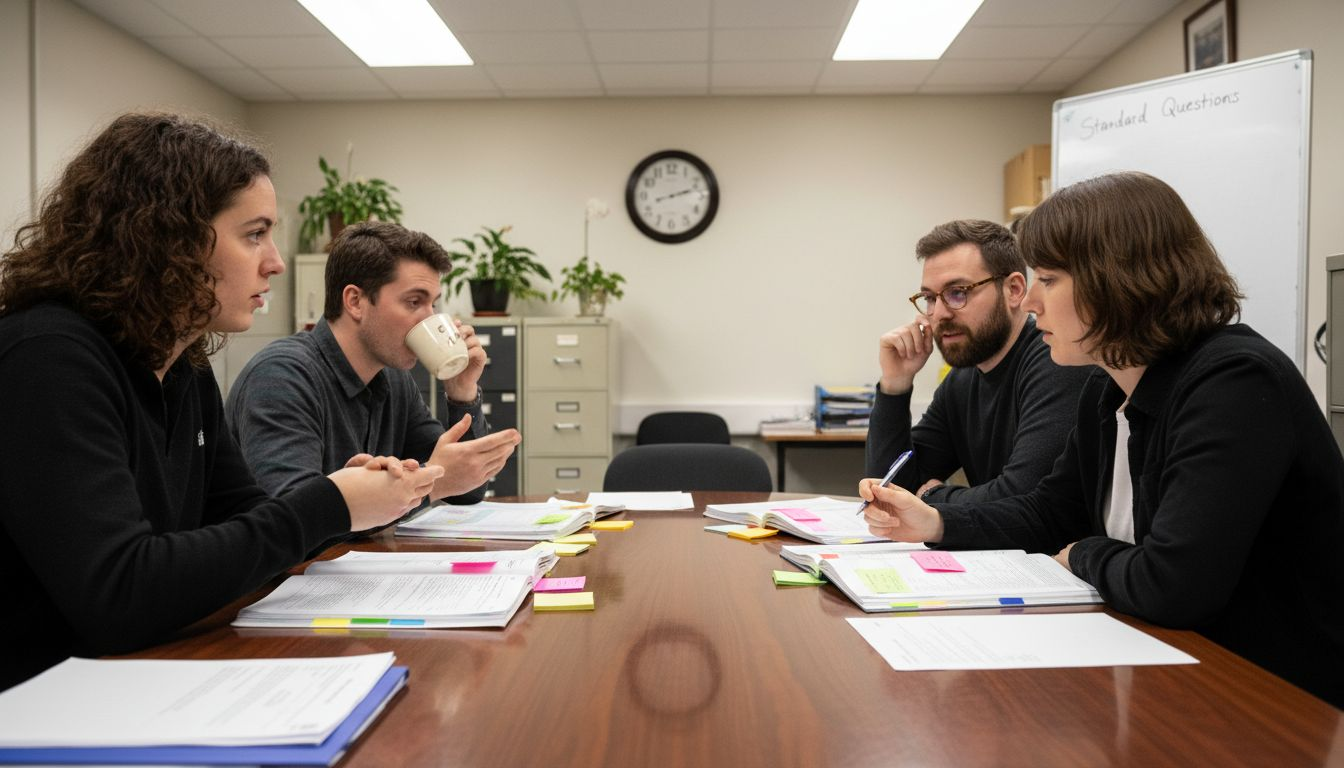
Skipping or rushing interviewer training occurs in roughly 35% of implementations. Without proper training, interviewers revert to unstructured habits, apply rubrics inconsistently, and allow biases to creep in. Solution: Mandate multi-session training covering question delivery, active listening, note taking, and scoring calibration. Schedule refresher sessions quarterly.
Ignoring cultural fit questions happens in approximately 30% of structured interviews. Organisations focus solely on technical competencies, missing the retention benefits of assessing values alignment. Solution: Integrate cultural fit questions into your core question set. Use your cultural fit checklist to design prompts that reveal candidate alignment with your values.
Not conducting interviewer calibration meetings affects about 25% of implementations. Without calibration, scoring standards drift over time as interviewers interpret rubrics differently. Solution: Hold monthly calibration sessions where interviewers score sample responses together, discuss discrepancies, and align on standards.
Structured interview failures often stem from incomplete preparation rather than flawed methodology. Organisations that skip standardised question development, rush training, ignore cultural fit, or neglect calibration see minimal improvement over unstructured approaches. These mistakes occur in 25% to 40% of implementations, significantly reducing the process’s effectiveness.
Additional tips to avoid pitfalls:
- Schedule training well before interview cycles begin
- Create a centralised question repository accessible to all interviewers
- Enforce calibration meeting attendance through policy
- Monitor scoring patterns to detect drift or bias
- Regularly update questions based on role evolution
For broader insights on data driven hiring improvements, explore resources that benchmark common implementation failures.
Expected outcomes and success metrics
Structured interviews deliver measurable improvements across multiple dimensions. HR managers should track specific metrics to quantify success and refine their processes continuously.
Bias reduction typically ranges from 20% to 25% compared to unstructured methods. Measure this through adverse impact analyses comparing selection rates across demographic groups. Structured interviews reduce hiring bias by 25% when implemented correctly.
Scoring reliability improves dramatically with training and calibration. Aim for inter-rater reliability coefficients (Cronbach’s alpha) above 0.85. This metric indicates interviewers score candidates consistently, reducing subjective variance.
Retention rates increase substantially when cultural fit questions are included. Expect 30% higher retention over the first 12 months for hires assessed through structured interviews incorporating values alignment questions. Track turnover by cohort to validate this outcome. Consult cultural matching retention data for benchmarks.
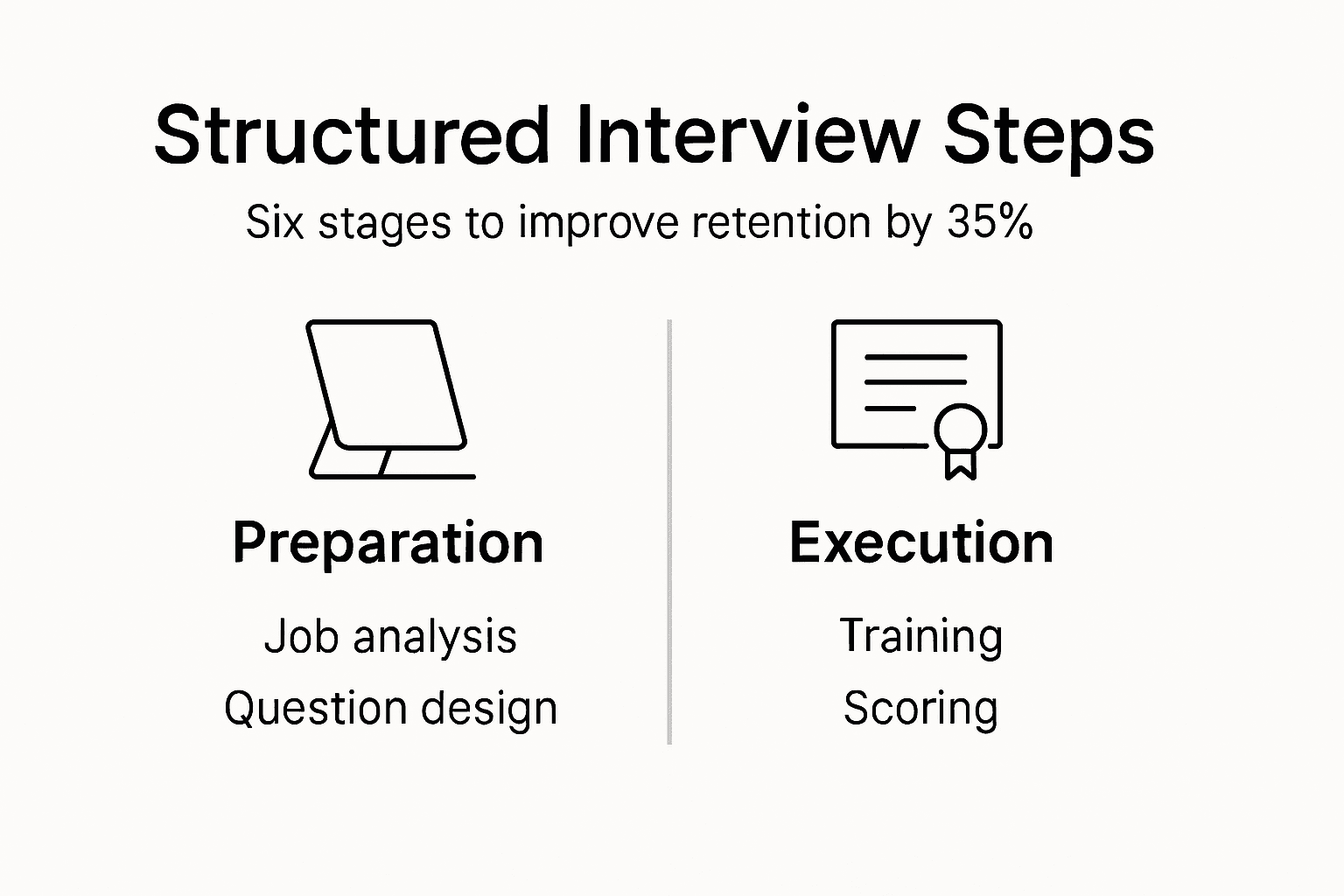
Efficiency improvements manifest as 20% to 30% reductions in time to hire and cost per hire. Standardised processes eliminate redundant interviews, reduce hiring manager involvement, and accelerate decision making. Monitor cycle time from application to offer acceptance.
| Assessment approach | Bias reduction | Scoring reliability | 12 month retention | Time to hire reduction |
|---|---|---|---|---|
| Unstructured interviews | Baseline | 0.65 | Baseline | Baseline |
| Structured interviews | 25% | 0.85 | 30% increase | 20% |
| Structured plus AI assessments | 35% | 0.90 | 35% increase | 35% |
Use these metrics to continuously improve hiring decisions. Conduct quarterly reviews of bias patterns, scoring consistency, and retention outcomes. Adjust questions, rubrics, and training based on findings. For additional metrics guidance, review hiring success measurement approaches.
Advanced integration: AI and real assessments
Traditional structured interviews provide a strong foundation, but integrating AI and cognitive assessments amplifies predictive validity and efficiency. Modern HR tech platforms offer tools that complement human judgment without replacing it.
AI interviews serve as initial screening mechanisms, delivering standardised video or text based interviews at scale. Candidates respond to predetermined questions, and AI analyses responses for competency indicators, communication patterns, and even sentiment. This approach reduces interviewer workload while maintaining consistency. Structured interviews combined with AI assessments yield 40% higher predictive validity than structured interviews alone.
Cognitive and skills tests provide objective performance prediction data. Assessments measuring reasoning, problem solving, or role specific skills complement interview data, creating a holistic candidate profile. Research shows cognitive tests predict job performance with validity coefficients around 0.5, among the highest of any single assessment method.
AI powered cultural fit assessments analyse candidate values, work preferences, and behavioural tendencies against your organisational culture profile. These tools reduce retention risk by identifying misalignments early. When integrated with structured interviews, they improve retention by up to 35%.
Statistical improvements from AI integration include 40% higher predictive validity, 35% reduction in hiring time, and 30% lower cost per hire. These gains result from automating routine tasks, providing richer candidate data, and enabling faster, more accurate decisions.
Best practices for integrating AI into structured interviews:
- Use AI for initial screening, reserving human interviews for finalists
- Combine AI competency scores with human cultural fit assessments
- Validate AI tools against your own performance data before full deployment
- Maintain human oversight of final hiring decisions to ensure fairness
- Train hiring managers on interpreting AI generated insights
- Regularly audit AI tools for bias and update algorithms as needed
Explore AI interview efficiency tips to reduce time to hire by 35% in 2026. Leverage AI cultural fit assessments to improve alignment and retention outcomes.
Discover advanced AI tools to transform your hiring
You’ve learned how structured interviews reduce bias and improve retention. Now take the next step by exploring AI powered tools that automate and enhance these processes. AI interviews streamline candidate screening, while cognitive tests and cultural matching assessments provide deeper insights into fit and performance potential.
Over The Moon offers tailored solutions for HR managers in the UK and Spain seeking to cut hiring time by up to 35% in 2026. Replace CV screening with real assessments: AI interviews, company challenges, cultural matching, cognitive tests, and video pitches. Access expert interview question list tips and proven frameworks designed to improve candidate assessment accuracy and cultural fit. Start transforming your talent acquisition today.
Frequently asked questions about structured interview process steps
How long does it typically take to implement a structured interview process?
Full implementation requires 8 to 12 weeks. This includes 2 to 3 weeks for job analysis and competency mapping, 2 weeks for question design and rubric creation, 1 to 2 weeks for interviewer training, and 2 to 4 weeks for pilot testing and refinement. Larger organisations with multiple roles may need additional time for customisation and rollout across departments.
What tools are best for scoring candidate responses objectively?
Behavioural anchored rating scales (BARS) provide the most reliable scoring framework. Digital platforms integrated with applicant tracking systems automate score compilation and reduce human error. Look for tools offering customisable rubrics, multi-rater functionality, and audit trail features. Many HR tech solutions now include structured interview modules with built-in BARS templates.
How often should interviewer calibration sessions be held?
Conduct calibration sessions monthly during initial implementation, then quarterly once the process stabilises. Each session should involve 3 to 5 interviewers scoring sample responses independently, followed by group discussion to resolve discrepancies. Track inter-rater reliability metrics to determine if more frequent calibration is needed. Review your cultural fit checklist during these sessions to ensure consistent values assessment.
Can structured interviews fully eliminate bias?
No assessment method eliminates bias entirely, but structured interviews reduce it substantially. Studies show 20% to 25% reduction compared to unstructured formats. Remaining bias often stems from unconscious factors like tone interpretation or non-verbal cues. Combining structured interviews with AI assessments and cognitive tests further minimises bias by providing objective data points that complement human judgment.
Are cultural fit questions mandatory for all roles?
While not legally mandatory, cultural fit questions significantly improve retention and should be included in all structured interview protocols. Tailor questions to role-specific values and team dynamics. For example, remote roles might emphasise autonomy and communication, while collaborative roles focus on teamwork and adaptability. Omitting cultural fit questions risks hiring technically qualified candidates who leave within 12 months due to misalignment.
Recommended
- How to Interview with AI: Cut Hiring Time by 35% in 2026 | We Are Over The Moon
- 7 Essential Interview Question List Tips for HR Success | We Are Over The Moon
- How to Screen Without CVs for Better Hiring Results | We Are Over The Moon
- How to Improve Candidate Matching for Better Hires | We Are Over The Moon
- Employee Retention Solutions, Lower Turnover | OpenElevator
- Master Performance Review Processes for Tech Teams | Nine Archs LLC