How to Interview with AI: Cut Hiring Time by 35% in 2026

AI promises to slash hiring time by up to 35% and reduce recruiting costs by 30%, yet 47% of HR leaders struggle with integration. If you’re an HR manager in the Netherlands, UK, or Spain seeking to streamline candidate assessments without sacrificing cultural fit, this guide provides actionable steps to implement AI interviews effectively while navigating European compliance requirements and avoiding common pitfalls.
Table of Contents
- Understanding AI’s Role In The Interview Process
- Prerequisites: Preparing For Effective AI Interviews
- Step By Step Guide To Implementing AI In Interviews
- Common Mistakes And How To Troubleshoot AI Interviewing
- Measuring Success: Outcomes And ROI Of AI Interviews
- Conclusion And Next Steps For HR Leaders
- Explore AI Interview Solutions To Transform Hiring
- Frequently Asked Questions
Key Takeaways
| Point | Details |
|---|---|
| Efficiency gains | AI reduces time to hire by 35% and cuts recruiting costs by 30%. |
| Balanced approach | Combine AI automation for screening with human judgment for cultural fit decisions. |
| Preparation essential | HR training, data audits, and governance policies prevent integration failures. |
| Avoid pitfalls | Poor data quality, over reliance on AI, and compliance gaps derail adoption. |
| Measure outcomes | Track time to hire, cost reduction, hiring accuracy, and bias incidents continuously. |
Understanding AI’s Role in the Interview Process
AI adoption in European recruitment is accelerating due to measurable efficiency and fairness improvements. AI in HR can reduce the time to hire by up to 35% and cut recruiting costs by about 30%, significantly increasing efficiency. These gains stem from faster resume screening, standardized evaluation criteria, and enhanced candidate assessment capabilities that free HR teams to focus on strategic decisions.
However, implementing AI in recruitment in 2026 brings unique challenges. Regulatory compliance with the EU AI Act, GDPR, and national employment laws in the Netherlands, UK, and Spain requires tailored governance frameworks. Data quality issues and maintaining human oversight remain critical hurdles.
The primary benefits include:
- Accelerated initial screening that processes hundreds of applications in minutes
- Standardized evaluation reducing interviewer inconsistency
- Improved candidate experience through faster feedback loops
- Enhanced assessment depth using natural language processing and sentiment analysis
- Better diversity outcomes when bias mitigation protocols are implemented
Yet AI impact on HR hiring efficiency depends heavily on integration quality. Cultural nuances across European markets mean AI models trained on one region may underperform in another. Dutch directness differs from British formality and Spanish communication styles, requiring localized training data and evaluation criteria.
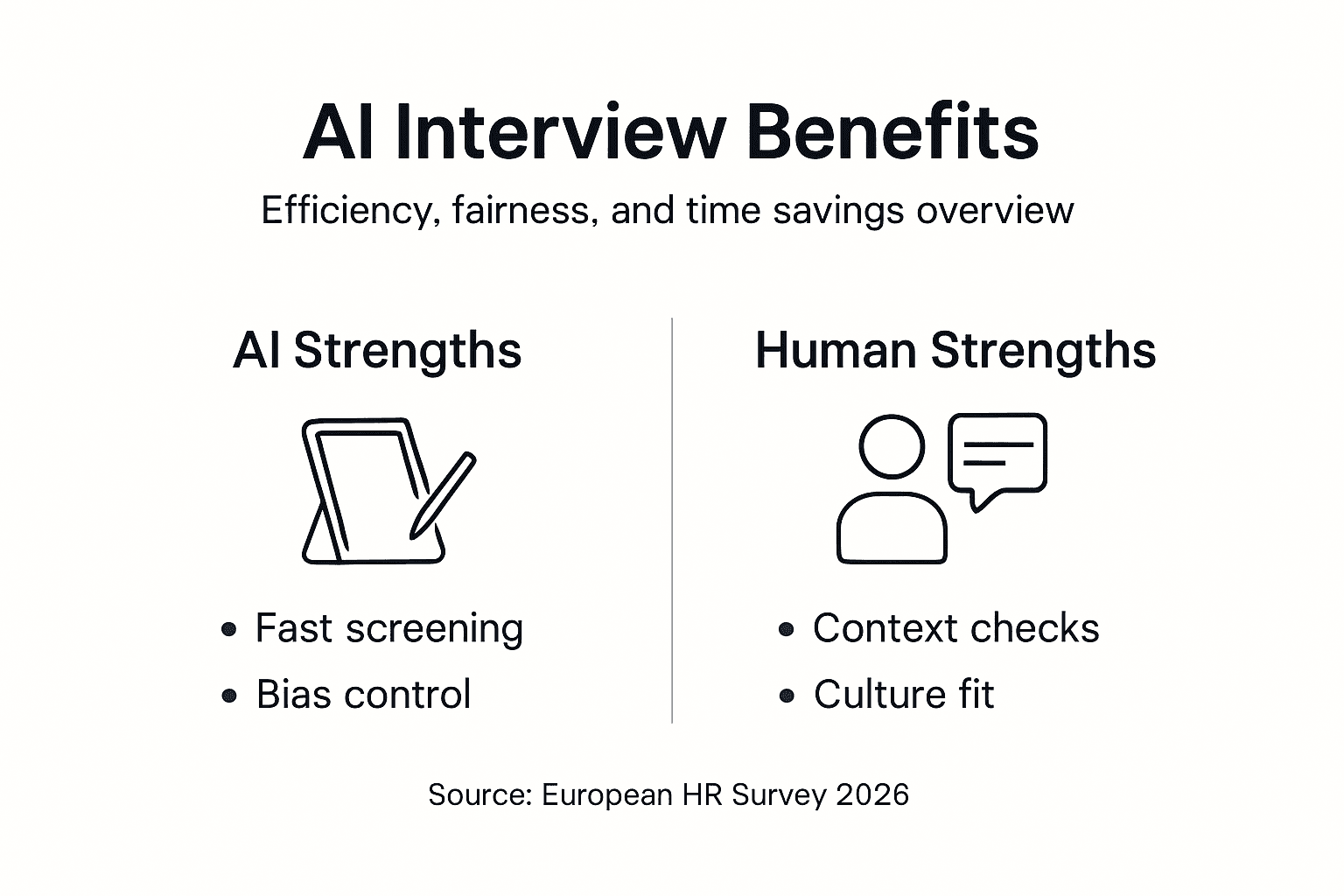
Successful AI interviewing balances automation with human insight. Use AI to eliminate unqualified candidates quickly, but reserve final hiring decisions for experienced recruiters who assess cultural alignment and soft skills that algorithms struggle to measure accurately.
Prerequisites: Preparing for Effective AI Interviews
Before deploying AI interview tools, your organization needs foundational elements in place. 47% of HR leaders experience AI integration challenges without preparation; AI literacy and governance are essential. Rushing implementation without these prerequisites leads to poor adoption, compliance risks, and wasted investment.
Data integration and quality audits come first. Your AI system requires clean, structured candidate data from application tracking systems, interview notes, and performance records. Audit existing data for completeness, accuracy, and potential bias before feeding it into AI models. Garbage in equals garbage out.
HR team AI literacy training prevents resistance and misuse. Your recruiters need to understand how AI makes decisions, its limitations, and when human judgment should override algorithmic recommendations. This training should cover:
- How AI scoring algorithms evaluate responses
- Recognizing potential bias signals in AI outputs
- Interpreting confidence scores and uncertainty indicators
- Escalation protocols when AI recommendations seem questionable
Establish clear governance policies aligned with AI preparation strategies before going live. Document who approves AI hiring decisions, how candidates can contest algorithmic assessments, and audit frequencies. These policies must address EU AI Act transparency requirements and GDPR data subject rights.
Select AI platforms vetted for bias control and European legal compliance. Not all vendors meet stringent EU standards. Evaluate platforms based on explainability features, bias testing results, data residency options, and compliance certifications relevant to your markets.
Pro Tip: Create a bias mitigation plan with specific metrics before deployment. Define acceptable variance in candidate demographic distributions, establish regular bias audits, and assign accountability for addressing disparities discovered through monitoring.
The importance of AI literacy and governance cannot be overstated. Organizations that invest in preparation see faster adoption, better outcomes, and fewer compliance incidents than those rushing into AI without groundwork.
Step by Step Guide to Implementing AI in Interviews
Successful AI interview implementation follows a structured sequence. Balancing AI automation with human judgment is critical; AI supports initial screening but human insight is needed for cultural fit. This approach maximizes efficiency gains while preserving hiring quality.
-
Define clear objectives and success metrics for your AI interview program. Specify target reductions in time to hire, cost savings goals, and quality indicators like 90 day retention rates. Vague goals lead to implementation drift.
-
Choose vetted AI tools aligned with your specific needs. Evaluate platforms based on integration capabilities with your applicant tracking system, language support for your markets, bias mitigation features, and compliance certifications. Request demo data showing accuracy across demographic groups.
-
Train your HR team and recruiters thoroughly. Beyond basic platform operation, ensure they understand AI decision logic, can identify potential errors, and know escalation procedures. Role playing exercises help build confidence.
-
Design structured interview questions compatible with AI evaluation. Questions must elicit responses AI can reliably assess. Behavioral questions with clear success criteria work better than open ended philosophical queries. Test questions with diverse candidate profiles before deployment.
-
Deploy AI for initial screening rounds only. Use algorithms to eliminate clearly unqualified candidates based on objective criteria like required certifications or experience thresholds. This stage should reduce your candidate pool by 60 to 70%.
-
Apply human judgment for cultural fit and final decisions. Shortlisted candidates meeting technical requirements need AI interview implementation tips that preserve the human connection essential for assessing team dynamics and organizational alignment.
-
Monitor and refine continuously. Review AI recommendations weekly initially, comparing algorithmic scores with human assessments. Adjust scoring weights, retrain models on new data, and update question banks based on performance data.
Pro Tip: Start with one role or department rather than company wide rollout. Learn from a controlled pilot, document lessons, and scale gradually. This approach reduces risk and builds organizational confidence.
The table below compares AI versus human strengths in different interview stages:
| Interview Stage | AI Strengths | Human Strengths |
|---|---|---|
| Resume screening | Processes thousands instantly, applies criteria consistently | Recognizes unconventional backgrounds, understands career narratives |
| Initial assessment | Evaluates technical skills objectively, reduces scheduling burden | Builds candidate rapport, explains company culture authentically |
| In depth evaluation | Analyzes speech patterns for confidence indicators | Reads body language, assesses team chemistry |
| Final decision | Provides data driven candidate comparisons | Makes judgment calls on growth potential and cultural alignment |
Explore AI interview examples and talent screening guide for deeper implementation insights. Remember that balancing AI and human judgment remains the foundation of effective hiring.
Common Mistakes and How to Troubleshoot AI Interviewing
Common AI interview mistakes include neglecting data quality, over reliance on AI without human oversight, lack of compliance with AI regulations, and inadequate monitoring. Understanding these pitfalls helps you avoid costly errors and maintain hiring quality.
Poor data integration undermines AI validity from the start. When your AI system trains on incomplete candidate records, inconsistent interview notes, or biased historical hiring data, it amplifies existing problems rather than solving them. Conduct thorough data audits before deployment and establish data quality standards for ongoing operations.
Over trusting AI without human verification creates multiple risks. Algorithms can miss context, misinterpret responses, or exhibit unexpected bias patterns. Implement mandatory human review for all AI driven rejections and require recruiter approval before final hiring decisions. This dual layer catches errors while maintaining efficiency gains.
Ignoring ongoing monitoring leads to compliance failures and fairness issues. AI models drift over time as candidate populations and job requirements evolve. Structured interviewing plus AI reduces bias and improves fairness in hiring decisions only when you actively monitor outcomes.
Common troubleshooting scenarios include:
- AI consistently scoring diverse candidates lower: Retrain models on balanced datasets, adjust feature weights, and validate scoring criteria against fair hiring principles
- Candidate complaints about AI assessments: Enhance transparency by explaining evaluation criteria upfront and providing personalized feedback regardless of outcome
- Low recruiter adoption rates: Address training gaps, simplify workflows, and demonstrate time savings through concrete metrics
- Legal compliance concerns: Engage employment law experts familiar with EU AI Act requirements and document all algorithmic decision processes
“The biggest mistake companies make is treating AI as a replacement rather than an augmentation tool. Human judgment remains irreplaceable for assessing cultural fit and growth potential.”
Training deficits create organizational resistance. When recruiters don’t understand how AI works or fear being replaced, they resist adoption or misuse tools. Invest in comprehensive change management, emphasizing how AI handles tedious screening while freeing recruiters for higher value relationship building.
Neglecting legal requirements risks substantial fines and reputation damage. The EU AI Act classifies many hiring AI systems as high risk, requiring conformity assessments, transparency documentation, and human oversight. Stay current with evolving regulations across your operating markets.
Review AI common mistakes and fixes regularly and learn from critical AI interview errors documented by other organizations. Apply bias reduction using AI methodologies systematically rather than reactively.
Measuring Success: Outcomes and ROI of AI Interviews
AI interviews can reduce time to hire by 35 to 50%, cut recruiting costs by 30%, and improve hiring accuracy and candidate experience. Tracking these metrics proves value and guides continuous improvement efforts.

Time to hire reduction appears first and most visibly. Measure days from job posting to offer acceptance before and after AI implementation. Break this metric into stages: application to first interview, first interview to final round, final round to offer. AI typically compresses early stages most dramatically.
Recruitment cost savings come from multiple sources. Calculate cost per hire including advertising spend, recruiter hours, assessment tools, and onboarding expenses. AI reduces manual screening time, enables smaller recruiting teams to handle higher volumes, and improves offer acceptance rates through faster processes.
The table below shows typical ROI metrics:
| Metric | Pre AI Baseline | Post AI Implementation | Improvement |
|---|---|---|---|
| Time to hire | 42 days | 28 days | 33% reduction |
| Cost per hire | €3,200 | €2,240 | 30% reduction |
| Offer acceptance rate | 68% | 79% | 16% improvement |
| 90 day retention | 82% | 87% | 6% improvement |
| Recruiter capacity | 25 hires/year | 38 hires/year | 52% increase |
Hiring accuracy improvements require longer measurement horizons. Track new hire performance ratings at 90 days, six months, and one year. Compare retention rates and promotion velocity between AI hired and traditionally hired employees. Quality improvements manifest gradually but prove AI’s strategic value.
Candidate experience scores provide early feedback. Survey applicants about process clarity, communication timeliness, and fairness perceptions. Positive candidate experience enhances employer branding even among those not hired.
Monitor diversity and bias metrics rigorously:
- Compare demographic distributions across hiring funnel stages
- Calculate adverse impact ratios for protected groups
- Track bias incident reports and resolution outcomes
- Measure diversity representation in final hires versus applicant pools
Implement regular audits and data driven feedback loops. Monthly reviews during initial implementation transition to quarterly assessments once processes stabilize. Use dashboards visualizing key metrics to facilitate quick decision making.
Set realistic benchmarks aligned to your organization’s scale and hiring volume. Small companies see different ROI patterns than enterprises. Compare performance against your own baseline rather than industry averages that may not reflect your context.
Explore measuring AI interview success frameworks and reference AI interview ROI metrics to refine your measurement approach. Remember that qualitative benefits like improved recruiter satisfaction and reduced hiring stress matter even when harder to quantify.
Conclusion and Next Steps for HR Leaders
Successful AI interviewing combines technological efficiency with irreplaceable human insight. The organizations achieving 35% time reductions and 30% cost savings share common practices: thorough preparation, balanced automation, continuous monitoring, and unwavering commitment to fairness.
Your next steps should include:
- Conducting honest assessments of your current data quality and HR team readiness
- Selecting AI platforms that prioritize transparency and European compliance
- Starting with limited pilot programs to build confidence and learn systematically
- Establishing clear governance policies before deployment rather than retroactively
- Investing in comprehensive training that addresses both technical skills and change management
Invest in training and clear legal compliance policies early. The upfront effort pays dividends through smoother adoption, fewer costly mistakes, and stronger organizational buy in. Compliance should enable innovation rather than constrain it.
Use data from AI processes to continually improve hiring quality. Every interview generates insights about what works, what needs adjustment, and where human judgment adds most value. Organizations treating AI implementation as iterative learning achieve better outcomes than those seeking perfect initial launches.
Leverage AI to engage candidates and boost fairness. When implemented thoughtfully, AI provides faster feedback, more consistent evaluation, and reduced bias compared to traditional methods. Candidates appreciate transparent processes and timely communication that AI enables.
Pro Tip: Create an AI steering committee including HR leaders, legal counsel, IT, and employee representatives. Regular cross functional review ensures balanced perspectives and catches blind spots individual departments might miss.
Start small, learn continuously, and scale thoughtfully. The competitive advantage goes to organizations that implement AI strategically rather than rushing adoption or remaining paralyzed by challenges. Your hiring quality and efficiency gains compound over time with disciplined execution.
Explore AI Interview Solutions to Transform Hiring
Ready to implement the strategies outlined in this guide? Modern AI interview platforms eliminate traditional CV screening bottlenecks while preserving the human judgment essential for cultural fit. AI interviews solutions designed specifically for European markets address compliance requirements and localization needs.
Discover how benefits of AI interviews extend beyond efficiency to improved candidate experience and reduced bias. Explore examples of AI interviews showing real world applications across industries and roles. Access training resources, implementation templates, and expert guidance to accelerate your AI adoption journey while avoiding common pitfalls that derail 47% of implementations.
Frequently Asked Questions
How do I ensure AI interviews comply with EU regulations?
Implement transparency documentation explaining how your AI makes decisions, maintain human oversight for all final hiring choices, and conduct regular bias audits. Engage legal experts familiar with the EU AI Act, GDPR, and national employment laws in your operating markets to review processes quarterly.
What training do HR teams need for AI interview adoption?
Your recruiters need comprehensive training covering AI decision logic, platform operation, bias recognition, escalation protocols, and change management. Practical exercises with real candidate scenarios build confidence better than theoretical instruction alone.
Can AI replace human judgment in hiring?
No. AI excels at initial screening and objective skill assessment but cannot reliably evaluate cultural fit, growth potential, or team dynamics. The most effective approach uses AI to eliminate clearly unqualified candidates while reserving final decisions for experienced recruiters.
How do we monitor AI tools for bias over time?
Track demographic distributions across hiring funnel stages monthly, calculate adverse impact ratios for protected groups, and compare AI scores against human assessments regularly. Establish acceptable variance thresholds and retrain models when bias indicators exceed limits.
What metrics best measure AI interview success?
Prioritize time to hire reduction, cost per hire savings, hiring accuracy measured by 90 day retention, candidate experience scores, and diversity outcome improvements. Combine efficiency metrics with quality indicators for comprehensive ROI assessment.
Recommended
- 6 Key Benefits of AI Interviews for Smarter Hiring | We Are Over The Moon
- AI in Recruitment: What Does This Mean for You in 2026? | We Are Over The Moon
- Why Use AI Interviews: Enhancing Recruitment Outcomes | We Are Over The Moon
- AI Interviews: Transforming Candidate Assessment in HR | We Are Over The Moon
- Effective Recruitment Guide: Hire Top Talent Faster