Candidate engagement guide: boost hiring success in 2026

TL;DR:
- Most applications are unqualified, making engagement more crucial than volume. Effective candidate engagement involves active interactions that foster trust and improve hiring outcomes. Innovative assessments and balanced technology-human approaches significantly enhance engagement and recruitment efficiency.
Filling your pipeline with hundreds of applications feels like a win, until you realise that 70% of applications are unqualified. For HR leaders and talent acquisition teams in mid-sized businesses across the UK, Netherlands, and Spain, the real challenge is not volume. It is engagement. When candidates feel genuinely valued and assessed fairly, your employer brand strengthens, your shortlists sharpen, and your hiring results improve dramatically. This guide walks you through exactly what candidate engagement means, why it matters more than ever in 2026, and which innovative methods are delivering real results for organisations just like yours.
Table of Contents
- Understanding candidate engagement: more than a buzzword
- Top challenges in candidate engagement for mid-sized businesses
- Innovative assessment methods that drive better candidate engagement
- Balancing technology with the human touch
- Applying engagement strategies for measurable improvement
- Why most candidate engagement advice misses the mark
- Take engagement to the next level with expert support
- Frequently asked questions
Key Takeaways
| Point | Details |
|---|---|
| Quality over quantity | Prioritising qualified engagement leads to better hires and lower attrition. |
| Leverage innovative assessments | Modern tools like AI provide measurable improvements in efficiency and candidate experience. |
| Balance tech and human touch | Blending automation with personal interaction builds trust and enhances engagement. |
| Track the right metrics | Using data like QoA, retention, and satisfaction helps demonstrate your engagement ROI. |
Understanding candidate engagement: more than a buzzword
Let us be honest. Candidate engagement is one of those phrases that gets thrown around a lot in HR circles without anyone pausing to properly define it. So here is a clear, working definition: candidate engagement is the collection of active interactions and communication touchpoints your team initiates with applicants throughout the hiring process. Think personalised messages, timely updates, skills assessments, and meaningful feedback.
This is different from candidate experience, which describes the overall feeling a person has about your hiring process from start to finish. As research from Traverse highlights, engagement refers to active tactics, while experience is about overall feel. Both matter, but engagement is the lever you can pull right now.
Why does this distinction matter for HR leaders in the UK, Netherlands, and Spain specifically? Because mid-sized businesses operate under different pressures than enterprise firms. You may not have a dedicated employer brand team or a massive recruitment marketing budget. Every touchpoint counts more.
Poor engagement carries serious risks. When candidates feel ignored or undervalued, brand perception takes a direct hit. Consider the following risks of weak engagement:
- Candidates share negative experiences publicly on platforms like Glassdoor and LinkedIn
- Talented applicants drop out of your funnel before you even meet them
- Employer brand damage makes future hiring cycles more expensive and slower
- Internal stakeholders lose confidence in the talent acquisition function
“Engagement is not a nice-to-have. It is the difference between a candidate choosing you over a competitor offering a similar role.”
The business case is compelling. Stronger engagement leads to higher quality shortlists, better retention rates post-hire, and a reputation that attracts talent organically. When you treat every applicant as a potential brand ambassador, the returns extend well beyond a single hire.
Top challenges in candidate engagement for mid-sized businesses
Knowing what engagement is and actually achieving it are two very different things. Mid-sized businesses face a specific set of obstacles that larger enterprises can often throw resources at and smaller businesses sidestep through sheer simplicity.
First, there is the volume problem. Europe’s hiring success rate sits at around 56%, with over 11% of positions remaining unfilled. That means recruiters are spending enormous energy on applicants who will not convert, while simultaneously failing to fill critical roles.
Here is a snapshot of how these challenges compare across three key markets:
| Challenge | UK | Netherlands | Spain |
|---|---|---|---|
| Average cost per applicant (CPA) | £8 to £20 | €7 to €18 | €5 to €15 |
| Average time to fill (TTF) | 30 to 45 days | 28 to 42 days | 35 to 50 days |
| Candidate ghosting rate | High | Medium | High |
| Tech adoption in SMEs | Moderate | High | Low to moderate |
Beyond statistics, here are the day-to-day challenges your team is likely navigating:
- Volume versus quality: Sifting through large numbers of applications consumes recruiter time with minimal return
- Tech adaptation: Introducing new tools without disrupting existing workflows or alienating your team
- Candidate ghosting: Applicants disappearing mid-process, wasting interview slots and time
- Managing expectations: Candidates expect faster, more transparent communication than ever before
Pro Tip: Before you invest in new engagement tools or strategies, focus on optimising the attraction funnel first. Improving who enters your pipeline delivers outsized efficiency gains compared to optimising later stages.
The cost of ignoring these challenges is not just financial. Unfilled roles create pressure on existing teams, increase burnout, and can stall business growth. For HR leaders, solving the engagement puzzle is one of the highest-leverage activities available right now.
Innovative assessment methods that drive better candidate engagement
Traditional job interviews have a well-documented flaw. They tend to predict how much an interviewer likes a candidate, not how well that person will actually perform in the role. Structured, skills-based assessments change that equation entirely, and they do so in a way that candidates genuinely appreciate.

Innovative methods such as AI interviews, job simulations, cognitive tests, and video pitches give candidates an active role in showcasing their abilities. Rather than passively answering questions, applicants demonstrate real competencies. This is engaging for candidates and far more informative for hiring teams.
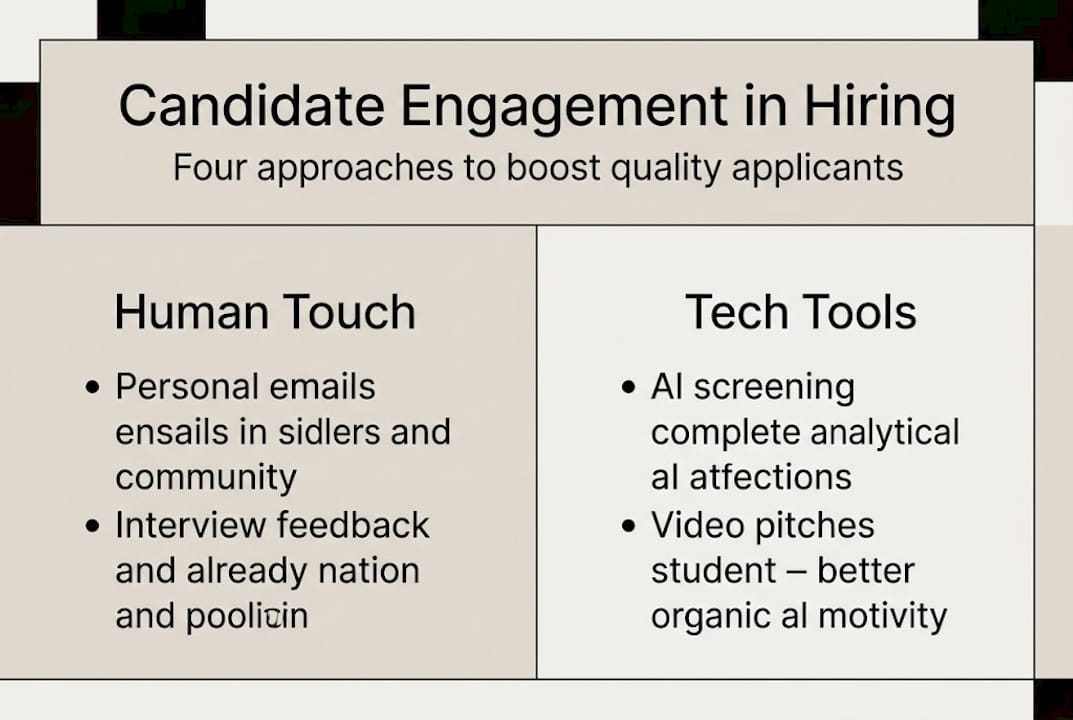
The AI assessment benefits are not just theoretical. Organisations using AI-powered assessments have reported saving over 400 hours and cutting costs by 20%, while boosting quality of hire by 15%. Those are numbers worth paying attention to.
Here is a look at how innovative methods compare to traditional approaches:
| Method | Hours saved | Cost reduction | Quality of hire improvement |
|---|---|---|---|
| AI skills assessment | 400+ per 2,800 candidates | Up to 20% | Up to 15% |
| Job simulations | Significant | Moderate | High |
| Traditional interview only | Minimal | None | Low to moderate |
Ready to implement? Here is a straightforward approach:
- Pilot with one role type: Choose a high-volume role and run a skills-based or AI assessment alongside your current process
- Gather candidate feedback: Ask applicants about their experience with the new assessment format
- Review the data: Compare shortlist quality, time to fill, and interview-to-offer ratios against your baseline
- Refine the process: Adjust question types, time limits, or assessment formats based on what you learn
- Scale with confidence: Roll out the improved process across other roles and teams
Pro Tip: When using AI-powered tools, always maintain human oversight. Reviewing AI outputs for fairness and consistency is essential for compliance with UK and EU equality legislation. Explore how candidate assessment tools can be implemented responsibly.
Balancing technology with the human touch
There is a real risk in recruitment right now. Excited by the efficiency gains of automation, some teams are replacing human connection with digital workflows and calling it engagement. Candidates notice. And they do not like it.
Effective engagement in 2026 means combining the speed and consistency of technology with genuinely warm, human interaction. Automation handles the repetitive tasks. People handle the conversations that matter.
Here is how to build a balanced sourcing and engagement model:
- Employee referrals: Still one of the strongest signals of cultural fit and genuine interest
- Niche job boards: Reach highly relevant candidates in specific sectors or regions
- Automated scheduling: Free up recruiter time for meaningful candidate conversations
- Personalised outreach: Use candidate data to tailor messages rather than sending generic templates
- Regular human check-ins: A brief, genuine update call builds trust far better than an automated email sequence
The data on AI in hiring is clear. AI reduces bias in many areas but requires human oversight for optimal candidate engagement. Understanding the role of AI in recruitment helps your team deploy these tools in a way that supports rather than replaces your recruiter relationships.
“When candidates feel like a number in a system, 60% report a negative perception of your employer brand, regardless of how good your product or culture actually is.”
The goal is not to choose between technology and humanity. It is to use technology to create more space for meaningful human moments. When your recruiters are not buried in CV screening, they can spend more time on the conversations that turn interested applicants into excited new hires. Staying updated on AI in recruitment 2026 trends helps you anticipate where the industry is heading and plan accordingly.
Applying engagement strategies for measurable improvement
Strategy without measurement is just guessing. The good news is that candidate engagement is highly measurable, and data-driven optimisation at the top of the funnel delivers the biggest efficiency gains for mid-sized businesses.
Here is a practical action plan to get started:
- Audit your current funnel: Map every touchpoint from application to offer and identify where candidates drop out
- Set a baseline: Record current Quality of Applicants (QoA), time to fill, and candidate satisfaction scores
- Introduce one innovation at a time: Avoid overwhelming your team by piloting one new tool or method per quarter
- Communicate changes to candidates: Let applicants know why you are using new assessment formats and what to expect
- Review and iterate every 90 days: Treat your engagement strategy as a living process, not a one-off project
Key metrics to track consistently include:
- Quality of Applicants (QoA): The ratio of qualified to total applicants
- Retention rate at 6 and 12 months: A strong indicator of engagement and cultural fit
- Candidate satisfaction score: Gathered through post-process surveys
- Time to fill: A direct reflection of funnel efficiency
- Offer acceptance rate: High rates suggest strong engagement throughout the process
To make this real, consider a mid-sized logistics company in the Netherlands that shifted from CV screening to skills-based AI assessments. Before the change, QoA sat at 28% and time to fill averaged 44 days. After six months of iterating on their assessment approach, with guidance from tools like those shown in examples of AI interviews, QoA rose to 61% and time to fill dropped to 27 days. Teams like this are achieving faster hiring with AI without sacrificing the quality of their shortlists.
Start small, measure everything, and build from genuine results. That is how engagement improvements stick.
Why most candidate engagement advice misses the mark
Here is something we believe strongly: most candidate engagement advice is surface-level. Automated check-in emails with the candidate’s first name, a chatbot that answers basic FAQ questions, a follow-up survey nobody reads. These tactics tick a box but rarely move the needle.
The organisations genuinely improving their hiring results are doing something more substantive. They are replacing the CV screening ritual with real assessments that respect candidates’ time and abilities. They are using cultural fit in hiring as a measurable criterion, not a vague gut feeling.
For mid-sized businesses in the UK, Netherlands, and Spain, the opportunity is significant. You are nimble enough to change quickly and focused enough to measure what actually works. The firms that win at candidate engagement in 2026 will not be the ones sending the most automated messages. They will be the ones whose processes feel genuinely respectful, fair, and worth a candidate’s time and energy.
Take engagement to the next level with expert support
We are genuinely excited about what is possible when mid-sized businesses replace outdated screening with real, meaningful assessments. If you are ready to move beyond CVs and into skills-based hiring, we can help.
With WAOTM, you gain access to AI candidate validation, company challenges, cognitive tests, video pitches, and cultural matching tools. All designed to engage your best candidates while saving your team significant time. Whether you want to match on skills from the very first touchpoint or want to explore what the right setup looks like for your business, we would love to talk. Find out more about our expertise and discover how we help teams like yours hire with confidence.
Frequently asked questions
What is the difference between candidate engagement and candidate experience?
Candidate engagement is about active interaction with applicants through deliberate touchpoints, while candidate experience covers their overall feelings throughout the process. As Traverse notes, engagement means active tactics while experience is the overall feel.
Why do most applicants remain unqualified, and how can we address this?
Up to 70% of applicants are unqualified, largely because job adverts are vague and application barriers are too low. Using skills-based assessments and AI screening filters for genuine fit from the very first touchpoint.
What are the key metrics to track candidate engagement success?
Track Quality of Applicants, retention rates at 6 and 12 months, candidate satisfaction scores, and time-to-fill metrics to get a full picture of how well your engagement tactics are performing.
How does AI improve candidate engagement?
AI tools save recruiters significant time, as shown by over 400 hours saved per 2,800 candidates, while reducing bias and creating more consistent, personalised touchpoints that candidates genuinely value.