Remote interview guide for tech hiring success in 2026

Remote tech hiring in Europe has transformed dramatically, yet 74% of companies still experience failed hires costing an average of £85,000 due to inadequate interview processes and technical disruptions. The shift to distributed teams demands new approaches that go beyond traditional face-to-face methods. This guide provides HR professionals with proven strategies to conduct effective remote interviews, reduce bias, assess remote-specific competencies, and build high-performing tech teams across European markets. You will learn structured frameworks, asynchronous techniques, and verification methods that increase retention whilst cutting time-to-hire significantly.
Table of Contents
- Understanding Challenges In Remote Tech Interviews
- Preparing Your Remote Interview Process: Tools And Techniques
- Executing Remote Interviews Effectively In Tech Roles
- Verifying Results And Handling Common Remote Interview Issues
- Explore Advanced Recruitment Solutions With We Are Over The Moon
- Frequently Asked Questions
Key takeaways
| Point | Details |
|---|---|
| Structured interviews boost retention | Standardised scorecards reduce bias and improve performance prediction by 47%, leading to better long-term hires. |
| Multi-phase assessments reveal true skills | Combining technical tests, behavioural questions, and async video provides comprehensive candidate evaluation. |
| Asynchronous video cuts hiring time | Flexible recording reduces time-to-hire by 40% and widens access to diverse European talent pools. |
| Blind hiring increases success rates | Removing identifying information improves hiring outcomes by 50% and better predicts actual job performance. |
| Remote traits need specific evaluation | Self-motivation, async communication, and timezone management are critical predictors of remote work success. |
Understanding challenges in remote tech interviews
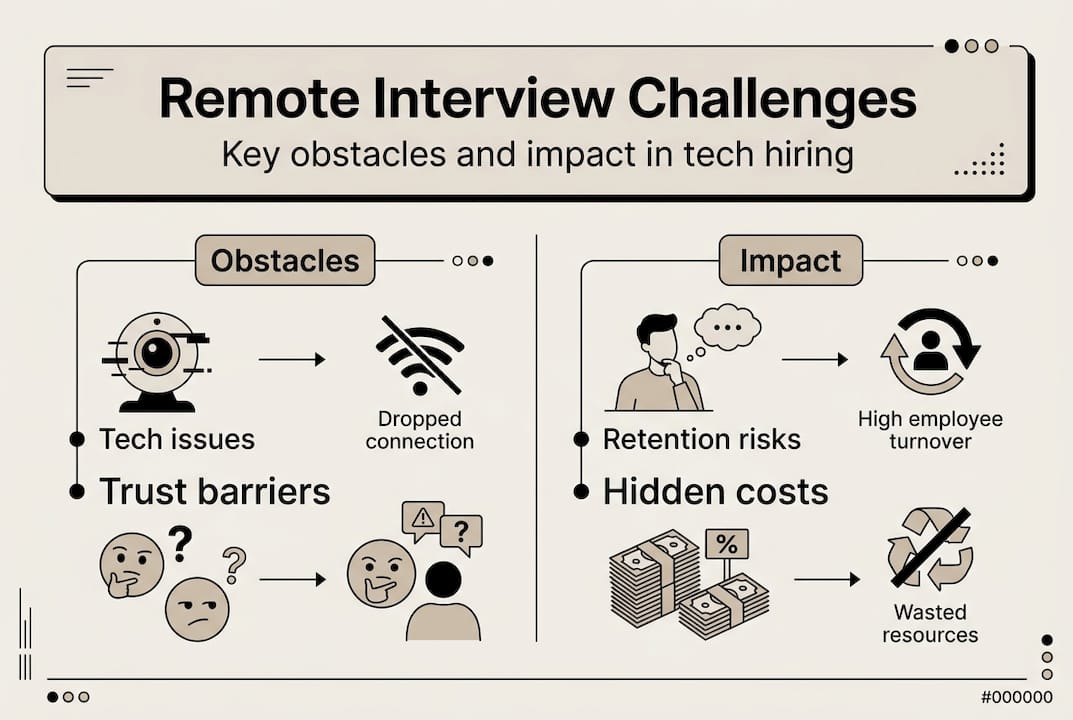
Remote interviewing introduces unique obstacles that traditional recruitment methods fail to address. Technical difficulties during video calls disrupt candidate assessment, creating unfair disadvantages for otherwise qualified individuals. Poor internet connections, audio delays, and platform incompatibility force interviewers to make judgements based on incomplete information rather than actual competencies. These disruptions cost valuable time and create negative candidate experiences that damage your employer brand across competitive European tech markets.
Inconsistent questioning and vague evaluation criteria compound these problems. When interviewers ask different questions or interpret answers subjectively, you lose the ability to compare candidates fairly. This inconsistency becomes particularly problematic in remote settings where non-verbal cues are harder to read and technical jargon can mask genuine understanding. Without standardised rubrics, hiring decisions rely too heavily on gut feelings rather than objective evidence of capability.
Untested technical setups and candidates who disable cameras create additional trust barriers. You need to verify that candidates can handle the remote work environment itself, not just the job responsibilities. Camera-off interviews make it impossible to assess engagement, communication style, and professional presence, all crucial for distributed team success. The absence of visual feedback also raises concerns about interview integrity and whether candidates receive unauthorised assistance.
Remote-specific traits like self-motivation and asynchronous communication require deliberate assessment. Traditional interviews focus on technical skills and cultural fit but often overlook the disciplines that make remote employees thrive. Can candidates manage their time across multiple timezones? Do they communicate clearly in writing? Will they stay productive without direct supervision? These questions become critical when 74% of companies experience failed tech hires costing £85,000 each due to overlooked remote competencies.
The financial and operational costs of hiring failures demand better approaches. Beyond direct recruitment expenses, poor hires drain team productivity, delay project timelines, and require costly replacement cycles. In competitive European tech markets, you cannot afford to repeat expensive mistakes. Improving your remote interview process directly impacts retention rates, team performance, and your ability to scale efficiently across borders. Understanding these challenges forms the foundation for implementing the structured solutions detailed in subsequent sections.
Pro Tip: Create a technical troubleshooting guide for candidates before interviews, including platform tutorials and connectivity requirements. This proactive step reduces disruptions and demonstrates your commitment to fair assessment processes.
Preparing your remote interview process: tools and techniques
Effective remote interviewing begins with robust preparation frameworks that standardise evaluation and reduce subjective bias. Implementing structured interviews with scorecards improves performance prediction and increases retention by 47% compared to unstructured conversations. Scorecards define specific competencies, rating scales, and evidence requirements for each role, ensuring every interviewer assesses candidates against identical criteria. This standardisation proves particularly valuable when multiple team members conduct interviews across different timezones and locations.
Your assessment strategy should incorporate multiple phases that test diverse candidate capabilities. Begin with application screening that focuses on skills rather than credentials, then progress to technical assessments that simulate real work scenarios. Follow with behavioural interviews using structured questions, and conclude with asynchronous video responses that reveal communication skills and remote work readiness. This multi-phase approach provides comprehensive insights whilst giving candidates multiple opportunities to demonstrate their strengths through different formats.
Compliance with European Union remote hiring regulations requires careful attention, particularly when recruiting across member states. The EURES framework establishes guidelines for fair remote recruitment practices, data protection standards, and cross-border employment considerations. You must ensure your interview process respects candidate privacy, stores recordings securely, and obtains proper consent for assessment tools. Non-compliance risks legal challenges and damages your reputation in European talent markets where regulatory awareness runs high.
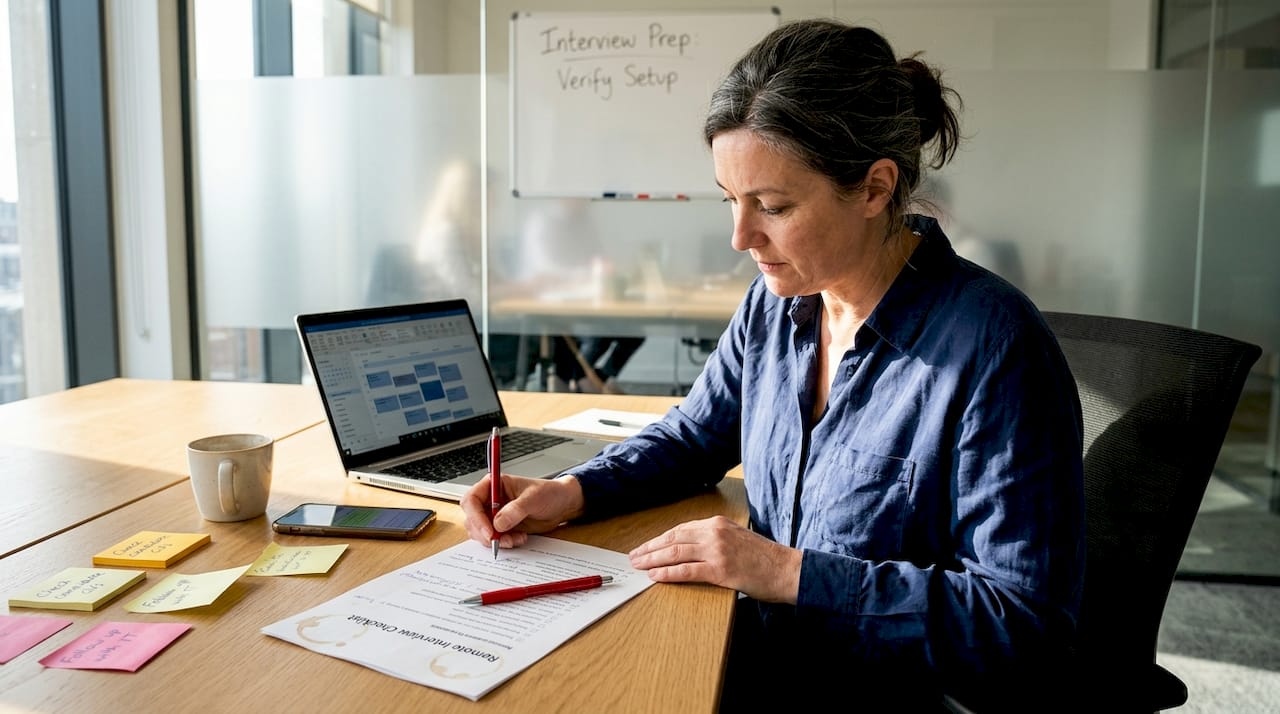
Technical preparation separates successful remote interviews from chaotic experiences. Create detailed checklists covering platform selection, backup communication channels, recording permissions, and interviewer training requirements. Test your entire setup before actual interviews, including screen sharing capabilities, breakout room functionality, and any technical assessment platforms you plan to use. Prepare candidates with clear instructions, system requirements, and troubleshooting resources at least 48 hours before their scheduled time.
| Preparation element | Purpose | Implementation |
|---|---|---|
| Standardised scorecards | Reduce bias and improve consistency | Define 5-7 key competencies with behavioural indicators and rating scales |
| Multi-phase assessments | Test diverse skills comprehensively | Combine skills tests, structured interviews, and async video responses |
| Technical checklists | Prevent disruptions | Test platforms, prepare backups, train interviewers on tools |
| Compliance protocols | Meet EU regulations | Secure data storage, obtain consent, follow EURES guidelines |
Blind hiring techniques enhance both diversity and quality outcomes. Removing names, photos, educational institutions, and other identifying information from initial screening methods for tech hiring forces evaluators to focus purely on demonstrated capabilities. This approach works particularly well for technical assessments and coding challenges where skills speak louder than credentials. Implementing screening without CVs creates fairer opportunities for candidates from non-traditional backgrounds whilst improving your ability to identify genuine talent.
Pro Tip: Conduct mock interviews with your team using your new structured process before launching it with real candidates. This practice reveals unclear questions, scoring ambiguities, and technical issues whilst building interviewer confidence and consistency.
Executing remote interviews effectively in tech roles
Successful remote interview execution follows a systematic three-step funnel that efficiently narrows your candidate pool whilst maintaining fairness. Start with application screening that evaluates skills and experience against role requirements, then advance qualified candidates to technical assessments that simulate actual job tasks. Finally, conduct structured interviews with your top performers, using standardised questions and scoring rubrics throughout. This funnel approach respects candidate time, reduces interviewer workload, and ensures you invest deep evaluation efforts only on genuinely promising individuals.
The STAR method provides a powerful framework for behavioural questions in remote settings. Ask candidates to describe specific Situations, Tasks, Actions, and Results from their past experiences, focusing on scenarios relevant to remote work challenges. Rather than hypothetical questions about what they might do, STAR questions reveal actual behaviours and decision-making patterns. For tech roles, probe situations involving technical problem-solving, collaboration across timezones, handling ambiguous requirements, and managing competing priorities without direct supervision.
Asynchronous video interviews address one of remote hiring’s biggest obstacles: coordinating schedules across European timezones. Adoption of asynchronous video cuts time-to-hire by 40% in pan-European campaigns by allowing candidates to record responses on their schedule whilst giving you flexibility to review submissions when convenient. This format also reveals communication skills, presentation abilities, and comfort with camera-based interaction, all essential for remote team success. Provide clear questions, time limits, and re-recording policies to ensure fair conditions for all participants.
Evaluating remote-specific traits requires deliberate questioning beyond traditional technical and cultural assessments. Probe candidates’ self-motivation by asking how they structure their workday, handle distractions, and maintain productivity without external accountability. Assess asynchronous communication skills through written responses, documentation quality, and their ability to provide context without real-time clarification. Explore timezone management by discussing their experience coordinating across regions, handling meeting schedules, and maintaining work-life boundaries when collaborating globally.
- Prepare your interview environment by testing technology, eliminating distractions, and having backup communication channels ready.
- Open with a brief rapport-building conversation to help candidates relax, then clearly explain the interview structure and timing.
- Ask your structured questions in the same order for every candidate, taking detailed notes on responses and observable behaviours.
- Allow time for candidate questions, treating this as a two-way evaluation that reveals their priorities and research depth.
- Record the session with permission, enabling you to review responses objectively and share with other decision-makers.
- Score immediately after completion using your standardised rubric, capturing fresh impressions before memory fades.
Standardised scoring transforms subjective impressions into objective data that supports defensible hiring decisions. Rate each competency on your defined scale, noting specific evidence that supports your scores. Compare candidates based on these numerical ratings rather than overall feelings, which often reflect unconscious biases. This disciplined approach proves especially valuable when video interviews with AI assistance can help identify patterns and flag inconsistencies that human reviewers might miss.
Pro Tip: Schedule interviews in blocks with 15-minute buffers between sessions. This spacing prevents technical issues from cascading, gives you time to complete scoring whilst memories are fresh, and reduces fatigue that degrades your evaluation quality.
Verifying results and handling common remote interview issues
Systematic results verification prevents costly hiring mistakes by exposing inconsistencies and validating candidate claims. Compare responses across multiple interview phases using your scorecards, looking for alignment between technical test performance, behavioural examples, and asynchronous video presentations. Discrepancies often reveal candidates who excel in one format but struggle in others, suggesting potential gaps in actual capability versus interview performance. This cross-validation becomes particularly important in remote settings where you lack the informal observations that office visits provide.
Vague or rehearsed answers serve as red flags requiring deeper investigation. When candidates provide generic responses lacking specific details, probe with follow-up questions that demand concrete examples. Ask about metrics, outcomes, challenges faced, and lessons learned to distinguish genuine experience from superficial familiarity. Technical setup failures during interviews also warrant attention, as they may indicate a candidate’s actual comfort level with remote work tools despite claims of extensive distributed team experience.
AI tools to assist in objective assessments can analyse speech patterns, detect inconsistencies, and flag potential concerns that human reviewers overlook. These technologies complement rather than replace human judgement, providing data-driven insights that reduce bias and improve decision quality. However, ensure any AI tools comply with European data protection regulations and provide transparency about how they influence hiring decisions. Candidates deserve to understand how technology factors into their evaluation.
| Challenge | Impact | Solution |
|---|---|---|
| Technical disruptions | Unfair assessment, candidate frustration | Offer reschedules, test backup platforms, provide troubleshooting support |
| Vague responses | Difficulty evaluating true capability | Use STAR follow-ups, request specific metrics and outcomes |
| Camera-off candidates | Limited engagement assessment | Set clear expectations, explain importance for role evaluation |
| Timezone coordination | Scheduling delays, limited availability | Implement async video, offer flexible interview windows |
Recognising remote work traits during verification helps predict long-term job success. Review how candidates handled scheduling, technical preparation, and communication throughout the recruitment process itself. Did they respond promptly to emails? Did they test their setup in advance? Did they ask clarifying questions when instructions seemed ambiguous? These behaviours during hiring often mirror their future work patterns, providing valuable predictive data beyond formal interview responses.
Blind hiring methods increase success rates by 50% and better predict skills by forcing evaluators to focus on demonstrated capability rather than credentials or demographics. When verifying results, maintain this discipline by reviewing work samples, technical test outputs, and structured interview scores before considering background information. This sequence prevents anchoring bias where impressive credentials overshadow mediocre performance or vice versa.
Post-interview feedback collection improves your process and enhances candidate experience regardless of hiring outcomes. Survey candidates about technical difficulties, question clarity, and overall fairness perceptions. This input reveals blind spots in your approach whilst demonstrating respect for their time and effort. Strong candidates who receive offers elsewhere will remember positive experiences, potentially returning as future applicants or referring talented colleagues to your organisation.
Common remote interview issues require proactive troubleshooting protocols. When technical problems occur, have clear escalation procedures that quickly switch to backup platforms or reschedule without penalty. For candidates showing promise but raising concerns, consider additional assessment phases rather than making hasty rejection decisions. The investment in thorough verification pays dividends through reduced turnover and stronger team performance once hiring is complete.
Explore advanced recruitment solutions with We Are Over The Moon
Modern recruitment demands tools that match the sophistication of today’s distributed hiring challenges. We Are Over The Moon transforms how European tech companies identify and assess talent by replacing traditional CV screening with comprehensive skill evaluations. Our platform combines AI-powered interviews, technical challenges, cultural matching assessments, and cognitive tests that reveal genuine candidate capabilities beyond credentials. You gain objective insights that reduce bias, accelerate decisions, and improve hiring quality across your entire recruitment funnel.
Trusted by innovative European tech companies, our solutions cut time-to-hire whilst advancing diversity through blind screening methodologies. The platform enables you to match on skills, not CVs, creating fairer opportunities for candidates from non-traditional backgrounds. Structured assessments provide the predictive validity that gut-feel interviews lack, directly addressing the challenges outlined throughout this guide. Explore our AI candidate validation platform to see how leading organisations are transforming remote hiring outcomes. Learn more about We Are Over The Moon and discover how we can elevate your recruitment success in 2026.
Frequently asked questions
What are the key benefits of structured interviews in remote hiring?
Structured interviews improve predictability by 47% and significantly reduce unconscious bias in hiring decisions. They provide clear evaluation criteria that make remote assessments fairer and more consistent across different interviewers and candidate pools. This standardisation proves particularly valuable when coordinating hiring across European markets with diverse cultural contexts.
How can asynchronous video interviews improve hiring in European tech companies?
Asynchronous video interviews reduce time-to-hire by 40% by eliminating the need to coordinate schedules across multiple timezones. They widen access to diverse talent pools throughout Europe by allowing candidates to participate regardless of location or current employment constraints. This flexibility particularly benefits companies seeking specialised skills that are geographically dispersed.
What remote-specific traits should recruiters assess during technical interviews?
Assess self-motivation through questions about daily structure and productivity maintenance without supervision. Evaluate asynchronous communication skills by reviewing written responses, documentation quality, and ability to provide context independently. Probe timezone management capabilities by discussing experience coordinating across regions and maintaining work-life boundaries in distributed teams.
How does blind hiring improve technical recruitment outcomes?
Blind hiring increases success rates by 50% by forcing evaluators to focus purely on demonstrated capabilities rather than credentials or demographics. It better predicts actual job performance because assessments centre on skills tests and work samples instead of proxies like educational pedigree. This approach particularly benefits organisations committed to building diverse, high-performing technical teams.
Recommended
- 7 Screening Methods List to Improve Tech Hiring Success | We Are Over The Moon
- 7 Ways to Improve CV Screening for Tech Hiring Success | We Are Over The Moon
- Video interviews: smarter hiring with AI in 2026 | We Are Over The Moon
- How to Interview with AI: Cut Hiring Time by 35% in 2026 | We Are Over The Moon