Why assessments outperform CVs for hiring success in 2026

CVs have dominated recruitment for decades, yet research reveals a troubling truth: they’re remarkably poor at predicting who will actually succeed in a role. With 77% of employers now encountering AI-generated applications and mounting evidence of unconscious bias in traditional screening, forward-thinking HR leaders are turning to skills assessments as a more accurate, fairer alternative. This guide explains why assessments deliver superior hiring outcomes and how to implement them effectively.
Table of Contents
- The Limits Of Relying Solely On CVs
- Why Skill Assessments Offer A Stronger Hiring Signal
- How AI And Market Trends Are Accelerating The Move Beyond CVs
- Implementing Skills Assessments For Better Recruitment Outcomes
- Transform Your Hiring With Over The Moon’s Skills-Based Solutions
- Frequently Asked Questions About Assessments And CVs
Key takeaways
| Point | Details |
|---|---|
| CVs have limited predictive power | Traditional CV screening explains only about 1% of variance in actual job performance, making it an unreliable hiring signal. |
| Assessments dramatically improve accuracy | Structured skill tests achieve validity coefficients of 0.5 or higher, vastly outperforming CV-based evaluation methods. |
| AI-generated CVs erode trust | The proliferation of AI-assisted applications undermines the already questionable reliability of traditional resumes. |
| Skills-based hiring is now mainstream | 85% of organisations now use skills-based approaches, with 76% deploying assessments to validate capabilities. |
| Implementation drives measurable results | Companies using skill assessments report faster hiring, better candidate quality, and enhanced applicant experience. |
The limits of relying solely on CVs
CV screening remains the default first step in most recruitment processes, yet it suffers from fundamental weaknesses that compromise hiring quality. The subjective nature of CV review means different recruiters often reach vastly different conclusions about the same candidate. What one hiring manager considers impressive experience, another might dismiss as irrelevant.
This subjectivity opens the door to unconscious bias. Research indicates CV screening is influenced by candidate’s name, education, and previous employers, causing unfair evaluations that disadvantage qualified candidates based on factors unrelated to their actual abilities. A candidate’s university, the prestige of their former employer, or even the sound of their name can disproportionately affect their chances.
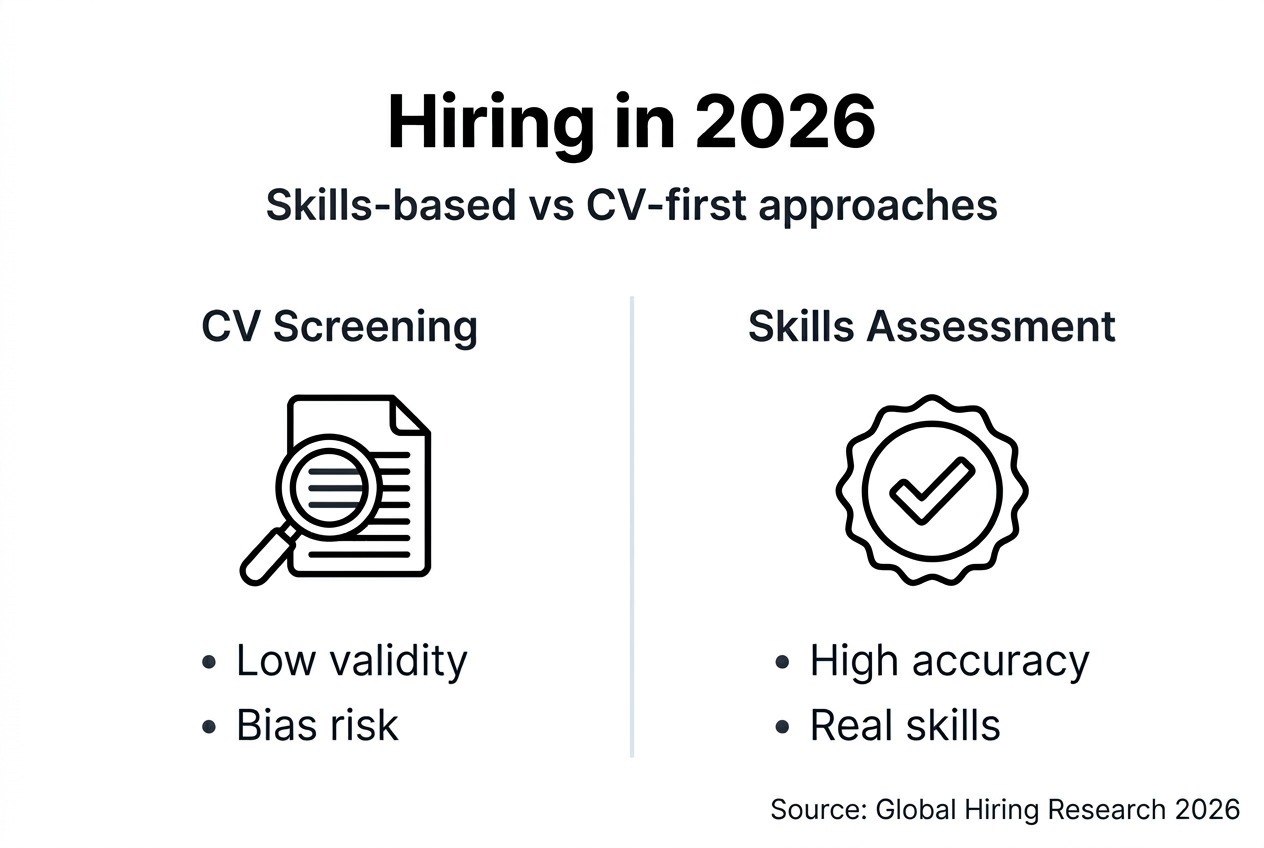
Beyond bias, CVs simply don’t predict job success reliably. Years of education on CVs explain only about 1% of variance in actual job performance. Think about that: nearly everything on a traditional CV has almost no correlation with how well someone will do the job you’re hiring them for.
Common CV screening pitfalls include:
- Overvaluing credentials whilst undervaluing practical skills
- Filtering out career changers who might bring valuable transferable abilities
- Missing capable candidates who lack polished writing skills
- Favouring candidates skilled at self-promotion over actual competence
The advantages of replacing CVs with objective assessments become clear when you consider these limitations. You’re not just reducing bias; you’re fundamentally improving your ability to identify candidates who will actually thrive in the role.
“The correlation between what’s on a CV and what someone can actually do in a job is surprisingly weak. We’re essentially making critical hiring decisions based on a very poor signal.”
Why skill assessments offer a stronger hiring signal
Skill assessments provide objective, measurable data about what candidates can actually do, rather than what they claim on paper. These structured evaluations test real abilities through work samples, cognitive tests, technical challenges, or situational judgement exercises that mirror actual job requirements.
The predictive power of assessments far exceeds traditional CV screening. Structured skill assessments achieve validity coefficients of 0.5 or higher, significantly outperforming CVs. This means assessment results correlate much more strongly with future job performance, giving you a genuinely useful hiring signal.
Adoption rates confirm what the research shows. 85% of organisations now use skills-based hiring, with 76% deploying tests to validate candidate capabilities. This isn’t a fringe trend; it’s becoming standard practice amongst leading employers.
The benefits of AI assessment tools amplify these advantages further by enabling scalable, consistent evaluation. Every candidate receives the same standardised assessment, eliminating the variability inherent in human CV review.
Key advantages of structured assessments include:
- Measuring actual competencies rather than credentials or self-descriptions
- Reducing unconscious bias by focusing on demonstrated abilities
- Identifying hidden talent overlooked by traditional screening methods
- Providing quantifiable data to support hiring decisions
- Creating fairer opportunities for diverse candidates
Assessments also reveal qualities CVs cannot capture: problem-solving approaches, learning agility, cultural alignment, and how candidates perform under realistic job conditions. You gain insight into how they think and work, not just where they’ve worked before.

Pro Tip: Combine different assessment types for the most comprehensive candidate picture. Cognitive ability tests measure learning potential, work samples evaluate technical skills, and structured interviews assess soft skills and cultural fit. Together, they provide far more predictive power than any single method.
The AI in candidate screening enables this multi-faceted approach at scale, allowing you to thoroughly evaluate large applicant pools without overwhelming your recruitment team.
How AI and market trends are accelerating the move beyond CVs
Artificial intelligence has created an ironic problem for CV-based hiring: the same technology meant to help candidates is making resumes less trustworthy than ever. Generative AI tools can now craft compelling CVs, polish language, and embellish experience with remarkable sophistication.
77% of employers encounter AI-generated or AI-assisted applications, worsening CV trustworthiness. When you cannot reliably distinguish between genuine experience and AI-enhanced claims, the entire CV screening process becomes questionable. How do you know if the impressive accomplishments described actually happened, or if they’re algorithmic embellishments?
This reality is driving employers to seek authentic skill signals. 40% of employers are actively moving away from CV-first hiring approaches. They’re prioritising what candidates can demonstrate over what they claim on paper.
Market adoption of skills-based hiring varies by region but shows consistent upward trajectory:
| Region | Skills-Based Adoption Rate | Key Drivers |
|---|---|---|
| United Kingdom | 82% of employers | Tight labour market, diversity initiatives, AI disruption |
| Netherlands | 65% growing to 80% by 2030 | Government-backed skills matching programmes |
| Spain | 58% increasing rapidly | EU digital skills agenda, youth unemployment solutions |
The Netherlands presents a particularly interesting case. The Netherlands initiative aims for 80% of workers in jobs matching their skills by 2030. This ambitious national goal reflects recognition that traditional credential-based hiring leaves talent untapped and workers mismatched.
Several converging trends explain this shift:
- Growing skills gaps make demonstrated abilities more valuable than formal credentials
- Remote work expands talent pools, requiring objective evaluation methods
- Diversity and inclusion efforts demand fairer, bias-reduced screening
- AI proliferation makes paper credentials less trustworthy
The AI trends in recruitment 2026 show assessment technology becoming more sophisticated whilst remaining user-friendly. Modern platforms deliver candidate-friendly experiences that feel nothing like the clunky tests of previous decades.
“We’re witnessing a fundamental shift from ‘who you know and where you studied’ to ‘what you can actually do.’ Skills assessments provide the evidence that CVs simply cannot.”
The advantages of replacing CVs extend beyond individual hiring decisions to strategic workforce planning. When you have objective skills data, you can identify capability gaps, plan training programmes, and build more effective teams.
Implementing skills assessments for better recruitment outcomes
Theory matters little without practical application. Successful implementation of skills-based hiring requires thoughtful design, appropriate technology, and commitment to candidate experience.
Unilever’s transformation illustrates what’s possible at scale. Unilever reduced 70,000 person-hours on manual interview tasks by employing AI-driven assessments. They replaced campus recruitment and CV screening with game-based assessments, video interviews, and job simulations. Results included faster hiring, better quality candidates, and dramatically improved diversity.
Crucially, Unilever provides personalised feedback to all applicants, enhancing candidate experience. Even rejected candidates appreciated understanding their strengths and development areas. This transforms recruitment from a black box into a developmental opportunity.
Your implementation roadmap should address several key areas:
- Define the specific skills and competencies each role genuinely requires
- Select or design assessments that validly measure those capabilities
- Ensure assessments reflect actual job tasks and challenges
- Train hiring managers to interpret and use assessment data effectively
- Provide all candidates with meaningful feedback regardless of outcome
The interview with AI guidance can complement structured assessments by ensuring consistent evaluation whilst maintaining the human connection candidates value.
Pro Tip: Start small with assessments for high-volume or hard-to-fill roles where the impact will be most visible. Gather data, refine your approach, then expand to other positions. This iterative method builds internal confidence whilst minimising risk.
Compare traditional CV screening against skills assessment approaches:
| Factor | CV Screening | Skills Assessment |
|---|---|---|
| Predictive validity | Low (0.1-0.2) | High (0.5+) |
| Bias susceptibility | High | Low with proper design |
| Candidate experience | Often frustrating, no feedback | Engaging, developmental |
| Scalability | Labour intensive | Highly scalable with technology |
| Time to hire | Often longer due to poor matching | Faster with better quality |
The benefits of AI assessment become tangible when you measure outcomes. Track metrics like time-to-hire, quality-of-hire ratings, new employee retention, and hiring manager satisfaction. Most organisations implementing skills assessments see improvement across all these dimensions.
Remember that skills-based hiring doesn’t mean ignoring experience entirely. Rather, it means prioritising demonstrated capabilities and using experience as supporting context. A candidate with less prestigious credentials but strong assessment performance often outperforms the CV-perfect candidate who cannot demonstrate the skills.
Transform your hiring with over the moon’s skills-based solutions
Moving beyond CV screening requires the right tools and expertise. We Are Over The Moon specialises in helping UK, Netherlands, and Spanish HR teams implement skills-first recruitment that delivers measurably better hiring outcomes.
Our platform replaces traditional CV screening with engaging assessments including AI interviews, company-specific challenges, cultural matching, cognitive tests, and video pitches. You gain objective insight into what candidates can actually do, whilst they experience a recruitment process that respects their time and showcases your employer brand.
Whether you’re hiring for three positions or three hundred, our technology scales effortlessly whilst maintaining the personalised experience candidates expect. Discover how to match on skills not CVs and build stronger teams faster. Learn more about our team and mission and how we’re helping progressive employers across Europe rethink recruitment.
Frequently asked questions about assessments and CVs
Are CVs completely useless in modern recruitment?
CVs aren’t worthless, but they’re vastly overweighted in most hiring processes. They provide useful context about career progression and experience but shouldn’t be the primary screening tool. Use CVs as supplementary information whilst making assessments your main evaluation method.
Will AI completely replace human recruiters in the hiring process?
No, AI augments rather than replaces human judgement. Technology excels at objective skill evaluation and initial screening, freeing recruiters to focus on relationship building, cultural assessment, and final decision making. The why use AI interviews approach combines technological efficiency with essential human insight.
How do skills assessments reduce bias compared to CV screening?
Assessments focus on demonstrated abilities rather than demographic markers or credentials that trigger unconscious bias. When designed properly, they evaluate every candidate using identical criteria. This standardisation removes much of the subjective judgement where bias typically enters the process.
What types of assessments work best for different roles?
Technical roles benefit from work samples and coding challenges. Customer-facing positions need situational judgement tests and communication assessments. Leadership roles require case studies and structured behavioural interviews. The AI interviews explained resource details how different assessment types map to various competencies.
How long does it take to implement skills-based hiring?
Timelines vary based on organisation size and commitment level. Pilot programmes for specific roles can launch within weeks. Full organisational transformation typically takes several months as you define competencies, select tools, train teams, and refine processes. Most organisations see positive results from initial implementations quickly, building momentum for broader adoption.
Recommended
- Advantages of replacing CVs: 74% faster hiring with AI assessments | We Are Over The Moon
- Why Replace CV Screening: Unlocking Better Hires | We Are Over The Moon
- How to Screen Without CVs for Better Hiring Results | We Are Over The Moon
- Benefits of AI Assessment: Boosting Recruitment Quality | We Are Over The Moon