Unlock success with soft skills assessment in recruitment

Across Europe, 73% of businesses now prioritise skills-based hiring, yet 69% struggle to match candidates effectively. Traditional CV screening misses the interpersonal abilities that determine workplace success. Soft skills like adaptability, communication, and emotional intelligence have become critical differentiators in competitive talent markets. This article explores innovative assessment methods transforming European recruitment, from AI-driven interviews to gamified evaluations, and provides actionable strategies for HR professionals seeking to enhance hiring outcomes whilst reducing bias and turnover.
Table of Contents
- Key takeaways
- Why soft skills assessments matter more than ever
- Innovative methods for evaluating soft skills effectively
- Challenges and considerations in implementing soft skills assessments
- Putting soft skills assessment into practice: effective strategies for HR
- Discover tailored soft skills assessment solutions
- Frequently asked questions
Key Takeaways
| Point | Details |
|---|---|
| Skills based hiring priority | The trend across Europe shows 73 per cent prioritising skills based hiring, with 69 per cent still struggling to match candidates accurately. |
| Bias reduction with AI | AI driven interviews and gamified assessments offer objective insights and reduce reliance on CV impressions. |
| Culture and language tailoring | Cultural and language biases remain challenges requiring tailored assessment approaches. |
| Faster hires via assessments | Effective soft skills evaluation can reduce turnover and shorten recruitment time. |
Why soft skills assessments matter more than ever
The recruitment landscape has fundamentally shifted from credential-focused screening to competency-based evaluation. Traditional hiring methods relied heavily on CVs, academic qualifications, and work history to predict candidate success. However, research consistently demonstrates that interpersonal abilities, problem-solving capacity, and emotional intelligence determine long-term job performance more reliably than technical credentials alone.
European organisations increasingly recognise this reality. In Ireland, 73% of businesses prioritise skills-based hiring in 2026, reflecting a continent-wide trend towards competency evaluation. Yet this shift presents challenges: 69% of these same organisations struggle with accurate skills matching, highlighting the gap between intention and execution. The disconnect stems from outdated assessment tools that fail to capture nuanced interpersonal capabilities.
Modern recruitment faces three interconnected challenges:
- Identifying candidates whose soft skills align with organisational culture and team dynamics
- Measuring abstract qualities like adaptability, resilience, and collaboration objectively
- Reducing unconscious bias whilst maintaining assessment efficiency at scale
Soft skills directly influence workplace outcomes in measurable ways. Employees with strong communication abilities resolve conflicts faster, reducing team friction. Adaptable workers navigate organisational change more effectively, maintaining productivity during transitions. Emotionally intelligent team members build stronger stakeholder relationships, improving client retention and internal collaboration.
“The ability to work effectively with others, communicate clearly, and adapt to changing circumstances determines success far more than technical knowledge alone. Organisations that assess these capabilities systematically gain competitive advantage in talent acquisition.”
Companies adopting skills assessments report immediate benefits. Early adopters observe improved quality of hire, with new employees demonstrating better cultural fit and faster time-to-productivity. Assessment-driven recruitment also reduces expensive mis-hires, as candidates undergo rigorous evaluation before receiving offers. These outcomes justify the investment in sophisticated evaluation tools, particularly as labour markets tighten and talent acquisition costs rise.
The shift towards soft skills assessment reflects broader economic changes. Automation increasingly handles routine technical tasks, elevating the importance of uniquely human capabilities. As artificial intelligence assumes more operational responsibilities, interpersonal skills, creative problem-solving, and emotional intelligence become the primary differentiators between adequate and exceptional employees.
Innovative methods for evaluating soft skills effectively
Cutting-edge technologies and validated methodologies are transforming how organisations measure interpersonal capabilities. These tools move beyond subjective interviewer impressions to provide objective, data-driven insights into candidate potential.
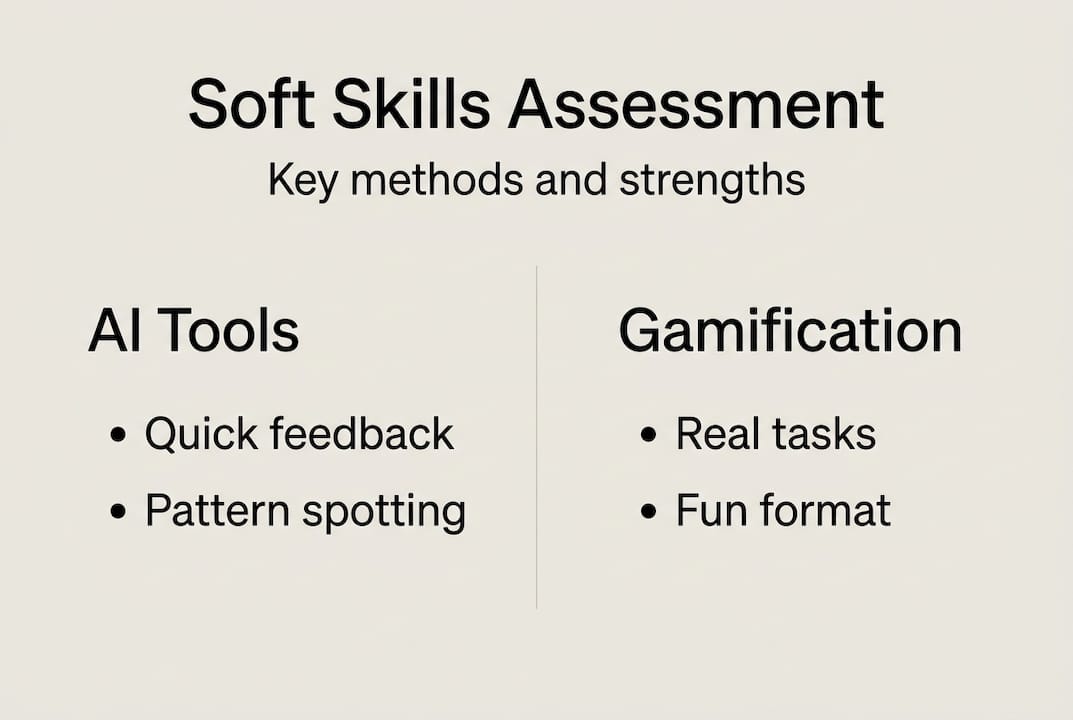
Artificial intelligence platforms analyse candidate responses across multiple dimensions simultaneously. AI interviews evaluate verbal communication patterns, response consistency, and problem-solving approaches without human bias. Natural language processing identifies communication clarity, whilst machine learning algorithms detect behavioural patterns correlating with workplace success. These systems process thousands of data points per candidate, revealing insights invisible to traditional screening methods.
Gamified assessments engage candidates through interactive scenarios that mirror real workplace challenges. Participants navigate simulated situations requiring collaboration, decision-making under pressure, and adaptive thinking. Combining gamified tools with validated psychometrics reduces bias whilst improving assessment efficiency across European hiring contexts. Game mechanics increase candidate engagement, reducing assessment fatigue whilst generating rich behavioural data.

Real-world results demonstrate the power of these approaches. Unilever implemented AI-driven recruitment assessments that reduced employee turnover by 50% in corporate roles. The company eliminated first-round interviews entirely, replacing them with gamified cognitive and soft skills evaluations. This transformation cut recruitment time dramatically whilst improving quality of hire metrics across all assessed dimensions.
Psychometric instruments provide scientific validation for soft skills measurement. Personality assessments based on established psychological frameworks like the Big Five model predict workplace behaviour with statistical reliability. Situational judgement tests present realistic scenarios, evaluating how candidates prioritise competing demands and navigate interpersonal complexity. When properly validated, these tools offer consistent measurement across diverse candidate populations.
Pro Tip: Select assessment tools that demonstrate bias resistance through independent validation studies and align with EU data protection standards. Prioritise platforms offering transparent scoring methodologies and candidate feedback mechanisms to maintain trust and legal compliance.
Different assessment methods offer distinct advantages for various hiring contexts:
| Assessment method | Primary strengths | Key limitations | Best use cases |
|---|---|---|---|
| AI-powered interviews | Scalability, consistency, reduced human bias | Requires substantial data for accuracy | High-volume recruitment, initial screening |
| Gamified assessments | Candidate engagement, realistic scenario testing | Development costs, cultural adaptation needs | Graduate hiring, customer-facing roles |
| Psychometric testing | Scientific validation, predictive accuracy | Candidate resistance, potential cultural bias | Leadership positions, team composition |
| Assessment centres | Comprehensive evaluation, multiple observer input | Resource-intensive, time-consuming | Senior appointments, critical hires |
| Video pitch analysis | Communication skills visibility, personality insights | Subjective interpretation risk, technology barriers | Sales roles, public-facing positions |
Integrating multiple methods creates robust evaluation frameworks. Organisations increasingly combine AI screening with psychometric validation and human interview stages, leveraging each approach’s strengths whilst mitigating individual weaknesses. This layered methodology improves prediction accuracy whilst maintaining candidate experience quality throughout the recruitment journey.
The European context demands particular attention to AI implementation standards. Forthcoming AI Act regulations require transparency in automated decision-making, algorithmic bias monitoring, and human oversight of high-stakes assessments. Forward-thinking organisations proactively adopt compliant platforms, future-proofing recruitment processes against regulatory changes.
Challenges and considerations in implementing soft skills assessments
Despite their potential, soft skills assessments face significant implementation barriers requiring strategic mitigation. Cultural differences, language variations, and sector-specific requirements complicate standardised evaluation across Europe’s diverse markets.
Bias remains a persistent challenge in assessment design and delivery. Text-based evaluations often disadvantage non-native speakers, even when language proficiency isn’t job-critical. Cultural and language bias affects assessment accuracy, but gamified and image-based tools reduce these distortions effectively. Visual and interactive assessments minimise language dependency, creating fairer evaluation conditions for multilingual candidate pools.
Successful bias mitigation requires multi-faceted strategies:
- Validating assessment tools across diverse demographic groups before deployment
- Offering assessments in multiple languages with culturally adapted scenarios
- Training assessors to recognise and counteract unconscious bias in interpretation
- Regularly auditing assessment outcomes for disparate impact across protected characteristics
- Implementing blind evaluation protocols where candidate demographics remain hidden
Sector-specific tailoring significantly improves assessment relevance and predictive accuracy. Generic soft skills frameworks fail to capture nuanced requirements across industries. Healthcare roles demand different interpersonal capabilities than technology positions or financial services. Tailoring questionnaires for sectors like nursing in Poland proves crucial for assessment accuracy, as culturally specific patient interaction norms influence what constitutes effective communication.
European skills frameworks provide valuable benchmarking foundations. The European Skills, Competences, Qualifications and Occupations (ESCO) classification and European Skills and Jobs Survey (ESJS) offer standardised taxonomies for describing and measuring competencies. Aligning internal assessment criteria with these frameworks facilitates cross-border talent mobility whilst ensuring consistent evaluation standards across multinational operations.
Legal compliance adds complexity to assessment implementation. The General Data Protection Regulation (GDPR) imposes strict requirements on candidate data collection, processing, and storage. Assessment platforms must demonstrate lawful basis for data processing, provide transparent privacy notices, and enable candidate rights to access and deletion. Non-compliance risks substantial fines and reputational damage.
Pro Tip: Collaborate with local HR experts and industrial psychologists when deploying assessments across multiple European markets. Their insights ensure cultural appropriateness and regulatory compliance whilst identifying sector-specific competency requirements that generic tools might overlook.
Technology barriers affect both organisations and candidates. Smaller enterprises often lack resources for sophisticated assessment platforms, whilst some candidates face digital access challenges. Ensuring assessment accessibility across device types and internet connection qualities prevents inadvertent exclusion of qualified talent. Mobile-optimised assessments with offline capability options broaden participation whilst maintaining evaluation rigour.
Candidate experience concerns require careful management. Lengthy or repetitive assessments increase dropout rates, particularly for passive candidates with multiple opportunities. Balancing comprehensive evaluation with respect for candidate time demands thoughtful assessment design. Providing clear timelines, progress indicators, and meaningful feedback improves completion rates whilst enhancing employer brand perception.
Implementing effective talent screening requires ongoing refinement based on outcome data. Organisations should track assessment validity by correlating scores with subsequent job performance, retention rates, and manager satisfaction. This evidence-based approach identifies which evaluation components predict success most reliably, enabling continuous improvement of the screening workflow.
Putting soft skills assessment into practice: effective strategies for HR
Transitioning from traditional recruitment to competency-based evaluation requires systematic implementation and stakeholder engagement. These practical steps enable HR teams to integrate soft skills assessments effectively whilst maximising return on investment.
-
Define role-specific competency frameworks. Collaborate with hiring managers to identify critical soft skills for each position. Move beyond generic lists to specify observable behaviours indicating competency presence. Document how each skill manifests in daily work activities and contributes to role success.
-
Select validated assessment tools aligned with organisational needs. Evaluate platforms based on scientific validation, bias resistance, candidate experience quality, and compliance with European regulations. Pilot tools with small candidate groups before full deployment, gathering feedback from both assessors and participants.
-
Integrate assessments strategically within recruitment workflows. Position soft skills evaluation at optimal funnel stages to maximise efficiency. Early-stage screening assessments filter large applicant volumes, whilst comprehensive evaluations suit final-round candidates. Avoid assessment overload by selecting targeted tools for specific decision points.
-
Train hiring teams on assessment interpretation and bias awareness. Ensure managers understand assessment outputs, including score meanings, confidence intervals, and appropriate weight in hiring decisions. Emphasise that assessments inform rather than replace human judgement, particularly for cultural fit evaluation.
-
Communicate assessment purpose and process transparently to candidates. Explain how soft skills evaluation benefits both organisation and applicant by ensuring role alignment. Provide clear instructions, technical support, and reasonable completion timeframes. Offer feedback to unsuccessful candidates, enhancing employer brand whilst supporting professional development.
-
Monitor assessment outcomes and refine continuously. Track metrics including completion rates, time-to-hire, quality-of-hire indicators, and diversity statistics. Analyse whether assessment scores correlate with subsequent performance ratings and retention. Adjust tool selection and weighting based on empirical evidence.
Measurable benefits justify this implementation effort. Organisations adopting soft skills assessments reduce recruitment time by 45% and turnover by 50%, substantially boosting organisational success through improved hiring accuracy. These improvements translate directly to bottom-line impact through reduced replacement costs, faster productivity ramp-up, and enhanced team stability.
Practical tips enhance implementation success:
- Begin with high-impact roles where mis-hires prove most costly, demonstrating ROI before broader rollout
- Involve successful current employees in validation studies to establish performance benchmarks
- Create assessment libraries for common role families, reducing setup time for similar positions
- Establish governance protocols for assessment data access, retention, and usage to ensure compliance
- Celebrate early wins publicly to build organisational confidence in competency-based hiring
Engaging stakeholders beyond HR proves critical for sustainable adoption. Finance teams need ROI evidence through reduced turnover costs and improved productivity metrics. Senior leadership requires strategic narrative connecting talent quality to business outcomes. Hiring managers want practical tools simplifying candidate comparison and selection decisions. Addressing each group’s priorities builds coalition supporting long-term transformation.
Data-driven decision-making elevates workforce quality systematically. Assessment analytics reveal patterns invisible in traditional recruitment. Which competencies most strongly predict performance in specific roles? Do certain assessment combinations improve prediction accuracy? How do soft skills profiles differ between high and average performers? These insights enable progressive refinement of hiring criteria, creating competitive advantage through superior talent selection.
Comparing assessments versus CVs demonstrates clear advantages in predictive validity and bias reduction. Whilst CVs indicate past experiences, assessments measure current capabilities and future potential. This forward-looking approach proves particularly valuable in dynamic industries where yesterday’s experience poorly predicts tomorrow’s success. Understanding why assessment tools improve efficiency helps HR teams articulate value to sceptical stakeholders.
Discover tailored soft skills assessment solutions
Navigating the complexity of modern recruitment demands sophisticated tools designed specifically for European talent markets. We Are Over The Moon specialises in replacing traditional CV screening with comprehensive assessment platforms that evaluate candidates holistically.
Our AI-powered platform combines intelligent interviews, company-specific challenges, cultural matching algorithms, cognitive testing, and video pitch analysis. This integrated approach captures the full spectrum of candidate capabilities whilst maintaining efficiency at scale. Every tool meets stringent EU compliance standards, ensuring your recruitment process respects candidate rights whilst delivering actionable insights.
Discover how tailored assessment solutions transform hiring outcomes. Explore our approach to skills-based recruitment or learn more about our mission to revolutionise talent acquisition across Europe. Our expertise helps organisations build high-performing teams through objective, bias-resistant evaluation methods.
Frequently asked questions
What are soft skills and why do they matter in recruitment?
Soft skills encompass interpersonal abilities like communication, emotional intelligence, adaptability, and collaboration that enable effective workplace interaction. Unlike technical competencies specific to particular roles, these transferable capabilities determine how individuals navigate relationships, solve problems, and contribute to organisational culture. Research consistently shows soft skills predict job performance and retention more reliably than credentials alone, making them essential evaluation criteria for forward-thinking recruitment strategies.
How do AI and gamified assessments improve soft skills evaluation?
Artificial intelligence analyses candidate responses across multiple dimensions simultaneously, identifying patterns correlating with workplace success without human bias. Gamified assessments engage participants through interactive scenarios mirroring real challenges, generating rich behavioural data whilst improving candidate experience. These approaches provide objective measurement of abstract qualities like adaptability and problem-solving that traditional interviews struggle to assess consistently. Combined with psychometric validation, they deliver scientifically robust insights at scale.
What challenges should HR consider when adopting soft skills assessments across Europe?
Cultural and language differences create bias risks requiring tailored approaches for diverse European markets. Text-heavy assessments disadvantage non-native speakers, whilst culturally specific scenarios may confuse international candidates. Compliance with GDPR and forthcoming AI Act regulations demands careful platform selection and data governance. Sector-specific competency requirements mean generic assessments often miss critical role nuances. Successful implementation requires local expertise, validated tools, and ongoing bias monitoring across demographic groups.
Can soft skills assessments reduce hiring time and employee turnover?
Yes, empirical evidence demonstrates substantial improvements in both metrics. Organisations implementing comprehensive soft skills evaluation report up to 45% faster recruitment cycles through efficient early-stage screening and better candidate shortlisting. Employee turnover decreases by as much as 50% when hiring decisions incorporate objective competency assessment, as improved skills matching ensures stronger role fit and cultural alignment. These benefits compound over time, creating competitive advantage through superior workforce quality and stability.
Recommended
- Why assessments outperform CVs for hiring success in 2026 | We Are Over The Moon
- Why candidate assessment tools improve hiring efficiency | We Are Over The Moon
- How to Screen Without CVs for Better Hiring Results | We Are Over The Moon
- Master Effective Screening Workflow for Modern Recruitment | We Are Over The Moon