Why cultural alignment matters: boost performance and retention

TL;DR:
- Poor cultural fit can increase turnover by up to 50% and cost an entire salary per bad hire.
- True cultural alignment involves shared values, purpose, and behavioral consistency, boosting commitment.
- Shifting from hiring for fit to adding diverse perspectives enhances innovation and long-term performance.
Skills get candidates through the door. Cultural alignment is what keeps them there. Many HR professionals across Europe are still treating cultural fit as a nice-to-have, when the evidence tells a very different story. Poor cultural fit can drive up turnover rates by as much as 50% and cost your organisation the equivalent of an entire annual salary per bad hire. This guide cuts through the noise, offering practical, evidence-backed strategies to help you recruit for genuine alignment, build stronger teams, and retain the talent you work so hard to find.
Table of Contents
- What is cultural alignment and why does it matter?
- The real cost of ignoring cultural alignment
- Culture fit vs culture add: Diversity without groupthink
- How to recruit for cultural alignment in modern teams
- The overlooked truth: Cultural alignment demands systems, not slogans
- Take the next step: Elevate your hiring results
- Frequently asked questions
Key Takeaways
| Point | Details |
|---|---|
| Retention boost | Cultural alignment cuts turnover and reduces hiring costs significantly. |
| Performance gains | Value-aligned teams are more productive, engaged, and committed at work. |
| Diversity advantage | Recruiting for ‘culture add’ increases diversity and boosts profitability. |
| Systematic approach | Ongoing, system-supported alignment outperforms one-off initiatives. |
What is cultural alignment and why does it matter?
Cultural alignment is not the same as hiring people who remind you of yourself. It is the degree to which an employee’s values, motivations, and working style genuinely connect with those of the organisation. This is a meaningful distinction. Organisational culture fit is often misunderstood as a preference for similar personalities or shared hobbies, which is where things go wrong.
True cultural alignment is about shared purpose. It asks whether a candidate believes in what the organisation is trying to achieve and whether they will thrive within its ways of working. That is a much richer question than “will they get along with the team?”
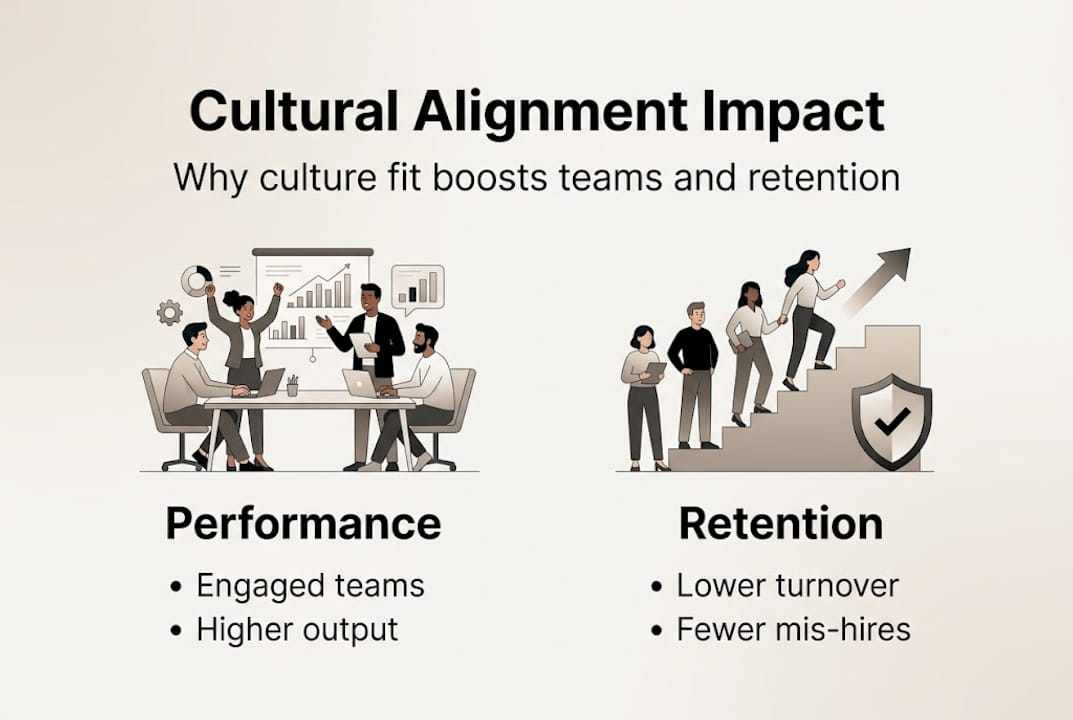
The strategic value here is enormous. When people feel genuinely connected to the mission and values of their employer, they bring more energy, more creativity, and more commitment to their work. They are not just completing tasks. They are invested.
Here are the core elements that make up genuine cultural alignment:
- Shared values: The candidate’s personal values mirror the organisation’s stated and lived principles.
- Team synergy: The individual’s working style complements and strengthens the existing team dynamic.
- Mission connection: The candidate feels personally motivated by the organisation’s broader purpose.
- Behavioural consistency: The way someone acts day-to-day reflects the culture you are trying to build.
- Adaptability: The person can grow with the culture as the organisation evolves.
The research backs this up powerfully. As multiple meta-analyses confirm:
“Value-aligned employees show 30% higher organisational commitment, greater job satisfaction, and lower turnover intentions.”
That is not a marginal gain. That is a transformational shift in how your workforce shows up. And yet, many recruitment processes still rely on gut instinct and CV screening to make these judgements. We can do so much better. Critics of traditional culture fit hiring rightly point out that it often masks bias and limits diversity. The answer is not to abandon alignment thinking, but to make it more rigorous, fair, and evidence-based.
The real cost of ignoring cultural alignment
Now that we understand the core of cultural alignment, what happens when it is overlooked? The short answer: it is expensive. Very expensive.
Turnover is the most visible cost, but it is far from the only one. When a new hire does not align with the team’s values, productivity drops, morale suffers, and managers spend disproportionate time managing friction rather than driving results.

Consider this striking finding from productivity research: poor manager-employee value alignment reduces productivity four times more than gender mismatches. In one documented case, a 23% productivity decline translated into a loss of €180,000 annually. That is a single misaligned hire costing nearly a fifth of a million euros every year.
| Cost factor | Impact |
|---|---|
| Turnover rate increase | Up to 50% higher with poor cultural fit |
| Rehiring cost | Equivalent to one full annual salary |
| Productivity decline | Up to 23% with value misalignment |
| Annual financial loss | Up to €180,000 per misaligned team member |
| Manager time lost | Disproportionate effort managing conflict |
These numbers are not abstract. They represent real budget, real time, and real team morale. Organisations focused on reducing tech turnover through cultural matching have seen measurable improvements in retention and team cohesion.
Statistic to remember: Poor value alignment reduces productivity 4x more than demographic mismatches, with documented cases showing €180k in annual losses from a single misaligned hire.
Pro Tip: Use a cultural fit checklist during your recruitment process to catch alignment red flags before they become costly problems. Structured assessments at the screening stage are far more reliable than interview impressions alone.
The good news is that these costs are largely preventable. With the right tools and a more intentional approach to recruitment, you can screen for alignment early and confidently.
Culture fit vs culture add: Diversity without groupthink
Seeing the risks of ignoring cultural alignment, it is equally important to recognise that not all alignment strategies are beneficial. Hiring purely for “culture fit” can quietly undermine your organisation in ways that are hard to spot until the damage is done.
When teams hire for fit alone, they tend to recruit people who look, think, and behave similarly. This feels comfortable in the short term. Over time, it creates homogeneity, reinforces bias, and leads to groupthink. Diverse perspectives get filtered out before they ever reach the table.
The smarter approach is “culture add.” Rather than asking “does this person fit our culture?” you ask “what will this person bring to our culture that we currently lack?”
| Dimension | Culture fit | Culture add |
|---|---|---|
| Definition | Similarity to existing team | Complementary values and new perspectives |
| Team impact | Comfortable but static | Dynamic and innovative |
| Risk of groupthink | High | Low |
| Diversity outcomes | Limited | Strong |
| Long-term performance | Plateaus | Grows |
The business case for this shift is compelling. As McKinsey research confirms:
“Diverse, value-aligned teams achieve 36% higher profitability than less diverse or homogenous groups.”
That is a remarkable return on a more thoughtful hiring philosophy. Here is how to make the shift from fit to add in your own organisation:
- Rewrite your job descriptions to focus on values and mission rather than personality traits.
- Train your hiring managers to recognise and challenge similarity bias during interviews.
- Use structured assessments that evaluate values and thinking styles, not just experience.
- Involve diverse panels in hiring decisions to reduce individual blind spots.
- Celebrate difference in your onboarding and team culture so new perspectives feel welcome.
Explore cultural matching tips that help you build diverse, high-performing teams without sacrificing alignment. You can also see how AI-based culture matching is making this process faster and more accurate than ever before.
How to recruit for cultural alignment in modern teams
With team diversity and purpose in focus, let us drill down into actionable ways to recruit for true cultural alignment. Good intentions are not enough. You need systems.
Research on strategic HR systems in Europe confirms that cultural alignment is essential for team performance, but only when it is supported by structured, scalable practices. High-performance work systems (HPWS) that embed alignment into every stage of the talent lifecycle consistently outperform organisations that treat culture as a side conversation.
Here are the most effective strategies for recruiting with cultural alignment at the centre:
- AI-driven candidate assessments: Use platforms that evaluate values, cognitive style, and cultural indicators beyond the CV. Tools that support improving candidate matching reduce guesswork significantly.
- Scenario-based interviews: Present candidates with real workplace dilemmas and observe how they reason through them. This reveals values in action, not just on paper.
- Values mapping exercises: Ask candidates to rank or respond to a set of organisational values before the interview. This creates a structured basis for comparison.
- Team involvement in hiring: Include future colleagues in the process. They often spot alignment signals that hiring managers miss.
- Structured debrief frameworks: After interviews, use consistent scoring criteria to evaluate cultural indicators rather than relying on general impressions.
The right hiring assessment tools make these practices scalable, even for high-volume recruitment. Pair them with cultural fit assessments to build a complete picture of each candidate.
Pro Tip: Alignment does not stop at the offer stage. Build regular values check-ins into your onboarding and performance review cycles. This turns a one-off hiring decision into an ongoing, evolving relationship between the person and the organisation.
You can also draw inspiration from diversity hiring strategies that balance alignment with inclusion, ensuring your process is both rigorous and fair.
The overlooked truth: Cultural alignment demands systems, not slogans
Here is something we see far too often. An organisation publishes a beautiful set of values on their website, runs a culture workshop, and then continues hiring exactly as before. That is not cultural alignment. That is cultural theatre.
Real alignment is a continuous, measured process. It requires systems that embed values into how you hire, onboard, develop, and retain people. It means regularly asking whether your lived culture matches your stated culture, and being honest when the answer is no.
European organisations that are genuinely succeeding at this are not doing anything magical. They are being consistent. They use structured assessments, involve diverse stakeholders in hiring, and treat aligning talent and culture as a strategic priority rather than an HR side project.
The uncomfortable truth is that feel-good cultural statements without integrated practices can actually make things worse. They create a gap between expectation and reality that erodes trust faster than having no stated values at all. If you want cultural alignment to drive performance, build it into your systems. Make it measurable. Make it accountable. That is where the real results live.
Take the next step: Elevate your hiring results
We are genuinely excited about what is possible when organisations move beyond CV screening and start hiring for real alignment. The evidence is clear, the tools are ready, and the results speak for themselves.
At We Are Over The Moon, we help HR teams and business leaders across Europe replace outdated screening with skills-based matching that actually works. Our platform combines AI interviews, cognitive tests, video pitches, and cultural matching to give you a complete picture of every candidate. Ready to see the difference? Explore AI candidate validation and discover about our approach to building teams that truly thrive together.
Frequently asked questions
How does cultural alignment reduce employee turnover?
Employees who feel culturally aligned are more likely to stay, lowering turnover rates and cost per hire. Poor cultural fit can increase turnover by up to 50% and cost the equivalent of a full annual salary per replacement.
Is hiring for culture fit the same as for cultural alignment?
No. Culture fit focuses on similarity, which risks homogeneity and groupthink, while alignment values shared purpose within a genuinely diverse team. The two approaches lead to very different outcomes.
Which recruitment tools best support cultural alignment?
Structured interviews, values-mapping assessments, and AI-driven candidate platforms offer effective alignment screening. Strategic HR systems that embed these tools into the full talent lifecycle deliver the strongest results.
Can strong cultural alignment improve business profitability?
Absolutely. Diverse, value-aligned teams are up to 36% more profitable than less aligned or homogenous groups, according to McKinsey research.