What is one-way interview: Boost hiring efficiency

Many HR managers wonder if one-way interviews truly engage candidates. Data shows that over 70% of candidates prefer asynchronous video interviews for flexibility and authentic self-expression. This article will explain what one-way interviews are, how AI powers them, their benefits for reducing bias and speeding hiring, and best practices for implementation in 2026.
Table of Contents
- Understanding One-Way Interviews: Definition And Mechanism
- How AI Enhances One-Way Interviews
- Benefits And ROI Of One-Way AI Interviews
- Common Misconceptions About One-Way Interviews
- Comparing One-Way Interviews With Traditional Methods
- Best Practices For Implementing One-Way Interviews In HR
- Case Studies And Real-World Applications In Europe
- Explore How We Help You Implement AI-Driven One-Way Interviews
- Frequently Asked Questions
Key takeaways
| Point | Details |
|---|---|
| One-way interviews are asynchronous video assessments | Enable scalable, efficient candidate screening without live coordination. |
| AI integration automates scoring | Improves recruiter efficiency by up to 40% through objective analysis. |
| Structured format reduces unconscious bias | Increases diversity representation by up to 25% in shortlisted candidates. |
| Significant time and cost savings | Cut hiring time by up to 50% and enhance panel scoring consistency by 30%. |
| Best practices drive success | Standardised questions, trained diverse panels, and clear candidate communication are essential. |
Understanding one-way interviews: definition and mechanism
One-way interviews are asynchronous video assessments with predefined questions recorded by candidates without live interaction. Commonly used by 60% of large European organisations, they enable efficient initial screening at scale. Candidates complete interviews on their own schedule, eliminating coordination challenges.
This format supports standardisation in recruitment by replacing initial live interview rounds. It fits as a complement to later-stage live interviews, not a replacement. Defining AI interviews in HR tech shows how this technology transforms early-stage candidate evaluation.
Key characteristics include:
- Preset questions ensure every candidate answers identical prompts
- Candidates record video responses within specified time windows
- Recruiters review recordings asynchronously, fitting evaluations into their schedules
- Standardised scoring rubrics enable objective comparison across candidates
- Integration with applicant tracking systems streamlines workflow management
The mechanism centres on removing scheduling friction whilst maintaining rigorous evaluation standards. This balance makes one-way interviews particularly valuable for high-volume recruitment.
How AI enhances one-way interviews
AI employs natural language processing and facial analysis to objectively score candidates and prioritise top fits. This technology improves recruiter efficiency by up to 40% through automated shortlisting. Facial analysis helps assess engagement and emotional cues for enriched evaluation.
Predictive hiring models support decisions based on performance likelihood. AI algorithms reduce unconscious bias by standardising scoring criteria across all candidates. AI in recruitment candidate screening demonstrates how these systems identify high-potential applicants more reliably than manual review.
Core AI capabilities include:
- Speech-to-text transcription enabling keyword and competency analysis
- Sentiment analysis detecting confidence, enthusiasm, and communication style
- Automated scoring against role-specific competency frameworks
- Pattern recognition identifying success indicators from historical hiring data
- Bias detection flagging potential unfairness in evaluation patterns
Pro tip: Configure AI scoring weights to match your specific role requirements rather than using generic defaults. This customisation significantly improves prediction accuracy.
AI doesn’t replace human judgement but augments it. Recruiters review AI-flagged top candidates, combining algorithmic insights with professional expertise for final decisions.
Benefits and ROI of one-way AI interviews
One-way interviews reduce hiring time by up to 50% and improve gender and ethnicity representation by up to 25%. Recruiters report up to 50% reduction in time-to-offer when implementing AI one-way interviews at scale. These efficiency gains directly impact your bottom line.

Improvement in quality of hire comes through AI-driven, objective candidate fit analysis. Enhanced diversity results from standardised evaluation removing unconscious bias points. Panel consistency and reliability improve compared to variable traditional interviews. Cost savings accumulate from reduced recruiter hours and faster time-to-offer.
Benefits of AI interviews for smarter hiring quantifies these advantages across industries. Advantages of replacing CVs with AI assessments shows 74% faster hiring when moving beyond traditional CV screening.
Quantifiable benefits include:
- Shortened recruitment cycles freeing HR capacity for strategic initiatives
- Higher acceptance rates from candidates valuing flexible interview formats
- Improved new hire performance through better competency matching
- Reduced early turnover from more accurate cultural and skills fit assessment
- Lower cost-per-hire through process automation and efficiency gains
The ROI becomes clear within the first hiring cycle, with compounding benefits as your team refines question sets and scoring models.
Common misconceptions about one-way interviews
Many believe one-way interviews reduce candidate engagement. Reality shows over 70% candidate satisfaction due to flexibility and ability to express authentically. Another misconception suggests they increase bias, but structured one-way interviews reduce unconscious bias compared to unstructured formats.
Some fear AI replaces human judgement entirely. In practice, AI supports but does not replace human decision-making. Candidates can authentically express themselves via recorded responses, often more naturally than in high-pressure live settings. Proper panel training and question standardisation are key to success.
Why use AI interviews addresses these concerns with evidence-based responses. Understanding unbiased screening explains how structured approaches actually enhance fairness.
Common myths debunked:
- Myth: Candidates feel disconnected without live interaction. Reality: Asynchronous format reduces anxiety, allowing thoughtful responses.
- Myth: AI scoring lacks transparency. Reality: Modern platforms provide clear competency breakdowns explaining scores.
- Myth: One-way interviews suit only junior roles. Reality: Senior executives report positive experiences with well-designed questions.
- Myth: Technology barriers exclude older candidates. Reality: Intuitive interfaces and clear instructions ensure accessibility across age groups.
Pro tip: Address misconceptions proactively in candidate communications. Clear explanations of process benefits improve completion rates and candidate experience scores.
Understanding these realities helps you confidently implement one-way interviews whilst managing stakeholder expectations.
Comparing one-way interviews with traditional methods
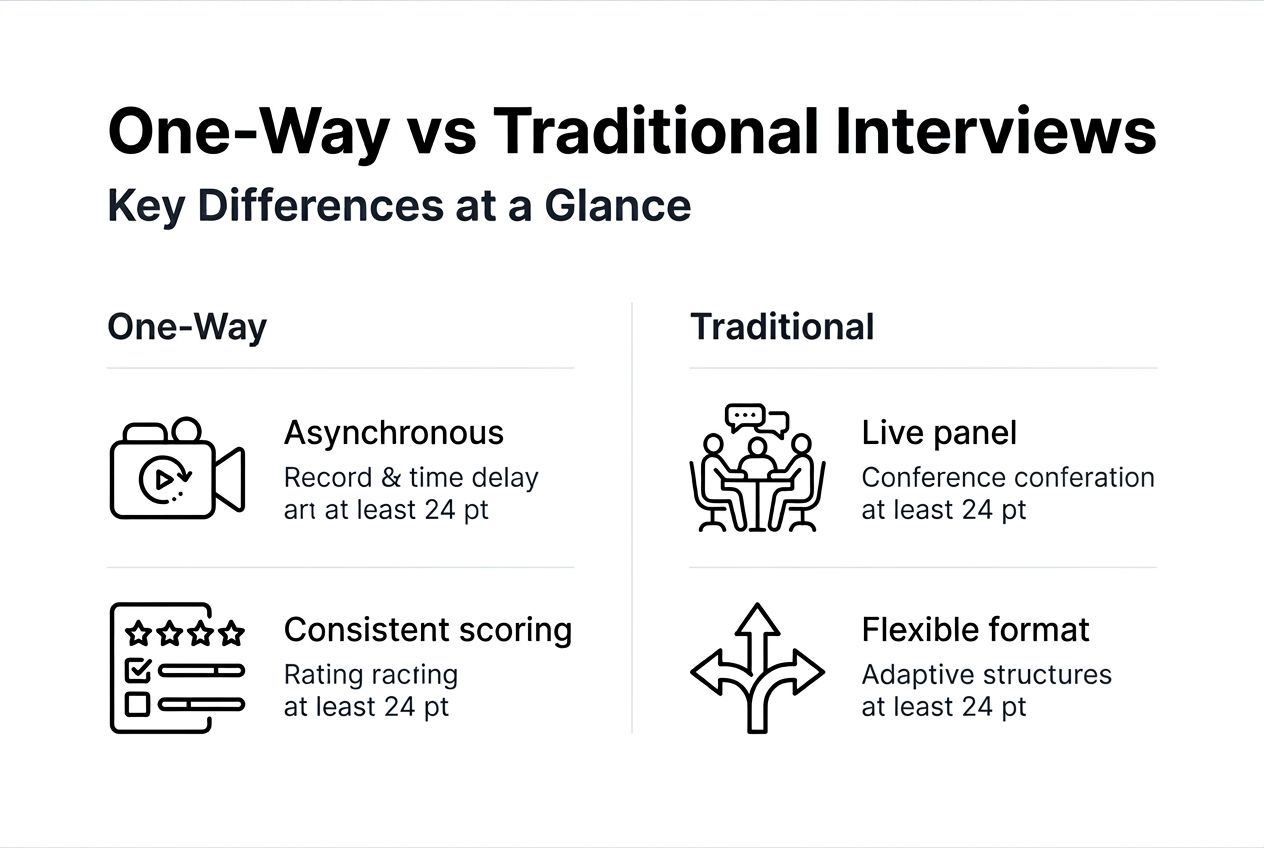
Structured one-way interviews increase panel scoring consistency by 30% compared to unstructured live interviews. This comparison framework highlights advantages across fairness, consistency, and logistics.
| Method | Format | Question consistency | Scoring approach | Bias reduction | Scheduling complexity |
|---|---|---|---|---|---|
| One-way interview | Asynchronous video | Standardised | AI-driven, objective | High through structured criteria | Low, candidate-led |
| Traditional live interview | Synchronous verbal | Variable by interviewer | Subjective, manual | Moderate to low | High, coordination required |
| CV screening | Text-based review | Not applicable | Manual, inconsistent | Low, resume bias common | None |
One-way interviews show 30% higher panel scoring consistency and reduce unconscious bias through standardisation. Scheduling and logistics simplify dramatically, easing recruiter workload. Traditional live interviews maintain flexibility but introduce variability and coordination overhead. CV screening lacks behavioural insight and carries significant resume bias risk.
How to interview with AI demonstrates cutting hiring time by 35% through hybrid approaches combining one-way and live formats.
Key differentiators:
- One-way interviews capture verbal communication skills CV screening misses entirely
- AI scoring removes interviewer mood and fatigue variables affecting live interviews
- Asynchronous format enables global candidate pools without timezone complications
- Recorded responses allow multiple reviewers to evaluate independently, increasing reliability
The optimal approach often combines one-way interviews for initial screening with live interviews for final-stage candidates, maximising efficiency and human connection.
Best practices for implementing one-way interviews in HR
Companies following structured implementation steps report 35% higher interviewer confidence and 20% less candidate drop-off. Success requires systematic planning and execution.
- Clearly define role-relevant competencies through job analysis and stakeholder consultation.
- Design structured interview questions mapped directly to each competency, ensuring behavioural focus.
- Assemble a diverse, trained evaluation panel representing varied perspectives and backgrounds.
- Implement standardised scoring rubrics with clear performance level definitions aligned to job criteria.
- Communicate clearly and consistently with candidates regarding process, timeline, and technical requirements.
- Monitor drop-out rates, completion times, and panel feedback to iteratively improve the process.
Benefits of AI assessment explores how systematic implementation maximises ROI and candidate satisfaction.
Pro tip: Pilot your one-way interview process with a small role before scaling organisation-wide. This allows refinement based on real feedback without high-stakes pressure.
Additional implementation considerations:
- Provide candidates with practice questions and technical setup guidance to reduce anxiety
- Set realistic time limits per question, typically 2-3 minutes for behavioural responses
- Train panel members on unconscious bias recognition and consistent rubric application
- Establish clear escalation paths for technical issues candidates may encounter
- Review and update question sets quarterly based on performance data and role evolution
Systematic implementation following these practices ensures your one-way interview programme delivers intended efficiency and fairness benefits.
Case studies and real-world applications in Europe
UK public sector reduced candidate screening time by 40% and minority candidate representation increased by 18% using AI-driven one-way interviews. These results demonstrate feasibility and impact in practice, supporting broader adoption among HR managers in the Netherlands, UK, and Spain.
Candidate quality and recruiter satisfaction maintained or improved across implementations. This evidence counters concerns about compromising hire quality for speed. Examples of AI interviews provides additional sector-specific case studies.
| Metric | Before implementation | After implementation | Improvement |
|---|---|---|---|
| Screening time per candidate | 45 minutes | 27 minutes | 40% reduction |
| Minority representation in shortlist | 22% | 40% | 18 percentage points |
| Time to first interview | 18 days | 9 days | 50% reduction |
| Panel scoring agreement | 64% | 89% | 25 percentage points |
| Candidate satisfaction score | 3.2/5 | 4.1/5 | 28% increase |
The data supports that AI-powered one-way interviews deliver measurable improvements across efficiency, diversity, and experience metrics. Public sector success provides a strong blueprint for private sector adoption.
Organisations report particular success when combining one-way interviews with skills-based assessments, creating comprehensive early-stage evaluation without excessive candidate burden. The flexibility proves especially valuable for attracting passive candidates who struggle to accommodate traditional interview scheduling.
Explore how we help you implement AI-driven one-way interviews
Unlock hiring efficiency and fairness with AI-powered one-way interviews tailored to your organisation. Our platform integrates seamlessly with your workflows to boost recruiter productivity and candidate quality. We specialise in helping Netherlands, UK, and Spain HR teams transition from CV screening to comprehensive skills-based assessment.
Match on skills, not CVs through our innovative approach combining AI interviews, company challenges, cultural matching, cognitive tests, and video pitches. Learn about our mission to transform recruitment by replacing outdated CV screening with real assessments that reveal true candidate potential. Visit our website to discover how we can help transform your hiring process in 2026.
Frequently asked questions
What are the main advantages of one-way interviews for HR managers?
One-way interviews dramatically reduce time-to-hire by eliminating scheduling coordination across candidates and panel members. They enable objective, standardised evaluation reducing unconscious bias whilst improving diversity outcomes. Cost savings and scalability make them ideal for high-volume recruitment.
How does AI scoring in one-way interviews work?
AI analyses video responses using natural language processing to assess competency-related keywords, communication clarity, and response structure. Facial analysis evaluates engagement cues. The system scores against predefined criteria, flagging top candidates for human review. Recruiters maintain final decision authority.
Can one-way interviews truly reduce bias in hiring?
Yes, structured one-way interviews with standardised questions and AI scoring reduce unconscious bias significantly compared to unstructured approaches. Every candidate answers identical questions, preventing interviewer variability. Diverse trained panels reviewing recordings further enhance fairness. Data shows up to 25% improvement in diversity representation.
What are the critical steps to ensure successful implementation?
Start by defining role-specific competencies and designing structured behavioural questions. Assemble and train a diverse evaluation panel on scoring rubrics. Communicate clearly with candidates about the process and technical requirements. Monitor completion rates and panel feedback, iterating based on data. Pilot before scaling organisation-wide.
How do candidates generally feel about one-way asynchronous interviews?
Over 70% of candidates report positive experiences, valuing the flexibility to complete interviews on their schedule. Many find asynchronous formats less stressful than live interviews, allowing more thoughtful, authentic responses. Clear instructions and practice questions further improve candidate satisfaction and completion rates.
Recommended
- How to Interview with AI: Cut Hiring Time by 35% in 2026 | We Are Over The Moon
- Advantages of replacing CVs: 74% faster hiring with AI assessments | We Are Over The Moon
- How to Screen Without CVs for Better Hiring Results | We Are Over The Moon
- 6 Key Benefits of AI Interviews for Smarter Hiring | We Are Over The Moon