Enhance hiring with effective candidate filtering steps

TL;DR:
- Structured candidate filtering increases objectivity, speed, and fairness in hiring.
- Defining clear requirements upfront improves match quality and reduces bias.
- Combining automation with human review enhances efficiency and insight during screening.
Hiring teams across the Netherlands, UK, and Spain know the feeling all too well. You post a role, applications flood in, and suddenly you’re buried under CVs that look nothing like what you need. Hours disappear, great candidates get overlooked, and the wrong hires slip through. The good news? A structured candidate filtering process changes everything. When you follow clear, repeatable steps, you stop guessing and start making confident decisions. This guide walks you through exactly how to build and refine a filtering approach that saves time, reduces bias, and connects you with people who genuinely fit your organisation.
Table of Contents
- Why structured filtering steps are essential
- Preparing your requirements: What to define before filtering
- Step-by-step candidate filtering process
- Advanced tools and techniques for filtering in 2026
- Verification and improving your filtering outcomes
- A fresh perspective on filtering for quality hiring
- Streamline your candidate filtering with We Are Over The Moon
- Frequently asked questions
Key Takeaways
| Point | Details |
|---|---|
| Structure boosts results | Well-defined filtering steps reduce bias and improve hiring outcomes. |
| Preparation matters | Clear requirements must be set before screening to attract the right candidates. |
| Leverage automation | Automation tools save time and ensure consistency in the filtering process. |
| Review and evolve | Regularly verify and adapt your process for continuous improvement and quality hires. |
Why structured filtering steps are essential
Without a clear system, candidate filtering quickly becomes a guessing game. One recruiter prioritises experience, another favours personality, and a third goes with gut instinct. The result? Inconsistency, wasted hours, and a hiring process that feels different every time. Unstructured filtering increases time-to-hire and bias, which means your team works harder and still ends up with weaker outcomes.
A stepwise filtering process solves this by introducing objectivity and structure at every stage. Here is what you gain:
- Objectivity: Every candidate is assessed against the same criteria, not a recruiter’s mood on a Monday morning.
- Speed: Documented steps mean no one reinvents the wheel for each new vacancy.
- Equity: Structured processes reduce the influence of unconscious bias, opening doors to a wider talent pool.
- Consistency: Teams align on expectations before reviewing a single application.
“A repeatable filtering process is not about removing human judgement. It is about making sure that judgement is applied fairly and at the right moment.”
Even skilled, well-intentioned hiring teams make costly errors without documented steps. A senior recruiter might unconsciously favour candidates who attended the same university, or a hiring manager might skip a skills check because a candidate seemed confident on paper. These small missteps compound over time.
Pro Tip: Before your next hiring round, map out your current filtering steps on paper. You will likely spot gaps, duplications, or stages where bias can creep in. Fixing these early is far easier than unpicking a poor hire later.
Adopting candidate-centric recruitment steps also improves the experience for applicants, which matters more than ever in competitive talent markets. Candidates talk, and a fair, transparent process builds your employer brand.
Preparing your requirements: What to define before filtering
Before you review a single application, you need crystal-clear requirements. This is where many hiring teams stumble. They start filtering before they have truly agreed on what they are filtering for.
Defining job requirements upfront increases hiring success rates, so invest time here before anything else. Start by separating mandatory requirements from desirable ones.
| Requirement type | Examples | Priority |
|---|---|---|
| Must-have skills | Specific software, language fluency, certifications | Non-negotiable |
| Desirable skills | Industry experience, additional languages | Weighted bonus |
| Culture-add factors | Collaborative mindset, growth orientation | Assessed later |
| Practical criteria | Location, availability, right to work | Early screen |
Once you have your list, share it with everyone involved in the process. Misalignment between recruiters and hiring managers is one of the biggest sources of filtering errors. Use collaborative tools like shared documents or your ATS (applicant tracking system) to document and communicate criteria before filtering begins.
Here are the key elements to define for each role:
- Non-negotiable criteria: These are your hard filters. If a candidate does not meet them, they do not progress.
- Weighted desirables: Skills or experiences that add value but are not deal-breakers.
- Culture-add indicators: What perspectives or working styles would genuinely strengthen the team?
- Practical requirements: Right to work, location, salary expectations.
Pro Tip: Run a quick alignment session with your hiring team before the role goes live. Ask each person to rank the top five requirements independently, then compare. Differences in ranking reveal hidden assumptions that could derail your filtering later.
This preparation also feeds directly into improving candidate matching, ensuring your filters actually connect you with the right people rather than simply narrowing the field arbitrarily.

Step-by-step candidate filtering process
With your criteria defined and your team aligned, you are ready to run a filtering process that is both efficient and fair. Here is a clear walkthrough.
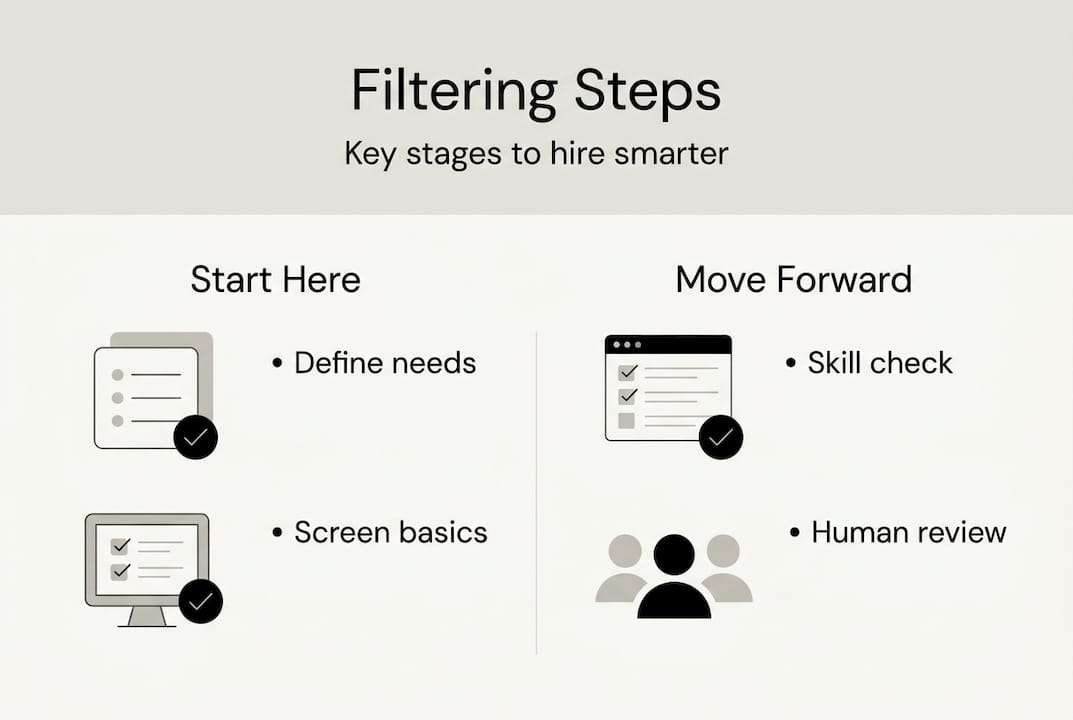
- Eligibility screening: Check must-have criteria first. Does the candidate have the right to work? Do they meet the essential qualifications? This step removes clear mismatches quickly and respectfully.
- Automated and manual red-flag checks: Use your ATS or a dedicated tool to flag inconsistencies, unexplained gaps, or mismatches against core requirements. Follow this with a manual review to catch nuances automation might miss.
- Structured skills and values assessment: This is where real filtering happens. Use standardised tests, work samples, or challenge-based tasks to assess actual ability rather than self-reported experience.
- Forward to interview or simulation: Candidates who pass the assessment move to a structured interview or role simulation, where cultural fit and deeper competencies are explored.
A quick comparison of approaches:
| Filtering method | Speed | Objectivity | Depth of insight |
|---|---|---|---|
| Manual only | Slow | Variable | High (if structured) |
| Automated only | Fast | High | Limited |
| Combined approach | Fast | High | High |
The combined approach wins every time. Automation in pre-screening handles the volume, while human review adds context and nuance. In fact, automation can save up to 23 hours per hire, which is genuinely exciting when you multiply that across a full hiring calendar.
Building a reliable screening workflow means documenting each of these steps so any team member can run the process consistently, regardless of role or seniority.
Advanced tools and techniques for filtering in 2026
The tools available to hiring teams in 2026 are genuinely exciting. Gone are the days when filtering meant one person reading a stack of CVs over a coffee. Modern tools make the process faster, fairer, and far more insightful.
Here is an overview of what is transforming candidate filtering right now:
- AI-based matching: Algorithms that score candidates against your defined criteria, surfacing the best fits without human fatigue.
- Skill assessments: Role-specific tests that reveal actual capability rather than polished self-presentation.
- Video pitches: Short, structured video responses that give a genuine sense of communication style and motivation.
- Gamified assessments: Problem-solving challenges that feel engaging for candidates while generating rich performance data.
- Bias mitigation tools: Features that anonymise applications or flag potentially biased language in job descriptions.
Assessment tools boost hiring efficiency and reduce bias, which means your team spends less time on administration and more time on meaningful conversations with strong candidates.
“Technology should amplify your team’s judgement, not replace it. The best filtering processes combine the speed of automation with the wisdom of experienced people.”
Emerging trends worth watching include AI in recruitment, particularly tools that can conduct structured initial interviews at scale, freeing up your team for later-stage assessment. The key is balance. Over-relying on tech risks missing the human qualities that make someone truly right for your culture. Use tools to handle volume and consistency, then apply human insight where it matters most.
The assessment tool benefits extend beyond efficiency. Teams that adopt structured digital assessments consistently report improvements in diversity metrics and candidate satisfaction scores.
Verification and improving your filtering outcomes
Running a filtering process is only half the job. The other half is checking whether it actually works and making it better over time. This is where many teams drop the ball, and it is a real missed opportunity.
Start by tracking these key metrics:
- Screen-to-hire ratio: How many filtered candidates ultimately receive an offer? A very low ratio suggests your early filters are too loose.
- Time-to-hire: Are your steps speeding things up or creating bottlenecks?
- Diversity of shortlists: Are you reaching a genuinely varied pool of candidates?
- Retention at 6 and 12 months: Are the people you hire actually staying and thriving?
- Hiring manager satisfaction: Do they feel the candidates forwarded to them are genuinely strong?
Candidate-centric adjustments lead to better hiring outcomes, so build feedback loops into your process. Ask candidates about their experience, even those who were not successful. Their perspective often reveals friction points you cannot see from the inside.
Pro Tip: Involve recent hires in reviewing your filtering process every six months. They went through it recently and can pinpoint exactly where it felt confusing, unfair, or unnecessarily long. Their feedback is gold.
Adapting your process based on evidence is not a sign of weakness. It is a sign of a team that takes quality seriously. Use candidate experience tips to refine each touchpoint, ensuring your process feels respectful and engaging for every applicant.
A fresh perspective on filtering for quality hiring
Here is something we believe strongly: following a checklist is not the same as filtering well. Many teams implement a structured process and then treat it as sacred, never questioning whether it still serves them. That rigidity is where standout talent gets lost.
We have seen companies reject brilliant candidates because they did not tick a box that turned out to be irrelevant. And we have seen teams so reliant on automation that they miss the spark of someone who does not fit the standard mould but would absolutely thrive in the role.
The best filtering processes are living systems. They evolve with your organisation, your industry, and your understanding of what great performance actually looks like. Experimenting with screening without CVs is one example of how breaking from convention can unlock talent you would otherwise never find.
Tech and automation are brilliant allies, but they need human curiosity alongside them. Challenge your steps regularly. Ask whether each stage is still earning its place. That mindset is what separates genuinely great hiring teams from those just going through the motions.
Streamline your candidate filtering with We Are Over The Moon
If you are excited about putting these steps into practice, we are over the moon to help you get there. At We Are Over The Moon, we have built a platform that replaces outdated CV screening with real assessments: AI interviews, company challenges, cultural matching, cognitive tests, and video pitches.
Our skill-based matching solutions are designed specifically for HR professionals and founders who want to hire smarter, not just faster. Every tool we offer is built around objectivity, candidate experience, and genuine fit. Whether you are refining an existing process or building one from scratch, we would love to show you what is possible. Learn more about the team and book a tailored demo today.
Frequently asked questions
What are the essential steps in candidate filtering?
Start by defining role requirements clearly, screen for must-have criteria, assess skills and cultural fit, and use assessment tools to add objectivity. Each step should be documented so the process is repeatable.
How can automation improve candidate filtering?
Automation saves significant time per hire by handling high-volume screening quickly and consistently, reducing manual effort and minimising the influence of unconscious bias in early stages.
How often should filtering steps be reviewed and updated?
Review your filtering steps at least annually and after any significant feedback from recent hires or changes in business priorities. Continuous process improvement consistently leads to stronger hiring outcomes over time.
Can candidate filtering improve diversity and inclusion?
Absolutely. Structured, tech-assisted filtering reduces the subjective judgements that often disadvantage underrepresented candidates. Assessment tools boost efficiency and can meaningfully enhance the diversity of your shortlists.
Recommended
- How to Improve Candidate Matching for Better Hires | We Are Over The Moon
- How to Screen Without CVs for Better Hiring Results | We Are Over The Moon
- Master Effective Screening Workflow for Modern Recruitment | We Are Over The Moon
- Defining Candidate Matching: Boosting Hiring Success | We Are Over The Moon