Why prioritising candidate potential drives better hiring

Most recruitment teams rely on CV screening to identify top talent, but this traditional approach often misses the very qualities that predict long-term success. Credentials and past job titles tell you where someone has been, not where they can go. Forward-thinking HR leaders in Europe are shifting focus from static qualifications to dynamic candidate potential, revealing abilities that conventional screening overlooks. This guide explores why prioritising potential transforms hiring outcomes and how to implement assessment strategies that surface the right talent faster.
Table of Contents
- Why Traditional CV Screening Falls Short
- Understanding Candidate Potential And Its Components
- Innovative Methods To Assess Candidate Potential Effectively
- Practical Steps To Prioritise Candidate Potential In Recruitment
- Discover How We Support Hiring For Potential
- Frequently Asked Questions
Key takeaways
| Point | Details |
|---|---|
| Potential predicts success | Assessing growth ability and adaptability reveals long-term employee performance better than experience alone. |
| Traditional CVs miss key traits | Conventional screening overlooks soft skills, learning agility, and cultural fit critical to modern roles. |
| Innovative methods reduce bias | AI assessments, simulations, and behavioural tests uncover hidden talents across diverse candidate pools. |
| Implementation requires mindset shift | Successful adoption demands training recruiters and redesigning workflows around potential-focused evaluation. |
| Faster, higher quality outcomes | Companies using potential-based approaches see quicker hiring cycles and improved candidate-job alignment. |
Why traditional CV screening falls short
Conventional recruitment hinges on CVs as primary gatekeepers, but this creates blind spots that cost organisations exceptional talent. Resumes catalogue past positions and qualifications, yet they reveal little about a candidate’s capacity to learn, adapt, or thrive in evolving environments. You might hire someone with an impressive employment history who lacks the agility your dynamic workplace demands.
Overreliance on CVs perpetuates unconscious bias and systematically excludes candidates with unconventional backgrounds. Career changers, returning parents, and self-taught professionals often possess remarkable potential but lack the linear progression traditional screening favours. This narrow lens shrinks your talent pool precisely when innovation requires diverse perspectives and fresh thinking.
Modern roles increasingly demand capabilities poorly reflected in static documents. Consider these limitations:
- Soft skills like emotional intelligence and collaboration rarely appear quantified on CVs
- Learning agility and problem-solving ability cannot be inferred from job titles alone
- Cultural fit and motivation remain invisible without interactive assessment
- Transferable skills from different industries get overlooked when screening focuses on exact experience matches
Research demonstrates the efficiency cost of CV-centric processes. Traditional CV screening overlooks transferable skills and adaptability, limiting hiring quality whilst dragging out timelines. Organisations replacing CVs with AI assessments achieve 74% faster hiring, proving that potential-focused methods deliver both speed and precision.
“The best predictor of future performance is not past experience but the ability to grow, adapt, and solve novel problems.”
When you design recruitment around potential rather than credentials, you open pathways to talent that conventional screening systematically misses. The company challenge in hiring becomes finding methods that reveal what candidates can become, not just what they have been.
Understanding candidate potential and its components
Candidate potential represents the capacity to grow, solve unfamiliar problems, and adapt to changing circumstances. Unlike experience, which looks backward, potential looks forward to how someone will perform in situations they have not yet encountered. This distinction matters enormously in fast-moving sectors where yesterday’s skills quickly become obsolete.
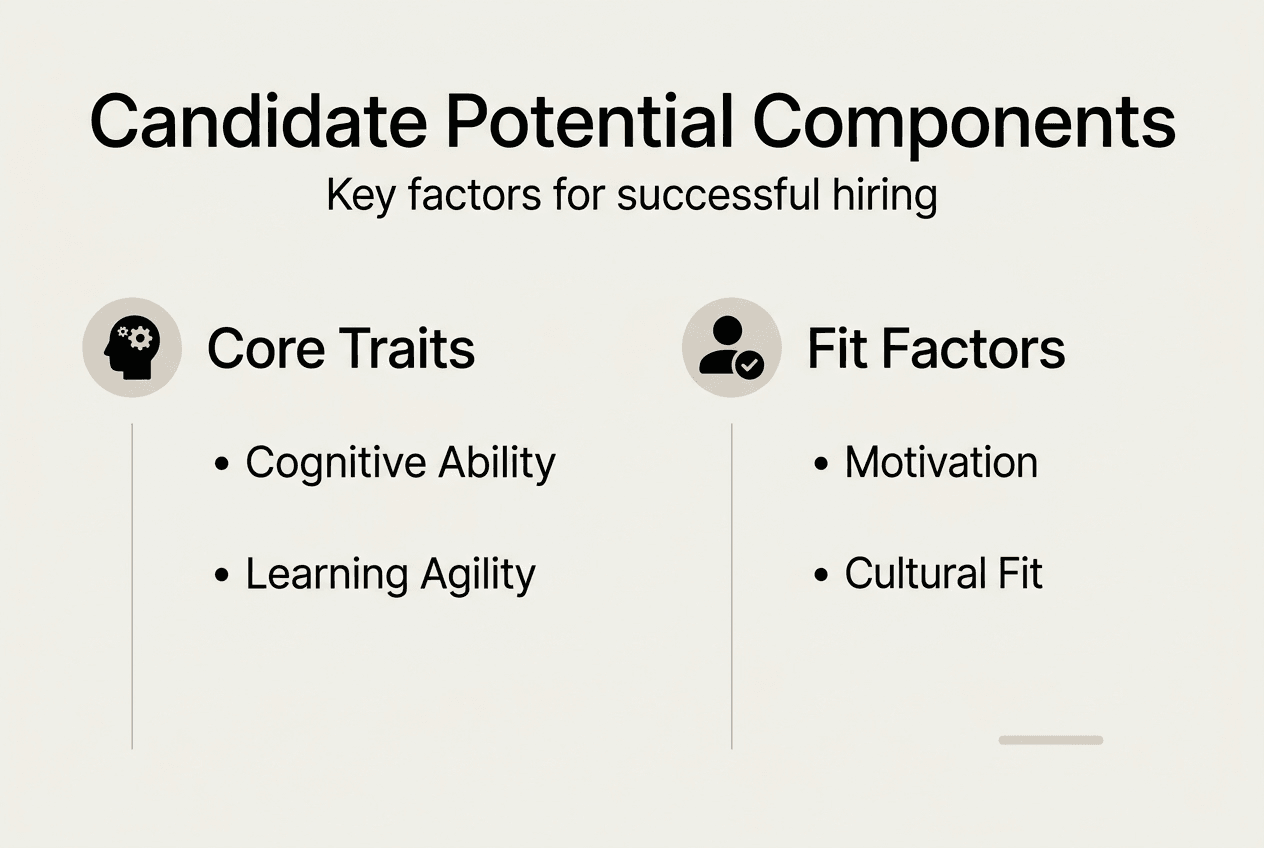
Four core components define candidate potential:
-
Cognitive ability: The capacity to process information, recognise patterns, and apply logic to new challenges. High cognitive ability enables rapid skill acquisition and complex problem solving.
-
Learning agility: How quickly someone absorbs new concepts, adapts strategies when circumstances shift, and applies lessons from one context to another. This trait predicts success in roles requiring continuous evolution.
-
Intrinsic motivation: The internal drive to excel, take initiative, and persist through obstacles. Motivated candidates bring energy and commitment that credentials cannot capture.
-
Cultural and emotional fit: Alignment with organisational values plus the emotional intelligence to collaborate effectively, manage stress, and navigate interpersonal dynamics.
‘Potential’ includes cognitive ability, learning agility, motivation, and cultural fit, all critical to success beyond experience. These elements combine to determine whether someone will thrive in your environment and grow with your organisation over time.

Understanding these components helps you design assessments that measure what truly matters. When you evaluate candidates through this lens, you identify individuals likely to exceed expectations rather than those who simply tick qualification boxes. Structured frameworks ensure consistency, enabling fair comparison across diverse applicant pools.
Pro Tip: Create a potential assessment matrix that scores candidates across all four components, weighting each based on role requirements. This structured approach reduces subjective judgement whilst ensuring you evaluate every candidate against the same success predictors.
Recognising potential requires looking beyond the surface. A candidate with a non-traditional background might demonstrate exceptional learning agility through self-directed skill development. Someone with gaps in employment could show intrinsic motivation through volunteer leadership or personal projects. Candidate matching hiring strategies that prioritise these deeper qualities consistently outperform credential-focused approaches.
Innovative methods to assess candidate potential effectively
Measuring potential demands tools that reveal abilities CVs cannot capture. Modern assessment techniques leverage technology and behavioural science to surface the traits that predict long-term success. These methods provide objective data whilst creating engaging candidate experiences that strengthen your employer brand.
AI-driven assessments analyse responses to situational judgement tests, cognitive challenges, and personality inventories at scale. Machine learning algorithms identify patterns correlating with high performance in specific roles, removing human bias from initial screening. AI-driven assessments and skill-based simulations lead to 74% faster hiring and better candidate-job fit, demonstrating measurable impact on recruitment efficiency.
Work simulations and job previews immerse candidates in realistic scenarios that mirror actual responsibilities. You observe how they approach problems, prioritise tasks, and adapt when conditions change. This reveals potential far more reliably than asking about hypothetical situations in interviews.
Gamified assessments measure cognitive ability and decision-making through interactive challenges that feel less like tests and more like engaging experiences. Candidates demonstrate skills naturally whilst you gather rich behavioural data. These tools particularly excel at uncovering potential in younger or less experienced applicants.
| Method | Strengths | Limitations |
|---|---|---|
| Traditional CV screening | Quick initial filter, familiar process | Misses soft skills, perpetuates bias, poor predictor of success |
| AI assessments | Objective, scalable, reveals hidden potential | Requires investment, candidates may find impersonal |
| Work simulations | Highly predictive, great candidate experience | Time intensive, needs careful design |
| Cognitive tests | Measures learning ability, reduces bias | May disadvantage neurodivergent candidates if not adapted |
| Behavioural interviews | Explores motivation and fit, personal connection | Interviewer bias risk, requires training |
Combining multiple methods creates the most complete picture. Start with AI assessments to efficiently screen large applicant pools, then use simulations and structured interviews to evaluate shortlisted candidates more deeply. This layered approach balances efficiency with thoroughness.
Pro Tip: Integrate assessments seamlessly into your application process rather than adding them as separate hurdles. Candidates engage more authentically when evaluations feel like natural steps rather than obstacles, improving both completion rates and data quality.
The screen without cvs for better hiring approach demonstrates how removing credential barriers whilst adding potential assessments expands your talent pool. Innovative assessment methods continue evolving, offering increasingly sophisticated ways to identify candidates who will excel in your unique environment.
Practical steps to prioritise candidate potential in recruitment
Transitioning to potential-focused hiring requires deliberate process redesign and cultural shifts. Follow these steps to implement assessment strategies that reveal candidate capabilities beyond credentials:
-
Audit your current process: Map every screening stage to identify where CV reliance creates bottlenecks or bias. Note which roles suffer most from credential-focused filtering.
-
Define success profiles: For each position, articulate the cognitive abilities, soft skills, and growth potential that predict performance. Move beyond listing required qualifications to describing ideal candidate traits.
-
Select appropriate assessments: Match evaluation tools to the competencies you identified. Cognitive tests for analytical roles, simulations for hands-on positions, cultural fit assessments for team-based work.
-
Redesign job postings: Emphasise potential and growth opportunities rather than listing rigid requirements. Invite applications from candidates who can demonstrate relevant abilities regardless of background.
-
Train your recruitment team: Equip recruiters and hiring managers to recognise potential signals and conduct structured evaluations. Address unconscious bias that favours traditional credentials.
-
Pilot with one role: Test your new approach on a single position, gather data on outcomes, and refine before scaling across the organisation.
Shifting recruitment processes to focus on potential enhances hiring quality and reduces time to hire significantly. The guide to talent screening hr success offers detailed frameworks for implementation.
| Screening Phase | Traditional Approach | Potential-Focused Approach |
|---|---|---|
| Initial filter | CV keyword matching | AI assessment of cognitive ability and motivation |
| First evaluation | Phone screen on experience | Work simulation or skills test |
| Deep assessment | Panel interview on qualifications | Structured behavioural interview plus cultural fit evaluation |
| Final decision | Reference checks, credential verification | 综合 potential scores, trial project, team interaction |
Organisational culture must evolve alongside process changes. Consider these necessary shifts:
- Leadership commitment to valuing growth potential over pedigree in hiring decisions
- Willingness to invest in candidate development rather than seeking “ready-made” hires
- Patience with learning curves as high-potential candidates grow into roles
- Celebration of diverse backgrounds and unconventional career paths
- Metrics that measure long-term employee success rather than just speed to fill positions
Pro Tip: Train recruiters to recognise signs of potential beyond credentials by reviewing case studies of successful non-traditional hires. This builds pattern recognition for identifying transferable skills and growth indicators that CVs obscure.
The improve candidate matching strategies you implement today determine whether you access the full talent market or remain limited to the narrow slice with conventional credentials. Potential-focused recruitment opens opportunities for both your organisation and candidates who deserve consideration based on capability rather than background.
Discover how we support hiring for potential
Implementing potential-based recruitment transforms hiring outcomes, but the transition requires expertise and the right tools. We specialise in helping European HR leaders match on skills not cvs through comprehensive assessment solutions that reveal candidate capabilities traditional screening misses.
Our platform combines AI interviews, company challenges, cultural matching, cognitive tests, and video pitches to create complete candidate profiles. You gain objective insights into learning agility, problem-solving ability, and cultural fit whilst dramatically reducing time to hire. Organisations using our approach consistently identify high-potential talent that conventional processes overlook.
Whether you need to redesign your entire recruitment workflow or enhance specific screening stages, our team provides tailored solutions and ongoing support. Explore case studies and discover how we help companies build stronger teams by prioritising potential. Learn more about us over the moon and start transforming your hiring today.
Frequently asked questions
What are the main benefits of hiring for potential over experience?
Prioritising potential expands your talent pool to include diverse candidates with unconventional backgrounds who bring fresh perspectives. You identify individuals capable of growing with your organisation rather than those limited by past roles. This approach reduces bias, improves long-term retention, and accelerates hiring by focusing on predictive traits rather than perfect credential matches.
How can we train recruiters to assess potential effectively?
Provide structured frameworks that define potential components for each role, then conduct workshops using real candidate examples to build pattern recognition. Role-playing exercises help recruiters practise identifying learning agility and motivation signals during interviews. Regular calibration sessions ensure consistency across your team whilst ongoing coaching addresses unconscious bias favouring traditional credentials.
Does prioritising potential increase the risk of bad hires?
Actually, potential-focused assessment reduces hiring risk when implemented properly. Validated cognitive tests and work simulations predict job success more reliably than credentials or unstructured interviews. The key is using multiple assessment methods and maintaining rigorous evaluation standards. Candidates demonstrating high potential across several measures typically outperform those hired solely on experience.
What technologies support potential-based recruitment?
AI assessment platforms analyse candidate responses to situational judgement tests and cognitive challenges, providing objective scores at scale. Video interview tools with sentiment analysis reveal communication skills and emotional intelligence. Gamified assessments measure problem-solving ability through engaging interactive challenges. Applicant tracking systems integrated with these tools streamline workflows whilst maintaining candidate data for analysis.
How does candidate experience improve when focus shifts from CVs?
Potential-based processes feel more engaging and fair to applicants. Interactive assessments and simulations let candidates demonstrate abilities rather than hoping keywords match. Applicants appreciate opportunities to show what they can do regardless of background. This inclusive approach strengthens your employer brand whilst reducing dropout rates, as candidates invest more readily in evaluations that feel relevant and respectful of their capabilities.
Recommended
- How to Improve Candidate Matching for Better Hires | We Are Over The Moon
- Qualities of top candidates: innovative assessment methods for HR leaders 2026 | We Are Over The Moon
- Defining Candidate Matching: Boosting Hiring Success | We Are Over The Moon
- Advantages of replacing CVs: 74% faster hiring with AI assessments | We Are Over The Moon