What is hybrid screening? A guide for HR professionals 2026

Traditional CV screening misses 73% of qualified candidates whilst hybrid screening cuts hiring bias by 25% and accelerates recruitment by 30%. This innovative approach combines AI-driven assessments with human expertise to transform how recruiters evaluate talent. You’ll discover how hybrid screening works, its measurable benefits, common misconceptions, and practical steps to implement this method in your organisation.
Table of Contents
- Introduction To Hybrid Screening
- How Hybrid Screening Works: Components And Mechanisms
- Benefits Of Hybrid Screening Over Traditional Methods
- Common Misconceptions And Realities About Hybrid Screening
- Framework For Implementing Hybrid Screening In Your Recruitment Process
- Regional Trends And Considerations In The UK, Netherlands, And Spain
- Conclusion: Next Steps For HR Professionals
- Discover Hybrid Screening Solutions At We Are Over The Moon
- Frequently Asked Questions
Key takeaways
| Point | Details |
|---|---|
| Hybrid screening definition | Blends AI tools with human judgement to improve hiring accuracy and reduce bias in candidate assessment. |
| Measurable impact | Reduces unconscious bias by 25%, speeds hiring by 30%, and increases predictive validity by 24%. |
| Core components | Combines AI interviews, cognitive tests, skill challenges, and cultural assessments with recruiter expertise. |
| Common myths debunked | AI augments rather than replaces recruiters, and scalable options exist for SMEs with strong ROI. |
| Implementation approach | Start with targeted pilots, train teams to blend AI insights with human judgement, then scale based on evidence. |
Introduction to hybrid screening
Hybrid screening integrates AI-driven tools with human assessment to overcome limitations of traditional CV-only screening. It addresses persistent challenges like unconscious bias, incomplete candidate data, and inefficient evaluation processes. This approach emerged as recruitment professionals recognised that CVs alone fail to predict job performance or cultural fit accurately.
The core components work together to create a richer candidate profile:
- Digital AI interviews provide standardised first impressions across all applicants
- Psychometric and cognitive tests measure abilities that CVs cannot capture
- Assessment challenges evaluate practical skills in realistic scenarios
- Cultural fit evaluations ensure alignment with organisational values
- Human recruiters synthesise all data points with contextual judgement
Early adoption trends show increasing interest among UK, Netherlands, and Spain recruiters seeking innovative solutions to talent shortages. These professionals recognise that combining objective AI analysis with human intuition delivers superior hiring outcomes. The method provides a systematic framework whilst preserving the irreplaceable value of human expertise in final candidate selection.
How hybrid screening works: components and mechanisms
AI video interviews create consistent evaluation standards by asking identical questions to every candidate. The technology analyses verbal responses, facial expressions, and communication patterns to identify strengths and areas requiring deeper exploration. This standardisation eliminates the variability that often creeps into traditional phone screenings.
Cognitive and psychometric tests predict future job performance more reliably than CV review alone. These assessments measure problem-solving abilities, logical reasoning, and personality traits that correlate with success in specific roles. Research shows they provide 24% higher predictive validity compared to traditional methods.
Skill challenges assess candidates’ practical abilities in realistic scenarios relevant to the role. A marketing position might include a campaign brief exercise, whilst a technical role could involve a coding challenge. These tasks reveal how applicants apply knowledge under conditions that mirror actual job demands.
Cultural fit assessments ensure alignment of values, reducing turnover risk. They evaluate whether a candidate’s working style, communication preferences, and motivations match your organisation’s environment. This component addresses the common problem of technically qualified hires who struggle to integrate into team dynamics.

Human recruiters synthesise all data points with contextual judgement for final decisions. They weigh AI insights against factors like team composition, role-specific nuances, and organisational priorities. This combination of AI assessment benefits with human wisdom creates a more complete evaluation than either approach could achieve independently.
Benefits of hybrid screening over traditional methods
Hybrid screening delivers measurable improvements across multiple recruitment metrics that directly impact your organisation’s bottom line.
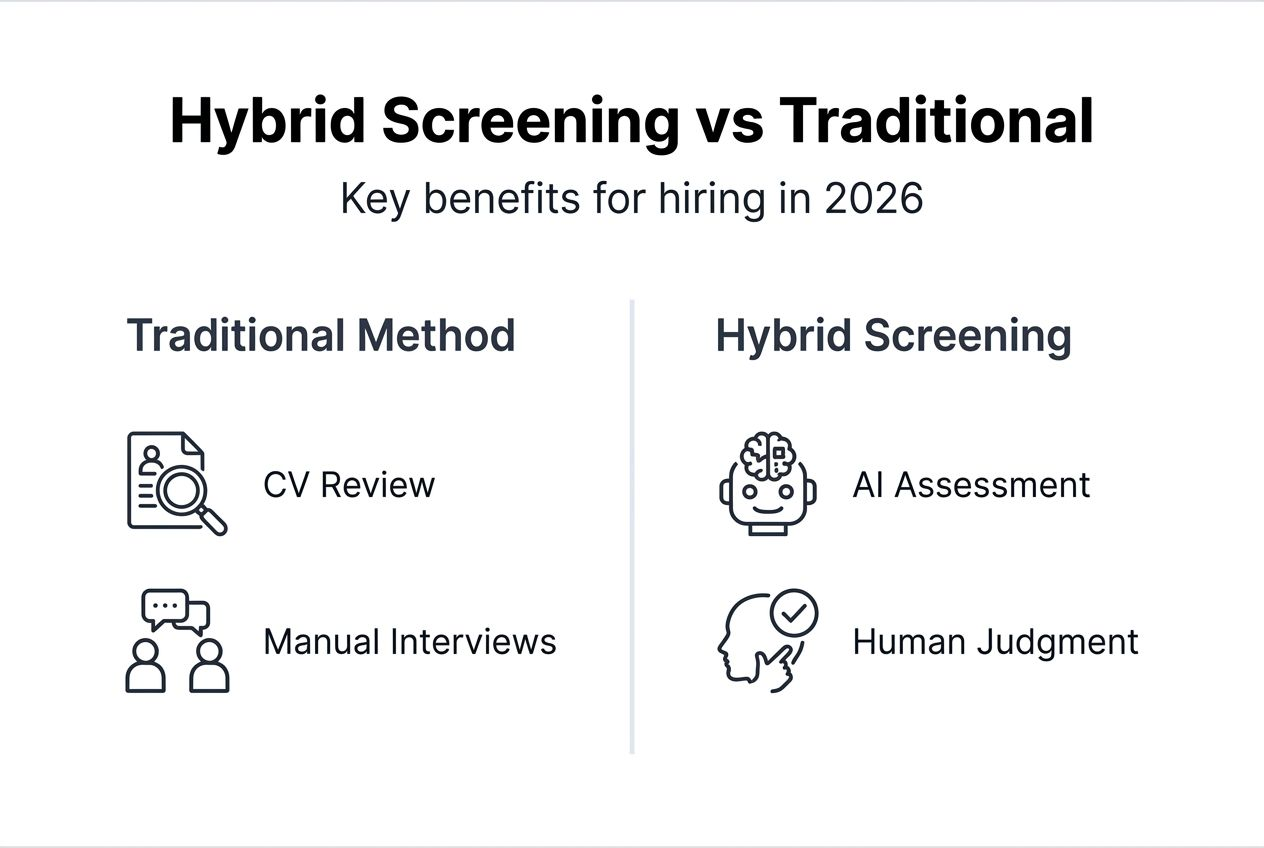
| Metric | Traditional CV screening | Hybrid screening | Improvement |
|---|---|---|---|
| Unconscious bias incidents | Baseline | 25% reduction | Significant fairness gain |
| Time to hire | 42 days average | 29 days average | 30% faster |
| Predictive validity | Standard baseline | 24% higher accuracy | Better candidate-job fit |
| Manager satisfaction | Baseline | 27% increase | Higher quality outcomes |
These improvements translate into tangible business value:
- Reduced unconscious bias by up to 25% enhances fairness and opens talent pools previously overlooked
- Accelerated hiring processes save approximately 13 days per role, freeing recruiters for strategic work
- Higher predictive validity of 24% leads to better long-term performance and retention
- Manager satisfaction improvements of 27% strengthen collaboration between HR and hiring teams
Integrating cultural assessments cuts early turnover by aligning values and expectations before offers are extended. This prevents the costly cycle of rehiring when new starters realise the role doesn’t match their working style preferences.
Pro Tip: Track your baseline metrics before implementing hybrid screening, then measure monthly to demonstrate ROI to stakeholders. Focus on time-to-hire, quality-of-hire ratings from managers, and 90-day retention rates for the clearest picture of impact.
“The combination of objective AI data with human insight gave us confidence in hiring decisions we previously second-guessed. Our regretted turnover dropped by 34% within six months.” – Senior Talent Acquisition Manager, Amsterdam
Understanding limitations of CV screening helps you appreciate why hybrid approaches deliver such significant improvements. Traditional methods simply cannot capture the full picture needed for informed hiring decisions in competitive talent markets.
Common misconceptions and realities about hybrid screening
Several myths prevent organisations from adopting hybrid screening despite its proven benefits. Let’s address the most common concerns with evidence.
Misconception: AI replaces recruiters, making human expertise obsolete. Reality: AI tools augment human judgement to improve decisions, not eliminate the need for experienced professionals. Research shows 85% of recruiters agree hybrid screening is most effective when AI supports human evaluation rather than replacing it. Your expertise in reading between the lines, assessing cultural nuances, and making final calls remains irreplaceable.
Misconception: Hybrid screening is prohibitively expensive and only accessible to large enterprises. Reality: Scalable options exist for SMEs with strong ROI that justifies initial investment. Many platforms offer tiered pricing based on hiring volume, and the time savings alone typically offset costs within months. The 30% reduction in time-to-hire translates directly into cost savings that make hybrid screening financially viable.
Misconception: Hybrid screening complicates hiring workflows and adds bureaucratic burden. Reality: With proper integration, processes become streamlined rather than more complex. Modern platforms integrate with existing applicant tracking systems, and candidates often prefer engaging assessments over submitting CVs into a void. The key lies in thoughtful implementation rather than bolting on disconnected tools.
Effective hybrid screening requires training recruiters to blend AI outputs with their expertise. This investment in skill development pays dividends as teams learn to interpret assessment data and combine it with intuitive judgement. Understanding AI interviews helps recruiters appreciate what the technology can and cannot reveal about candidates.
Pro Tip: Start with small, targeted pilots for one role or department to demonstrate value and ease adoption hurdles. Collect feedback from both recruiters and candidates, then refine your approach before scaling. This builds internal advocates who can champion the change based on first-hand experience.
The benefits of AI assessment become clear when you see how it complements rather than competes with your professional judgement. The goal is to make your job easier and your decisions more informed, not to automate away the human element that makes great recruitment possible.
Framework for implementing hybrid screening in your recruitment process
Successful adoption requires a structured approach that aligns hybrid screening with your organisation’s unique context and goals.
-
Analyse current recruitment challenges and define clear goals for hybrid screening adoption. Identify specific pain points like time-to-hire bottlenecks, quality-of-hire concerns, or diversity gaps. Set measurable objectives such as “reduce time-to-hire by 25%” or “increase diverse candidate interview rates by 40%.”
-
Select AI and assessment tools tailored to roles and company culture for greater relevance. Not all positions require the same evaluation approach; technical roles might emphasise cognitive tests whilst client-facing positions prioritise communication assessments. Ensure tools reflect your values and don’t inadvertently screen out desired candidates.
-
Train recruitment teams to interpret AI insights alongside human judgement effectively. Invest in workshops that teach how to read assessment reports, identify patterns, and weight different data points appropriately. Help your team understand what AI does well and where human expertise adds irreplaceable value.
-
Pilot the hybrid approach, collect data to measure impact on quality and speed. Choose a role with sufficient hiring volume to generate meaningful results but low enough stakes to allow learning. Track metrics like candidate experience ratings, time savings, and hiring manager satisfaction.
-
Scale up adoption based on evidence and continuous refinement. Use pilot learnings to adjust tool selection, process design, and training approaches. Roll out gradually to additional roles and departments, building on successes and addressing challenges systematically.
Common pitfalls include misaligned tools that don’t match role requirements and over-reliance on AI without human checks. Avoid these by involving hiring managers in tool selection and maintaining recruiter oversight at every stage. Replacing CV screening requires thoughtful change management, not just technology adoption.
Consider how pre-screening automation benefits can free your team to focus on high-value activities like candidate engagement and stakeholder consultation. The framework should enhance rather than burden your existing workflows.
Regional trends and considerations in the UK, Netherlands, and Spain
Hybrid screening adoption patterns and regulatory contexts vary across these three markets, requiring localised approaches.
| Region | Adoption growth (2023-2026) | Key drivers | Unique considerations |
|---|---|---|---|
| UK | 42% increase | Talent shortages post-Brexit, digital transformation push | GDPR compliance, preference for transparent AI explainability |
| Netherlands | 38% increase | Tech sector competition, progressive HR practices | Strong worker protection laws, candidate consent requirements |
| Spain | 35% increase | Youth unemployment solutions, modernisation efforts | Traditional interview culture, growing openness to innovation |
Talent shortages across all three regions incentivise adoption of innovative screening to identify best-fit candidates faster. The UK faces particular pressure from reduced EU worker mobility, whilst Netherlands competes intensely for tech talent. Spain’s high youth unemployment creates urgency to match qualified candidates with opportunities more effectively.
Legal requirements and cultural factors shape assessment tool choices and acceptance in each country. UK recruiters emphasise AI transparency to satisfy both candidates and regulators. Dutch organisations prioritise candidate consent and data privacy given strong worker protection traditions. Spanish recruiters balance innovation with cultural expectations around personal interaction in hiring.
Recruiters in these markets face unique challenges that hybrid screening addresses through tailored implementation. Understanding local norms ensures respectful, effective candidate evaluation that feels appropriate rather than foreign or impersonal.
Conclusion: next steps for HR professionals
Hybrid screening represents a practical evolution in recruitment that addresses real challenges facing modern HR teams. The evidence demonstrates clear advantages:
- Combining AI objectivity with recruiter expertise improves hiring outcomes measurably across bias reduction, speed, and quality metrics
- Implementation reduces unconscious bias by 25%, accelerates hiring by 30%, and increases predictive validity by 24%
- Starting small with targeted pilots allows you to demonstrate value and gather feedback before full commitment
- Continuous measurement ensures ongoing optimisation tailored to your organisation’s specific needs and culture
- This approach is accessible to organisations of all sizes, not just large enterprises with extensive budgets
The path forward begins with honest assessment of your current recruitment challenges and clear definition of what success looks like. Select tools that align with your roles and values, invest in training your team, and measure everything to prove ROI to stakeholders.
Hybrid screening is not a distant future concept but a practical, scalable innovation available today. The question is not whether to adopt these methods but how quickly you can implement them to gain competitive advantage in securing top talent.
Discover hybrid screening solutions at we are over the moon
Transforming recruitment from CV guesswork to evidence-based assessment requires the right partner and platform. We Are Over The Moon specialises in hybrid screening solutions that integrate AI-driven tools with human expertise seamlessly.
Our approach helps recruiters reduce bias, improve candidate fit, and accelerate hiring cycles through tailored assessments aligned with your company’s culture and goals. We match on skills, not CVs, replacing outdated screening with AI interviews, company challenges, cultural matching, cognitive tests, and video pitches.
Explore how our innovative platform can transform your recruitment today. Learn more about We Are Over The Moon and discover why forward-thinking organisations across the UK, Netherlands, and Spain trust us to modernise their hiring processes.
Frequently asked questions
What is hybrid screening in recruitment?
Hybrid screening combines AI assessments with human judgement for better candidate evaluation. It aims to reduce bias and improve recruitment speed and accuracy beyond what traditional CV screening achieves. Implementation varies by organisation depending on roles, culture, and specific hiring goals.
How does hybrid screening reduce hiring bias?
AI tools provide standardised assessment criteria applied consistently to every candidate, eliminating common sources of unconscious bias. The combination with human judgement ensures balanced evaluation, reducing reliance on subjective CV impressions that often favour certain backgrounds or experiences. This approach has demonstrated up to 25% reduction in bias incidents.
Is hybrid screening suitable for small and medium enterprises?
Hybrid screening offers scalable options accessible to SMEs through tiered pricing and modular implementations. ROI typically justifies investment through faster and better-quality hires that reduce costly turnover. Many platforms allow you to start small and expand as you prove value.
What are the first steps to implement hybrid screening?
Assess current recruitment bottlenecks and define clear, measurable objectives for improvement. Select relevant AI tools and assessments matching your roles and company culture. Train recruiters to integrate AI insights with their expertise effectively. Pilot with one role or department, measure results carefully, then scale based on evidence and learnings.