Why use structured interviews for fairer hiring in 2026

Traditional CV screening introduces bias into hiring decisions, disadvantaging qualified candidates with career breaks or non-traditional backgrounds. Structured interviews reduce this bias by standardising questions and scoring criteria, creating fairer, more predictive assessments. This article explains how structured interviews benefit HR teams and talent acquisition specialists, addresses common misconceptions, and provides practical implementation guidance to move beyond CV screening.
Table of Contents
- Introduction To Structured Interviews
- Limitations Of Traditional CV Screening
- How Structured Interviews Improve Fairness And Predict Hiring Success
- Designing And Implementing Structured Interviews
- Common Misconceptions About Structured Interviews
- Comparison Framework: Structured Interviews Versus Traditional CV Screening And Unstructured Interviews
- Techniques And Tools Within Structured Interviews
- Conclusion And Practical Next Steps For HR
- Discover Smarter Hiring With We Are Over The Moon
Key takeaways
| Point | Details |
|---|---|
| Structured interviews reduce bias | Standardised questions and scoring promote fairer candidate comparisons and minimise unconscious bias. |
| Traditional CV screening is limited | CV reviews alone trigger unconscious bias and poorly predict job success. |
| Diverse panels enhance fairness | Interview teams with varied backgrounds and calibrated scoring improve equity. |
| Implementation requires planning | Job analysis, standardised questions, interviewer training, and score calibration are essential steps. |
| Structured methods outperform alternatives | Evidence shows structured interviews surpass CV screening and unstructured interviews in fairness and effectiveness. |
Introduction to structured interviews
Structured interviews use standardised questions and scoring applied consistently across all candidates for a role. Every applicant answers identical core questions, and interviewers assess responses using predefined criteria. This contrasts sharply with unstructured interviews, where questions vary by candidate and evaluations rely on interviewer intuition.
Unstructured interviews lack consistency, making them vulnerable to bias and subjective judgement. Traditional CV screening compounds these problems by triggering unconscious bias based on career gaps, educational backgrounds, or demographic signals embedded in CVs. Structured interviews address these gaps by focusing assessment on job-relevant competencies rather than background characteristics.
Key features of structured interviews include:
- Identical core questions for all candidates
- Clear scoring rubrics tied to job requirements
- Diverse interview panels to broaden perspectives
- Calibration sessions to align interviewer judgements
- Documentation of responses and scores for transparency
Adoption of structured interviews is growing across UK and Spanish organisations as evidence mounts about their effectiveness. These methods enable objective candidate assessment whilst reducing legal and reputational risks associated with discriminatory hiring practices. For HR professionals seeking fair, evidence-based selection, structured interviews represent a proven alternative to CV-dependent processes.
Limitations of traditional CV screening
CV screening remains common, yet it introduces significant bias into hiring decisions. Unconscious bias in CV screening disadvantages candidates with career breaks, particularly women returning after parental leave. Research shows 53% of UK STEM returners report bias linked to career gaps visible on CVs. This bias eliminates qualified candidates before interviews occur.
Anonymising CVs offers modest improvement but fails to eliminate bias entirely. Removing names and demographic markers increases interview rates for some underrepresented groups, yet structural biases remain embedded in how work histories and educational credentials are valued. CVs tell you where someone has been, not what they can do.
Problems with CV screening include:
- Unconscious bias triggered by career gaps, age signals, or educational pedigree
- Poor prediction of actual job performance
- Overemphasis on credentials rather than competencies
- Exclusion of non-traditional candidates with relevant skills
- Lack of standardisation across reviewers
Unstructured interviews exacerbate these issues. Without consistent questions or scoring, interviewers make subjective judgements influenced by personal preferences and unconscious biases. Candidates who build rapport quickly may score higher regardless of competence. Interview quality varies wildly depending on who conducts it.
Traditional CV screening methods show significant unconscious bias, disadvantaging candidates with career breaks, particularly women. Without standardised assessment, organisations miss talented individuals who could excel in roles.
Relying solely on CV screening misses important signals that predict candidate success, including problem-solving abilities, cultural fit, and behavioural competencies. Structured interviews capture these dimensions through systematic questioning and evidence-based evaluation.
How structured interviews improve fairness and predict hiring success
Structured interviews reduce bias through standardised questions and scoring that enable comparisons across candidates, interviewers, and panels. When every candidate answers identical core questions, interviewers assess responses against consistent criteria rather than gut feelings. This consistency minimises the influence of personal preferences and unconscious bias.
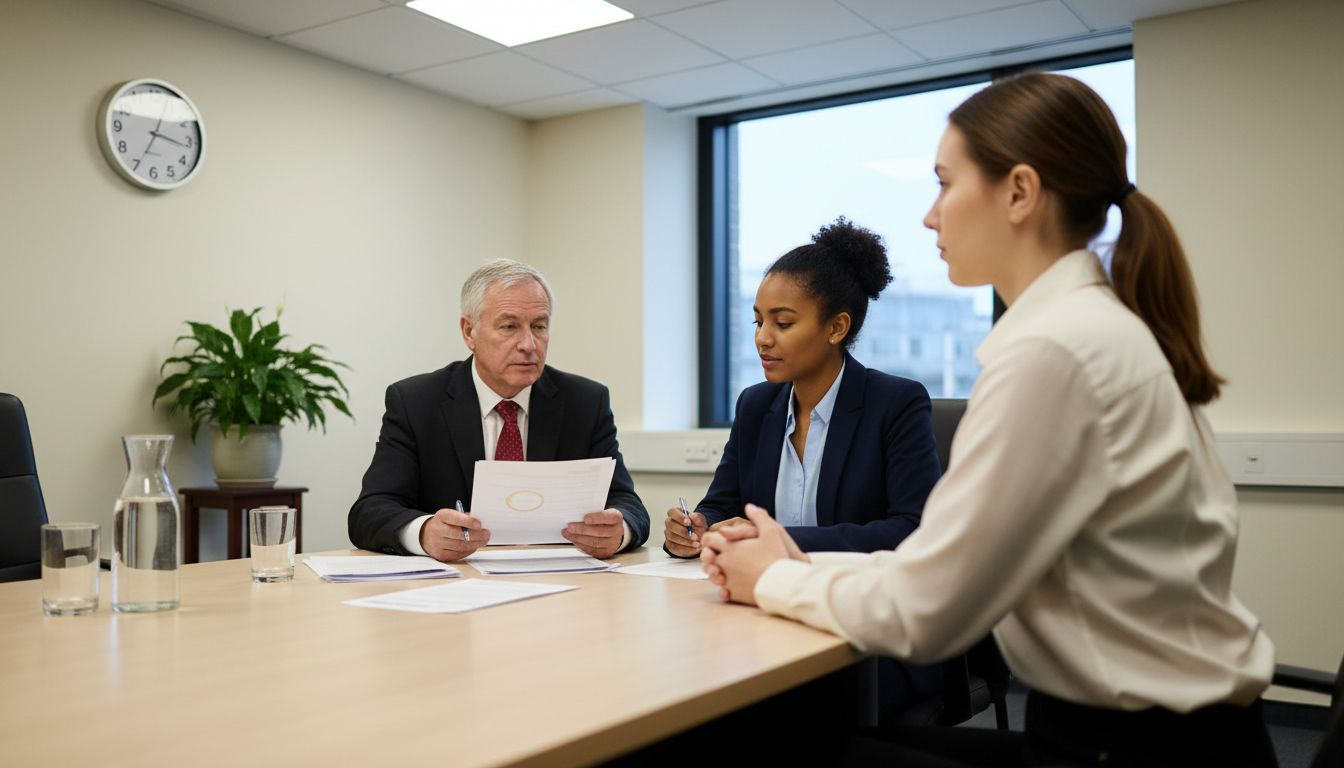
Standardisation creates fairness in multiple ways. First, predetermined questions focus on job-relevant competencies identified through role analysis. Second, scoring rubrics specify what constitutes strong, adequate, or weak responses. Third, diverse panels bring multiple perspectives that catch individual biases. Together, these elements create transparent, defensible hiring decisions.
Beyond fairness, structured interviews predict job performance more accurately than alternatives. Better job matching reduces turnover and improves retention rates by selecting candidates whose skills align with role requirements. Early staff turnover costs UK organisations thousands of pounds per role in recruitment and training expenses.
Organisations using structured interviews report improved workforce diversity. Reducing bias in assessment naturally increases representation of women, ethnic minorities, and candidates from non-traditional backgrounds. These improvements stem from evaluating what candidates can do rather than where they studied or worked previously.
Pro Tip: Ensure interview questions are job-relevant and tested with diversity leads or employee resource groups. Questions that seem neutral may inadvertently disadvantage certain groups. Piloting questions with diverse reviewers identifies potential issues before implementation.
Structured interview benefits extend beyond individual hires. Consistent processes generate data that helps organisations refine questions, identify effective interviewers, and track hiring outcomes over time. This evidence-based approach supports continuous improvement in talent acquisition, complementing tools like structured interview processes that formalise best practices.
Designing and implementing structured interviews
Building effective structured interviews begins with thorough job analysis. Identify the competencies, skills, and behaviours essential for role success through consultation with hiring managers, current role holders, and team members. This analysis forms the foundation for relevant questions.
Once competencies are clear, develop standardised questions that elicit evidence of these capabilities. Behavioural questions asking candidates to describe past situations where they demonstrated key skills work well. Pilot questions with diversity leads to ensure they are fair and job-relevant. Diverse panels and piloted questions increase fairness whilst reducing bias.
Implementation steps include:
- Conduct job analysis to identify critical competencies
- Develop standardised, behaviour-focused questions
- Create clear scoring rubrics defining response quality
- Form diverse interview panels with at least two members from different backgrounds
- Train interviewers on structured processes, scoring criteria, and calibration techniques
- Conduct interviews using identical questions and scoring methods
- Calibrate scores through panel discussion to minimise individual bias
- Document decisions and feedback for transparency and continuous improvement
Panel diversity matters significantly. Include interviewers from different genders, ethnic backgrounds, and organisational levels. Research shows diverse panels reduce bias and improve candidate experience. Aim for at least two panel members to prevent single-person bias dominating decisions.
Interviewer training ensures consistency. Cover the structured process, how to use scoring rubrics, and calibration techniques that align judgements across panel members. Training reduces variation in how interviewers interpret responses and apply scoring criteria.
Pro Tip: Keep follow-up questions job-relevant and ask them uniformly across candidates. Probing deeper on responses is appropriate, but ensure all candidates receive similar opportunities to elaborate. Inconsistent follow-up reintroduces bias.
Post-interview calibration involves panel members discussing scores before finalising decisions. This discussion surfaces individual biases and creates consensus on candidate rankings. Calibration improves reliability and helps interviewers learn from each other. For detailed guidance on structured interview process steps, organisations can access frameworks that formalise these practices. AI interviews offer additional tools for standardising early-stage assessments.
Common misconceptions about structured interviews
Several misunderstandings prevent organisations from adopting structured interviews. Addressing these misconceptions clarifies the true value and flexibility of structured methods.
Misconception: Structured interviews are too rigid and prevent natural conversation. Reality: Structured interviews allow follow-up questions that remain job-relevant. The structure applies to core questions and scoring, not to building rapport or exploring responses. Skilled interviewers create conversational flow whilst maintaining consistency.
Misconception: Structured interviews do not improve diversity. Evidence contradicts this belief. Studies show structured methods reduce bias against women, ethnic minorities, and candidates with career breaks. Standardised assessment prevents demographic characteristics from influencing decisions.
Misconception: CV screening alone suffices for candidate assessment. CVs reveal credentials and work history but poorly predict job performance. They trigger unconscious bias and exclude talented individuals with non-traditional backgrounds. Interviews assess capabilities CVs cannot capture.
Misconception: Unstructured interviews work just as well. Research demonstrates unstructured interviews increase bias and inconsistency. Without standard questions or scoring, interviewer preferences dominate decisions. Unstructured methods feel more natural but produce worse hiring outcomes.
Common concerns about structured interviews include:
- Fear they feel robotic or impersonal to candidates
- Belief they require excessive preparation time
- Assumption they eliminate interviewer judgement
- Worry they cannot adapt to different roles or seniority levels
These concerns misunderstand how structured interviews function. Well-designed processes balance consistency with flexibility, use interviewer expertise within defined frameworks, and adapt question content to role requirements whilst maintaining structural rigour. Candidate feedback on structured interviews is typically positive, as transparency and fairness enhance the candidate experience.
Structured interviews represent professional, evidence-based hiring practices that respect both organisational needs and candidate dignity. They complement rather than replace interviewer judgement by channelling expertise towards job-relevant assessment.
Comparison framework: structured interviews versus traditional CV screening and unstructured interviews
Understanding differences between assessment methods helps HR teams select appropriate approaches. This comparison highlights how structured interviews provide standardised questions, reduce bias, and improve prediction compared to alternatives.
| Dimension | Structured interviews | CV screening | Unstructured interviews |
|---|---|---|---|
| Question consistency | Identical core questions for all candidates | Not applicable | Questions vary by candidate and interviewer |
| Scoring method | Predefined rubrics with clear criteria | Subjective reviewer judgement | Interviewer intuition and personal preference |
| Bias risk | Reduced through standardisation and diverse panels | High due to unconscious bias triggers | High due to lack of consistency |
| Predictive validity | Strong predictor of job performance | Weak predictor, focuses on credentials | Moderate to weak, depends on interviewer skill |
| Candidate experience | Transparent, fair, consistent | Opaque, prone to bias | Variable, depends on interviewer approach |
| Resource requirements | Upfront design investment, efficient execution | Low upfront cost, time-intensive review | Minimal preparation, inconsistent outcomes |
| Diversity impact | Improves representation of underrepresented groups | Perpetuates existing biases | Maintains or worsens bias |
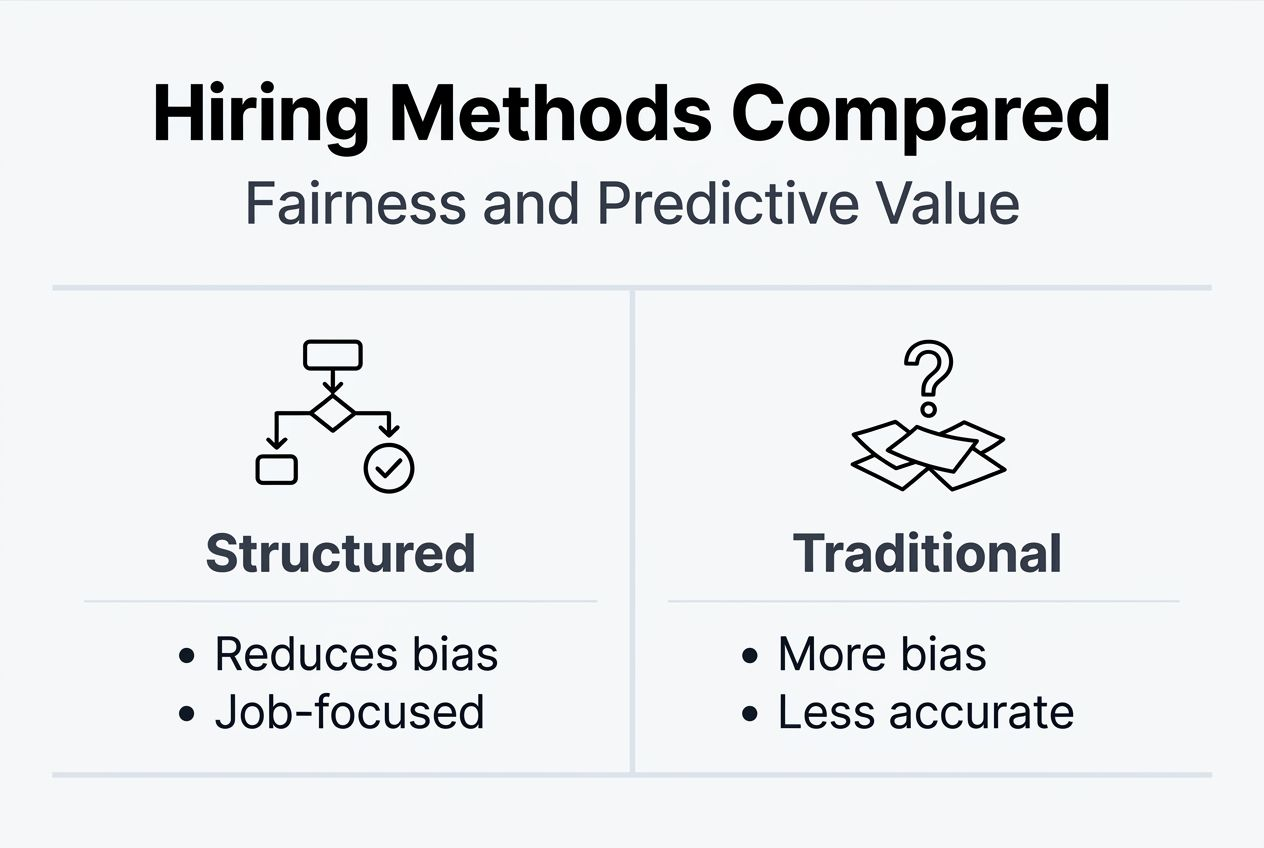
Structured interviews require upfront investment in question design and interviewer training but generate better hiring outcomes. CV screening appears efficient yet introduces bias and misses critical competencies. Unstructured interviews feel natural but sacrifice fairness and predictive power.
Key differentiators include:
- Standardisation enables fair comparisons across candidates
- Evidence-based scoring reduces subjective bias
- Transparent processes improve candidate trust
- Better prediction reduces costly hiring mistakes
Pro Tip: Use this framework to match assessment methods to organisational priorities. High-stakes roles benefit most from structured interviews, whilst CV screening may suffice for initial filtering when combined with subsequent structured assessment.
Selecting the right method depends on role requirements, organisational capacity, and commitment to fairness. For most professional roles, structured interviews outperform alternatives across fairness, prediction, and candidate experience dimensions.
Techniques and tools within structured interviews
Effective structured interviews employ specific techniques that enhance response quality and assessment consistency. The STAR method represents a widely recognised approach for structuring candidate answers and evaluating behavioural competencies.
STAR stands for Situation, Task, Action, Result. This framework guides candidates to provide concrete examples rather than abstract claims. When answering behavioural questions, candidates describe the context (Situation), what needed accomplishing (Task), steps they took (Action), and outcomes achieved (Result). This structure yields evidence-based responses interviewers can score objectively.
Behavioural interviewing using STAR elicits past performance indicators that predict future behaviour. Questions like “Describe a time you resolved a team conflict” require candidates to share specific examples. Interviewers assess how candidates approached situations, made decisions, and achieved results. This beats hypothetical questions asking what candidates would do, which often generate rehearsed, idealised answers.
Standardised behavioural questions focus assessment on relevant competencies identified during job analysis. For a project management role, questions might explore planning, stakeholder management, and problem-solving. For customer service positions, questions address conflict resolution, empathy, and communication. Tailoring questions to role requirements ensures interviews assess what matters.
Key advantages of behavioural techniques include:
- Concrete evidence of past performance
- Reduced candidate ability to fabricate responses
- Clear structure for scoring and comparison
- Focus on demonstrable competencies over credentials
Scoring frameworks tied to STAR responses enhance objectivity. Rubrics specify what strong, adequate, or weak answers contain. A strong response includes a clear situation, specific actions, and measurable results. Weak responses lack detail or fail to demonstrate the target competency. Interviewers apply these criteria consistently across candidates.
Integrating STAR and behavioural interviewing with structured interview frameworks creates robust assessment processes. These tools complement standardised questions and diverse panels to maximise fairness and predictive validity.
Conclusion and practical next steps for HR
Structured interviews improve hiring fairness, reduce unconscious bias, and enhance selection accuracy compared to CV screening and unstructured methods. They enable objective, consistent, transparent candidate evaluation that benefits both organisations and applicants. For HR professionals and talent acquisition specialists, adopting structured interviews represents a strategic shift towards evidence-based hiring.
Implementation requires thoughtful planning but yields measurable improvements. HR teams should begin with thorough job analyses identifying critical competencies for roles. Develop standardised, job-relevant questions that elicit behavioural evidence of these competencies. Form diverse interview panels representing different backgrounds and perspectives. Train interviewers on structured processes, scoring rubrics, and calibration techniques.
Practical next steps include:
- Conduct pilot structured interviews for selected roles
- Gather feedback from interviewers and candidates
- Refine questions and scoring based on experience
- Monitor hiring outcomes and retention rates
- Expand structured methods across additional roles
- Integrate structured interviews with broader talent assessment strategies
Start incrementally rather than overhauling all hiring processes simultaneously. Test structured interviews on a few roles, learn what works, then scale. Track metrics like time-to-hire, candidate quality, retention rates, and diversity outcomes to demonstrate value to stakeholders.
Pro Tip: Engage leadership support for the culture shift towards evidence-based hiring. Structured interviews challenge traditional practices and require buy-in from hiring managers. Demonstrating early successes builds momentum for broader adoption.
Transitioning from CV screening to structured interviews positions organisations to attract and select diverse, high-performing talent. These methods align with modern expectations for fair, transparent hiring whilst delivering measurable business results through better hiring decisions.
Discover smarter hiring with We Are Over The Moon
Moving beyond traditional CV screening requires tools and expertise that support skills-focused assessment. We Are Over The Moon specialises in innovative hiring solutions that prioritise capabilities over credentials, aligning perfectly with structured interview principles.
Our approach replaces CV screening with real assessments including AI interviews, company challenges, cultural matching, cognitive tests, and video pitches. These methods evaluate what candidates can do rather than where they have been. Structured, evidence-based assessment reduces bias, improves candidate matching, and enhances workforce diversity.
Explore how our solutions modernise recruitment processes for HR teams seeking fairer, more effective talent acquisition. Visit our about page to learn more about our mission and discover how we support organisations building high-performing, diverse teams through skills-based hiring.
FAQ
What are structured interviews and why are they important?
Structured interviews use standardised questions and predefined scoring criteria applied consistently across all candidates for a role. They are important because they reduce unconscious bias, enable fair comparisons, and predict job performance more accurately than CV screening or unstructured methods.
How do structured interviews help reduce unconscious bias?
By using identical core questions and clear scoring rubrics, structured interviews limit opportunities for personal biases to influence decisions. Diverse interview panels and calibration discussions further minimise individual bias, promoting equitable assessment regardless of candidate background.
Can structured interviews improve workforce diversity?
Yes, evidence demonstrates structured interviews reduce bias against underrepresented groups including women, ethnic minorities, and candidates with career breaks. Focusing assessment on job-relevant competencies rather than credentials creates more equitable hiring outcomes.
What are some best practices for designing structured interviews?
Conduct thorough job analysis to identify critical competencies. Develop standardised, behaviour-focused questions and pilot them with diversity leads. Form diverse interview panels, train interviewers on scoring criteria, and calibrate scores through panel discussion before finalising decisions.
How do structured interviews compare to CV screening?
Structured interviews assess capabilities through standardised questions and evidence-based scoring, whilst CV screening reviews credentials and work history. Structured methods reduce bias, predict performance better, and provide transparent candidate experiences compared to CV screening alone.
Recommended
- Structured interview process steps: 35% better retention | We Are Over The Moon
- 6 Key Benefits of AI Interviews for Smarter Hiring | We Are Over The Moon
- 7 Essential Interview Question List Tips for HR Success | We Are Over The Moon
- Advantages of replacing CVs: 74% faster hiring with AI assessments | We Are Over The Moon