Understanding interview automation for smarter hiring

Many HR managers believe interview automation strips away the human element from recruitment, yet quantified studies show efficiency gains of up to 35% without compromising candidate quality. The real challenge is not whether to adopt automation, but how to implement it thoughtfully across diverse European markets whilst maintaining cultural fit and GDPR compliance. This article unpacks the practical realities of interview automation, cutting through misconceptions to reveal actionable strategies for mid-sized to large European companies seeking to transform their hiring processes through intelligent technology integration.
Table of Contents
- Key takeaways
- What is interview automation and why it matters
- Implementing interview automation in European companies: best practices
- Measuring success: key performance indicators and evaluation
- Challenges and nuances: cultural diversity and data privacy in Europe
- Explore expert solutions to elevate your hiring
- Frequently asked questions
Key Takeaways
| Point | Details |
|---|---|
| Automation speeds hiring | Automation speeds up hiring while preserving candidate quality when it augments recruiter judgement rather than replacing it. |
| Maintains candidate quality | The approach must balance speed gains with a high quality candidate experience and use metrics that capture both efficiency and cultural alignment. |
| GDPR compliant integration | GDPR compliant integration is essential to ensure data protection and regulatory alignment across multiple European markets. |
| Cultural fit calibration | Cultural fit should be calibrated to local contexts while retaining standardised evaluation frameworks. |
| Data driven KPIs | Data driven KPIs track performance and support continuous improvement. |
What is interview automation and why it matters
Interview automation refers to the strategic use of artificial intelligence and digital workflows to streamline candidate evaluation processes, from initial screening through final selection. For European companies managing high-volume recruitment across multiple markets, this technology addresses the persistent challenge of identifying quality candidates quickly whilst maintaining fairness and compliance with stringent data protection regulations.
The core components of modern interview automation include:
- Pre-screening algorithms that evaluate candidate responses against role-specific criteria
- Video interview platforms with AI-driven analysis of communication skills and cultural indicators
- Cognitive assessments that measure problem-solving abilities and learning potential
- Automated scheduling systems that eliminate coordination friction
- Integration layers connecting with existing applicant tracking systems
Many HR managers initially approach automation with skepticism, concerned about losing the nuanced judgement that comes from face-to-face interaction. This hesitation often stems from misconceptions about how the technology actually functions. Rather than replacing human decision-making, effective automation handles repetitive evaluation tasks whilst flagging candidates who warrant deeper human assessment. Research demonstrates efficiency gains when automation focuses on augmenting rather than replacing recruiter expertise.
The relevance to European companies extends beyond simple time savings. Mid-sized to large organisations operating across multiple countries face unique challenges around cultural adaptation and regulatory compliance. Interview automation provides standardised evaluation frameworks that can be calibrated for local contexts, ensuring consistent quality whilst respecting regional differences in communication styles and candidate expectations. Understanding why AI interviews work helps HR leaders identify which aspects of their current processes would benefit most from technological enhancement.
Implementing interview automation in European companies: best practices
Successful implementation requires a phased approach that prioritises learning over rapid deployment. European HR leaders should begin with high-volume roles where the efficiency gains will be most visible and the risk of disruption lowest. Customer service positions, sales roles, and technical support functions typically offer ideal starting points because they involve clearly defined competencies and frequent hiring cycles.
Follow these implementation steps for optimal results:
- Audit your current recruitment process to identify bottlenecks and time-consuming manual tasks
- Select one or two high-volume roles for initial pilot testing
- Integrate automation tools with your existing applicant tracking system to maintain data continuity
- Establish baseline metrics before launch to enable accurate before-and-after comparison
- Train hiring managers on interpreting automated assessments alongside traditional interview insights
- Collect candidate feedback systematically to identify experience friction points
- Refine algorithms and workflows based on early results before expanding to additional roles
GDPR compliance must be embedded from the start rather than added as an afterthought. Research on AI automation in interviews emphasises that mid-large EU firms should enforce compliance via immutability and audit trails, with recommended time-to-shortlist targets of 2-4 days. This means implementing technical safeguards that create permanent records of how candidate data was collected, processed, and stored, enabling you to demonstrate compliance during regulatory audits.

Cultural adaptation represents another critical consideration. A cultural fit checklist helps ensure your automation parameters reflect the values and communication norms relevant to each market. German candidates may expect more formal, structured interactions than their Dutch counterparts, whilst French hiring processes often emphasise educational credentials differently than UK practices. Configure your automation tools to accommodate these variations rather than forcing a uniform approach.
Pro Tip: Establish a compliance review committee that includes legal, HR, and IT representatives to evaluate automation decisions quarterly. This cross-functional oversight catches potential GDPR violations before they occur and ensures technical implementations align with both regulatory requirements and candidate experience goals. The committee should review audit logs, assess algorithm fairness metrics, and update data processing agreements as your automation capabilities expand.
Selecting the right candidate assessment tools requires evaluating vendors on technical capability, compliance features, and cultural adaptability. Prioritise platforms that offer transparent algorithm logic, customisable evaluation criteria, and robust data protection features including encryption and access controls.
Measuring success: key performance indicators and evaluation
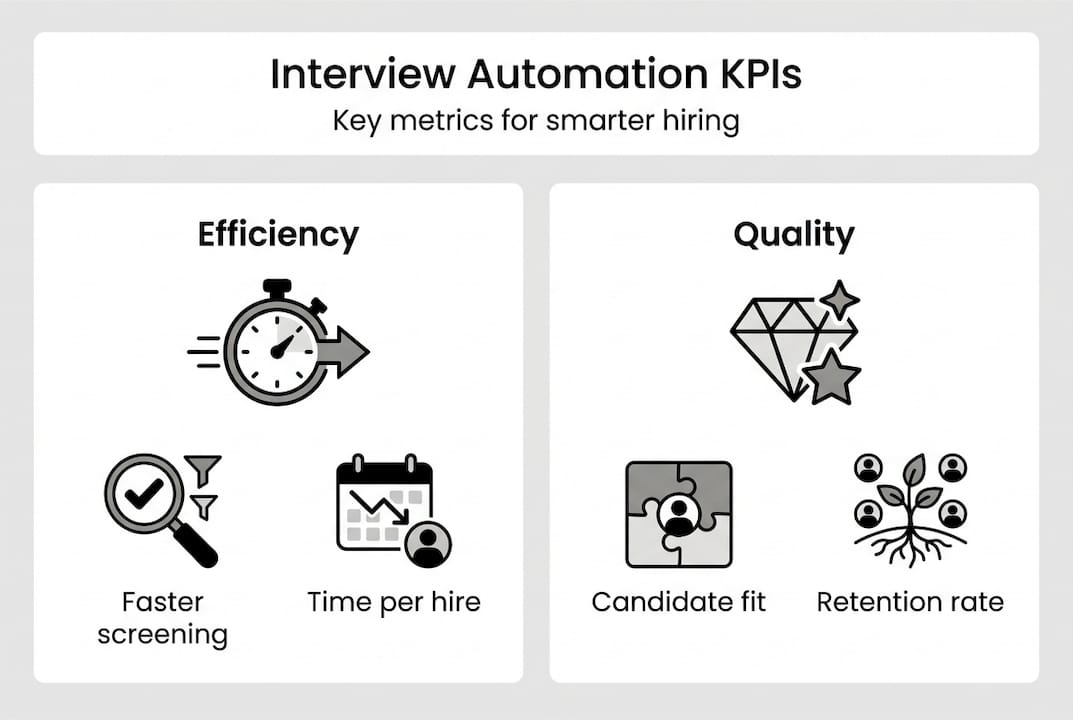
Quantifying the impact of interview automation requires tracking both efficiency metrics and quality indicators. Without clear measurement frameworks, you cannot determine whether your investment delivers genuine value or simply creates the illusion of improvement through faster but less effective hiring.
| KPI | Target range | Implication |
|---|---|---|
| Time-to-shortlist | 2-4 days | Measures how quickly automation identifies qualified candidates |
| Cost-per-hire | 15-25% reduction | Tracks financial efficiency gains from reduced manual screening |
| Candidate drop-off rate | Below 30% | Indicates whether automation creates friction in candidate experience |
| Quality-of-hire score | Maintain or improve baseline | Ensures efficiency gains do not compromise candidate quality |
| Cultural fit rating | Above 4.0/5.0 | Validates that automation preserves human judgement on soft factors |
These quantitative measures tell only part of the story. Studies validating automation benefits emphasise the importance of local validation for cultural fit across diverse European markets. Collect qualitative feedback through:
- Structured candidate surveys measuring experience quality at each automation touchpoint
- Hiring manager interviews assessing whether automated shortlists match their expectations
- New hire performance reviews tracking whether automated selections succeed in role
- Exit interviews with candidates who withdrew to understand friction points
The most revealing insights often emerge from comparing automated versus manual hiring outcomes for similar roles. Run parallel processes for a subset of positions, with some candidates evaluated through automation and others through traditional methods. This controlled comparison reveals whether automation actually improves outcomes or simply processes candidates faster without enhancing quality.
Pre-screening automation results demonstrate that properly implemented systems can save 23 hours per hire whilst maintaining candidate quality. However, these gains require ongoing optimisation rather than set-and-forget deployment. Review your metrics monthly to identify trends, adjusting algorithms and workflows based on what the data reveals about actual performance.
Pro Tip: Create a dashboard that displays efficiency metrics alongside quality indicators in a single view. This prevents the common mistake of optimising for speed whilst inadvertently degrading candidate quality or experience. Include both leading indicators like candidate engagement rates and lagging indicators like new hire performance scores to maintain a balanced perspective on automation effectiveness.
Understanding how to cut hiring time with AI provides additional context for setting realistic targets and evaluating vendor claims against achievable outcomes.
Challenges and nuances: cultural diversity and data privacy in Europe
European HR leaders face unique complexities when deploying interview automation across markets with distinct cultural norms and regulatory frameworks. The assumption that a single automation configuration will work equally well in Stockholm, Madrid, and Warsaw consistently proves false in practice.
Cultural fit validation requires localised calibration:
- Communication style preferences vary significantly, with some markets valuing directness whilst others prioritise diplomatic phrasing
- Educational credential expectations differ, affecting how algorithms should weight formal qualifications versus practical experience
- Interview formality norms range from casual conversations to structured formal assessments
- Response time expectations influence candidate engagement, with some markets expecting immediate feedback and others accepting longer evaluation periods
| Market | Automation preference | Key regulatory consideration | Cultural adaptation priority |
|---|---|---|---|
| Germany | Structured, formal | Strict works council consultation | Emphasis on qualifications and formal credentials |
| Netherlands | Pragmatic, efficient | Moderate data protection focus | Balance between informality and professionalism |
| France | Comprehensive evaluation | Strong labour law protections | Respect for educational pedigree and written communication |
| UK | Flexible, results-focused | Post-Brexit regulatory divergence | Practical experience valued over pure credentials |
GDPR compliance extends beyond technical safeguards to encompass transparency and candidate rights. Your automation systems must enable candidates to understand how their data informs hiring decisions, request corrections to inaccurate information, and exercise their right to human review of automated decisions. Research consistently emphasises that efficiency gains must be validated locally for cultural fit across Europe’s diverse landscape.
Privacy challenges requiring active mitigation include:
- Ensuring video interview recordings are encrypted and access-controlled
- Implementing data retention policies that automatically delete candidate information after defined periods
- Creating audit trails that document every access to candidate data
- Establishing clear data processing agreements with automation vendors
- Providing candidates with transparent explanations of how algorithms evaluate their responses
The technical architecture of your automation platform matters significantly for compliance. Cloud-based systems must store European candidate data within EU borders, with vendors able to demonstrate compliance with data localisation requirements. Request detailed documentation of vendor security practices, including penetration testing results and third-party compliance audits.
Exploring video interviews with AI reveals how modern platforms balance evaluation capability with privacy protection. Understanding the advantages of AI assessments versus CVs helps HR leaders recognise where automation delivers genuine value versus where traditional methods remain superior.
Explore expert solutions to elevate your hiring
Transforming recruitment through interview automation requires more than understanding best practices. You need technology platforms purpose-built for European HR requirements, combining sophisticated AI evaluation with GDPR compliance and cultural adaptability. We Are Over The Moon specialises in replacing CV screening with real assessments that reveal candidate potential through AI interviews, company challenges, cultural matching, cognitive tests, and video pitches.
Our AI candidate validation platform addresses the specific challenges European HR leaders face when implementing automation across diverse markets. Rather than forcing candidates through generic evaluation frameworks, our technology adapts to your organisation’s unique cultural requirements whilst maintaining consistent quality standards. Learn more about our approach to building recruitment technology that respects both efficiency goals and candidate experience quality.
The most successful implementations begin with focused pilots that demonstrate value before expanding to full deployment. Start with a single high-volume role, measure results rigorously, and refine your approach based on what the data reveals. Our skills-based matching platform provides the foundation for this iterative improvement process, enabling you to optimise automation parameters as you learn what works best for your organisation.
Frequently asked questions
What is interview automation and how does it work?
Interview automation uses artificial intelligence and digital workflows to streamline candidate evaluation, from initial screening through final selection. The technology analyses candidate responses to structured questions, assesses communication skills through video interviews, and evaluates cognitive abilities through targeted tests, all whilst maintaining audit trails for compliance purposes.
How does interview automation maintain GDPR compliance?
Compliant systems implement immutable audit trails that document every data access and processing decision, encrypt candidate information both in transit and at rest, store data within EU borders, and enable candidates to exercise their rights to access, correction, and human review. Technical safeguards must be embedded in the platform architecture rather than added as afterthoughts.
Can interview automation work across different European cultures?
Effective automation requires localised calibration for each market’s communication norms, credential expectations, and candidate experience preferences. A single configuration rarely works equally well across diverse European countries, so platforms must offer customisable evaluation criteria that respect cultural differences whilst maintaining consistent quality standards.
What efficiency gains can European companies expect from interview automation?
Properly implemented systems typically reduce time-to-shortlist by 35-50% and save 15-23 hours per hire through automated screening and assessment. However, these gains require ongoing optimisation and should be validated against quality metrics to ensure speed improvements do not compromise candidate selection effectiveness.
How should HR leaders measure interview automation success?
Track both quantitative metrics like time-to-shortlist, cost-per-hire, and candidate drop-off rates alongside qualitative indicators including cultural fit ratings, candidate experience feedback, and new hire performance scores. Balanced measurement prevents optimising for efficiency at the expense of quality or candidate experience.
Recommended
- How to Interview with AI: Cut Hiring Time by 35% in 2026 | We Are Over The Moon
- Video interviews: smarter hiring with AI in 2026 | We Are Over The Moon
- 6 Key Benefits of AI Interviews for Smarter Hiring | We Are Over The Moon
- Pre-Screening Automation Saves 23 Hours per Hire in 2026 | We Are Over The Moon