Why use challenge-based hiring to find top talent

TL;DR:
- Challenge-based hiring evaluates candidates through practical tasks reflecting real job demands.
- It reduces bias, broadens talent pools, and provides more accurate insights into skills and cultural fit.
- Implementing it requires careful design, automation, and fair candidate treatment to ensure scalability and fairness.
CVs have never really told the full story. You can screen a hundred applications and still not know whether a candidate can actually do the job, let alone thrive in your team’s culture. That frustration is familiar to most HR leaders across the Netherlands, the UK, and Spain. Challenge-based hiring offers a genuinely exciting alternative, one that puts real skills and cultural alignment at the centre of your selection process. This article explains what challenge-based hiring is, why it works, what pitfalls to watch for, and how to implement it in a way that’s fair, scalable, and actually enjoyable for candidates.
Table of Contents
- What is challenge-based hiring?
- Key benefits of challenge-based hiring
- Real challenges: what HR teams must consider
- Expert insights: making challenge-based hiring scalable and fair
- The uncomfortable truth about challenge-based hiring most miss
- Build smarter teams with challenge-based hiring solutions
- Frequently asked questions
Key Takeaways
| Point | Details |
|---|---|
| Reduces hiring bias | Challenge-based hiring helps reduce unconscious bias by assessing practical skills rather than backgrounds. |
| Expands talent pool | Organisations consider more diverse candidates by focusing on abilities, not just CVs. |
| Implementation requires planning | Scalable, fair processes and candidate experience are crucial for long-term hiring success. |
| Fairness and anti-cheat matter | Paid trials and robust anti-cheating processes ensure candidate trust and process validity. |
What is challenge-based hiring?
Having established why traditional approaches fall short, it is important to clarify what challenge-based hiring actually involves.
At its core, challenge-based hiring is a process where candidates complete practical or situational tasks that reflect the real demands of the role they are applying for. Instead of relying purely on a polished CV or a smooth interview performance, you ask candidates to show what they can do. That shift from telling to showing is enormously powerful.
Traditional CV screening and standard competency interviews are largely backward-looking. They ask candidates to describe past experiences and hope those descriptions translate to future performance. Challenge-based hiring is forward-looking. It places candidates in context and observes how they think, decide, and act right now.
The types of challenges used vary by industry and role. Common formats include:
- Case studies that simulate real business problems
- Technical tasks such as coding exercises, data analysis, or design briefs
- Cultural fit simulations that present team scenarios and gauge interpersonal judgement
- Video pitches where candidates explain their approach to a problem
- Cognitive assessments that measure reasoning speed and accuracy under realistic conditions
Each of these formats gives you immediate, observable insight into a candidate’s capabilities, thinking style, and approach to challenges. You can even use a company challenge in hiring that mirrors an actual project your team is working on, making the relevance crystal clear from day one.
Companies that adopt skills-based hiring report a 90% reduction in mishires, an expanded talent pool, and less credential-based bias. That is a remarkable shift in both quality and equity.
The beauty of this approach is that it removes the gatekeeping function that a CV performs. Candidates from non-traditional backgrounds, career changers, and self-taught professionals all get a genuine opportunity to demonstrate their value.
Key benefits of challenge-based hiring
Now that you know what challenge-based hiring is, let us explore why so many forward-thinking HR leaders are making the shift.
The most immediate benefit is a dramatic reduction in hiring bias. When you evaluate a candidate on what they actually produce rather than where they studied or which companies they have worked for, you strip away many of the unconscious assumptions that creep into traditional screening. Skills-based hiring directly focuses on abilities rather than credentials, which means your shortlist is built on merit rather than familiarity.
A broader, more diverse talent pool naturally follows. Candidates who might have been filtered out at the CV stage because of an unconventional career path can now prove their worth through performance. That is genuinely exciting for teams looking to bring in fresh perspectives and build inclusive cultures.
Challenge-based hiring also provides direct, visible evidence of both hard and soft skills. A well-designed task will reveal how a candidate approaches ambiguity, how they communicate under time pressure, and whether their values align with your team’s way of working. Assessing candidate fit becomes far more accurate when you have real behavioural data rather than interview impressions alone.

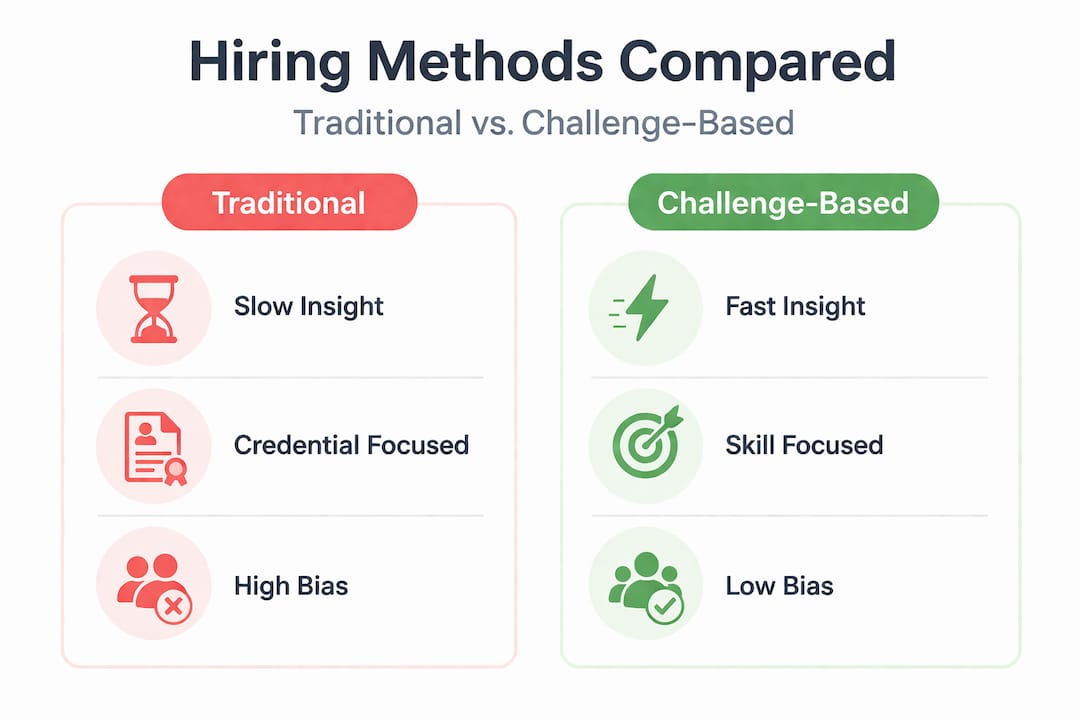
Traditional vs. challenge-based hiring
| Factor | Traditional hiring | Challenge-based hiring |
|---|---|---|
| Speed of insight | Slow, multiple rounds | Faster, task-based feedback |
| Reliability | Variable, subjective | Higher, based on performance |
| Bias reduction | Limited | Significantly improved |
| Talent pool | Narrow, credential-filtered | Broader, ability-focused |
| Cultural fit assessment | Interview-dependent | Embedded in task design |
| Candidate experience | Often passive | Engaging and revealing |
The contrast is striking. And it is worth noting that the benefits do not stop at better hires. Companies that combine challenge-based formats with AI cultural fit assessment tools can add a further layer of consistency, ensuring that every candidate is evaluated against the same benchmarks.
Understanding the full range of types of hiring challenges available also helps you choose the right format for each role. A creative director needs a different challenge from a data analyst, and matching format to function is what makes the process genuinely predictive.
Pro Tip: Build a multi-dimensional scoring rubric before you run any challenge. Score candidates on correctness, communication quality, speed, and approach, not just whether they got the right answer. This gives you richer, more defensible data to compare candidates fairly.
Real challenges: what HR teams must consider
Despite clear benefits, challenge-based hiring presents hurdles that should not be ignored.
The most commonly cited barrier is resource intensity. Designing, running, and evaluating tailored challenges takes time, specialist knowledge, and in many cases a dedicated platform. It is not simply a matter of sending candidates a questionnaire. According to data on implementation constraints, 53% of employers report resource constraints as a significant barrier when trying to roll out skills-based hiring at scale.
Here is a breakdown of the most common challenges HR teams face, along with how widely each is felt:
| Challenge | Percentage of employers affected |
|---|---|
| Resource constraints (time, budget, platform) | 53% |
| Reproducibility and consistency of scoring | 41% |
| Risk of cheating in gamified or technical tasks | 38% |
| Ensuring equity without paid trials | 34% |
| Candidate drop-off due to task length | 29% |
Equity is a particularly important consideration. If you ask candidates to complete unpaid work as part of your selection process, you risk excluding those who cannot afford to invest significant time without compensation. This is especially relevant for longer, more demanding tasks. Paying candidates for substantive trial work is not just ethical, it also signals that you value their time and effort, which reflects positively on your employer brand.
Anti-cheat measures are another practical concern, particularly in technical and gamified challenges. If candidates can easily look up answers or use AI tools to complete tasks without genuine engagement, the validity of your assessment drops. Building challenges that require real-time reasoning, live demonstrations, or verbal explanation of decisions can help address this.
Steps to address these challenges in your process:
- Define the minimum viable challenge that gives you enough information without exhausting candidates
- Use a dedicated platform that supports automated scoring and reduces manual review time
- Compensate candidates fairly for any substantive work that takes more than 30 minutes
- Build anti-cheat safeguards into technical tasks, such as randomised question sets or live coding environments
- Standardise your scoring criteria across all evaluators before launching the challenge
Reading a broader skills-based hiring guide can help you frame your overall strategy, and exploring the argument for skills over credentials will reinforce why making this investment is worthwhile in the long run.
Pro Tip: Pilot your challenge process with a small group of internal volunteers or a limited external cohort before scaling. You will catch scoring inconsistencies, timing issues, and candidate experience problems before they affect your live hiring pipeline.
Expert insights: making challenge-based hiring scalable and fair
To apply challenge-based hiring effectively, it pays to learn from experts who have optimised these processes.
One of the most important lessons from experienced practitioners is that pass/fail scoring is far too blunt an instrument. A candidate who completes a task correctly but slowly, or brilliantly but with poor communication, tells you something very different from a candidate who is fast but careless. Multi-dimensional scoring looks at correctness, robustness, performance speed, and presentation quality together, giving you a much richer picture.
Automation is another critical lever for scale. For technical roles in particular, deterministic test harnesses, automated pipelines that run candidate submissions against pre-set test cases, can process hundreds of applications consistently and without fatigue. This is especially valuable in competitive European recruitment markets where volume is high and speed matters.
The reproducibility problem is real. Across organisations rolling out challenge-based formats, a significant proportion report that scoring inconsistency undermines confidence in the process. When different evaluators apply the same rubric differently, comparisons between candidates become unreliable. Investing in calibration sessions, where evaluators review and discuss sample submissions together before scoring live applications, makes a genuine difference.
Steps to build a fair and scalable challenge pipeline:
- Define the competencies you are assessing before you design the task, not after
- Use deterministic automated tests for technical roles to ensure consistent scoring at volume
- Calibrate evaluators with practice submissions before they score real candidates
- Collect candidate feedback after every challenge to identify friction points and improve the experience
- Review outcomes by demographic group periodically to check for unintended disparate impact
Combining these expert practices with tools designed for reducing recruitment bias creates a process you can defend both internally and externally. And leaning into assessment-driven selection more broadly gives your entire hiring process a more credible, evidence-based foundation.
The uncomfortable truth about challenge-based hiring most miss
After covering the operational nuts and bolts, let us step back for some honest reflection.
Most articles on challenge-based hiring focus on the mechanics: task design, scoring rubrics, automation tools. All of that matters. But the organisations that see the biggest long-term impact from this approach are the ones that treat the challenge as a two-way conversation rather than a one-way test.
Here is the uncomfortable truth: a poorly designed challenge communicates something about your company, not just the candidate. If your task is confusing, your instructions are vague, or you never give candidates feedback after they complete it, you are telling them exactly what it feels like to work for you. And the best candidates, the ones with options, will walk away.
We see this pattern regularly. Companies invest in great challenge tools but neglect to think about what the experience feels like from the other side of the screen. The most effective challenge-based hiring processes are those where the task itself reflects your team’s actual values. If collaboration is central to how you work, your challenge should involve a collaborative element. If creative problem-solving is prized, the task should have genuine ambiguity built in, not a neat right answer waiting to be found.
Cultural fit assessment is not a separate stage that happens after the challenge. It should be woven into the challenge itself. The way a candidate handles ambiguity, asks for clarification, or communicates their reasoning tells you far more about whether they will thrive in your team than any cultural fit questionnaire completed in isolation.
Companies that close the feedback loop, telling every candidate what they did well and where they could improve, see meaningfully better retention rates among successful hires. Those candidates arrive with realistic expectations, having already experienced a slice of how the company thinks and communicates. That alignment, built before the offer letter is even sent, is genuinely priceless.
Build smarter teams with challenge-based hiring solutions
Ready to bring challenge-based hiring into your organisation? We are over the moon to help you get there.
At WAOTM, we believe that great hiring starts with real evidence, not polished paperwork. Our platform replaces CV screening with AI interviews, company challenges, cultural matching, cognitive tests, and video pitches, all designed to give you a complete, fair picture of every candidate. Whether you are building a skills-based match from scratch or adding challenge formats to an existing process, our AI hiring platform is built to scale with you. Curious about the thinking behind our approach? Find out more about how we work and why we are passionate about assessment-first recruitment. Your best hires are waiting to be discovered.
Frequently asked questions
How does challenge-based hiring reduce bias in recruitment?
Challenge-based hiring screens for capability rather than credentials, cutting bias by using objective skill demonstrations. By focusing on abilities rather than where someone studied or who they know, assessments level the playing field considerably.
What types of roles are best suited to challenge-based hiring?
It works best for professional, technical, and creative roles where hands-on demonstration is possible. That said, with thoughtful design, situational challenges can add value in a wide range of customer-facing, managerial, and operational roles too.
Is challenge-based hiring more resource-intensive than traditional methods?
Deploying challenge-based hiring can be resource-intensive initially, but scalable solutions and automation can offset this over time. Data shows that 53% of employers cite resource constraints as a barrier, making the choice of platform critically important.
How can companies ensure fairness in challenge-based hiring?
Paying for trial work and using anti-cheat systems ensures fairness and builds trust with candidates. Paid trials and anti-cheat measures are both practical and ethical safeguards that signal genuine respect for candidate time.
What is a real-world example of a challenge-based hiring assessment?
A marketing firm might ask candidates to draft a campaign brief for a fictional product launch, while a tech employer could offer a small coding project that mirrors their everyday sprint tasks. Both formats reveal real capability quickly and give candidates a genuine taste of the work ahead.
Recommended
- Hiring challenges: enhance candidate assessment and fit
- Company Challenge in Hiring – Transforming Talent Assessment | We Are Over The Moon
- Qualities of top candidates: innovative assessment methods for HR leaders 2026 | We Are Over The Moon
- Why prioritising candidate potential drives better hiring | We Are Over The Moon
- Top talent acquisition tips for smarter hiring in 2026 | Testask Blog | testask
- How to Uncover and Elevate Leadership Hiring Best Practices