What is diversity hiring? A practical guide for HR leaders

TL;DR:
- Effective diversity hiring redesigns recruitment processes to remove systemic barriers and expand talent pools.
- It relies on evidence-based practices like structured assessments, impact monitoring, and inclusive sourcing to ensure fairness.
Diversity hiring is not about filling quotas or ticking boxes, and the most forward-thinking HR leaders in Europe already know this. Mature diversity programmes focus on fairer process design and removing the systemic barriers that prevent talented people from ever reaching your interview stage. Get it right and you gain access to a wider talent pool, stronger team performance, and a more resilient organisation. Get it wrong and you face growing legal, reputational, and financial risks. This guide walks you through what diversity hiring truly means, why it matters right now, and exactly how to build an evidence-based approach that holds up to scrutiny.
Table of Contents
- Defining diversity hiring: Moving beyond buzzwords
- Why diversity hiring matters: Business, legal and ethical drivers
- Building an evidence-based diversity hiring process
- Measuring and improving your diversity hiring impact
- Rethinking diversity hiring: What most experts miss
- Take your diversity hiring practices further
- Frequently asked questions
Key Takeaways
| Point | Details |
|---|---|
| Diversity hiring requires system change | It focuses on audit, process design, and ongoing review rather than simple quotas or quotas. |
| Evidence underpins legal safety | European law supports fairer processes, not automatic preferences—document everything for compliance. |
| Impact monitoring measures true progress | Use data-driven metrics and corrections to ensure inclusion efforts are working. |
| Practical steps outperform targets | Structured interviews, diverse sourcing, and training drive lasting cultural change. |
Defining diversity hiring: Moving beyond buzzwords
Diversity hiring is the deliberate redesign of recruitment processes to remove barriers that disadvantage candidates based on characteristics unrelated to job performance. It is not simply about inviting more people to apply. It covers how you write job adverts, where you source candidates, how you screen applications, how you conduct interviews, and how you make final decisions.
An evidence-based way to make this operational is to build hiring standards that address both disparate treatment and disparate impact through three pillars: process design, impact monitoring, and corrective action. Disparate treatment means actively treating candidates differently because of a protected characteristic. Disparate impact means that a seemingly neutral process produces systematically worse outcomes for a particular group.
Research across Europe examines which company characteristics make recruiters less likely to discriminate on the basis of ethnicity, nationality, or caregiving responsibilities. The findings are illuminating because discrimination often operates at process level, not through individual prejudice alone.
Common misconceptions about diversity hiring in HR circles:
- Diversity hiring means lowering the bar for certain candidates
- Setting numerical targets is the same as introducing quotas
- Diversity hiring only benefits underrepresented groups
- Compliance with the Equality Act 2010 automatically means inclusive hiring
- Removing bias is a one-time project rather than an ongoing process
These misconceptions are genuinely harmful. They cause organisations to either avoid the topic entirely or to implement surface-level changes that create legal risk without producing real inclusion. Refer to our fair recruitment guidance for a detailed look at how process-level changes translate into fairer outcomes.
| Term | Definition | European context |
|---|---|---|
| Protected characteristic | A legally defined attribute that cannot be used as a selection criterion (e.g., race, sex, age, disability) | Equality Act 2010 (UK); EU Equal Treatment Directives |
| Disparate impact | When a neutral policy produces significantly worse outcomes for a protected group | Recognised across EU member states and UK case law |
| Positive action | Lawful steps to help underrepresented groups compete on equal terms | Permitted under Section 159 of the Equality Act 2010 |
| Positive discrimination | Automatically favouring candidates solely due to a protected characteristic | Unlawful in the UK and most EU jurisdictions |
| Adverse impact ratio | A statistical measure comparing selection rates between groups | Used in HR audits and regulatory investigations |
Diversity hiring defined: The systematic redesign of recruitment processes to identify and remove barriers that produce unfair outcomes for candidates with protected characteristics, with the aim of selecting the best person for every role through a genuinely fair process.
Why diversity hiring matters: Business, legal and ethical drivers
The business case for diversity hiring is substantial. Diverse teams generate better decisions, surface more creative solutions, and are more adaptable during periods of change. When your workforce reflects the communities you serve, your organisation builds trust with customers and partners. These are not aspirational statements; they are observed outcomes in organisations that invest seriously in inclusive recruitment.

The legal case is just as compelling. Poorly designed diversity initiatives create real legal risk when they cross the line from lawful positive action into unlawful discrimination. European employers operating under the Equality Act 2010 in the UK, or under EU Equal Treatment Directives across the continent, need careful governance and lawful process design to stay on the right side of the law. Misunderstanding the boundary between positive action and positive discrimination is one of the most common and costly mistakes HR teams make.
Consequences of ignoring diversity in your recruitment process:
- Narrowing your talent pool to a shrinking homogeneous group
- Facing Employment Tribunal claims and regulatory investigations
- Reputational damage in candidate markets where employer brand matters enormously
- Missing innovation and problem-solving capacity that comes from diverse perspectives
- Reinforcing systemic disadvantage, which creates cultural and morale issues internally
One area where the data is especially striking concerns caregiving responsibilities. European research consistently shows that mothers, and particularly single mothers, face measurable disadvantage at the hiring stage. Inclusive hiring practices actively moderate this effect. This is not a soft issue. It is a measurable, correctable problem that affects real people and real business outcomes.
The connection to assessing cultural fit is also worth noting here. When “cultural fit” is defined loosely, it becomes a backdoor for bias. When it is defined rigorously through observable, job-relevant behaviours and values, it becomes a genuinely inclusive selection tool.
Pro Tip: Focus your diversity hiring efforts on barrier removal, not on numerical preferences. “Positive action” under the Equality Act 2010 allows you to support underrepresented candidates in competing on equal terms. It does not allow you to select a less qualified candidate over a better-qualified one simply because of a protected characteristic. The distinction is legally significant and practically important.
Building an evidence-based diversity hiring process
Building a genuinely inclusive hiring process requires more than good intentions. It requires a structured, repeatable methodology that you can audit, defend, and improve over time. Here is a practical roadmap designed for European HR teams.
Step-by-step diversity hiring roadmap:
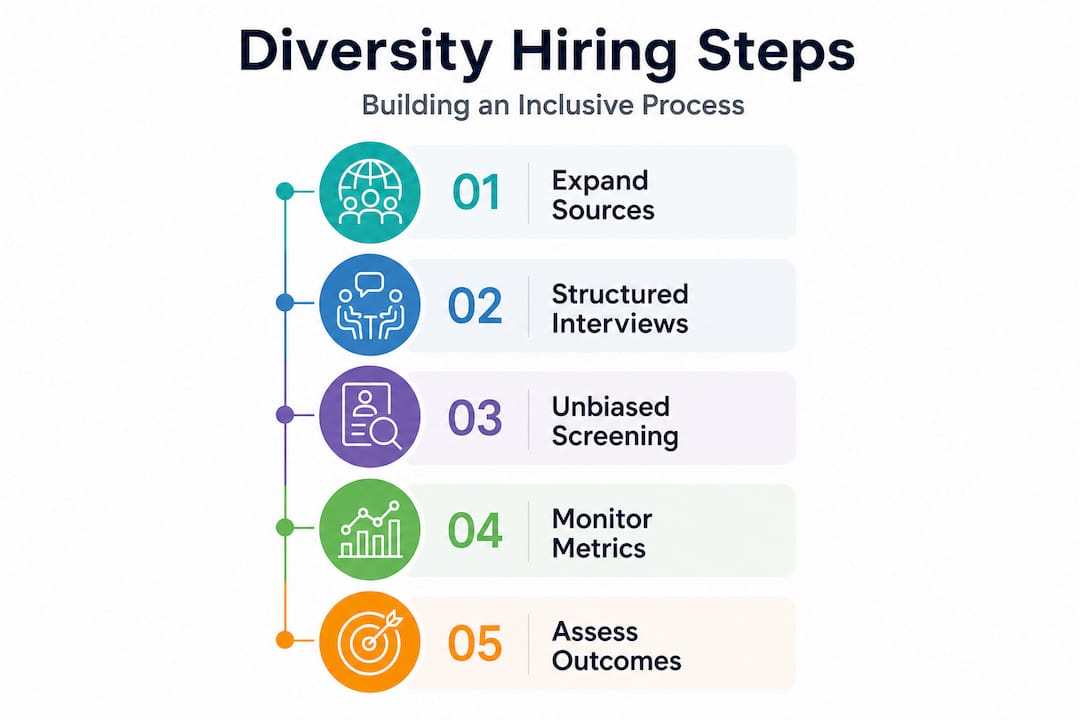
- Audit your current process. Map every stage of recruitment from job design to offer stage. Identify where candidate data drops off by demographic group and where subjective judgement plays the largest role.
- Redesign job descriptions. Remove gendered language, unnecessary degree requirements, and experience criteria that are not genuinely job-relevant. Use structured competency frameworks instead.
- Diversify your sourcing channels. Relying solely on job boards that reach the same narrow audience will not change your candidate mix. Partner with community organisations, specialist networks, and universities that serve underrepresented groups.
- Implement structured interviews. Every candidate answers the same questions, evaluated against the same criteria by a trained panel. This dramatically reduces the variability that allows bias to operate.
- Apply bias mitigation training. Train your hiring managers on how unconscious bias operates and give them practical tools to counteract it. Awareness alone is not enough; process-level interventions are what create change.
- Track metrics at every stage. Measure candidate flow, selection rates, and offer acceptance rates by protected characteristic group where legally permitted. Use these numbers to identify problem stages.
A well-established HR methodology for inclusive hiring includes diversifying sourcing channels, using structured interviews, bias mitigation training, and tracking metrics through regular assessments. The organisations that do this well treat it as a continuous quality improvement process, not a one-off project.
European policy recommendations translate research evidence into concrete employer actions. These include expanding recruitment panels, introducing professional development policies, and standardising evaluation criteria across all hiring stages.
| Traditional hiring process | Evidence-based diversity hiring process |
|---|---|
| CV screening based on credentials | Skills-based screening using structured assessments |
| Unstructured conversational interviews | Structured interviews with standardised scoring |
| Single interviewer decisions | Diverse panel with calibration discussions |
| Sourcing from familiar networks | Multi-channel sourcing including specialist communities |
| No demographic data tracking | Stage-by-stage adverse impact monitoring |
| Subjective “gut feel” cultural fit | Observable, behaviourally defined culture criteria |
Using unbiased screening methods at the top of your funnel makes the biggest difference because it determines who reaches your interview stage in the first place. And exploring AI-led bias reduction tools can help you operationalise these principles at scale, particularly for high-volume recruitment.
Pro Tip: Set up a quarterly diversity hiring dashboard. Track stage-by-stage conversion rates by demographic group, time-to-hire, and offer acceptance rates. Review it with your hiring managers every quarter and treat any significant gaps as process improvement signals rather than blame-attribution moments. This creates a culture of continuous, data-driven improvement.
Measuring and improving your diversity hiring impact
Measuring impact is not optional. It is a legal and ethical requirement, and it is also what separates organisations that make real progress from those that simply talk about it.
How to set up diversity hiring impact monitoring:
- Define your measurement framework. Decide which demographic characteristics you will track, consistent with local data protection law (GDPR in the EU, UK GDPR post-Brexit). Clarify the legal basis for collecting sensitive data and communicate it transparently to candidates.
- Collect stage-by-stage data. Track how many candidates from each group apply, pass screening, reach interview, receive offers, and accept. This gives you a complete picture of where drop-off occurs.
- Calculate adverse impact ratios. Divide the selection rate for a minority group by the selection rate for the majority group. A ratio below 0.8 (the “four-fifths rule”) signals a potential problem that requires investigation.
- Investigate root causes. When you identify an adverse impact, do not assume it is deliberate bias. Look at the specific stage where it occurs and examine the process design, the decision-makers involved, and the criteria being applied.
- Implement corrective actions. Make targeted, evidence-based changes to the specific stage where the problem occurs. Retest after two or three hiring cycles and measure again.
| Hiring stage | Metric to track | Target benchmark |
|---|---|---|
| Application | Representation rate by group | Reflects relevant labour market |
| CV/assessment screening | Adverse impact ratio | Above 0.8 |
| First interview | Adverse impact ratio | Above 0.8 |
| Final interview | Adverse impact ratio | Above 0.8 |
| Offer stage | Offer conversion by group | No significant disparity |
| Hire | Representation vs. applicant pool | Closely matched |
Process design, impact monitoring, and corrective action are the three non-negotiable pillars of mature diversity hiring. Adverse impact analysis is the engine that keeps the whole system honest.
Larger recruitment panels and professional development policies within organisations are empirically associated with reduced discrimination in hiring decisions. This is a powerful and actionable finding. More diverse panels with trained members produce fairer outcomes.
“Translating measurement into meaningful action requires organisations to move from passive data collection to active process redesign. Identify the stage, investigate the cause, intervene with evidence, and measure again. This cycle is the engine of genuine diversity improvement.”
Candidate benchmarking tools can support this process by giving you consistent, comparable data across your candidate population. And approaching hiring challenges and assessment with a structured mindset transforms your evaluation from a subjective conversation into a data-rich process.
Rethinking diversity hiring: What most experts miss
Here is an uncomfortable truth that most diversity consultants will not tell you directly. The organisations that invest the most in visible diversity commitments, bold target announcements, and high-profile hiring drives are often the ones with the slowest sustained progress. Why? Because visible action feels like progress, and it is genuinely hard to admit that culture change is slower, less glamorous, and more difficult than setting a headline target.
Quick-win target-setting creates perverse incentives. Hiring managers feel pressure to select candidates from underrepresented groups regardless of process quality. This can produce tokenism, resentment, and legal exposure all at once. It also undermines the confidence of talented people from those groups, who have every right to know they were selected because they were the best candidate, not because they filled a metric.
Positive action in the UK must be lawful and evidence-based. It is categorically not the same as unlawful positive discrimination or automatic preferences. The distinction matters enormously in practice, and HR leaders who blur this line expose their organisations to serious legal risk.
“Positive action allows employers to take steps to help underrepresented groups compete more effectively. It does not permit selecting a less qualified candidate over a better-qualified one on the basis of a protected characteristic. The line between the two is the line between lawful inclusion and unlawful discrimination.”
Sustainable diversity improvement requires three things that cannot be shortcut: genuine cultural buy-in from leaders and managers, education that changes how people think about fairness and merit, and system-level redesign that removes bias at the process level rather than compensating for it at the decision level.
Understanding AI’s role in recruitment is increasingly central to this conversation. AI tools can standardise evaluations, reduce inconsistency, and surface candidates who would have been filtered out by biased screening. But they need to be implemented thoughtfully, with their own bias audits in place.
Pro Tip: Document every hiring decision and the criteria used to make it. This is not bureaucracy for its own sake. When a candidate challenges a decision, or when a regulator asks for evidence of a fair process, your documentation is your defence. Make it a non-negotiable standard across all hiring activity.
Take your diversity hiring practices further
We are genuinely excited about what happens when organisations move from theory to action in diversity hiring. The shift from CV-based screening to real, skills-focused assessment changes everything.
At We Are Over The Moon, we have built our platform specifically to replace biased CV screening with assessments that reveal what candidates can actually do. Match on skills, not CVs using AI interviews, cognitive tests, video pitches, and company challenges that give every candidate a fair opportunity to shine. Our AI Candidate Validation Platform supports evidence-based, compliant hiring at scale, helping European HR teams build the diverse, high-performing teams they are aiming for. If you are ready to operationalise everything this guide has covered, we would love to show you what that looks like in practice.
Frequently asked questions
How does diversity hiring differ from positive discrimination?
Diversity hiring focuses on removing barriers and creating fair processes, while positive discrimination means treating candidates less favourably or giving automatic preferences solely based on protected characteristics, which is unlawful in most of Europe.
What are the first steps to implement diversity hiring in a European company?
Define your diversity context, review your hiring standards for bias, and start monitoring candidate data by stage to identify where drop-off or adverse impact occurs.
What metrics should we track to monitor diversity hiring success?
Track candidate flow by stage, adverse impact ratios, and representation of underrepresented groups at every recruitment checkpoint, using regular metric assessments to guide continuous improvement.
Are there legal risks if we set diversity targets?
Yes, improper application of targets or quotas can increase legal risk for unlawful discrimination. Careful governance and a focus on evidence-based process changes are essential to stay within lawful boundaries.