What Is Candidate Experience and Its Impact on Hiring

Recruitment in the fast-paced technology sector demands much more than the right skills on paper. For HR decision-makers in the Netherlands, UK, and Spain, ensuring every candidate feels respected and informed is now a central priority. Organisations embracing innovative assessment solutions build stronger employer brands and create genuinely memorable candidate journeys. This article highlights practical strategies that help transform standard recruitment into an engaging, positive experience for every applicant.
Table of Contents
- Defining Candidate Experience In Recruitment
- Key Stages Of The Candidate Journey
- How Positive Experience Benefits Organisations
- Common Pitfalls And Mistakes To Avoid
- Leveraging Innovative Assessments For Improvement
Key Takeaways
| Point | Details |
|---|---|
| Importance of Candidate Experience | Candidate experience significantly impacts organisational reputation and talent acquisition, necessitating genuine respect and transparency throughout the recruitment process. |
| Candidate Journey Stages | Understanding the seven stages of the candidate journey aids in creating effective touchpoints that enhance the overall experience and attract quality talent. |
| Benefits of Positive Experiences | A positive candidate experience leads to improved employer branding, higher engagement rates, and long-term strategic advantages for organisations. |
| Avoiding Common Pitfalls | Organisations must address communication issues and complex application processes to prevent potential talent loss and maintain a strong brand image. |
Defining Candidate Experience in Recruitment
Candidate experience represents the comprehensive journey and emotional interaction job seekers have throughout an organisation’s recruitment process. Organisational research from industrial psychology experts reveals this experience encompasses every touchpoint from initial job application to final hiring decision.
At its core, candidate experience involves multiple critical dimensions:
- Perception and interactions during recruitment
- Quality and timeliness of communication
- Transparency about role expectations
- Respect shown throughout selection stages
- Emotional journey of potential employees
Organisations increasingly recognise that candidate experience extends far beyond simple transactional interactions. Each engagement represents an opportunity to build employer brand reputation, potentially influencing future talent acquisition and organisational attractiveness.
The recruitment journey involves multiple psychological and emotional checkpoints where candidates form nuanced impressions. These perceptions can significantly impact an organisation’s ability to attract top talent, with candidates sharing experiences through professional networks and online platforms.
Candidate experience is not just about selecting the right person, but treating every applicant with dignity and respect throughout the process.
Pro tip: Regularly audit your recruitment process from a candidate’s perspective to identify and eliminate potential friction points that might discourage exceptional talent from engaging with your organisation.
Key Stages of the Candidate Journey
The candidate journey represents a strategic pathway that transforms potential applicants into engaged employees through a series of carefully designed interactions. Advanced recruitment strategies highlight the importance of understanding each stage’s unique psychological and professional dynamics.
The recruitment funnel typically encompasses seven critical stages:
-
Initial Exposure
- Job advertisement discovery
- Employer brand visibility
- First organisational impressions
-
Information Gathering
- Role and company research
- Understanding job requirements
- Assessing cultural fit
-
Application Submission
- CV/resume preparation
- Online application completion
- Additional documentation submission
-
Initial Screening
- Preliminary candidate evaluation
- Skills and qualification assessment
- Initial communication touchpoints
-
Assessment and Interviews
- Technical and behavioural evaluations
- Multiple interview rounds
- Skills demonstration
-
Selection and Offer
- Candidate ranking
- Job offer negotiation
- Compensation discussion
-
Onboarding
- Welcome process
- Initial training
- Integration into organisational culture
Each stage represents a crucial touchpoint where candidates form perceptions about the potential employer. Organisations that design seamless, transparent, and respectful journeys significantly enhance their ability to attract and retain top talent.
Successful candidate journeys transform recruitment from a transactional process into a strategic relationship-building opportunity.
The complexity of these stages demands a holistic approach that balances efficiency with genuine human connection. Sophisticated recruitment teams recognise that every interaction contributes to the overall candidate experience and potential long-term organisational reputation.

Pro tip: Map out your current candidate journey, identifying potential friction points and opportunities for personalisation to create a more engaging and supportive recruitment experience.
How Positive Experience Benefits Organisations
Transformative recruitment strategies demonstrate that positive candidate experiences yield substantial organisational advantages beyond traditional hiring metrics. These benefits extend far deeper than simply filling job vacancies, creating long-term strategic value for forward-thinking businesses.
The key organisational benefits include:
- Enhanced employer branding
- Improved talent acquisition capabilities
- Higher candidate engagement rates
- Stronger competitive positioning
- Reduced recruitment marketing costs
- Increased candidate conversion rates
- Potential for spontaneous professional referrals
Positive candidate experiences fundamentally transform recruitment from a transactional process into a relationship-building opportunity. Organisations that prioritise candidate interactions create powerful brand ambassadors, even among candidates who are not ultimately selected. These individuals may recommend the company to peers, share positive experiences on professional networks, and maintain goodwill towards the organisation.
Moreover, comprehensive candidate experience strategies directly impact recruitment efficiency. Companies demonstrating respect, transparency, and professionalism throughout selection processes attract higher-quality talent and reduce time-to-hire metrics. By designing seamless, user-friendly application experiences, organisations signal their commitment to employee welfare and progressive workplace cultures.
A superior candidate experience is not an expense, but a strategic investment in organisational reputation and future talent acquisition.
The psychological impact of positive recruitment interactions cannot be overstated. Candidates who feel valued and respected, regardless of hiring outcomes, are more likely to maintain positive perceptions of the organisation, potentially becoming future applicants or business partners.
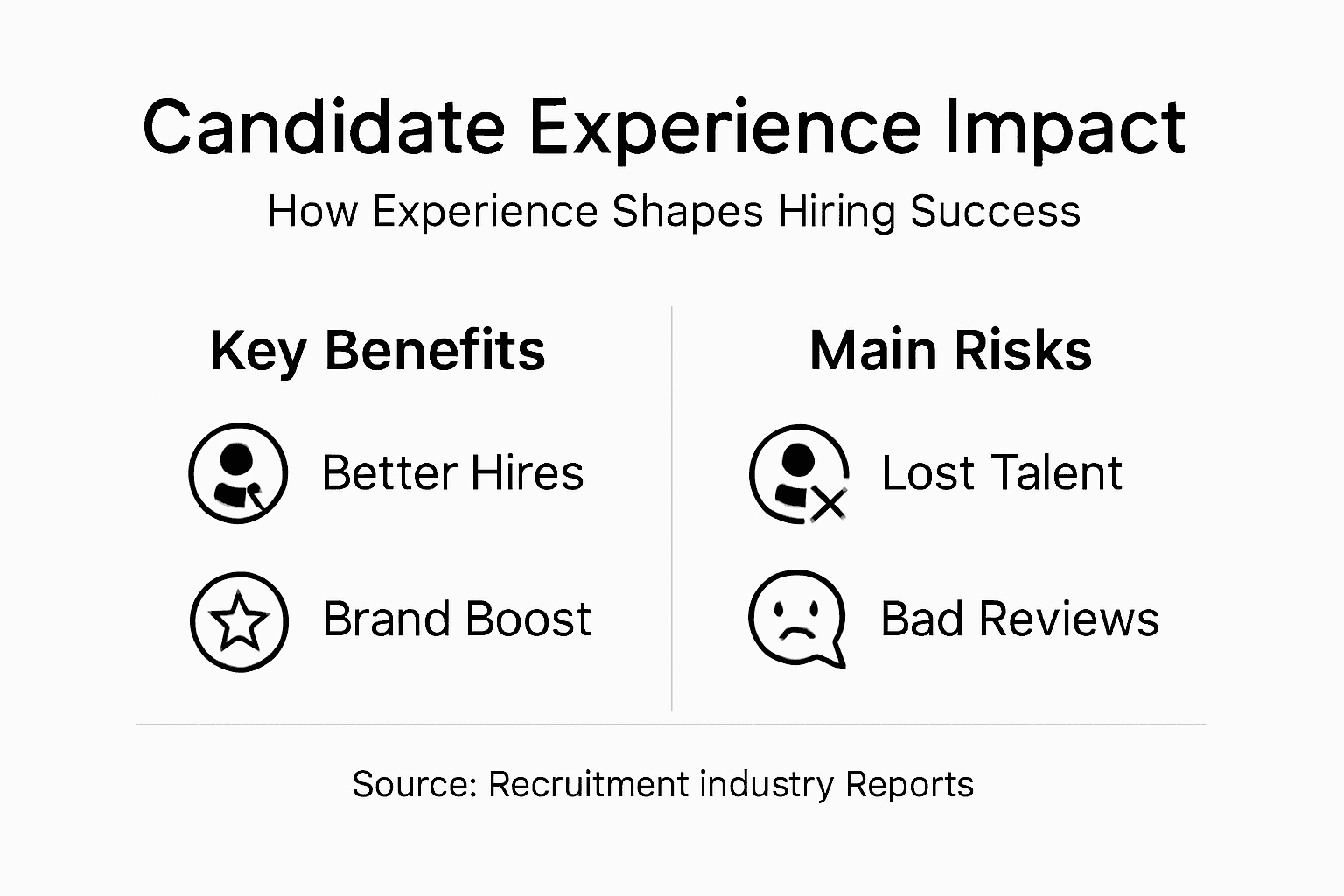
To illustrate how candidate experience impacts organisational outcomes, consider the following summary:
| Organisational Area | Impacted by Positive Experience | Enhanced Outcome |
|---|---|---|
| Employer brand | Greater candidate advocacy | Stronger reputation |
| Talent attraction | Wider high-quality applicant pool | Competitive edge |
| Recruitment cost | More efficient processes | Reduced expenses |
| Employee loyalty | Improved onboarding engagement | Higher retention |
Pro tip: Implement a structured feedback mechanism to continuously refine and improve your candidate experience, treating each interaction as an opportunity for organisational learning and brand enhancement.
Common Pitfalls and Mistakes to Avoid
Recruitment experience research reveals numerous critical mistakes organisations routinely make during candidate interactions. Understanding these pitfalls is crucial for developing a sophisticated and respectful recruitment approach that attracts top talent.
The most significant candidate experience mistakes include:
- Unclear communication patterns
- Overly complex application processes
- Lack of transparency about role expectations
- Inconsistent or delayed feedback
- Impersonal interaction approaches
- Disorganised interview scheduling
- Neglecting candidate emotional experience
Many organisations underestimate the psychological impact of their recruitment processes. Candidates are not merely applicants but potential brand ambassadors who carefully evaluate every interaction. A single poorly managed touchpoint can permanently damage an organisation’s reputation, potentially deterring exceptional talent from future engagement.
Technical recruitment challenges often stem from systemic issues within hiring frameworks. Complicated application systems, excessive documentation requirements, and prolonged decision-making processes create significant friction. These barriers discourage high-quality candidates from completing applications, effectively self-selecting out of potentially rewarding opportunities.
Candidate experience is a reflection of organisational culture - every interaction tells a story about your company’s values and professionalism.
Recruitment teams must recognise that modern candidates expect a seamless, respectful, and transparent journey. This requires deliberate design of each interaction, from initial job advertisement to final communication, regardless of hiring outcome.
Pro tip: Conduct monthly audits of your recruitment process, mapping each candidate touchpoint and systematically eliminating unnecessary complexity and potential points of frustration.
Leveraging Innovative Assessments for Improvement
Innovative assessment strategies are transforming recruitment by moving beyond traditional evaluation methods. These approaches prioritise understanding candidate potential through more dynamic, interactive, and holistic assessment techniques that reveal deeper insights into individual capabilities.
Key innovative assessment approaches include:
- Competency-based simulations
- Real-world problem-solving challenges
- Video-based skill demonstrations
- Collaborative team assessment exercises
- Personality and cognitive potential mapping
- Interactive skills portfolios
- Contextual performance evaluations
Modern recruitment demands more nuanced evaluation methods that go beyond standard CV screening and structured interviews. Innovative assessments provide candidates opportunities to demonstrate skills authentically, while simultaneously offering organisations richer, more comprehensive candidate insights.
Technology plays a crucial role in enabling these advanced assessment strategies. Digital platforms allow for more flexible, engaging evaluation processes that can be tailored to specific organisational requirements. By integrating interactive assessment tools, recruiters can create more inclusive, transparent, and meaningful candidate experiences that highlight individual strengths beyond traditional metrics.
Below is a comparison of traditional versus innovative assessment methods in recruitment:
| Assessment Type | Traditional Approach | Innovative Approach |
|---|---|---|
| Candidate evaluation | CV screening, standard interviews | Simulations, real-world tasks |
| Measurement depth | Basic skills, qualifications | Behaviour, potential, collaboration |
| Candidate engagement | Passive, one-way questions | Interactive, two-way communication |
| Inclusion potential | Limited, often biased | Broader, supports diversity |
Innovative assessments transform recruitment from a binary selection process into a dynamic exploration of human potential.
Successful implementation requires a strategic approach that balances technological capabilities with human-centric design. Organisations must develop assessment frameworks that are both rigorous and empathetic, creating environments where candidates can genuinely showcase their unique talents.
Pro tip: Design assessment processes that feel more like collaborative problem-solving opportunities rather than high-pressure evaluations, enabling candidates to demonstrate their true capabilities.
Elevate Your Candidate Experience with WAOTM
The article highlights critical challenges such as unclear communication and overly complex application processes that damage candidate perception and organisational reputation. If you want to transform your recruitment journey into a seamless, respectful, and engaging experience that truly reflects your culture and values, it is time to move beyond traditional CV screening. WAOTM offers real assessments including AI interviews, company challenges, cognitive tests and video pitches that empower candidates to demonstrate authentic skills and potential
Discover how innovative assessments and cultural matching can eliminate friction points and build stronger relationships with candidates from the very first interaction. Take control of your hiring outcomes with WAOTM and join organisations prioritising positive candidate journeys. Start now to attract top talent who feel valued and respected every step of the way. Visit WAOTM to revolutionise your recruitment process today.
Frequently Asked Questions
What is candidate experience in recruitment?
Candidate experience refers to the overall journey and emotional interaction that job seekers have throughout an organisation’s recruitment process, encompassing every touchpoint from application to hiring decision.
Why is candidate experience important for organisations?
A positive candidate experience enhances employer branding, improves talent acquisition, increases candidate engagement rates, and can lead to spontaneous professional referrals. It transforms recruitment from a transactional process into a strategic relationship-building opportunity.
What are the key stages of the candidate journey?
The key stages include initial exposure, information gathering, application submission, initial screening, assessment and interviews, selection and offer, and onboarding. Each stage is crucial for shaping candidates’ perceptions of the employer.
How can organisations improve their candidate experience?
Organisations can improve candidate experience by regularly auditing their recruitment process, ensuring clear communication, eliminating complexity in application processes, providing timely feedback, and designing interactive assessment methods that value candidates’ experiences and capabilities.