What is behavioural interviewing? A guide for 2026

TL;DR:
- Behavioral interviewing predicts future performance by examining candidates’ past actions through structured questions.
- It improves retention by 35% and fosters diversity through standardized assessment.
- Digital tools and training enable scalable, fair, and consistent implementation across large hiring teams.
Traditional interviews feel productive. Candidates give polished answers, interviewers nod along, and everyone leaves the room feeling reasonably confident. Yet research consistently shows that unstructured interviews are poor predictors of actual job performance. Behavioural interviewing changes that equation entirely. Rather than asking what someone would do in a hypothetical situation, it asks what they have done in a real one. This guide walks you through what behavioural interviewing is, why the most forward-thinking HR teams in Europe have adopted it, and how you can embed it into your own hiring process with confidence.
Table of Contents
- What is behavioural interviewing?
- Why do leading companies use behavioural interviewing?
- Behavioural interviewing techniques: questions and frameworks
- Implementing behavioural interviewing at scale
- Our take: The art and limits of behavioural interviewing
- How We Are Over The Moon can optimise your hiring
- Frequently asked questions
Key Takeaways
| Point | Details |
|---|---|
| Evidence-based hiring | Behavioural interviewing uses real examples to improve hiring decisions compared to traditional methods. |
| Business value | Structured behavioural interviews are proven to increase retention and reduce unconscious bias in hiring. |
| Simplicity and scalability | Digital tools and simple frameworks enable consistent behavioural interviews even in high-volume hiring environments. |
| Practical application | HR professionals can adopt proven frameworks like STAR to design effective questions for all job levels. |
What is behavioural interviewing?
Behavioural interviewing is a structured approach to candidate assessment that uses past behaviour as the primary lens for evaluating future potential. Instead of asking broad, speculative questions like “How would you handle a difficult colleague?”, behavioural interviews ask candidates to share specific examples from their working history. The logic is straightforward: what someone did before is the clearest signal of what they will do next.
This method stands in sharp contrast to traditional interviews, which often rely on hypothetical scenarios, personality impressions, or CV-based questioning. Those approaches introduce a significant amount of subjectivity, and subjectivity tends to let bias in through the back door. Behavioural interviewing replaces gut feeling with structured evidence.
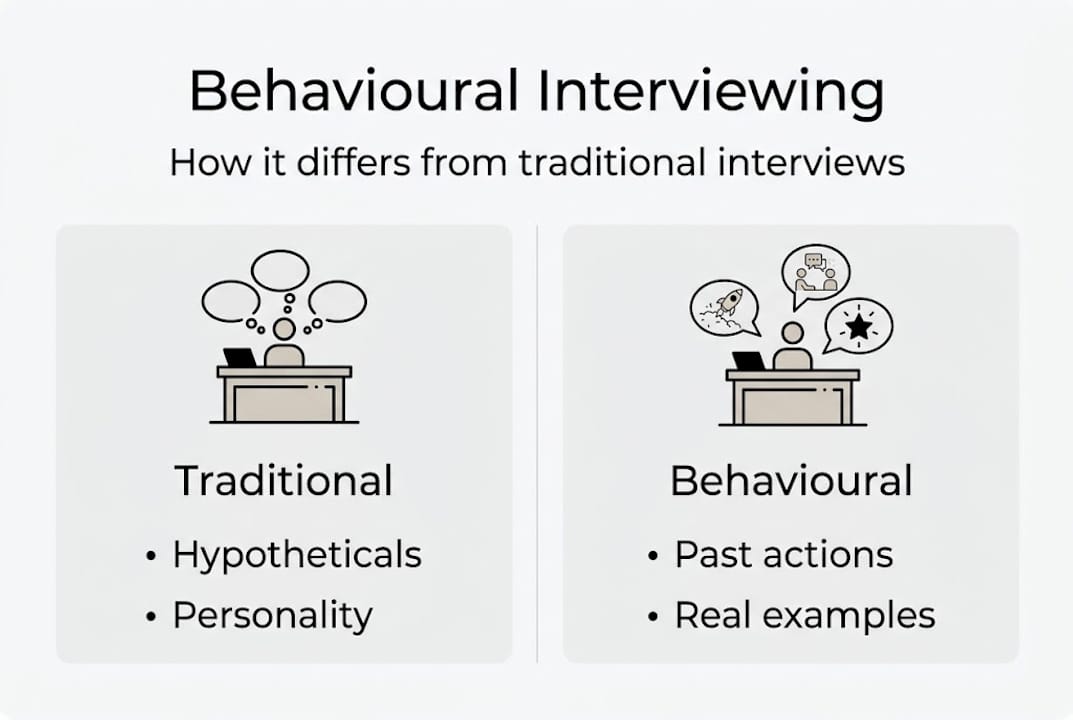
As noted in modern behavioural interviewing, behavioural interviews predict future job performance by focusing on past behaviour, making them a far more reliable tool than the unstructured alternatives most organisations still use.
A typical behavioural interview includes several core components:
- Competency-mapped questions tied directly to the skills and behaviours the role demands
- Structured scoring rubrics so every assessor evaluates responses against the same criteria
- Probing follow-up questions that dig into the depth and authenticity of a candidate’s example
- Consistent question sets applied equally to all candidates to enable fair comparison
“Past behaviour is the best predictor of future performance. Not confidence in the interview room. Not a well-formatted CV. Real, lived experience.”
It is worth clearing up a common misconception here. Many HR professionals assume that a well-structured interview is simply one with a set agenda. Behavioural interviewing goes further than that. It requires a deliberate alignment between the questions asked, the competencies being assessed, and the evaluation framework used to score answers. Without all three, you are simply having a tidier version of the same old conversation.
When done well, behavioural interviewing gives every candidate an equal opportunity to demonstrate their capabilities through concrete evidence rather than charm or presentation skills. That is genuinely exciting for teams committed to fair and effective hiring.
Why do leading companies use behavioural interviewing?
Forward-thinking HR leaders across Europe are shifting to behavioural interviewing because it delivers measurable results. This is not a trend built on theory alone. The data is compelling.

Structured behavioural interviews improve retention rates by 35%, which is a remarkable return on what is effectively a change in questioning technique. Think about what a 35% improvement in retention means at scale: fewer replacement hires, reduced onboarding costs, stronger team continuity, and better cultural cohesion over time.
| Interview type | Bias risk | Prediction accuracy | Retention impact |
|---|---|---|---|
| Unstructured traditional | High | Low | Minimal |
| CV-based screening | High | Moderate | Low |
| Structured behavioural | Low | High | Up to 35% better |
Beyond retention, improving hiring outcomes through behavioural methods also supports diversity goals. When every candidate is assessed on the same behavioural evidence rather than pedigree or presentation, hiring managers are less likely to default to unconscious preferences. The result is a more diverse shortlist and, ultimately, a more diverse workforce.
Here is a quick summary of the direct business benefits that behavioural interviewing brings:
- Stronger cultural fit, because questions map to real organisational values
- Higher retention, as role expectations are clarified through real examples
- Reduced bias, thanks to standardised scoring
- Better team performance, because competency is assessed rather than assumed
- Greater hiring confidence, with evidence-based decisions replacing gut instinct
Pro Tip: Align your behavioural questions directly with your organisation’s core values. If collaboration is a key value, ask specifically about times when a candidate had to navigate a difficult team dynamic. Generic questions produce generic insight.
Leading companies also appreciate that behavioural interviewing creates a better candidate experience. When candidates are asked thoughtful, specific questions, they feel the organisation has taken the role seriously. That impression matters, particularly in competitive talent markets.
Behavioural interviewing techniques: questions and frameworks
Knowing why behavioural interviewing works is one thing. Knowing how to run one effectively is where the real value lies.
The most widely used framework is the STAR method. As question frameworks like STAR demonstrate, behavioural interviewing is most effective when candidates are guided to structure their responses clearly. STAR stands for:
- Situation – What was the context or background?
- Task – What was the candidate responsible for?
- Action – What specific steps did they take?
- Result – What was the measurable outcome?
This structure stops candidates from giving vague, generalised answers. It keeps responses anchored in reality and gives assessors consistent, comparable data across all candidates.
Here are some sample behavioural questions across common competencies:
| Competency | Example question | Insight gained |
|---|---|---|
| Problem-solving | Describe a time you resolved a complex issue under pressure | Analytical thinking and composure |
| Leadership | Tell me about a time you motivated a disengaged team | People skills and adaptability |
| Communication | Give an example of delivering difficult feedback | Emotional intelligence |
| Initiative | When did you identify an opportunity others missed? | Proactivity and ownership |
For assessors, structuring a behavioural interview effectively involves these steps:
- Map each question to a specific competency the role requires
- Prepare two to three follow-up probes for each question
- Use a scoring rubric with defined levels before the interview begins
- Allow the candidate enough time to provide a full, detailed example
- Avoid jumping to a new question before the previous one is fully explored
Pro Tip: Avoid hypothetical questions entirely. Questions like “What would you do if…” open the door to idealised answers. Instead, always ask “Tell me about a time when…”. This small shift produces dramatically more useful responses. You can also explore soft skills testing examples to complement your question design.
Implementing behavioural interviewing at scale
For talent acquisition teams managing high-volume hiring or geographically distributed processes, rolling out behavioural interviewing consistently is both a necessity and a genuine challenge.
The good news is that digitally streamlined interviews are making it far easier to standardise and scale behavioural assessment. Digital and AI-powered interviews streamline behavioural assessment at scale, enabling consistent question delivery, automated scoring, and structured candidate comparison across large cohorts.
Here is what a successful large-scale implementation typically looks like:
- Train all assessors on the STAR framework and scoring rubrics before the process begins
- Standardise your question bank so every interviewer is drawing from the same competency-mapped set
- Use digital platforms to record and review responses, reducing memory bias
- Build feedback loops so assessors calibrate their scoring regularly against agreed benchmarks
- Review your process quarterly to catch any drift in question quality or scoring consistency
Common pitfalls to watch for at scale include assessors reverting to unstructured conversation when they feel rushed, inconsistent use of scoring rubrics across teams, and failing to update question banks when role requirements evolve. A well-designed screening workflow can help you catch these issues before they undermine your data.
The benefits of AI interviews are particularly relevant here. AI tools can analyse response patterns, flag inconsistencies, and surface competency evidence that a human assessor might miss in a busy hiring sprint.
Pro Tip: Use structured interview templates stored in a shared digital platform rather than individual assessor notes. This single change dramatically reduces variation and makes it far easier to compare candidates fairly, even across different hiring managers or office locations.
Our take: The art and limits of behavioural interviewing
We are genuinely enthusiastic about behavioural interviewing. It brings rigour, fairness, and evidence to a process that has historically relied far too much on instinct. But we would be doing you a disservice if we presented it as a complete solution on its own.
Behavioural interviewing excels at assessing competencies and interpersonal behaviours. It is less suited to evaluating deep technical expertise or the kind of problem-solving that only emerges when someone is actually doing the work. That is why we recommend pairing it with skills-based assessments and peer review stages as part of a fuller approach. You can explore the range of HR interview types available to build a hybrid model that truly serves your hiring goals.
One pitfall we see repeatedly is organisations adopting behavioural interviewing in name only, keeping the same unstructured conversations but adding STAR to the vocabulary. The framework only works when the scoring, the question design, and the assessor training all support it. Above all, keep the candidate experience central. A well-run behavioural interview should feel like a genuine conversation, not an interrogation.
How We Are Over The Moon can optimise your hiring
Behavioural interviewing is a powerful step forward, and pairing it with the right platform makes it even more effective.
At We Are Over The Moon, we believe in replacing CV screening with real assessments. Our skill-based hiring approach combines AI interviews, company challenges, cultural matching, cognitive tests, and video pitches into one seamless experience. If you are ready to move beyond guesswork and build a hiring process grounded in genuine evidence, we would love to show you what is possible. Explore our AI candidate validation tools and see how your team can hire with far greater confidence and consistency starting today.
Frequently asked questions
How does behavioural interviewing differ from traditional interviews?
Behavioural interviewing focuses on candidates’ past actions as predictors of future performance, while traditional interviews often rely on hypothetical or less structured questions. As shown in research, behavioural interviews use real experiences rather than qualifications alone, making them considerably more predictive.
What is the STAR method in behavioural interviewing?
The STAR method helps candidates structure responses by outlining the Situation, Task, Action, and Result for each experience. This framework, as explored in STAR method guidance, keeps answers grounded in concrete evidence rather than generalised claims.
Can behavioural interviewing be used with digital assessment tools?
Absolutely. Digital platforms and AI can standardise and automate behavioural interviews for large hiring volumes. Digital interviews enhance both consistency and scalability across distributed hiring teams.
Are behavioural interviews suitable for all roles?
They are highly effective for roles requiring key competencies or interpersonal behaviours, but work best when complemented by technical tests for specialist positions. Soft skills assessments pair particularly well with behavioural interviews in those contexts.