What is a video interview? A practical guide for hiring

TL;DR:
- Video interviews, including live and asynchronous formats, are now central to modern recruitment processes.
- They significantly reduce hiring time, costs, and improve candidate assessment consistency.
- Challenges include technology barriers, AI bias risks, and maintaining human connection; careful implementation is essential.
Most hiring managers still picture interviews as face-to-face conversations. But the reality in 2026 is quite different. A video interview is a remote assessment conducted via video technology, either live or asynchronously, and it has quietly become the backbone of modern recruitment. Two main formats exist: live (synchronous) and pre-recorded (asynchronous). Each serves a distinct purpose in your hiring workflow. This guide cuts through the confusion, explains exactly how both formats work, and gives you the practical steps to use them well.
Table of Contents
- What exactly is a video interview?
- How video interviews work step by step
- Why companies use video interviews: Key benefits and benchmarks
- Limitations and risks of video interviews
- What most HR teams get wrong about video interviews
- Take the next step with efficient hiring solutions
- Frequently asked questions
Key Takeaways
| Point | Details |
|---|---|
| Live vs async formats | Live video interviews occur in real time; async allows flexible, pre-recorded responses for efficiency. |
| Majority adoption | Over 86% of companies now use video interviews for recruitment, driven by speed and reach. |
| Time and bias reduction | Using async formats and structured questions can reduce time-to-hire by up to 75% and limit bias. |
| Critical limitations | Video interviews have tech and engagement drawbacks, best solved by blending formats and clear candidate support. |
What exactly is a video interview?
A video interview is a structured conversation or recorded response session between a recruiter and a candidate, conducted entirely through video technology. No travel. No room bookings. Just focused, efficient assessment.
There are two core types:
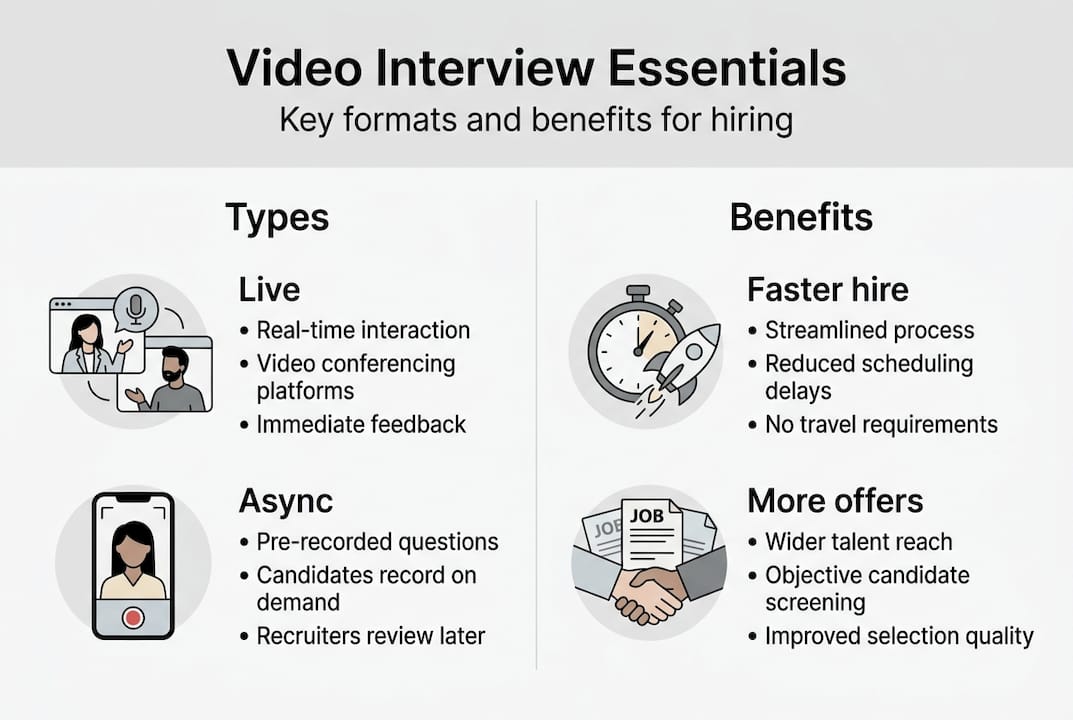
- Live video interviews happen in real time, with both parties online simultaneously. Think of it as a video call with a structured agenda. Platforms like Zoom, Microsoft Teams, or specialist tools facilitate this format.
- Asynchronous video interviews (also called one-way interviews) let candidates record answers to pre-set questions at their own convenience. Recruiters review responses later, on their own schedule.
Both formats have a clear place in modern hiring. Live interviews work well for final-stage assessments, where rapport and real-time dialogue matter. Asynchronous interviews shine at the screening stage, where you need to assess dozens or hundreds of candidates quickly and fairly.
According to the industry glossary definition, video interviews integrate AI for analysis, including tone, natural language processing, and personality indicators, making them far more powerful than a simple video call.
Where do they fit in the hiring workflow? Typically, asynchronous interviews replace the initial phone screen. Live video interviews then follow for shortlisted candidates. This two-stage approach keeps your pipeline moving without sacrificing quality.
The scale of adoption is genuinely exciting:
“86 to 87% of companies now use video interviews as a core part of their hiring process, reflecting the growing use in professional hiring across industries.”
That is not a niche trend. That is a fundamental shift in how organisations find and assess talent. If your team is not yet using video interviews consistently, you are likely spending more time and money than you need to on early-stage screening.
How video interviews work step by step
Understanding the mechanics helps you set up a smooth experience for both your team and your candidates. Here is how the process unfolds in practice.
For asynchronous video interviews:
- HR sets up the interview on a chosen platform, writes the questions, and configures time limits per response.
- Candidates receive an email invitation with a link and clear instructions.
- Candidates record their answers at a time that suits them, often with the option to retake responses.
- Recruiters log in to review recordings, score responses using a rubric, and share shortlists with hiring managers.
- Top candidates progress to the next stage.
The interview platform steps typically include automated reminders, deadline settings, and collaborative scoring tools, which saves your team significant administrative time.
Here is a side-by-side comparison of both formats:
| Step | Live interview | Asynchronous interview |
|---|---|---|
| Scheduling | Both parties align calendars | Candidate chooses own time |
| Format | Real-time dialogue | Pre-recorded responses |
| Recruiter review | Immediate | Flexible, on demand |
| Candidate retakes | Not applicable | Often available |
| Best stage | Final or mid-stage | Early screening |
| AI analysis | Limited | Fully integrated |
The asynchronous interview mechanics are worth exploring in detail if you are setting this up for the first time. The candidate experience differs significantly from a live call, and preparation matters.
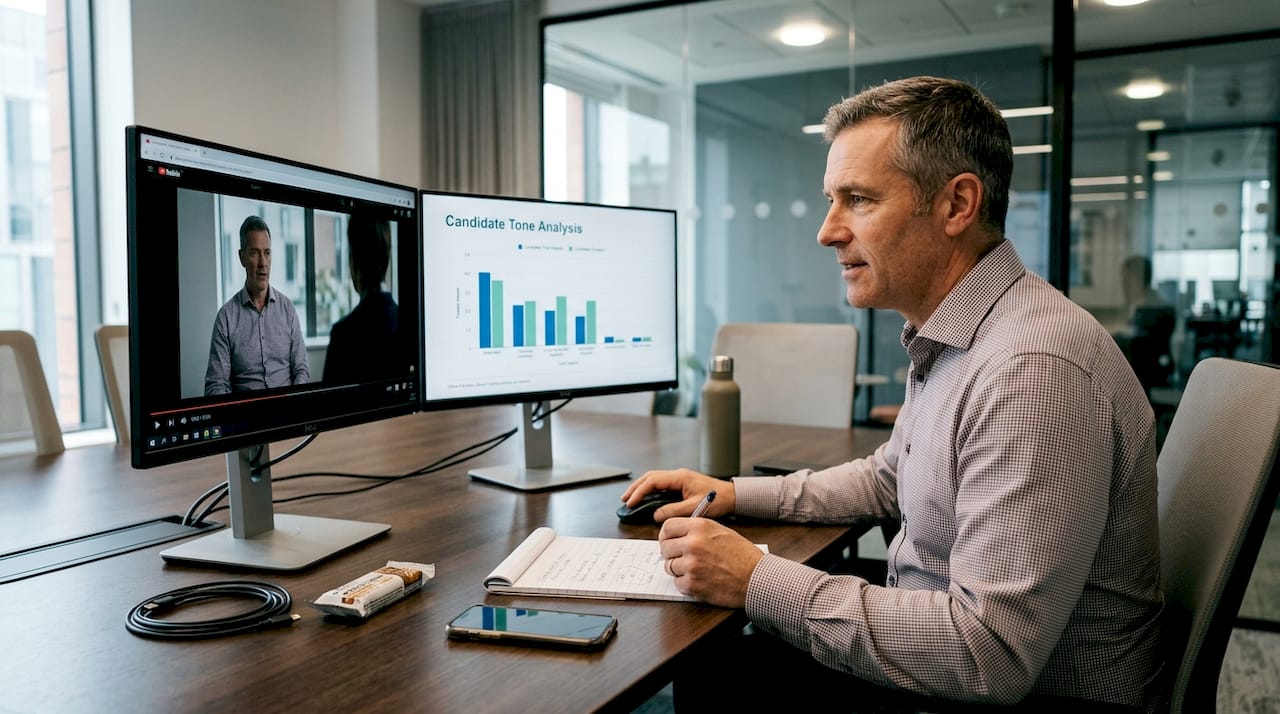
For AI in video interview analysis, platforms can now score tone, flag key phrases, and even assess communication clarity automatically. This means your team spends time on genuine decision-making, not manual note-taking.
Pro Tip: Give candidates at least two attempts to record each response. Research consistently shows this reduces dropout rates and produces more authentic, confident answers. A nervous first take rarely reflects a candidate’s true ability.
Why companies use video interviews: Key benefits and benchmarks
The business case for video interviews is backed by solid data, and the numbers are genuinely impressive.
Video interviews reduce time-to-hire by 50 to 75%, while also increasing offer acceptance rates, candidate starts, and long-term retention. That is a remarkable return for a relatively straightforward process change.
| Metric | Without video interviews | With video interviews |
|---|---|---|
| Time-to-hire | Baseline | 50 to 75% faster |
| Interviews per hire | High | Significantly reduced |
| Offer acceptance rate | Moderate | Notably higher |
| Early retention (90 days) | Variable | Improved |
| Cost per hire | Higher | Lower |
Beyond speed, the core benefits for HR teams include:
- Wider reach: You can assess candidates from any location without travel costs or logistical complexity.
- Consistency: Every candidate answers the same questions in the same format, making comparisons far more reliable.
- Reduced bias: Structured questions and scoring rubrics, combined with improving fairness with structure, help minimise subjective impressions.
- Cost savings: Fewer in-person interview rounds means lower costs for both your team and your candidates.
- Scalability: You can screen 200 candidates in the time it previously took to screen 20.
The industry benchmarks from SHRM confirm that organisations using structured video screening consistently outperform those relying on unstructured phone calls or CV reviews alone.
The AI boosts in video interviewing add another layer of value. Automated scoring, sentiment analysis, and keyword detection mean your team gets richer candidate data faster than ever before. It is not about replacing human judgement. It is about giving your team better information to make great decisions.
Limitations and risks of video interviews
A balanced view matters here. Video interviews are powerful, but they are not without challenges.
Technology barriers can disadvantage candidates who are less tech-savvy, have unreliable internet connections, or lack access to a quiet recording space. This is a real equity issue, and it deserves attention in your candidate support materials.
The key risks and limitations to plan for include:
- Tech difficulties: Candidates may struggle with platform setup, camera quality, or audio issues. Clear instructions and a test run option help enormously.
- Reduced rapport in async formats: One-way interviews lack the natural back-and-forth of a conversation. They are excellent for screening but should not replace live interviews entirely.
- AI bias risks: Automated scoring tools can reflect biases present in their training data. Always pair AI analysis with human review.
- Privacy concerns: Candidates may feel uncomfortable being recorded. Transparent communication about data handling builds trust.
- Candidate drop-off: Some candidates abandon async interviews if the process feels impersonal or unclear.
For supporting candidates in remote interviews, the best practice is to send a preparation guide before the interview link. Explain what to expect, how long it will take, and what happens next.
Pro Tip: Blend both formats for the best results. Use asynchronous interviews for volume screening, then move strong candidates to a live video conversation. This combination gives you efficiency at scale and depth where it counts.
For mitigating tech obstacles, consider offering a brief technical check-in for candidates who flag difficulties. A small gesture that protects your candidate experience significantly.
The pros and cons of one-way video interviews are well documented, and the consensus is clear: used thoughtfully, the benefits far outweigh the drawbacks.
What most HR teams get wrong about video interviews
Here is something we see regularly. Organisations invest in a great async video platform, roll it out across all roles, and then wonder why candidate satisfaction scores drop and hiring manager buy-in fades.
The mistake is treating async video as a complete solution rather than one layer of a thoughtful process. The best HR teams we have worked with always add a live layer for any role above entry level. Not because async is inadequate, but because human connection at the right moment changes the candidate experience and the quality of the hire.
Another common error is launching without enough support for hiring managers. They need to understand how to score responses fairly, what to look for, and how to give feedback. Without that, you get inconsistent assessments and frustrated managers.
Adopt async video for initial screening to cut time-to-hire, but pair with live for depth and pilot with strong support to reduce dropouts. Start with one team or one role type. Gather feedback from candidates and hiring managers alike. Then scale what works. A thoughtful pilot beats a rushed rollout every single time.
Take the next step with efficient hiring solutions
Video interviews are just the beginning of what modern recruitment technology can do for your team. We are over the moon about the possibilities.
At We Are Over The Moon, we believe great hiring goes beyond CVs and video calls. Our AI candidate validation platform combines video pitches, cognitive tests, company challenges, and cultural matching to give you a genuinely complete picture of every candidate. You can match on skills, not CVs and build teams that truly fit. Whether you are just starting with video interviews or ready to go further, we would love to help you make hiring something to celebrate.
Frequently asked questions
What is the difference between live and asynchronous video interviews?
Live interviews happen in real time with both parties online simultaneously, while asynchronous interviews let candidates record answers at their own convenience for recruiters to review later.
How do video interviews help reduce time-to-hire?
Asynchronous video interviews can cut time-to-hire by 50 to 75% by removing the need to align schedules for every initial screening conversation.
Do video interviews introduce new hiring risks?
Yes, including technology barriers for candidates who are less tech-savvy and potential AI bias if automated scoring tools are not carefully monitored and paired with human review.
Can video interview responses be analysed automatically?
Yes, AI tools can score responses for tone, keywords, and communication clarity when structured rubrics and consistent question formats are in place.