Types of company challenges in recruitment: how to overcome them

Recruitment today demands more than posting job adverts and sifting through CVs. HR managers and talent acquisition leaders face varied company challenges that slow hiring, reduce candidate quality, and drain resources. From outdated processes to talent shortages and cultural mismatches, these obstacles require tailored strategies. Understanding the types of challenges and how to evaluate them is essential for building effective recruitment systems. This article explores key challenge categories, provides comparison frameworks, and offers practical guidance to help you choose the right solutions for your organisation’s hiring success.
Table of Contents
- How To Evaluate Company Challenges In Recruitment
- Top Types Of Company Challenges In Recruitment
- Comparing Recruitment Challenges: Impact And Solutions
- When And How To Choose The Right Strategy For Your Recruitment Challenges
- Discover Innovative Recruitment Solutions With We Are Over The Moon
- Frequently Asked Questions
Key takeaways
| Point | Details |
|---|---|
| Challenge variety | Recruitment challenges include process inefficiencies, talent shortages, cultural fit issues, and technology adoption barriers. |
| Evaluation criteria | Clear frameworks help prioritise which recruitment challenges to address first based on impact and feasibility. |
| Innovative strategies | AI-driven tools and assessment methods transform hiring effectiveness and reduce bias. |
| Informed decisions | Comparing challenge types and solutions facilitates better recruitment outcomes and resource allocation. |
How to evaluate company challenges in recruitment
Before tackling recruitment obstacles, you need a structured way to assess them. A structured evaluation framework allows prioritising recruitment challenges effectively, helping you focus resources where they matter most. Without clear criteria, HR teams risk spreading efforts too thin or addressing symptoms rather than root causes.
Start by defining evaluation criteria that reflect your organisation’s needs. Key dimensions include impact on hiring outcomes, urgency based on business goals, resource requirements for implementation, and alignment with company culture. For example, a challenge causing high candidate drop-off rates demands immediate attention, whilst a minor process inefficiency might wait.
Consider these essential criteria when evaluating recruitment challenges:
- Process inefficiencies that delay time to hire or frustrate candidates
- Talent scarcity in critical roles affecting business growth
- Cultural fit issues leading to high turnover within the first year
- Technology gaps preventing adoption of modern assessment tools
Pro Tip: Combine quantitative metrics like time to hire and cost per hire with qualitative feedback from candidates and hiring managers to build a complete picture of each challenge’s true impact.
Once you establish criteria, score each challenge to create a priority matrix. This approach transforms vague concerns into actionable insights, enabling you to allocate budget and attention strategically. For more on addressing these challenges systematically, explore our guide on company challenge in hiring.
Top types of company challenges in recruitment
Recruitment challenges fall into distinct categories, each requiring different approaches. Recognising these types helps you diagnose problems accurately and select appropriate solutions.
Process challenges stem from outdated recruitment workflows. Manual CV screening, lengthy approval chains, and poor candidate communication create bottlenecks. Challenges include process inefficiencies, talent shortages, cultural mismatches, and technology adoption hurdles that collectively undermine hiring effectiveness. These inefficiencies frustrate top candidates who expect swift, transparent processes and often accept competing offers whilst you deliberate.

Talent scarcity represents another major challenge type. In competitive markets, qualified candidates are scarce, especially for specialised roles. Traditional sourcing methods yield diminishing returns, forcing HR teams to broaden search strategies. This challenge demands creative approaches like skills-based hiring, internal mobility programmes, and partnerships with educational institutions.
Cultural fit issues arise when candidates possess required skills but clash with organisational values. Mismatches lead to disengagement, poor performance, and costly turnover. Identifying cultural alignment early prevents expensive hiring mistakes. Assessment methods that evaluate behaviours, motivations, and work preferences alongside technical abilities address this challenge effectively.
Technology adoption hurdles slow recruitment modernisation. Many organisations resist AI-driven tools, fearing complexity or bias concerns. This reluctance keeps teams stuck with manual processes that cannot scale. Overcoming technology resistance requires demonstrating clear ROI, providing training, and selecting user-friendly platforms. Learn more about modern assessment approaches through understanding talent matching smarter hires 2026.
Key challenge types to recognise:
- Workflow bottlenecks delaying candidate progression
- Market competition for scarce talent pools
- Assessment gaps failing to predict cultural fit
- Technology resistance limiting innovation adoption
Comparing recruitment challenges: impact and solutions
Understanding challenge types is valuable, but comparing them directly helps you make strategic decisions. Comparing challenges side-by-side aids HR decision-making and solution prioritisation, enabling you to allocate resources where they deliver maximum return.
The table below contrasts major recruitment challenge types, highlighting their impact, detection methods, and proven solutions:
| Challenge Type | Primary Impact | Detection Signs | Recommended Solutions |
|---|---|---|---|
| Process inefficiencies | Slow time to hire, candidate drop-off | Long approval cycles, manual tasks | Workflow automation, applicant tracking systems |
| Talent scarcity | Unfilled roles, compromised quality | Low applicant volumes, extended searches | Skills-based hiring, broader sourcing channels |
| Cultural fit issues | High turnover, disengagement | Early departures, performance problems | Cultural assessments, behavioural interviews |
| Technology gaps | Scalability limits, bias risks | Manual screening, inconsistent evaluations | AI-driven platforms, structured assessments |
Each challenge requires tailored strategies. Process inefficiencies respond well to automation that eliminates repetitive tasks and accelerates decision-making. Talent scarcity demands expanding your candidate pool through alternative credentials, internal talent development, and partnerships. Cultural fit issues improve with assessments that reveal candidate values and work styles beyond CV claims.
Technology gaps close when you adopt platforms that enhance rather than replace human judgement. Modern AI tools handle initial screening, identify patterns humans miss, and reduce unconscious bias. This frees recruiters to focus on relationship-building and strategic activities.
Best practices for addressing recruitment challenges:
- Automate repetitive tasks to reduce time to hire by 30 to 50 percent
- Implement skills-based assessments to access wider talent pools
- Use structured interviews and cultural matching tools to predict retention
- Pilot AI screening platforms on high-volume roles before full deployment
Pro Tip: Complex recruitment challenges often require combined approaches. For instance, talent scarcity plus cultural fit concerns benefit from skills-based hiring paired with behavioural assessments. Discover more about candidate qualities through qualities of top candidates innovative assessment methods.
When and how to choose the right strategy for your recruitment challenges
Selecting the right recruitment strategy depends on your organisation’s context, resources, and goals. Effective recruitment requires prioritising challenges based on company readiness and goals, ensuring solutions fit your operational reality.
Follow these steps to choose appropriate strategies:
- Assess current state by gathering data on time to hire, cost per hire, candidate satisfaction, and turnover rates within the first year.
- Identify your most pressing challenge using the evaluation criteria discussed earlier, focusing on obstacles with highest business impact.
- Evaluate internal readiness by considering budget availability, technology infrastructure, team capabilities, and change management capacity.
- Research proven solutions by reviewing case studies, consulting peers, and exploring vendor demonstrations that address your specific challenge type.
- Pilot before scaling by testing new methods on one role or department, measuring results, and refining the approach based on feedback.
- Monitor key performance indicators continuously to detect when strategies need adjustment or when new challenges emerge.
Budget considerations matter significantly. Process automation tools require upfront investment but deliver ongoing efficiency gains. Skills-based hiring platforms may cost more initially than traditional methods but reduce turnover expenses. Calculate total cost of ownership over multiple hiring cycles to compare options fairly.
Technology readiness influences implementation success. If your team lacks experience with AI tools, choose platforms offering robust training and support. Start with user-friendly interfaces that integrate with existing systems rather than requiring complete process overhauls.
Team capacity affects rollout speed. Introducing multiple new methods simultaneously overwhelms recruiters and hiring managers. Phased implementation allows learning, adjustment, and building confidence before expanding scope.
Pro Tip: Establish baseline metrics before implementing new strategies so you can measure improvement objectively. Track time to hire, quality of hire scores, candidate experience ratings, and hiring manager satisfaction quarterly to validate your approach.
For comprehensive guidance on modern screening methods, visit our guide to talent screening hr success.
Discover innovative recruitment solutions with We Are Over The Moon
After exploring recruitment challenges and strategies, you might wonder how to implement these insights practically. We Are Over The Moon offers an ai candidate validation platform designed specifically to address the challenges discussed in this article. Our platform replaces traditional CV screening with real assessments including AI interviews, company challenges, cultural matching, cognitive tests, and video pitches.
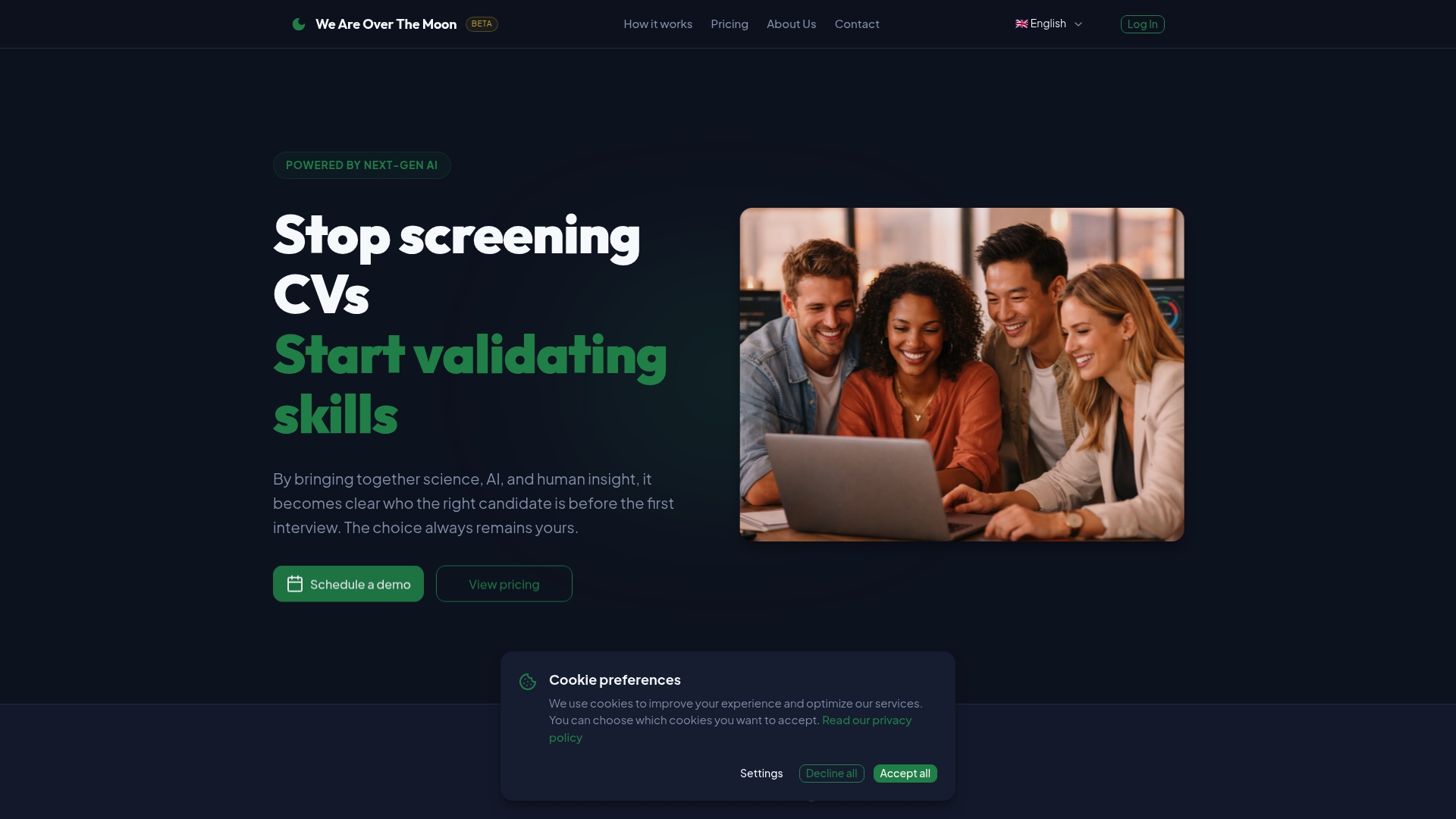
This approach enables skills-based hiring that reveals candidate capabilities beyond credentials. You gain deeper insights into cultural fit, problem-solving abilities, and communication skills before investing interview time. Our AI-driven tools reduce bias, accelerate screening, and improve quality of hire across your organisation. Learn more about us over the moon and discover how to match on skills not cvs for better recruitment outcomes.
Frequently asked questions
What common challenges do companies face in recruitment?
Companies encounter four main recruitment challenges: process inefficiencies that slow hiring, talent shortages in competitive markets, cultural fit issues causing turnover, and technology adoption resistance limiting innovation. These challenges affect hiring speed, candidate quality, and cost effectiveness. Addressing them requires tailored strategies based on organisational context and priorities.
How can HR leaders prioritise which recruitment challenges to address first?
Prioritise challenges by evaluating their impact on hiring quality and business outcomes alongside implementation feasibility. Use data including time to hire, turnover rates, and candidate feedback to identify the most critical obstacles. Focus resources on challenges that deliver maximum return when resolved, considering your budget, technology readiness, and team capacity.
What role does technology play in overcoming recruitment challenges?
Technology automates repetitive tasks, enhances candidate assessment accuracy, and improves talent matching through data-driven insights. AI-driven platforms reduce unconscious bias, scale screening processes, and predict cultural fit more reliably than manual methods. Modern recruitment technology frees HR teams to focus on relationship-building and strategic activities whilst improving hiring outcomes.
How do skills-based assessments improve recruitment outcomes?
Skills-based assessments evaluate candidate capabilities directly rather than relying on credentials or CV claims. This approach expands talent pools by identifying qualified candidates from non-traditional backgrounds. Assessments predict job performance more accurately than education or experience alone, reducing turnover and improving quality of hire across diverse roles and industries.
When should companies pilot new recruitment strategies before full implementation?
Pilot new strategies when introducing unfamiliar technology, changing established processes significantly, or investing substantial resources. Test approaches on high-volume roles or specific departments first, measuring results against baseline metrics. Pilots reveal implementation challenges, allow refinement based on feedback, and build organisational confidence before scaling across the entire recruitment function.