Real-time candidate scoring: a practical guide for HR

TL;DR:
- Real-time candidate scoring automatically evaluates and ranks applicants as data is received, enabling faster, more consistent shortlisting. Its effectiveness depends on thorough calibration, validation, and continuous benchmarking against human outcomes to ensure quality and fairness. Implementing regular reviews and transparent data integration enhances scoring accuracy and supports smarter, unbiased hiring decisions.
Automation promises faster hiring, but more data does not always mean better decisions. Many tech HR teams invest in candidate scoring tools and then wonder why their shortlists still feel off. The truth is that real-time candidate scoring is genuinely exciting and powerful, but its quality depends entirely on how well it is calibrated, validated, and maintained. This guide walks you through what real-time scoring really is, how it works in practice, which metrics actually matter, and how to avoid the traps that catch even experienced teams off guard.
Table of Contents
- What is real-time candidate scoring?
- How real-time scoring works in practice
- Evaluating the quality of candidate scoring
- Pitfalls and best practices for real-time candidate scoring
- Applying real-time scoring for better hiring decisions
- Why benchmarking and calibration matter more than the algorithm
- How We Are Over The Moon can help you unlock accurate, fair hiring
- Frequently asked questions
Key Takeaways
| Point | Details |
|---|---|
| Scoring must be calibrated | Quality hiring decisions depend on regular calibration and evidence-based benchmarking of scoring systems. |
| Use rank-aware metrics | Metrics such as precision@k and MAP give better insight into shortlist quality than traditional accuracy measures. |
| Avoid fairness drift | Update thresholds and logic frequently to prevent the unintentional introduction of biases over time. |
| Integrate, but verify | Real-time scoring works best when combined with expert review and is continuously improved from hiring outcomes. |
| Human input is still vital | Retaining a human checkpoint is crucial during early adoption to ensure the system works as intended. |
What is real-time candidate scoring?
Real-time candidate scoring is the process of automatically evaluating and ranking candidates using live data and algorithmic models as applications are received. Unlike a batch review at the end of a recruitment window, a real-time system updates rankings continuously, meaning your shortlist reflects the latest and most complete picture at any given moment.
It is worth being clear about what this is not. Real-time scoring is not simply keyword matching or basic filtering by years of experience. Those are static filters. A true scoring system draws on multiple data signals, weighs them against role-specific criteria, and produces a dynamic rank order. Think of it less like a sieve and more like a live leaderboard that shifts as each new piece of evidence arrives.
The core benefits are compelling:
- Faster shortlist creation: candidates are ranked as they apply, so you are not waiting until the closing date to start reviewing.
- Reduced unconscious bias: structured scoring criteria treat every application consistently, removing some of the variability that comes with human-only review.
- Dynamic adaptation: as new signals arrive (for example, a completed cognitive test or a video pitch), the ranking updates to reflect the fuller picture.
- Scalability: large applicant volumes that would overwhelm a manual process become manageable.
These gains are real and worth celebrating. But the exciting part comes with a caveat. Assessment tools efficiency only materialises when the underlying scoring model is grounded in evidence, not just speed.
“Real-time scoring must be validated against operational baselines and rank-aware metrics.” Choosing the right benchmark is just as important as choosing the right algorithm.
How real-time scoring works in practice
With a clear definition in place, it is useful to see how these scoring systems actually operate in a typical HR environment.
At its core, a real-time scoring system follows a clear sequence. Here is how it generally works:
- Application input: a candidate submits their application through your applicant tracking system (ATS) or hiring platform.
- Data extraction: the system parses structured and unstructured data, including CV details, assessment results, and any pre-screening responses.
- Signal weighting: each data point is assigned a weight according to the scoring model. A strong cognitive test result might carry more weight than years of experience, depending on your role criteria.
- Score calculation: the model produces a composite score and places the candidate in the rank order.
- Dynamic updates: when a new signal arrives, such as a completed skills challenge or a reference check outcome, the score is recalculated and the rank updated immediately.
- Human review layer: a recruiter reviews the top-ranked candidates, applying judgement where the model cannot.
The data signals that feed into a real-time scoring model can include CV parsing outputs, psychometric test results, structured interview scores, video pitch ratings, cultural fit assessments, and reference check flags. The richness of these inputs is what separates a genuinely intelligent scoring system from simple automation.
Integrations are central to making this work well. Your scoring model should connect with your ATS, any psychometrics provider you use, and ideally your reference checking platform. The more seamlessly these connect, the more complete the data picture for each candidate.
One of the biggest technical risks in real-time systems is rescoring. When a new data point arrives and the model recalculates, it can inadvertently double-count earlier signals. For example, if a CV skill is weighted once during parsing and again when linked to a test result, rescoring can double-count evidence or overweight early signals if not regularly calibrated. This is why regular formula reviews are not optional; they are essential.
It is also important to maintain a modern screening workflow that keeps candidates informed about where they stand. Transparency builds trust and improves candidate experience, which matters enormously in a competitive tech talent market.

Pro Tip: Document every weighting decision and model update in a shared log. When a shortlist looks unusual, your team can trace exactly what changed and why, rather than treating the model as a mysterious black box.
Evaluating the quality of candidate scoring
Understanding how the process works leads naturally to the next question: how do you know if your system is actually good?
This is where many teams stumble. They assume that because the system is running and producing scores, it must be working. But without the right evaluation metrics, you genuinely cannot tell whether your shortlists are better than random.
The metrics worth knowing are:
| Metric | What it measures | Best use case | Key limitation |
|---|---|---|---|
| Precision@k | Of the top k candidates ranked, how many are actually suitable? | Evaluating shortlist accuracy | Ignores candidates ranked outside k |
| Recall@k | Of all suitable candidates, how many appear in the top k? | Checking for missed talent | Can be gamed by expanding k |
| MAP (mean average precision) | Average precision across multiple ranking positions | Comparing models across roles | Assumes relevance is binary |
| NDCG@k (normalised discounted cumulative gain) | Quality of ranking, with higher positions weighted more | Where rank order matters most | Requires graded relevance scores |
| ROC-AUC | Model’s ability to distinguish suitable from unsuitable | General model performance | Can look good even when rankings are poor |
Scoring quality must be measured with rank-aware metrics, not just standard AUC or accuracy. This is a genuinely important distinction. A model can achieve a high ROC-AUC score while still producing a shortlist that misses your best candidates, because AUC measures classification ability rather than ranking quality. In a hiring context, the rank order is everything. Whether your top-ranked candidate is actually your best fit matters far more than whether the model correctly classifies someone in position 47.
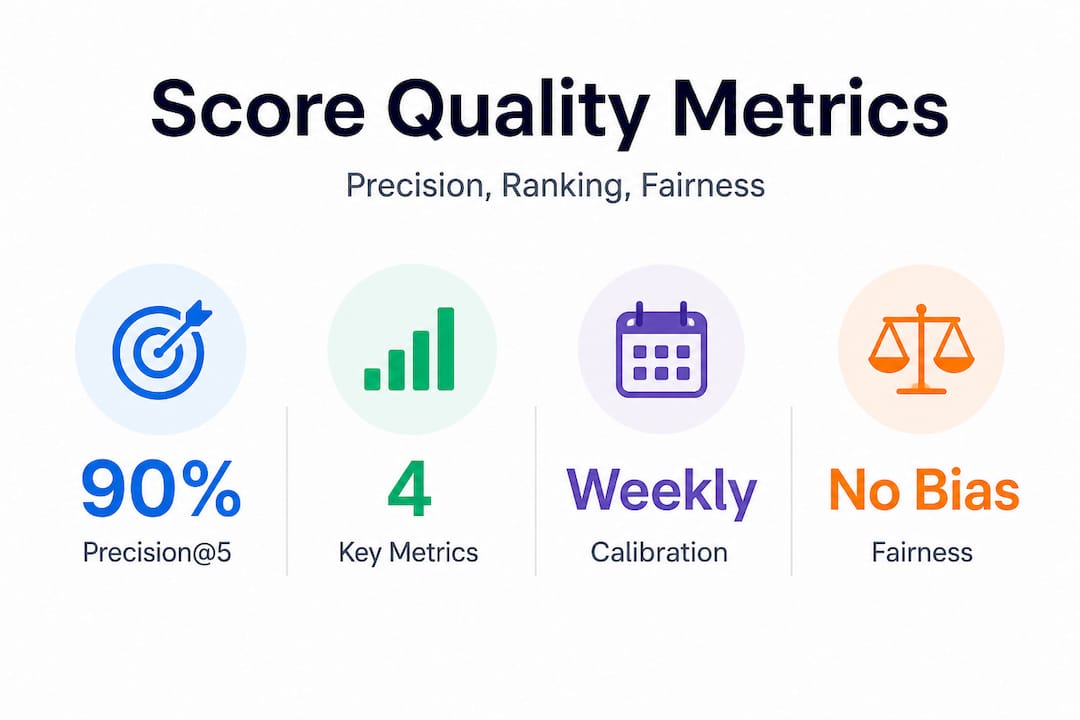
Using a candidate benchmarking guide approach, you can systematically compare your scoring outputs against known good hires and benchmark your precision@k over time. Teams that do this consistently find that their shortlist quality improves meaningfully within just a few hiring cycles.
Operational calibration checks are equally important:
- Blinded list comparison: have recruiters independently rank a set of candidates without seeing the model scores, then compare the two lists.
- Human versus AI shortlist outcomes: track which candidates from human-only shortlists versus AI-assisted shortlists progressed furthest and performed best after hire.
- Cohort analysis: monitor whether certain candidate groups are systematically ranked higher or lower than outcomes would justify.
These checks are not bureaucratic overhead. They are the feedback loops that make the whole system smarter over time.
Pitfalls and best practices for real-time candidate scoring
Even with robust metrics in place, real-world use brings its own set of challenges that HR teams need to anticipate.
The most common mistake is double counting. If your model pulls a signal from a CV parse, then separately receives the same signal via a structured interview answer, and counts both independently, a candidate’s score can be inflated by the same piece of evidence appearing twice. This sounds like a technical detail but it has real consequences for shortlist fairness.
Here is a simplified illustration of how faulty scoring compares with correct scoring:
| Scenario | Scoring approach | Shortlist outcome | Impact |
|---|---|---|---|
| Candidate A with strong CV and matching test result | Correct weighting, signals deduplicated | Ranked appropriately in top 10 | Fair outcome, good hire candidate |
| Candidate B with moderate CV but double-counted test signal | Inflated score due to duplicate weighting | Ranked artificially high | Misleading shortlist, wasted interview time |
| Candidate C with strong late-stage signals but early poor CV parse | Early signal overweighted, late signals underweighted | Ranked too low | Strong candidate missed entirely |
The maintenance tasks that prevent these problems include:
- Cross-validation: test your model on held-out historical data before applying it to live rankings.
- Outcome monitoring: track what happens to hired candidates over their first six months and feed that data back into model updates.
- Fairness checks: regularly audit rankings by demographic group to identify drift before it becomes a compliance risk.
- Threshold reviews: thresholds and model logic should be revisited regularly to avoid fairness drift as your business needs change.
Connecting your scoring logic to business KPIs is also something teams often overlook. If your current priority is speed-to-hire, your scoring threshold might be set to produce a shortlist of five candidates quickly. If your priority is quality-to-hire, you might accept a slightly longer process in exchange for a more thoroughly validated shortlist. For practical guidance on improving tech CV screening and reviewing screening methods for tech hiring, there are excellent resources available that walk through role-specific adjustments.
Pro Tip: Treat your scoring model like software code. Use version control for your model logic and scoring formulas. When you update a weighting or change a threshold, log the version, the date, the reason, and the expected impact. This makes debugging far easier and gives you a clear audit trail for fairness reviews.
Applying real-time scoring for better hiring decisions
Finally, let us move from theory to action with a practical plan for deploying real-time scoring in your hiring process.
Here is a straightforward sequence for getting started:
- Define your goals clearly: are you optimising for speed-to-hire, quality-of-hire, diversity, or a combination? Your goal shapes every other decision.
- Select the right KPIs: based on your goals, choose your primary metric. For quality-focused hiring, NDCG@k or precision@k are strong choices.
- Map your data sources: identify every signal you can feed into the model: CV, skills assessments, cognitive tests, video pitches, cultural matching responses, reference checks.
- Run a controlled pilot: apply the scoring model to a live role but have human recruiters also produce an independent shortlist. Compare results before trusting the model fully.
- Review and recalibrate: after the first hiring round, compare model-shortlisted candidates against actual outcomes. Candidate scoring systems should be updated and calibrated based on real hiring outcomes and business needs.
- Expand gradually: once your model performs well on one role type, begin extending it to others, adjusting weights as needed for each.
One area where teams often see fast improvements is in improving candidate matching by connecting assessment results more directly to role requirements rather than relying heavily on CV parsing alone. This shift reduces the influence of formatting and presentation on scores, which is a meaningful step towards fairer hiring.
Pro Tip: In your first three months of using a live scoring system, keep human review as a mandatory step before any invitation to interview. The model is learning your organisation’s standards, and a human catch at this stage prevents the most costly errors.
Why benchmarking and calibration matter more than the algorithm
To round off, it is worth reflecting on how these lessons play out beyond the technology itself.
There is a tempting belief in the HR tech world that a more sophisticated algorithm will automatically produce better outcomes. We have seen this play out in practice, and the reality is more nuanced. Teams that invest heavily in algorithm sophistication but neglect ongoing calibration often end up with impressively complex models that slowly drift away from their original purpose.
The teams that see the biggest and most sustained gains are those that benchmark continuously against human outcomes. They compare their model’s shortlist to what experienced recruiters would have chosen. They track hired candidates through their first year. They hold regular reviews of scoring logic, not just when something goes wrong, but as a scheduled habit.
Guarding against fairness drift and aligning KPIs to business needs are what truly separate effective scoring programmes from expensive experiments. An algorithm is only as good as the feedback loop that surrounds it.
The benchmarking best practice approach we advocate is built on a simple principle: your scoring model should make better predictions over time, not just maintain its initial accuracy. That improvement only happens when you treat calibration as a continuous process rather than a one-time setup task.
We genuinely believe that when HR teams commit to this disciplined approach, the results are something to be over the moon about. Faster hiring, fairer outcomes, and stronger hires are all within reach. The algorithm is your tool. Calibration is your craft.
How We Are Over The Moon can help you unlock accurate, fair hiring
If you are ready to apply these expert techniques, here is how our team can help you go further.
At We Are Over The Moon, we are passionate about replacing outdated CV screening with real, evidence-based assessments. Our platform is built for skills-based, real-time candidate scoring that actually reflects a candidate’s potential, not just how well they formatted their CV.
We offer AI interviews, company challenges, cultural matching, cognitive tests, and video pitches, all designed to feed rich, meaningful data into a continuously calibrated scoring system. Everything on our skills-based matching platform is aligned with the evidence-based best practices covered in this guide. If you are curious about how AI candidate validation works in practice for tech hiring, we would love to show you. Book a demo and let us help you build a hiring process you are genuinely proud of.
Frequently asked questions
What makes real-time candidate scoring different from standard automated screening?
Real-time scoring updates candidate rankings instantly as new data arrives, rather than applying static filters. This means your shortlist reflects the most complete and current picture at every moment in the process.
Which metrics should I use to ensure scoring quality?
Prioritise rank-aware metrics such as precision@k, recall@k, MAP, and NDCG@k rather than relying on ROC-AUC alone, as these metrics directly reflect real recruitment outcomes and shortlist quality.
How often should scoring models be calibrated?
Models should be reviewed and recalibrated regularly, with calibration essential to avoid bias and fairness drift. Ideally, review after each major hiring round or at a minimum every quarter.
Can real-time candidate scoring introduce bias?
Yes, if scoring logic and thresholds are not actively monitored, fairness drift can occur as the model’s assumptions no longer match your current candidate pool or business needs.
Should human review be removed from the process?
Not at all, especially in early deployment. Human review remains an essential fail-safe for catching errors, validating model outputs, and ensuring the scoring system is truly reflecting your hiring goals before you rely on it fully.