Predictive hiring: transform your talent acquisition with AI

TL;DR:
- Predictive hiring leverages AI and data analytics to accurately forecast candidate performance before interviews.
- It improves efficiency, reduces bias, and enhances consistency but requires careful validation, transparency, and legal compliance.
Predictive hiring is rapidly moving from niche experiment to mainstream strategy across the UK, Netherlands, and Spain. Yet many HR leaders still treat it as just another tech trend rather than a genuinely transformative shift in how we identify, assess, and secure talent. We are here to change that perception. This article breaks down exactly what predictive hiring is, how it works in practice, what the real benefits and challenges look like, and how your team can apply it responsibly and confidently. If you have been wondering whether it is worth the investment, by the end of this piece you will have a clear answer.
Table of Contents
- What is predictive hiring and how does it work?
- Benefits and challenges of predictive hiring for HR teams
- How to implement predictive hiring in your organisation
- Ensuring fairness and compliance in predictive hiring
- Why predictive hiring is not a silver bullet: insights for forward-thinking HR leaders
- Discover predictive hiring solutions built for you
- Frequently asked questions
Key Takeaways
| Point | Details |
|---|---|
| AI-enhanced efficiency | Predictive hiring tools can significantly reduce time-to-hire and administrative workload. |
| Reduces unconscious bias | Well-validated models help identify top candidates more fairly than manual methods. |
| Legal and ethical essentials | Staying compliant and transparent is critical when using AI for talent decisions. |
| Human judgement matters | AI should support, not replace, skilled HR decision-making—especially for nuanced roles. |
What is predictive hiring and how does it work?
Predictive hiring means using statistical models, machine learning, and AI-driven assessments to forecast how well a candidate will perform in a role before you even meet them in person. Rather than relying on a CV and a gut feeling from an interview panel, predictive hiring draws on structured data to match people to roles far more accurately. As AI and analytics for candidate assessment become more sophisticated, the gap between instinct-driven hiring and data-driven hiring is growing fast.
The core technologies driving predictive hiring include machine learning algorithms that identify performance patterns across thousands of previous hires, natural language processing (NLP) that analyses written and spoken responses in assessments, and psychometric testing that measures cognitive ability, personality, and cultural alignment. Each of these tools contributes a different layer of insight. Together, they create a far richer picture of a candidate than any CV can provide.
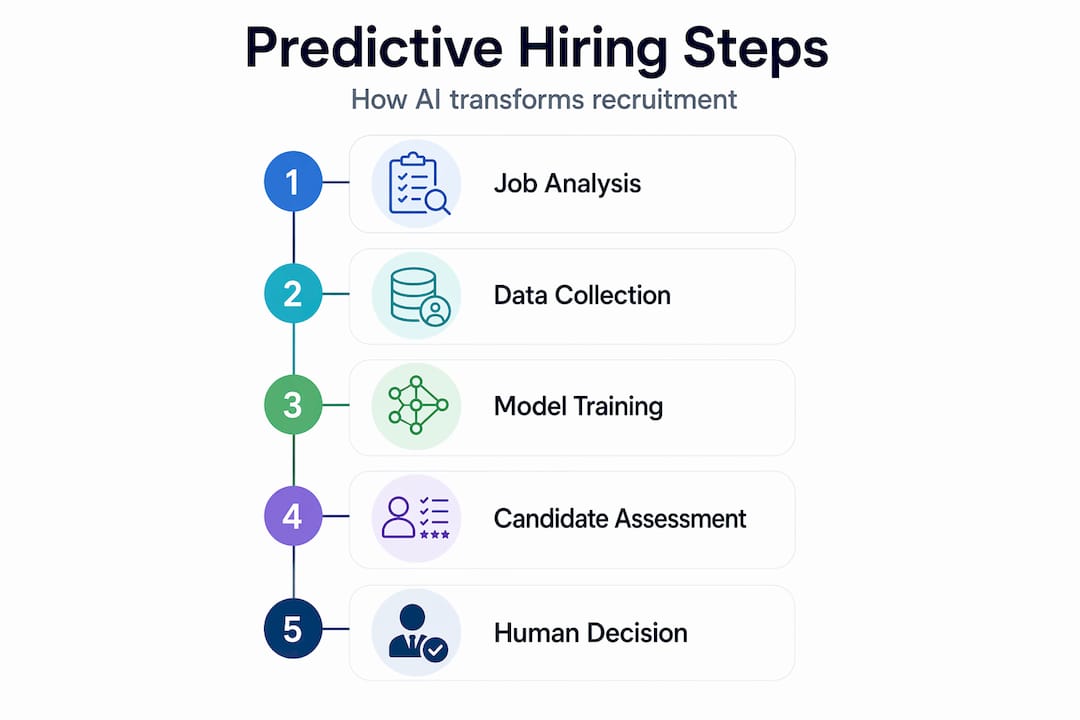
Here is how a typical predictive hiring process unfolds in practice:
| Stage | What happens | Technology involved |
|---|---|---|
| Job analysis | Define competencies, skills, and performance indicators | Role benchmarking tools |
| Candidate assessment | Cognitive tests, video pitches, challenges | AI, NLP, psychometrics |
| Data scoring | Candidate scores compared to success profiles | Machine learning models |
| Shortlisting | Ranked candidates surfaced to hiring managers | Algorithmic ranking |
| Human review | Recruiters validate AI outputs with context | Human oversight |
| Decision | Final hire decision made by a person | Blended judgement |
Notice that the process ends with a human, not a machine. This is not an accident. Understanding the role of AI in recruitment means recognising that the technology is at its best when it informs human decisions rather than replacing them.
Pro Tip: Always validate your AI model’s outputs against real hiring outcomes on a rolling basis. A model that was accurate twelve months ago may have drifted if your business context, team structures, or role requirements have changed.
Benefits and challenges of predictive hiring for HR teams
Once you understand the mechanics, the excitement really sets in. Predictive hiring genuinely can transform what is possible for talent acquisition teams. Speed improves dramatically. Consistency across candidate cohorts becomes achievable. Unconscious human bias, which affects even the most well-intentioned hiring managers, can be significantly reduced when structured assessments replace unstructured interviews.

The potential efficiency gains alone make a compelling case. Many teams that move to structured, data-driven pre-screening report saving considerable hours per hire. Exploring how hiring efficiency with assessment tools scales up quickly shows why early adopters are so enthusiastic. When you multiply time savings across dozens or hundreds of hires per year, the return on investment becomes very clear indeed.
Here is a comparison of traditional and predictive approaches side by side:
| Factor | Traditional hiring | Predictive hiring |
|---|---|---|
| Candidate screening | CV review, gut instinct | Structured assessments, AI scoring |
| Speed to shortlist | Days to weeks | Hours to days |
| Bias risk | High (unconscious) | Reduced (but must be monitored) |
| Consistency | Varies by interviewer | Standardised |
| Candidate experience | Passive, CV-heavy | Active, skills-based |
| Decision transparency | Often unclear | Data-documented |
The benefits are real, but so are the challenges. Predictive hiring improves efficiency and consistency but introduces legal risks if not properly validated. This is the part many enthusiastic early adopters skip over, and it is exactly where things can go wrong.
Key challenges include:
- Algorithmic bias: Models trained on historical data can inadvertently encode past biases, particularly around gender, ethnicity, or educational background.
- Legal compliance: GDPR, equal opportunity legislation in the UK and Netherlands, and similar frameworks in Spain all impose strict requirements on how candidate data is used.
- Candidate fairness: Candidates deserve transparency about how they are being assessed and why.
- Model validation: Without regular testing against real outcomes, even well-designed models degrade over time.
Exploring the full pros and cons of AI hiring is essential before rolling out any tool at scale. Looking at innovative candidate assessment methods that balance rigour with fairness gives your team a strong starting point.
“When AI is positioned as a decider rather than a decision-support tool, HR teams can lose sight of the individual and the context that makes hiring genuinely human.” This is not just a philosophical concern. It is a practical risk that can undermine your employer brand, expose you to legal challenge, and cost you the best candidates.
Pro Tip: Build a data quality audit into your predictive hiring programme from day one. Garbage data in means unreliable predictions out. Regularly sample your training data and check it for demographic skew before any model goes live.
How to implement predictive hiring in your organisation
Bringing predictive hiring into your organisation is exciting, and it does not have to be overwhelming. The key is a structured approach that builds confidence at every stage. Rushing straight to a full deployment without testing and stakeholder buy-in is the single biggest mistake teams make.
Here is a step-by-step process that works well across organisations of varying sizes in the UK, Netherlands, and Spain:
- Conduct a needs analysis. Identify which roles or business units have the clearest performance data and the most pressing hiring volumes. These are your best starting points.
- Define success profiles. Work with hiring managers to determine what high performance actually looks like in each target role. You need this to train or configure your models meaningfully.
- Select your tools. Evaluate platforms against your specific assessment needs, legal context, and integration requirements. Look for tools that offer transparency in their scoring logic.
- Run a pilot programme. Start with one team or one role type. Gather data, compare AI-shortlisted candidates with those selected by traditional methods, and track outcomes over a meaningful period.
- Train your HR team. Every recruiter who uses predictive tools needs to understand what the outputs mean, what they do not mean, and how to communicate findings to candidates and hiring managers.
- Set candidate expectations clearly. Tell applicants upfront what assessments they will complete, how their data will be used, and how decisions are made. Transparency builds trust.
- Iterate continuously. Schedule quarterly reviews of model performance. Recalibrate when you notice drift or unexpected patterns in outcomes.
Practical guidance on improving candidate matching shows how fine-tuning your competency frameworks before you even choose a platform pays dividends. It is also worth exploring how pre-screening automation can slot into your existing workflow without creating friction for candidates.
Common pitfalls to avoid include:
- Treating model scores as final verdicts rather than inputs to a conversation
- Neglecting to communicate transparently with candidates about the process
- Skipping legal review when introducing new assessment technologies
- Failing to retrain models when workforce composition or role requirements evolve
- Underestimating the change management effort required to bring hiring managers on board
Legal and fairness risks should be addressed with careful validation and ongoing monitoring, not treated as a one-time compliance checkbox. Build these reviews into your calendar from the outset, and you will save yourself considerable difficulty later.
Ensuring fairness and compliance in predictive hiring
This is the section that really matters if you want predictive hiring to be sustainable. Getting the technology right is only half the challenge. The other half is making sure you deploy it ethically, legally, and in a way that treats every candidate with genuine respect.
Across the UK, Netherlands, and Spain, several legal frameworks directly shape how you can use predictive hiring tools. GDPR requires informed consent for data processing, the right to explanation for automated decisions, and strict data minimisation principles. UK employment law adds further requirements around non-discrimination. Spain’s Estatuto de los Trabajadores and Dutch equal treatment legislation create additional obligations. Ignoring any of these is not a small oversight. It is a significant risk to your organisation.
Predictive models not validated for job relevance expose organisations to legal and fairness challenges that can be both costly and reputationally damaging. Your assessments must be demonstrably connected to genuine job requirements.
Practical steps every HR team should take include:
- Train your validators. Everyone who interprets or acts on AI assessment data needs specific training on how to read outputs critically and ethically.
- Conduct impact assessments. Before launching any new tool, run a data protection impact assessment (DPIA) and a bias impact review.
- Document every decision. Maintain clear records of how candidates were assessed, what data was used, and how decisions were reached. This protects you legally and builds organisational learning.
- Provide transparency to candidates. Inform applicants about the assessments they will complete, the logic behind scoring, and their right to request a human review.
- Monitor continuously for bias drift. Even a well-validated model can develop skew over time as the candidate pool or organisational context shifts.
- Align assessments with genuine job relevance. Every test, challenge, or cognitive assessment must connect clearly to skills and behaviours the role actually requires.
Resources on reducing recruitment bias with AI and a thorough look at pre-employment tests and predictive hiring can help you build a compliance-first approach from the ground up. Understanding common candidate assessment challenges in your specific market context rounds out the picture.
Why predictive hiring is not a silver bullet: insights for forward-thinking HR leaders
We are genuinely excited about what predictive hiring makes possible. But we also believe that honest enthusiasm is more useful than uncritical cheerleading, so let us share what real-world deployments have taught us.
Predictive hiring works brilliantly when it augments human judgement. It struggles when organisations treat model outputs as the final word. High-context hiring situations, creative roles, leadership positions, and roles requiring nuanced interpersonal judgement all involve variables that data models capture imperfectly. A candidate’s resilience in a specific team environment, their ability to navigate organisational politics, or the way they might inspire a disengaged team are genuinely difficult to quantify. That does not mean assessment data is useless. It means the data should inform and enrich a conversation, not conclude it.
The organisations that see the best results from predictive hiring share a few characteristics. They invest in model transparency, meaning they choose tools where the scoring logic can be explained to candidates and to internal stakeholders. They build genuine stakeholder engagement by involving hiring managers in defining success profiles rather than handing them a ranked list and expecting compliance. And they recalibrate their models regularly, treating predictive hiring as a living programme rather than a one-time technology deployment.
“If models are treated as deciders not decision-support, HR teams can lose sight of context and candidate experience.” This is precisely the trap that erodes trust in predictive hiring and sets otherwise excellent programmes back by months or years.
The uncomfortable truth is that replacing CV screening with smarter assessments requires courage as well as technology. It means challenging colleagues who still believe a good degree from a prestigious university is the best predictor of success. It means investing time in validation work that does not always feel glamorous. And it means communicating openly with candidates, even when that feels uncomfortable. Get those pieces right, and predictive hiring becomes one of the most powerful tools in your talent acquisition toolkit.
Discover predictive hiring solutions built for you
We know that moving from theory to practice can feel like a big step, and we are over the moon to be part of that journey with you.
At We Are Over The Moon, we have built a platform that replaces CV screening with real, meaningful assessments. AI interviews, company challenges, cultural matching, cognitive tests, and video pitches all designed to give you a fuller, fairer picture of every candidate. Our tools are built with compliance and transparency at their core, and they are tailored for HR teams operating across the UK, Netherlands, and Spain. Whether you are starting your predictive hiring journey or looking to upgrade your current approach, matching on skills is where we begin. Explore our full AI candidate validation platform and see what genuinely modern hiring looks like.
Frequently asked questions
How does predictive hiring differ from traditional recruitment?
Predictive hiring uses AI and analytics for assessment to forecast candidate success based on structured data, whereas traditional recruitment relies primarily on CVs and unstructured interviews. The result is greater consistency, speed, and objectivity in the shortlisting process.
Can predictive hiring help reduce bias in the hiring process?
Yes, when properly designed, predictive models can meaningfully reduce unconscious bias by standardising how candidates are evaluated. However, as predictive hiring introduces legal risks if not validated, regular monitoring is essential to prevent new biases from creeping into model outputs.
What legal considerations should HR teams be aware of with predictive hiring?
HR leaders must ensure their tools comply with GDPR, are validated for genuine job relevance, and are checked regularly for fairness. Predictive models not properly validated expose organisations to significant legal and reputational risk across all three markets.
Is predictive hiring suitable for all types of roles?
Predictive hiring delivers its strongest results for roles with clear, measurable performance indicators such as sales, customer service, and technical positions. For complex, people-oriented or senior leadership roles, it works best as one input within a broader assessment framework rather than as the primary decision-making tool.
Recommended
- AI in Recruitment – Transforming Candidate Screening and Fit | We Are Over The Moon
- Role of AI in Recruitment Agency Success | We Are Over The Moon
- Benefits of AI Assessment: Boosting Recruitment Quality | We Are Over The Moon
- How to Interview with AI: Cut Hiring Time by 35% in 2026 | We Are Over The Moon