Objective candidate evaluation steps for fair hiring

TL;DR:
- Structured candidate evaluation relies on objective criteria, standardized questions, and thorough evaluator calibration to minimize bias. This disciplined approach enhances fairness, consistency, and confidence in hiring decisions, supported by continuous review and improvement. Technology like Weareoverthemoon can further embed evidence-based assessment methods into the process, ensuring hiring outcomes are driven by skills, not assumptions.
Hiring the right person should come down to evidence, not instinct. Yet without clear objective candidate evaluation steps in place, even experienced recruiters can fall into patterns shaped by unconscious bias, inconsistent scoring, and gut feelings dressed up as professional judgement. The result? Talented candidates get overlooked, poor hires slip through, and your hiring process loses the credibility it deserves. This guide walks you through every stage of a structured candidate evaluation workflow, from preparation and execution to verification and continuous improvement, so you can make hiring decisions you feel genuinely confident about.
Table of Contents
- Key takeaways
- Laying the groundwork: criteria, panels, and questions
- Building a structured evaluation workflow
- Running evaluations: interviews, assessments, and deliberations
- Verification, calibration, and ongoing improvement
- Common pitfalls to avoid
- My honest take on objectivity in hiring
- How Weareoverthemoon supports objective hiring
- FAQ
Key takeaways
| Point | Details |
|---|---|
| Define criteria before you advertise | Job-relevant criteria must be agreed upon before evaluation begins to prevent bias from shaping the goalposts. |
| Structured scoring beats gut instinct | Behavioural anchors and scoring rubrics produce more consistent, defensible hiring decisions across all candidates. |
| Calibration is non-negotiable | Training evaluators on rubric use and discussing scoring examples before interviews is what separates fair panels from chaotic ones. |
| Bias checks must be built in | Explicit prompts to question assumptions at the scoring stage improve fairness and rating accuracy throughout the process. |
| Continuous review sharpens the process | Analysing evaluation data and gathering feedback after each hiring round keeps your candidate evaluation workflow relevant and fair. |
Laying the groundwork: criteria, panels, and questions
The most common reason candidate evaluation goes wrong has nothing to do with the interview itself. It happens in the week before, when teams skip the preparation and walk into assessments without agreed criteria, clear scoring guides, or a shared understanding of what a strong answer actually looks like.
Start with a thorough job analysis. Identify the specific skills, behaviours, and competencies that genuinely predict success in the role. Not a wish list, but a prioritised set of objective hiring criteria drawn from what the job actually requires day to day. GOV.UK guidance recommends using job-relevant criteria alongside standardised grading and diverse panels to produce fairer hiring outcomes.
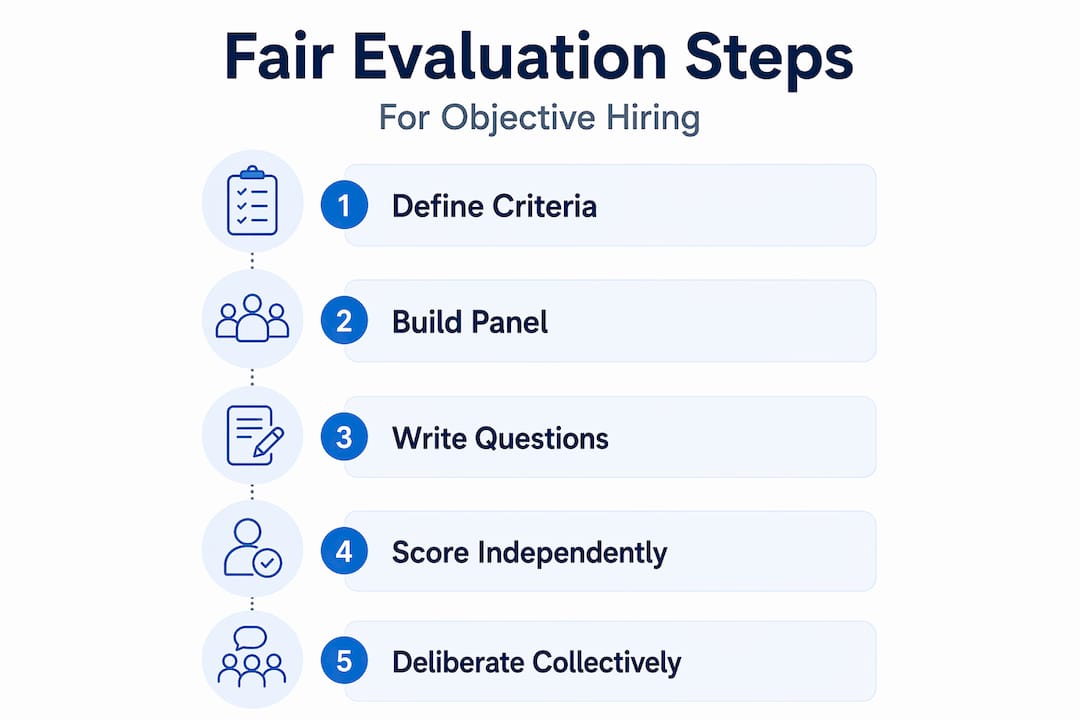
Once your criteria are defined, assemble your evaluation panel with diversity in mind. Panels made up of people with similar backgrounds and perspectives tend to score similarly biased outcomes. Aim for a mix of functions, seniority levels, and lived experiences. Assign each panel member a clear role so nobody dominates the conversation or defers entirely to a senior voice.
Pro Tip: Write your scoring rubrics before you draft your interview questions. Starting with what a “strong”, “adequate”, and “weak” response looks like forces you to be honest about what you actually value, rather than reverse-engineering criteria to justify a favourite.
When developing questions, mix behavioural and hypothetical formats. Behavioural questions (“Tell me about a time you handled a difficult stakeholder”) reveal past performance patterns. Hypothetical questions (“How would you approach launching a product in a market you know nothing about?”) assess future-oriented thinking. Combining both question types gives you a richer picture of each candidate’s capability.
Here is a quick comparison of question types and their purposes:
| Question type | What it reveals | Best used for |
|---|---|---|
| Behavioural | Past behaviours and patterns | Roles requiring proven experience |
| Hypothetical | Problem-solving and reasoning | Roles requiring adaptability and creativity |
| Technical | Specific knowledge and skills | Specialist or technical positions |
| Situational | Judgement under real conditions | Management and leadership roles |
Building a structured evaluation workflow
Once your criteria and questions are ready, the next step is turning them into a repeatable candidate evaluation workflow that every evaluator follows in the same way for every candidate.
- Create candidate evaluation forms that list each criterion, the associated questions, and the scoring guide alongside them. These are not just admin tools. They are the backbone of a fair evaluation process for candidates, because they prevent evaluators from rating on memory or overall impression.
- Add behavioural anchors to every score level. A score of “4 out of 5” means nothing without a description of the evidence that earns it. Behaviourally anchored rating scales give evaluators a shared understanding that reduces inconsistency significantly.
- Train your evaluators before the first interview. Walk through the rubric together, discuss scoring examples, and practise on sample answers. Calibration and training on rubrics is what stops one evaluator’s “strong” from being another evaluator’s “adequate”.
- Fix the interview order and structure. Every candidate should receive the same questions in the same sequence. Deviations might feel natural in the moment but they introduce variables that make comparison unreliable.
- Record detailed notes during the interview. Not impressions. Actual quotes, examples, and evidence from what the candidate said. Notes are what allow you to score accurately after the conversation, when memory starts to blur.
- Use technology to support the workflow. Applicant tracking systems and assessment platforms can automate form distribution, score aggregation, and scheduling, freeing evaluators to focus on quality assessment rather than admin.
Pro Tip: Before your panel meets to discuss scores, ask every evaluator to lock in their individual ratings without seeing anyone else’s. Group discussion improves calibration, but only if independent scoring happens first. Shared discussion before individual scoring is one of the fastest routes to groupthink.
Running evaluations: interviews, assessments, and deliberations
With your structure in place, execution becomes much more manageable. Here is where the discipline of following your candidate evaluation guide pays off most visibly.

Conduct interviews in batches where possible. Evaluating candidates within a short window makes comparison more accurate because your reference points stay fresh. Spreading interviews across several weeks introduces memory drift and makes scoring inconsistent, even when you are using rubrics.
Evaluate individually before deliberating collectively. Every panel member should complete their own scoring form after each interview, without discussing their ratings with colleagues first. This protects against the “anchor effect”, where the first person to speak shapes everyone else’s judgement. Explicit bias checks at this stage, prompting evaluators to ask themselves “Am I rating this answer or this person?”, meaningfully improve scoring fairness.
Skill-based assessments add another layer of objectivity. Job simulations and skill tests tied to actual daily tasks give you performance data that interviews alone cannot provide. A content strategist completing a real brief, or a developer working through a representative coding problem, tells you far more than asking them to describe how they would approach those tasks hypothetically.
Pro Tip: When a panel member gives a notably high or low score, ask them to read out the specific candidate quote or example that led to that rating before the discussion continues. This single habit, borrowed from Google re:Work’s structured interviewing guidance, reduces score inflation and anchors deliberations in evidence rather than enthusiasm.
Cross-check scores and notes at the end of each interview day, not at the end of the whole process. Catching scoring gaps early means you can address calibration issues before they compound across a dozen candidates.
Verification, calibration, and ongoing improvement
Completing the evaluations is not the finish line. Verification and calibration are what turn a good process into a great one. This is the stage most teams skip, and it is exactly why the same hiring mistakes tend to repeat themselves.
- Review all scores and notes collectively. Look for wide discrepancies between evaluators on the same candidate. A gap of two or more points on any criterion is worth a structured conversation, not a vote.
- Run a bias check before confirming rankings. Ask the panel to consider whether any candidate received a higher or lower rating because of factors unrelated to the job criteria. This is not accusatory. It is a professional checkpoint.
- Calibrate evaluators after each hiring round. Share examples of well-scored and poorly scored answers and discuss them as a group. Over time, this builds a shared standard that makes your evaluation process for candidates sharper and more consistent.
- Analyse evaluation data for patterns. If one evaluator consistently scores lower, or certain criteria produce widely varying scores across candidates, that is a signal to revisit your rubric, your training, or both.
- Gather feedback from candidates and interviewers. Candidates who felt the process was fair and well-structured are far more likely to speak positively about your organisation, even if they did not get the role. Interviewer feedback surfaces blind spots in your workflow you might otherwise miss.
Here is a summary of what to review after each hiring cycle:
| Review area | What to check | Action if issues found |
|---|---|---|
| Score discrepancies | Gaps of 2+ points between evaluators | Facilitate calibration discussion |
| Bias indicators | Non-job-related rating influences | Re-run bias check prompts and training |
| Question effectiveness | Criteria that produced vague or unclear answers | Revise question wording or scoring guide |
| Process feedback | Evaluator and candidate experience ratings | Adjust workflow for next round |
Common pitfalls to avoid
Even teams with excellent intentions run into problems. Knowing where the most common mistakes happen means you can design them out of your process before they cause harm.
- Overrelying on gut feelings despite having rubrics. Rubrics only work if evaluators actually use them. If someone is scoring from instinct and filling in the form afterwards, your entire evaluation workflow is compromised. Make evidence-based scoring non-negotiable, not optional.
- Starting with vague or incomplete job criteria. Criteria written as “good communicator” or “team player” are too broad to score reliably. Tie every criterion to a specific, observable behaviour tied to the candidate assessment checklist for the role.
- Skipping evaluator calibration. One training session before the process starts is not enough. Calibration should happen before each hiring round and ideally after it too.
- Ignoring bias at the scoring stage. Bias checks feel uncomfortable, but forming bias-aware ratings at the individual scoring stage is one of the highest-value habits a panel can build.
- Poor documentation of candidate responses. Vague notes like “seemed confident” or “good energy” are not evidence. They are impressions. Evaluators who cannot point to a specific answer to support a score should be asked to revisit it.
- Homogeneous panels. A panel that all think alike will consistently favour candidates who think alike too. Diversity in the evaluation panel is not a nicety. It is a structural requirement for fair hiring.
“The goal of a structured evaluation is not to make every hire feel the same. It is to make every hiring decision feel equally defensible.”
My honest take on objectivity in hiring
I’ve spent a lot of time working with hiring teams who genuinely believe they are being objective. And they mean it. They have rubrics, they have panels, they have a structured interview process. But when I dig into how those tools are actually being used, I often find that the rubrics exist on paper and the gut feeling drives the decision.
What I’ve learned is that objectivity is not a property of your tools. It is a property of your habits. A perfectly designed evaluation form used carelessly produces the same biased outcomes as no form at all. The teams who get this right are the ones who treat calibration as a standing agenda item, not a one-off onboarding task.
I’ve also seen recruiters worry that too much structure will make their process feel cold or transactional. In my experience, the opposite is true. Candidates who go through a well-structured, fair and consistent process consistently report feeling more respected, even when they do not get the role. Structure signals that you take their time seriously.
The other thing I’d push back on is the idea that technology replaces the need for human judgement. It does not. What technology does brilliantly is remove low-value admin and introduce consistency at scale. But the interpretation of evidence, the calibration conversations, the commitment to fair process. Those still need humans who care.
— Maarten
How Weareoverthemoon supports objective hiring
If you are ready to move beyond CV screening and build a genuinely objective candidate evaluation process, Weareoverthemoon is built for exactly that.
The platform replaces guesswork with real assessment data. AI-powered interviews, company-specific challenges, cognitive tests, and video pitches give your team rich, standardised performance evidence for every candidate, before a single panel conversation takes place. You get skills-based candidate matching that removes CV bias from the equation entirely, alongside detailed analytics that make calibration and review meetings far more productive.
Weareoverthemoon integrates with your existing hiring workflow, so your team spends less time on admin and more time on decisions that actually matter. If fair, evidence-based hiring is the goal, the AI candidate validation platform gives you the structure to get there consistently. Try WAOTM and see what your hiring looks like when it is built on evidence, not assumption.
FAQ
What are the key objective candidate evaluation steps?
The core steps include defining job-relevant criteria, building a diverse panel, developing standardised questions with scoring rubrics, training evaluators, conducting structured interviews, and reviewing scores with bias checks before confirming decisions.
Why does structured candidate evaluation reduce bias?
Structured interviews reduce bias by standardising questions, scoring criteria, and the order of assessment for every candidate, which prevents personal characteristics from influencing ratings.
How often should you calibrate your evaluation panel?
Calibration should happen before each hiring round as a minimum. Reviewing scoring examples and discussing discrepancies after each round sharpens consistency over time and keeps your evaluation process for candidates genuinely fair.
What makes a good candidate evaluation form?
A strong evaluation form lists each job-relevant criterion, includes the associated interview question, and provides behavioural anchors for each score level so evaluators know exactly what evidence is needed to justify a rating above baseline.
When should skill assessments be included in the evaluation process?
Skill assessments work best when they reflect actual job tasks and are scored against clear criteria. They complement structured interviews by providing objective performance data that self-reported answers cannot replicate.