Master the modern skills assessment workflow for hiring

TL;DR:
- Traditional CVs and interviews often fail to accurately assess candidate skills and potential.
- Implementing multi-method, AI-supported assessments improves hiring fairness and prediction of job performance.
- Regularly reviewing assessment tools and bias patterns is essential for effective, fair recruitment.
A candidate’s CV can tell you where they’ve been. It rarely tells you what they can actually do. That gap is where hiring goes wrong, and it’s a problem HR leaders across the Netherlands, UK, and Spain know all too well. Traditional screening methods are riddled with unconscious bias, unreliable signals, and a stubborn focus on credentials over capability. The good news? Innovative, structured workflows built around real skills assessment are changing everything. This guide walks you through exactly how to upgrade your process, step by step, so you can hire with confidence and far less guesswork.
Table of Contents
- Why reinvent your skills assessment workflow?
- What you need: Tools, methods, and preparation steps
- Step-by-step: Building a multi-method assessment workflow
- Verifying results: Avoiding bias and maximising predictive accuracy
- Our take: Why innovative skills assessment is non-negotiable
- Explore next-level skills assessment solutions
- Frequently asked questions
Key Takeaways
| Point | Details |
|---|---|
| Skills-first approach | Modern workflows prioritise actual abilities over CV credentials, leading to better hires. |
| Multi-method assessment | Combining AI, psychometrics and real-world tasks improves accuracy and reduces bias. |
| Market trend insights | HR leaders in Spain, the UK, and the Netherlands are embracing innovative tools and strategies rapidly. |
| Ongoing workflow optimisation | Continuous review and adaptation keep your process effective and compliant. |
Why reinvent your skills assessment workflow?
Let’s be honest. The classic CV and single interview model was never that great. It favours articulate candidates over capable ones, rewards polish over performance, and leaves hiring managers guessing. Most experienced recruiters know this, yet the old habits persist.
The world of work is shifting fast, particularly in Spain and across Europe. 70% of job openings in Spain through to 2035 will require high qualifications, with predictive analytics and gamified tools increasingly used to identify talent. That’s not a minor trend. It’s a structural change in what employers need and how they find it.
The core problems with traditional assessment include:
- CV reliance: Past job titles and university names say almost nothing about actual competency.
- Unstructured interviews: Without standardised criteria, interviewers are heavily influenced by first impressions.
- Single-method bias: Using only one assessment tool amplifies its weaknesses rather than compensating for them.
- Slow feedback loops: Traditional processes take weeks, causing top candidates to drop out.
Modern, skills-first workflows solve these issues by combining multiple methods. Multi-method workflows outperform single assessments, with AI helping reduce bias and real-world simulations revealing genuine capability. The shift from credentials to demonstrated skills is no longer optional for competitive hiring teams.
We’ve seen first-hand how faster hiring with AI assessments transforms both recruiter workload and candidate quality. And the evidence clearly supports boosting recruitment quality through structured, evidence-based methods.
“The best predictor of future performance is observed performance on relevant tasks, not a list of previous job titles.”
Pro Tip: When redesigning your assessment process, anchor every method you choose to a real work task. Ask: does this test what the person will actually do in the role? If not, cut it.
What you need: Tools, methods, and preparation steps
Before you build anything, you need the right ingredients. A great skills assessment workflow starts with clear thinking about what you’re measuring and which tools are actually fit for purpose.

The Spain HR assessment market was valued at USD 453.81 million in 2024 and is projected to reach USD 931.48 million by 2032, growing at a CAGR of 9.41%. This growth is driven by AI psychometric tools and skills tests, reflecting just how quickly the market is maturing.
Here’s a quick overview of the core tools you’ll want to consider:
| Tool type | Purpose | Best used for |
|---|---|---|
| AI interview platforms | Standardised video or text-based screening | Early-stage candidate filtering |
| Psychometric assessments | Cognitive ability, personality, and behavioural fit | Mid-stage evaluation |
| Practical skills tests | Role-specific task simulation | Technical and functional roles |
| Gamified assessments | Engagement-led evaluation of decision-making | Younger candidate pools |
| Cultural fit tools | Values and team alignment | Final-stage selection |
Before choosing tools, work through this preparation checklist:
- Map the top five to seven skills genuinely required for the role (not just from the job description).
- Decide which skills are best assessed objectively versus through observation.
- Confirm GDPR compliance and data security standards for any platform you use.
- Involve hiring managers and current team members to validate your skills criteria.
- Pilot your chosen tools with a small group before rolling out at scale.
For guidance on AI-driven sourcing and how it improves both speed and quality, there’s a wealth of evidence that early-stage AI screening tools consistently deliver stronger candidate pools.
Pro Tip: Always evaluate your chosen tools from the candidate’s perspective first. A clunky, confusing assessment experience signals poorly for your employer brand, regardless of how robust the scoring methodology is. Also explore how transforming candidate screening with AI changes the quality of your shortlists almost immediately.
Step-by-step: Building a multi-method assessment workflow
With your tools selected and your skills criteria mapped, it’s time to build the actual workflow. Structure matters here. A poorly sequenced process exhausts candidates and produces muddled data.
Follow these steps to design a workflow that works:
- Define core competencies clearly. For each role, list the observable behaviours that signal success. Be specific: not “communication skills” but “ability to explain complex information simply to non-technical stakeholders.”
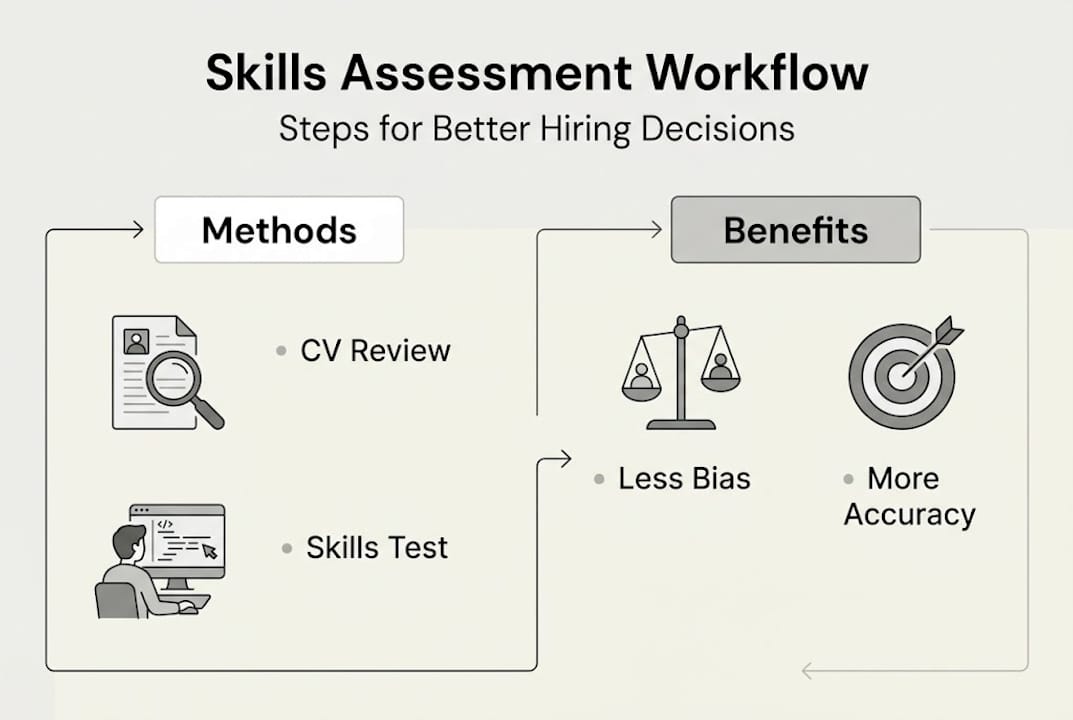
- Choose two to four complementary methods. Combine at least one cognitive or psychometric tool with at least one practical task. Avoid stacking similar methods together.
- Sequence for engagement. Start with shorter, more engaging assessments (like gamified tests or brief video pitches) before moving to longer exercises. This reduces drop-off and keeps candidates motivated.
- Pilot with a test group. Run your workflow with current employees or a small external cohort. Identify where scoring feels inconsistent or where candidates struggle unnecessarily.
- Calibrate your scoring rubric. Ensure assessors agree on what a strong versus acceptable versus poor response looks like for each method before reviewing live candidates.
- Include structured scoring for interviews. Assessment centres combining multiple methods are established UK best practice precisely because they reduce individual assessor bias and give a fuller picture of candidate potential.
This table shows how the classic approach compares to a multi-method workflow:
| Approach | Bias risk | Predictive accuracy | Candidate experience |
|---|---|---|---|
| Classic CV and interview | High | Low | Variable |
| Multi-method workflow | Low | High | Consistently strong |
For roles involving AI screening tools, understanding AI interviews in HR and how to use AI for cultural fit gives your team a real advantage in building well-rounded shortlists.
Pro Tip: Sequence your assessments so cognitive load increases gradually. Start with something engaging, move to practical tasks, and end with structured interviews. This mirrors how performance actually ramps up in a new role.
Verifying results: Avoiding bias and maximising predictive accuracy
Building a great workflow is only half the job. The other half is making sure it stays great, and that your results genuinely predict performance rather than reinforce existing patterns.
Bias can creep into any process, even one that looks thoroughly modern. Here’s how to guard against it:
- Use AI to standardise scoring. Human assessors bring gut instincts that aren’t always fair. AI reduces bias by applying consistent criteria across every candidate without fatigue or favouritism.
- Cross-validate across methods. If a candidate scores strongly on a practical task but poorly in a structured interview, investigate before deciding. Single data points should never make or break a decision.
- Monitor demographic patterns in your results. If one group consistently underperforms in a specific assessment, that’s a signal the tool may be culturally biased, not a reflection of that group’s capability.
- Run periodic audits. Review your assessment data every quarter to spot drift in scoring consistency or emerging bias patterns.
“Skills-first hiring, backed by AI and multi-method validation, consistently outperforms credential-led approaches in predicting long-term job success.”
The Spanish market is a strong example here. Predictive analytics tools are being widely adopted to model candidate success before hire, dramatically reducing early attrition. Understanding the role of AI in recruitment agencies shows how this trend is reshaping hiring across Europe.
Multi-method strategies using AI for bias reduction are increasingly considered essential, not optional, for recruiters aiming to meet both quality and diversity goals simultaneously.
Pro Tip: Run periodic reviews every three to six months to update your methods and check for bias drift. Recruitment markets shift, candidate expectations evolve, and your assessment tools should evolve with them.
Our take: Why innovative skills assessment is non-negotiable
We believe most recruitment teams already know their current workflows are falling short. The harder question is why change feels so difficult to act on.
Here’s the uncomfortable truth we’ve learned from working in this space: conventional workflows don’t just miss hidden talent, they actively reinforce the biases that have always existed. Candidates who look good on paper and interview confidently continue to win roles over people who would genuinely outperform them. That’s a costly mistake, both for your team and your employer brand.
The evolving regulatory landscape in the Netherlands, UK, and Spain is also tightening expectations around fair, evidence-based hiring. Progressive HR teams are getting ahead of this now rather than scrambling when the market or compliance obligations force their hand. What we see clearly in AI in recruitment in 2026 is that the tools are no longer experimental. They’re proven, accessible, and delivering measurable results. The teams who adapt now will hire better, faster, and more fairly. That’s something worth being genuinely excited about.
Explore next-level skills assessment solutions
If you’re ready to move beyond CVs and guesswork, the right tools make all the difference. We’re over the moon about what modern, AI-powered assessment can do for your hiring process, and we’d love to show you.
At WAOTM, we help HR teams match on skills, not CVs, using AI interviews, company challenges, cultural matching, cognitive tests, and video pitches. Whether you’re hiring in Amsterdam, London, or Madrid, our AI candidate validation platform is built for the way modern recruitment actually works. Want to learn more about who we are and what we stand for? Visit our About Us page. Let’s hire better, together.
Frequently asked questions
How does AI help reduce bias in skills assessment?
AI reduces unconscious bias by standardising decision criteria and evaluating candidates on actual skills rather than personal connections or academic backgrounds. Skills-first AI approaches consistently outperform credential-led methods for fair and predictive hiring.
What makes multi-method assessment better than interviews alone?
Multi-method assessment combines skills testing, simulations, and interviews, giving a more reliable and rounded view of each candidate’s potential. Assessment centres using multiple methods are well-established UK best practice for reducing bias and evaluating true potential.
What are the current trends in Spain for skills assessment?
Spain is rapidly adopting predictive analytics and gamified tools, with the HR assessment market set to nearly double from USD 453.81 million in 2024 to USD 931.48 million by 2032, driven by AI psychometric testing.
How do I start upgrading my skills assessment workflow?
Begin by mapping required job skills, selecting modern tools including AI and psychometrics, and structuring multi-stage assessments for unbiased hiring. Multi-method workflows consistently outperform single assessments in both fairness and predictive accuracy.
Recommended
- Master Effective Screening Workflow for Modern Recruitment | We Are Over The Moon
- Assess candidates with AI and cultural fit for better hiring
- Top 4 ModernHire.com Alternatives in 2026 for Effective Candidate Assessment | We Are Over The Moon
- How assessments transform hiring for better candidate selection