Master competency-based interview steps for better hires
TL;DR:
- Competency-based interviews significantly improve prediction of job performance and reduce hiring bias.
- Different countries adapt the approach to local culture, emphasizing formal, practical, or relational factors.
- Proper preparation, structured questioning, and consistent scoring are key to successful implementation.
Traditional interviews miss the mark far too often. You ask about a candidate’s CV, they tell you what you want to hear, and three months later you’re wondering why performance doesn’t match the promise. Structured competency-based interviews reduce hiring bias by 72% while predicting job performance five times better than diploma-based screening. For HR leaders in the Netherlands, UK, and Spain, that’s a result worth getting excited about. This guide walks you through every step, from defining competencies to verifying outcomes, so you can build a hiring process that actually works.
Table of Contents
- What are competency-based interviews?
- Preparing for a competency-based interview process
- Step-by-step: The key phases of a competency-based interview
- Verifying outcomes and achieving better hiring decisions
- Why cultural context shapes competency-based interviews
- Take your competency-based interviews to the next level
- Frequently asked questions
Key Takeaways
| Point | Details |
|---|---|
| Evidence-based selection | Competency-based interviews predict performance and retention more reliably than traditional methods. |
| Bias reduction | Structured processes cut hiring bias by 72% for fairer, more diverse teams. |
| STAR method mastery | Using STAR or Ringo STARR ensures probing for authentic, job-relevant behaviours. |
| Cultural customisation | Tailoring frameworks for the UK, Netherlands, and Spain enhances cultural fit and candidate success. |
What are competency-based interviews?
Now that you see the shortcomings of traditional interviews, let’s define competency-based interviewing and why it’s so effective.
A competency-based interview is a structured conversation where every question targets a specific skill or behaviour required for the role. Instead of asking “Tell me about yourself,” you ask “Describe a time you managed a difficult stakeholder.” The candidate’s answer reveals real evidence of past behaviour, which is the strongest predictor of future performance.
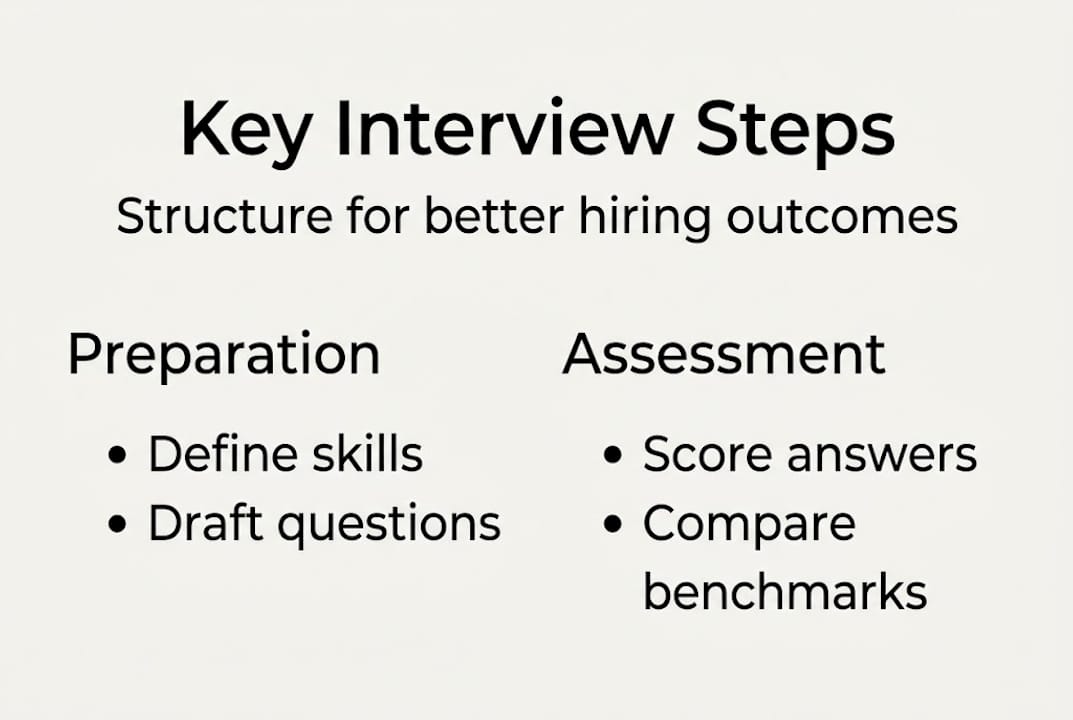
The core principle is simple: past behaviour predicts future behaviour. Every question is tied to a defined competency, every answer is scored against a consistent rubric, and every candidate is assessed on the same criteria. This consistency is what makes the method so powerful.
Structured interviews predict employee success with a validity score of 0.51, compared to just 0.10 for diploma-focused hiring. That’s a massive difference in predictive power. And with 65% of Dutch organisations expecting to adopt competency-based interviewing in 2026, the momentum is clearly building.
How the three countries approach it differently
The method looks slightly different depending on where you operate. Understanding these nuances helps you design a process that resonates locally.
| Country | Approach | Key feature |
|---|---|---|
| United Kingdom | Formal and framework-driven | Success Profiles, scored 1 to 7 |
| Netherlands | Skills-first, anti-diploma | Practical evidence over credentials |
| Spain | Relational and team-focused | Cultural and interpersonal fit |
These differences matter more than most HR leaders realise. Explore the full range of types of HR interviews to see how competency-based approaches compare to panel, situational, and strengths-based formats.
Key features that set competency-based interviews apart from traditional ones:
- Questions are pre-defined and tied to specific competencies
- All candidates answer the same core questions
- Scoring is done in real time using a consistent scale
- Interviewers are trained to probe for behavioural evidence
- Decisions are based on data, not gut feeling
Pro Tip: Use a candidate benchmarking guide to establish clear performance baselines before you design your question bank. This keeps your scoring grounded in what genuinely strong performance looks like for your specific role.
Preparing for a competency-based interview process
With competency-based interviews defined, the foundation of success lies in solid preparation. Here’s how to structure your process for consistency and bias reduction.
The most common reason competency-based interviews fail isn’t the interview itself. It’s poor preparation. If your competency framework is vague, your interviewers are untrained, or your question bank is inconsistent, the whole process falls apart before a single candidate walks through the door.
Building your competency framework
Start by identifying the four to six competencies that genuinely predict success in the role. Not every competency matters equally. A customer-facing sales role needs strong communication and resilience. A data analyst role needs analytical thinking and attention to detail. Prioritise ruthlessly.
The UK’s Success Profiles framework standardises nine core behaviours, measured on a 1 to 7 scale with a pass mark at 4. This is an excellent template for any organisation wanting a rigorous, auditable process. You don’t need to copy it exactly, but the principle of scoring behaviours on a defined scale is worth adopting universally.
Here’s a practical comparison of framework approaches across the three markets:
| Element | UK (Success Profiles) | Netherlands | Spain |
|---|---|---|---|
| Competency source | Civil Service framework | Organisational job analysis | Role and team culture |
| Scoring scale | 1 to 7 | Typically 1 to 5 | Often qualitative |
| Pass threshold | 4 out of 7 | Defined per role | Consensus-based |
| Cultural emphasis | Formal, structured | Practical, evidence-led | Relational, contextual |
Steps to prepare your process
- Define your competencies. Work with line managers and high performers to identify the behaviours that distinguish excellent from average performance.
- Write behavioural questions. Each question should start with “Tell me about a time when…” or “Give me an example of…” to prompt real evidence.
- Build a scoring rubric. Define what a strong, acceptable, and weak answer looks like for each competency before the interview begins.
- Train your interviewers. Interviewers need to know how to probe for specifics, avoid leading questions, and score in real time without bias.
- Create a structured question bank. Standardise which questions are asked in every interview so comparisons between candidates are fair.
Use a candidate evaluation checklist to make sure every interviewer is assessing the same dimensions consistently. Pair this with a solid HR hiring checklist to cover the administrative and compliance side of your process.
Step-by-step: The key phases of a competency-based interview
With preparation covered, let’s go to the actionable interview steps, making sure each candidate is assessed fairly and consistently.
Running a competency-based interview well is a skill. It requires discipline, active listening, and the ability to score objectively while keeping the conversation natural. Here’s how to do it right.
The interview phases in order
- Opening and rapport building (5 minutes). Welcome the candidate, explain the format, and set expectations. Tell them you’ll be asking for specific examples and that it’s fine to take a moment to think. This reduces nerves and improves answer quality.
- Structured questioning (30 to 40 minutes). Work through your pre-defined questions, one competency at a time. Ask the core question, then probe for depth using follow-up questions like “What was your specific role?” or “What was the outcome?”
- Real-time scoring (throughout). Score each answer immediately after the candidate finishes responding. Don’t wait until the end of the interview. Memory fades and recency bias creeps in.
- Candidate questions (10 minutes). Give candidates space to ask their own questions. Their questions often reveal as much about their motivations and values as their answers do.
- Closing and next steps (5 minutes). Explain the timeline, thank the candidate, and close professionally. First impressions run both ways.
Using STAR and Ringo STARR effectively
STAR stands for Situation, Task, Action, Result. It’s the most widely used framework for structuring both questions and answers. Civil Service interviews use STAR and Ringo STARR, scored 1 to 7 with a pass threshold of 4.
Ringo STARR adds two extra elements: Reflection (what the candidate learned) and Repeat (whether they’d do it differently). This extended version is particularly useful for senior roles where learning agility and self-awareness are critical competencies.
When a candidate gives a vague answer, probe with “What specifically did you do?” or “What was the measurable result?” Vague answers often mean the candidate is describing a team effort rather than their own contribution. You need individual evidence.
Key insight: Structured interviews predict performance five times better than diploma-focused hiring. Every time you’re tempted to shortcut the process, remember that number.
Common mistakes to avoid:
- Asking hypothetical questions instead of behavioural ones (“What would you do?” instead of “What did you do?”)
- Allowing interviewers to score after a panel discussion rather than independently
- Skipping the probing stage when an answer sounds impressive
- Failing to document scores during the interview
For a deeper look at running each phase effectively, the structured interview steps guide covers how this approach improves retention by 35%. And if you want the full case for consistency, fairer hiring practices explains exactly why structure beats intuition every time.
Verifying outcomes and achieving better hiring decisions
The interview process doesn’t end at scoring. Here’s how to maximise the value from your data and choose candidates who thrive.
Once interviews are complete, many HR teams rush straight to a decision. That’s a mistake. The scoring data you’ve collected is genuinely valuable, and it deserves proper analysis before you make a final call.
Interpreting and benchmarking scores
Start by reviewing each candidate’s scores against your pre-defined pass thresholds. Don’t adjust thresholds after the fact because a strong candidate fell just short. That’s how bias re-enters the process. If your threshold was 4 out of 7, hold to it.
| Score range | Interpretation | Recommended action |
|---|---|---|
| 6 to 7 | Exceptional evidence | Strong shortlist candidate |
| 4 to 5 | Solid evidence | Meets threshold, consider for role |
| 2 to 3 | Partial evidence | Does not meet threshold |
| 1 | No evidence | Reject at this stage |
High-scoring candidates in structured interviews show stronger retention and promotion rates. This means your investment in rigorous scoring pays dividends well beyond the hire itself. You’re not just filling a vacancy; you’re building a team that performs and stays.
Ensuring validity and reducing bias
After scoring, conduct a calibration session with all interviewers before making a final decision. Each interviewer shares their scores independently, then the panel discusses any significant differences. This catches individual bias and ensures the final decision reflects collective evidence, not one person’s impression.
Key actions for a valid, auditable process:
- Document scores and evidence for every candidate, including those not selected
- Review score distributions across demographic groups to identify potential bias
- Audit your process quarterly to check whether your competencies still reflect role requirements
- Use a candidate-centric process guide to ensure the experience is positive for candidates at every stage
Connecting results to onboarding and cultural fit
The data from your competency interviews is most valuable when it flows into onboarding. If a candidate scored strongly on communication but showed development areas in stakeholder management, share that with their line manager. It shapes the onboarding plan and sets the new hire up for success from day one.
In Spain, where relational fit carries significant weight, it’s worth including a team-based interview stage alongside the structured competency assessment. This isn’t about replacing the data; it’s about enriching it with the relational context that matters in Spanish working culture. In the Netherlands, the emphasis is on practical evidence and autonomy, so onboarding plans should reflect that by giving new hires early ownership of real work. In the UK, formal feedback aligned to the Success Profiles framework helps new hires understand where they excelled and where they can grow.
Why cultural context shapes competency-based interviews
Beyond steps and data, cultural differences have a profound impact on competency interviewing. Here’s how to use this to your advantage.
We see a lot of HR teams adopt a single global competency framework and roll it out identically across all markets. It looks efficient. In practice, it creates friction that quietly undermines your results.
The conventional wisdom says skills are universal. And in a technical sense, they are. Problem-solving is problem-solving whether you’re in Amsterdam, London, or Madrid. But the way candidates demonstrate those skills, and the way interviewers interpret the evidence, is shaped by cultural norms that no framework fully captures.
UK interviews are formal and framework-driven, Dutch interviews focus on skills not diplomas, and Spanish processes are notably relational. This isn’t just a stylistic difference. A Dutch candidate who gives a direct, no-frills answer might score lower with a UK interviewer trained to expect structured narrative. A Spanish candidate who weaves in team context might seem unfocused to an interviewer expecting crisp individual attribution.
The fix isn’t to lower standards. It’s to train interviewers on cultural communication styles so they can distinguish between a weak answer and a culturally different one. Explore the full range of HR interview types to see how different formats can complement your competency process in each market.
We believe the most effective competency frameworks are living documents. They should be reviewed annually, tested against actual performance data, and adjusted when the evidence says they’re missing something. Cultural context is one of the most important inputs to that review. Build it in deliberately, and your process becomes genuinely stronger across every market you operate in.
Take your competency-based interviews to the next level
If you’re ready to upgrade your approach and harness technology for better, bias-free hiring, consider partnering with experts who live and breathe skills-first recruitment.
We Are Over The Moon replaces CV screening with real assessments, so you’re evaluating what candidates can actually do, not just what they’ve written about themselves. From AI interviews and cognitive tests to video pitches and cultural matching, the platform is built to support every step of the competency-based process you’ve just read about.
Whether you’re rolling out structured interviews across the Netherlands, UK, or Spain, our tools help you validate candidates consistently and confidently. Read more about our approach and see how skills-based matching transforms hiring outcomes. Ready to see it in action? Explore the full AI validation platform and start building a recruitment process you’re genuinely over the moon about.
Frequently asked questions
What is a competency-based interview step?
Each step involves using structured questions to assess the skills and behaviours candidates need for the role, often using the STAR or Ringo STARR format to gather specific behavioural evidence.
Why are competency-based interviews fairer than traditional ones?
They reduce hiring bias by 72% and predict job performance five times better than diploma-based interviews, because decisions are grounded in evidence rather than impressions.
How do scoring and passing work in the UK Civil Service?
Interviewers score responses from 1 to 7 on core behaviours, and the pass mark is 4 or higher using the Success Profiles framework.
What is the projected adoption rate for competency-based interviews in the Netherlands in 2026?
Sixty-five percent of organisations in the Netherlands are expected to use competency-based interviewing in 2026, reflecting rapid growth in skills-first hiring.
How do Dutch, UK, and Spanish competency interviews differ?
The UK uses formal frameworks with structured scoring, the Netherlands focuses on practical skills over diplomas, while Spain emphasises relational fit and team-based examples throughout the process.