How to shortlist applicants for better hiring outcomes

TL;DR:
- European law requires human oversight, transparency, and DPIAs for AI-assisted shortlisting in 2026.
- Combining AI tools with structured human review improves efficiency and fairness in candidate selection.
- Proper documentation and bias monitoring are essential to ensure compliance and maintain diversity.
Shortlisting applicants is one of the most consequential steps in the hiring journey. When you are managing hundreds of applications for a single role, the pressure to identify the right people quickly, fairly, and within legal boundaries is immense. European HR teams now face a uniquely complex environment: rising application volumes, tightening data protection rules, and genuinely exciting AI tools that can either transform your shortlist quality or create serious compliance headaches if used carelessly. This guide walks you through everything you need to shortlist applicants with confidence in 2026.
Table of Contents
- What you need before you start shortlisting
- Step-by-step process to shortlist applicants efficiently
- How to maintain fairness, accountability, and diversity
- Common mistakes to avoid when shortlisting applicants
- Why shortlisting with AI still needs the human touch
- Improve your shortlisting process with advanced AI tools
- Frequently asked questions
Key Takeaways
| Point | Details |
|---|---|
| Legal compliance first | Always ensure GDPR and EU AI Act rules are in place before shortlisting applicants. |
| Blend AI and human oversight | Use AI to improve speed and quality, but maintain human judgment for fair final selection. |
| Monitor for bias | Regularly check that your shortlisting process rewards diversity and avoids hidden discrimination. |
| Document every step | Keep records of each decision and method to ensure transparency and facilitate audits. |
What you need before you start shortlisting
Before diving into the step-by-step process, ensure you address the key legal and operational prerequisites for shortlisting. Getting these foundations right saves enormous time and protects your organisation from regulatory risk.
The legal landscape in Europe has changed significantly. Recruitment AI is high-risk under the EU AI Act from August 2026, meaning GDPR Article 22 already prohibits solely automated decisions about candidates, and you must conduct a Data Protection Impact Assessment (DPIA) whenever AI plays a significant role in screening. This is not optional. Ignoring these requirements exposes your organisation to regulatory fines and reputational damage. Read up on AI in recruitment compliance to stay ahead of the curve.
On the operational side, gather these materials before you begin:
- A clear, role-specific job description with defined essential and desirable criteria
- A scoring rubric that assigns weighted points to each requirement, making evaluation consistent across reviewers
- Candidate consent documentation confirming applicants understand how their data will be used
- A DPIA (if AI tools are involved in screening or ranking candidates)
- An audit trail template to record who reviewed each application, when, and on what basis
“Transparency and human oversight are not bureaucratic hurdles. They are the foundation that makes your shortlisting process defensible, fair, and trustworthy.”
Pro Tip: When building your scoring rubric, involve line managers and current team members. They bring on-the-ground insight about what genuinely predicts success in the role, which makes your criteria far more predictive than a generic skills checklist.
| Requirement | Why it matters | Action to take |
|---|---|---|
| GDPR lawful basis | Legal foundation for processing applicant data | Document your chosen basis (e.g., legitimate interest) |
| DPIA | Required for high-risk AI use in recruitment | Complete before deploying any AI screening tool |
| Human oversight | Mandatory under GDPR Art. 22 | Assign a named reviewer for AI-assisted decisions |
| Candidate transparency | Builds trust and legal compliance | Include data use statement in application process |
| Scoring rubric | Ensures consistent, unbiased evaluation | Create before reviewing any applications |
Understanding transforming candidate screening through AI also helps you appreciate where technology adds genuine value and where human judgement remains irreplaceable.
Step-by-step process to shortlist applicants efficiently
With requirements in place, you can now follow a systematic approach to shortlisting that incorporates both human and AI-powered tools. This process balances speed with rigour, and consistency with genuine personalisation.
-
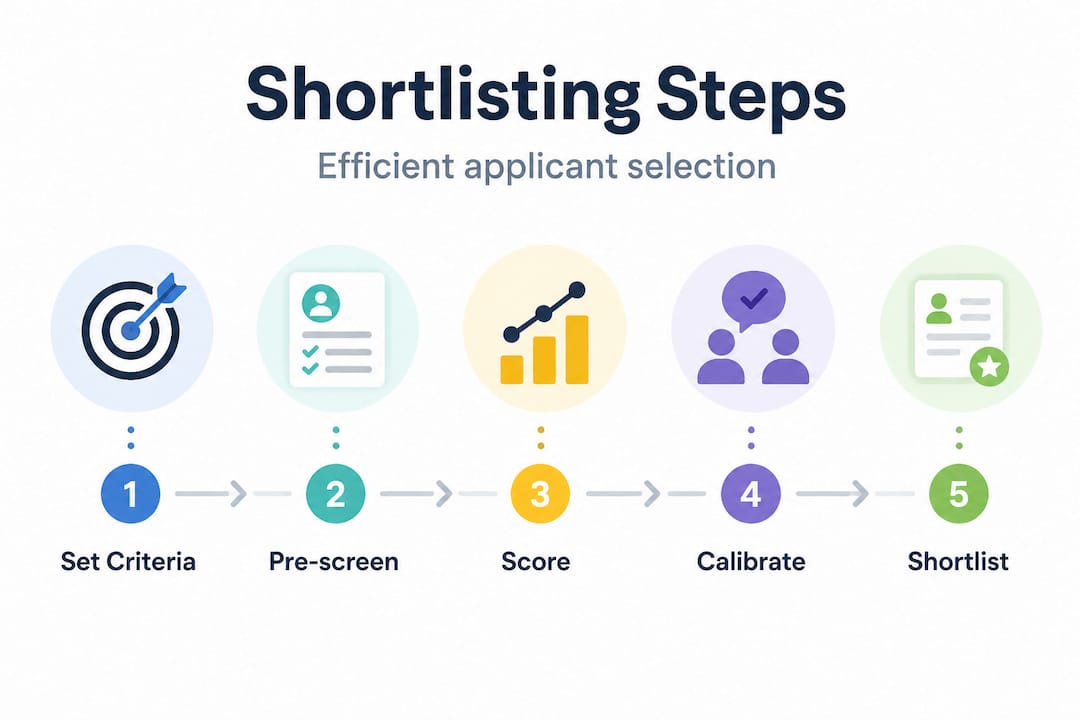
Define your criteria precisely. Start by separating essential criteria (qualifications or skills without which a candidate cannot do the job) from desirable criteria (attributes that would be a bonus). Assign a numerical weight to each. Essential criteria typically carry 60 to 70 percent of the total score.
-
Review all applications against your rubric. Have every reviewer score independently before discussing. Group discussion before independent review introduces anchoring bias, where the first opinion shapes everyone else’s. Independent scoring keeps assessments honest.
-
Apply a structured scoring pass. Score each application section by section: relevant experience, skill match, qualifications, and any role-specific requirements. This structured approach, endorsed as part of fair and structured interview techniques, significantly reduces the influence of gut feeling.
-
Leverage AI tools with active oversight. AI can process applications at scale, flag keyword matches, and surface candidates who might be overlooked in manual review. Tools that support AI-driven sourcing can dramatically reduce time-to-shortlist. But a trained reviewer must validate every AI recommendation before it influences who progresses.
-
Calibrate your shortlist size. Aim for five to eight candidates per role for interview stages. Too few limits your options. Too many wastes interviewer time and dilutes the quality of the process.
-
Document every decision. Record the score, the rationale, and the name of the reviewer for each application. This audit trail protects you if a rejected candidate challenges the decision.
-
Communicate clearly with candidates. Let shortlisted candidates know promptly and give unsuccessful applicants timely, respectful feedback where possible. This protects your employer brand and reflects the transparency GDPR requires.
| Method | Speed | Bias risk | Compliance fit | Best use case |
|---|---|---|---|---|
| Manual review only | Slow | Moderate to high | Straightforward | Small volume, niche roles |
| AI scoring with human review | Fast | Low (if well configured) | Strong with DPIA | High volume roles |
| Fully automated AI | Very fast | Variable | Non-compliant under GDPR | Not recommended |
| Structured panel review | Moderate | Low | Strong | Senior or specialist roles |
Teams adopting AI assessment approaches report 74% faster hiring in certain scenarios, which is genuinely exciting. The key is pairing that speed with the oversight and documentation that European law demands.
Pro Tip: Run a calibration session with your reviewers before starting. Have everyone score the same two or three sample applications and compare results. Where scores diverge significantly, discuss the rubric until you reach shared understanding. This single step dramatically improves inter-reviewer consistency.

How to maintain fairness, accountability, and diversity
Applying these methods brings new responsibility: you must guard against bias and ensure fair outcomes throughout your selection process. Fairness is not just a compliance requirement; it is a genuine competitive advantage because diverse teams consistently outperform homogeneous ones.
Research findings on AI and diversity are genuinely fascinating and worth understanding in detail. AI scores women and minorities higher than human reviewers do in comparable studies, and predicts employment success more accurately. However, supervised AI systems (trained on historical hiring data) can inadvertently replicate existing bias patterns if the training data reflects past discriminatory decisions. Exploratory AI approaches, sometimes called “bandit” models, actively test new candidate profiles and can increase diversity by avoiding the reinforcement of historical patterns.
This means your choice of AI tool and how it is configured genuinely shapes your diversity outcomes. It is not enough to simply “turn on AI” and assume fairness follows automatically.
Practical steps to protect fairness:
- Use diverse shortlisting panels to reduce the influence of any single reviewer’s unconscious bias
- Anonymise applications at the initial sift stage (remove names, photos, and addresses) to reduce demographic bias
- Monitor AI outputs by demographic group regularly and investigate any patterns of under-selection
- Set explicit diversity targets and track shortlist composition against them
- Require AI vendors to provide transparency reports on how their algorithms score candidates
- Use structured assessments (skills tests, video pitches, cognitive evaluations) rather than CV review alone, since benefits of AI assessment include more objective evidence of capability
“A shortlist built on structured, evidence-based criteria is a shortlist you can be proud of and defend. Gut feeling has its place, but it should never be the primary driver of who progresses.”
Understanding how AI reduces bias in recruitment gives you a clearer picture of where technology genuinely helps and where it demands your active monitoring.
Accountability also means keeping records. If a candidate or regulator asks why a particular person was not shortlisted, you need a clear, documented, criteria-based answer. That is only possible if your scoring rubric and reviewer notes are stored systematically.
Common mistakes to avoid when shortlisting applicants
Even with robust processes, there are several hazards that can undermine your efforts. Being aware of these is critical for compliance and reputation in 2026.
The most frequent shortlisting mistakes we see:
- Skipping the DPIA. If you are using any AI tool to score, rank, or filter applicants, a Data Protection Impact Assessment is required. Many teams only discover this after deployment, when it is far more costly to fix.
- Allowing fully automated rejections. Rejecting a candidate based solely on an AI score, without human review, is a GDPR Article 22 violation. Even if your AI tool is highly accurate, a human must be meaningfully involved in the decision.
- Using opaque algorithms. If you cannot explain how your AI tool scores candidates, you cannot demonstrate compliance, respond to candidate queries, or monitor for bias. Always demand algorithm transparency from vendors.
- Inconsistent criteria application. Changing your criteria mid-process (for example, adding a new “must-have” after reviewing early applications) is both legally risky and ethically questionable. Define criteria before you see any applications.
- Poor candidate communication. Leaving candidates without updates for weeks, or providing no feedback to unsuccessful applicants, damages your employer brand and may raise transparency concerns under GDPR.
- Ignoring pre-screening automation opportunities. Teams that do everything manually miss significant time savings and introduce more human error into early-stage screening.
Pro Tip: Create a shortlisting checklist that reviewers complete for every role. Include confirmation that criteria were set before applications were seen, that AI outputs were reviewed by a human, and that all decisions are documented. A simple checklist takes two minutes and prevents the most common compliance failures.
“The shortlisting process is where good intentions meet real-world pressure. Volume, speed, and familiarity bias all push teams toward shortcuts. Awareness is your best defence.”
Documentation is genuinely your friend here. The teams that face the most regulatory scrutiny are those that cannot reconstruct their decision-making process after the fact. Treat every shortlisting decision as something you may need to explain clearly in six months’ time.
Why shortlisting with AI still needs the human touch
Here is something we feel strongly about at We Are Over The Moon: the most exciting thing about modern shortlisting tools is not that they replace human judgement. It is that they finally give human judgement something worth working with.
Full automation, even when it is technically legal and well-configured, routinely misses candidates who would be exceptional. That is because cultural fit, growth potential, and contextual resilience are extraordinarily difficult to capture in a numerical score. An AI can tell you that a candidate matches 87% of the role’s keywords. It cannot tell you that this person’s unconventional career path reflects exactly the kind of adaptive thinking your team needs right now.
The EU AI Act’s high-risk classification of recruitment AI is not just a compliance burden. It is a prompt to think carefully about what you are actually asking AI to do. Shortlisting is not a sorting exercise. It is the beginning of a relationship between a person and an organisation. Treating it as a tick-box process, whether manual or automated, produces shortlists that are technically defensible but practically disappointing.
What we find works brilliantly is using AI to surface candidates that structured CV review would miss, then applying human review to add the contextual layer that algorithms cannot. Tools like AI interview examples show how video pitches and structured AI interviews can reveal personality, communication style, and genuine enthusiasm in ways a CV never could. Then your hiring team brings the judgement to interpret those signals intelligently.
The teams getting the best results from AI-assisted shortlisting are not the ones who automate the most. They are the ones who automate the right things, and stay deeply engaged with the human decisions that follow. That combination, technology doing the heavy lifting and humans doing the nuanced thinking, is where shortlisting becomes genuinely transformative.
Improve your shortlisting process with advanced AI tools
If you are ready to reduce time-to-hire and boost outcome quality, the right AI tools make shortlisting more powerful and less risky. We are genuinely excited about what modern assessment platforms make possible for European HR teams.
At We Are Over The Moon, we believe that replacing CV screening with real assessments changes everything. Our platform combines AI interviews, company challenges, cultural matching, cognitive tests, and video pitches so you build shortlists based on genuine evidence of capability, not just polished CVs. Explore our skills-based shortlisting tools and see how structured assessment transforms your candidate pipeline. You can also discover our full AI candidate validation platform for a complete overview of what is possible. We would love to show you what shortlisting looks like when it is built on real insight. Find out more about We Are Over The Moon and let’s build better shortlists together.
Frequently asked questions
What steps should I take to ensure GDPR compliance when shortlisting applicants?
You must communicate your fair use of data, keep human oversight in place, and avoid fully automated rejections to comply with GDPR requirements. A documented DPIA is also mandatory when AI tools are involved in candidate screening.
Can AI increase diversity in hiring shortlists?
Yes, some AI models promote diversity by evaluating applicants with less bias than humans, though the design of the system strongly influences whether this benefit is realised. Exploratory AI approaches tend to support diversity more effectively than models trained solely on historical hiring data.
When will the EU AI Act affect recruitment processes?
The EU AI Act classifies recruitment AI as high-risk from August 2026, requiring new safeguards, transparency obligations, and active human oversight for any AI used in hiring decisions.
Is it possible to automate shortlisting fully under current European law?
No, full automation without meaningful human review is prohibited under GDPR and reinforced by the EU AI Act for recruitment contexts. A qualified human reviewer must be genuinely involved in any shortlisting decision that affects a candidate’s progression.