How to implement a candidate challenge process

TL;DR:
- Structured candidate challenge processes provide observable evidence of practical skills, making hiring more reliable and fairer.
- Proper preparation, clear design, scoring rubrics, and candidate feedback are essential to maximize effectiveness and predictive validity.
Traditional interviews are notoriously unreliable. Candidates rehearse answers, interviewers fall for confident personalities, and the whole process often tells you more about how well someone performs under social pressure than how well they can actually do the job. Structured assessment methods like take-home assignments, case studies, and work simulations give you real, observable evidence of practical skill and problem-solving ability. This guide walks you through every stage of building a candidate challenge process that genuinely works, from initial setup all the way to scoring, validation, and continuous improvement.
Table of Contents
- What is a candidate challenge process?
- What you need to set up a challenge process
- How to design and deliver candidate challenges
- Scoring, debrief, and validation for fairness
- Expected outcomes and troubleshooting common issues
- A different take: what most candidate challenge guides overlook
- Level up your hiring with skills-first candidate challenge processes
- Frequently asked questions
Key Takeaways
| Point | Details |
|---|---|
| Real work assessment | Candidate challenge processes reveal true skills through practical tasks, not CVs alone. |
| Fair and scalable methods | Rubric-based scoring and ATS integration ensure fairness and enable hiring at scale. |
| Validation boosts results | Debriefing after challenges improves authenticity and predictive hiring outcomes. |
| Troubleshoot for success | Address unclear instructions and over-complexity to prevent candidate drop-off. |
What is a candidate challenge process?
A candidate challenge process is a structured approach to recruitment that goes beyond what a CV or standard interview can reveal. Instead of asking candidates what they would do in a given situation, you give them the actual situation and watch what they do with it.
Structured assessment methods such as take-home assignments, case studies, and work simulations are specifically designed to evaluate practical skills and problem-solving abilities that simply cannot be measured through conversation alone. The key word here is structured. These are not informal tasks or vague prompts. They are carefully designed, consistently delivered, and scored against clear criteria.
Common formats include:
- Take-home assignments: Candidates complete a relevant task in their own time, such as writing a strategy document, building a small code feature, or creating a campaign brief.
- Case studies: Candidates are presented with a realistic business scenario and asked to analyse it, identify problems, and propose solutions.
- Live simulations: Candidates work through a task in real time, sometimes alongside a hiring manager or team member.
- Work sample tests: Short exercises that mirror specific duties from the actual role.
“A candidate challenge process shifts the hiring conversation from ‘Tell me about a time when…’ to ‘Here is the situation. Show us what you can do.’”
For HR leaders in mid-sized to large organisations, the advantages are significant. Challenge-based methods increase fairness because every candidate receives the same task under the same conditions. They improve predictive validity, meaning the results are genuinely linked to on-the-job performance. They also reduce the influence of unconscious bias, since assessors are evaluating outputs rather than impressions. Incorporating a well-designed company challenge in hiring is one of the most reliable ways to raise the quality of your hiring decisions.
What you need to set up a challenge process
Preparation is everything. Before you send a single task to a single candidate, your team needs the right foundations in place. Jumping in without them leads to inconsistent scoring, candidate confusion, and outcomes that are impossible to defend if challenged.
Here is what you need to prepare:
| Element | What it includes | Why it matters |
|---|---|---|
| Scoring rubric | Criteria, weightings, rating scales | Ensures objective, consistent evaluation |
| Assignment template | Brief, instructions, expected format | Reduces ambiguity for candidates |
| Communication plan | Invite email, deadlines, FAQ document | Sets clear expectations and reduces drop-off |
| ATS integration | Stage tracking, submission links, scoring fields | Enables scalability across volume hiring |
| Anonymisation protocol | Blind scoring, candidate ID system | Reduces evaluator bias |
| Legal review checklist | Relevance to role, data handling compliance | Protects the organisation legally |
Rubric-based scoring and timed limits are widely regarded as essential for fairness in mid-to-large organisations, and integrating challenges into your ATS is the most practical way to manage them at scale.
When integrating with your ATS, map each challenge as its own pipeline stage. This lets you track completion rates, flag late submissions, and pull data for reporting without manual effort. Most modern ATS platforms support custom stages and file submissions, so the technical lift is usually lighter than teams expect.
Essential items to confirm before launch:
- Is the task directly relevant to core responsibilities of the role?
- Does every candidate receive the same brief, time allocation, and instructions?
- Are assessors trained on how to use the rubric?
- Is candidate data stored securely and in line with GDPR requirements?
- Have you piloted the task internally to check clarity and realistic time requirements?
Pro Tip: Ask a recent hire in a similar role to complete the task before you deploy it. Their feedback on clarity, difficulty, and time required is invaluable for calibrating expectations.

How to design and deliver candidate challenges
Good design is what separates a challenge process that candidates respect from one that drives them away. The task should feel relevant, achievable within a reasonable timeframe, and clearly connected to the actual work they will be doing if hired.
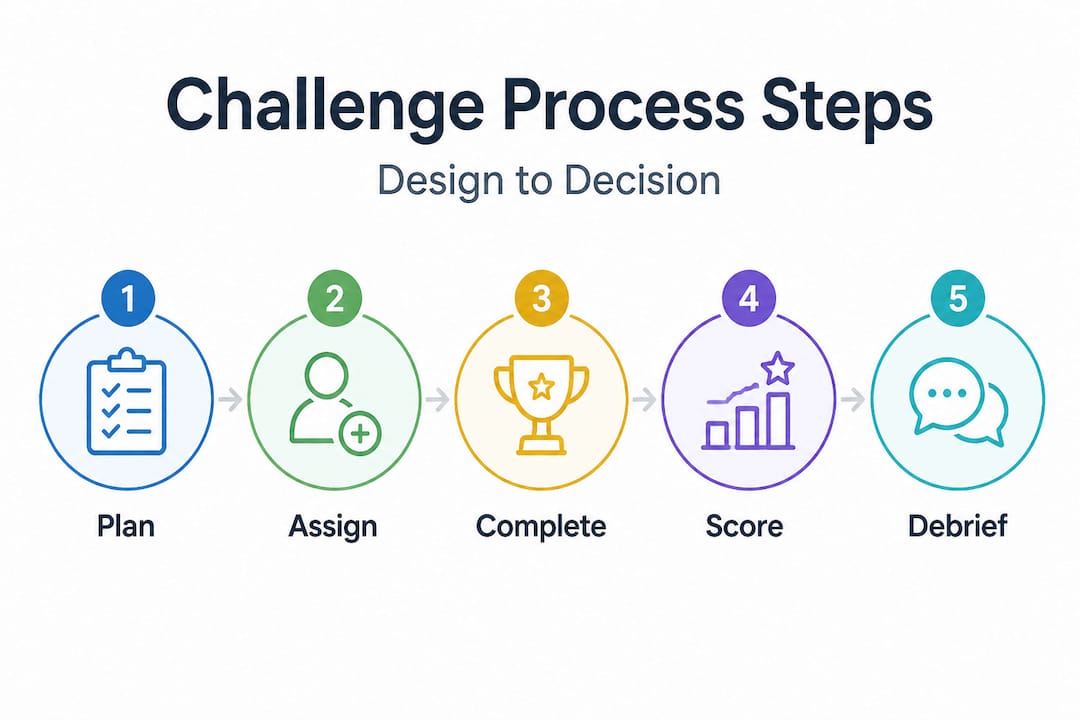
Follow these steps to design and deliver effectively:
-
Define the core competencies you want to assess. Start with the job specification. Identify the two or three most critical skills for success in the role. Your challenge should assess those skills directly.
-
Choose the right format. A take-home assignment suits roles requiring independent analysis or creative output. A live simulation works well for customer-facing or collaborative roles. Use the comparison table below to help choose.
-
Write a clear, concise brief. Include the context, the task, the expected output format, the time allowance, and any supporting materials. Ambiguity is your enemy here.
-
Set a realistic time limit. For take-home tasks, two to four hours is a reasonable range for most professional roles. Anything longer risks penalising candidates with caregiving responsibilities or full-time roles.
-
Communicate clearly and promptly. Send the challenge with enough lead time for candidates to plan. Include a contact point for questions and a clear submission deadline.
-
Use a multi-hurdle approach where appropriate. This means sequencing challenges after initial screening, so candidates who progress to the task stage have already demonstrated a baseline level of suitability.
| Method | Best suited for | Key advantage | Key limitation |
|---|---|---|---|
| Take-home assignment | Analytical, creative, technical roles | Candidates work at their own pace | Risk of third-party help |
| Live simulation | Customer-facing, collaborative roles | Authentic real-time observation | Can disadvantage nervous candidates |
| Work sample test | Roles with clear technical requirements | Highly job-relevant outputs | Narrow in scope |
Effective screening workflow strategies can help you sequence these methods intelligently within a broader hiring funnel, so that challenges are used at the right point rather than as a first gate.
Pro Tip: For remote or hybrid roles, consider recording live simulations with candidate consent. This allows asynchronous review by multiple assessors, which reduces scheduling pressure and adds an extra layer of consistency to scoring.
Scoring, debrief, and validation for fairness
Scoring is where most challenge processes lose their rigour. Without a structured approach, assessors drift into subjective judgements, and the whole exercise becomes just another form of gut-feel evaluation.
Use a rubric with clearly defined criteria and a consistent rating scale, such as one to five, where each number corresponds to a specific description of performance. For example, a score of three for “analytical reasoning” should mean something concrete: the candidate identified the core problem and proposed a logical solution, but did not explore alternative approaches. A score of five means they identified multiple dimensions of the problem, weighed trade-offs, and presented a well-reasoned recommendation.
Always follow up with a debrief or discussion session after the challenge. Following with a discussion validates authenticity and depth, and it genuinely boosts predictive validity. Candidates who completed the work themselves can speak to their thinking fluently. Those who received outside help often struggle to explain their reasoning in real time.
Common scoring mistakes to avoid:
- Scoring based on presentation quality alone rather than substance
- Failing to calibrate assessors before the process begins
- Allowing assessors to see other scores before forming their own judgement
- Not providing feedback to candidates who request it after a decision is made
- Using the same rubric across roles with significantly different requirements
Exploring how assessment and cultural fit interact in the scoring stage is worth attention too. Practical skill is only one dimension. A candidate who scores brilliantly on a technical task but whose working style clashes with the team is still a hiring risk.
Linking challenge outcomes to soft skills assessment examples also strengthens your overall picture of a candidate, particularly for senior or cross-functional roles where interpersonal and communication skills carry real weight.
Expected outcomes and troubleshooting common issues
When candidate challenge processes are well designed and consistently applied, the results are exciting. You will typically see higher quality of hire, reduced bias in hiring decisions, and a much richer skills data set to inform workforce planning. Candidates who accept offers through this process also tend to show higher engagement in the early weeks, because the job has already been previewed realistically.
That said, every system has its friction points. Here is what to watch for:
Common issues and practical solutions:
- Candidate drop-off: Some candidates will disengage when asked to complete a task. Review the time requirement and brief clarity first. If drop-off remains high, consider whether the challenge is positioned too early in the process.
- Unclear task instructions: Test the brief with an internal team member before deployment. If they have questions, candidates will too.
- Perceived cheating or third-party completion: Use a debrief session to probe the work. Authenticity questions such as “Walk me through your decision at this point” quickly reveal depth of understanding.
- Over-complexity: Challenges that try to assess too many skills at once become confusing and unfair. Focus on two or three competencies at most per task.
- Candidate pushback on relevance: If candidates question why a task is required, your communication plan may need strengthening. Explain explicitly how the task connects to the role.
A multi-hurdle structure that sequences challenges after screening, uses debrief discussions to probe reasoning, and iterates based on candidate feedback consistently outperforms single-stage assessments in quality of hire outcomes.
Keeping a close eye on candidate experience throughout the process is not just a nicety. Candidates who feel respected during the challenge stage, even if they are ultimately unsuccessful, are more likely to speak positively about your employer brand. In a competitive talent market, that matters enormously.
A different take: what most candidate challenge guides overlook
Here is something we do not see discussed often enough: the biggest failure mode in candidate challenge processes is not poor rubrics or weak tasks. It is over-engineering.
Teams get excited about building elaborate, multi-stage assessments with complex scoring matrices and detailed scenario briefs. The result often looks impressive on paper but creates a stressful, confusing experience for candidates. When the process feels like a trick rather than an opportunity, strong candidates with options simply withdraw. You end up selecting for persistence under unclear conditions rather than genuine job-relevant skill.
The most effective challenge processes we have seen are remarkably simple. They involve one clear, relevant task, a generous but defined time limit, and a human follow-up conversation. That is it.
Another undervalued insight is the importance of involving recent hires in the design process. Hiring managers know what they want to see. But recent hires know what the task actually felt like from the other side. Their input on tone, clarity, and realistic time requirements is often more useful than extensive internal debate about competency frameworks.
We are also strong advocates for screening without CVs as the front end of this process. When you remove CV-based gatekeeping and lead with a challenge, you immediately access a wider, more diverse talent pool. The skills-first approach is not just fairer. It is smarter.
The final thing most guides overlook is the feedback loop. After each hiring cycle, review which challenge outcomes actually predicted performance at the three-month and twelve-month marks. This data, even from a small sample, will tell you more about what to adjust than any best-practice framework.
Level up your hiring with skills-first candidate challenge processes
We are genuinely excited about what structured challenge-based hiring can do for your organisation. The shift away from CV screening towards real, measurable assessment is one of the most positive developments in talent acquisition, and it is happening right now.
At WAOTM, our approach is built entirely around this philosophy. We offer AI interviews, company challenges, cultural matching, cognitive tests, and video pitches, all designed to replace guesswork with evidence. Our platform provides AI candidate validation that helps you move faster without sacrificing rigour. Whether you are assessing five candidates or five hundred, our skills-based hiring platform makes it straightforward to run fair, scalable challenge processes that genuinely predict who will thrive in the role. Come and see what skills-first hiring looks like in practice.
Frequently asked questions
What types of tasks work best in a candidate challenge process?
Tasks that closely mirror real job scenarios are most effective, including work simulations, case studies, or take-home assignments that reflect the actual responsibilities of the role.
How do you keep candidate challenges fair?
Use clear scoring rubrics, timed limits, and anonymised evaluations. Rubric-based scoring and timed limits are recommended as the baseline standard for fairness in mid-to-large organisations.
Should challenge results always include a debrief?
Yes. A follow-up discussion helps verify authenticity, provides deeper insight into the candidate’s reasoning, and significantly improves the predictive validity of the overall assessment.
What if a candidate refuses to complete a challenge?
Respect their choice, but review the challenge instructions first to ensure they were clear and directly relevant to the role before making a final decision on their application.
How does a challenge process fit into existing ATS workflows?
Challenge stages can be mapped directly into your ATS pipeline for efficient tracking. Integrating into ATS for scalability ensures that scoring, submissions, and progress data are all accessible in one place across high-volume hiring cycles.