Hiring challenges: enhance candidate assessment and fit

TL;DR:
- Hiring challenges provide practical assessments that reveal real skills and cultural compatibility.
- They outperform traditional interviews in predicting job performance and reduce bias when well-designed.
- Effective implementation involves concise tasks, blind scoring, and continuous refinement to fit regional contexts.
Relying solely on CVs and interviews to hire great people is a bit like judging a book by its cover. You might get lucky, but you’ll miss a lot. Traditional hiring methods frequently fail to surface real skills and genuine cultural compatibility, leaving teams with costly mis-hires and unfilled potential. Hiring challenges offer a smarter, more exciting path forward. In this guide, we’ll walk you through what hiring challenges are, when to use them, how to design them well, and why they’re becoming the go-to tool for HR professionals across the Netherlands, the UK, and Spain.
Table of Contents
- What is a hiring challenge?
- When and why to use hiring challenges
- Balancing skills, behaviour and cultural fit
- Designing and implementing effective hiring challenges
- A hard look: what most HR teams miss about hiring challenges
- Elevate your hiring with innovative solutions
- Frequently asked questions
Key Takeaways
| Point | Details |
|---|---|
| Skills in action | Hiring challenges reveal real capabilities that CVs and interviews can miss. |
| Cultural fit and add | Balancing fit with diversity expands your talent pool and reduces bias. |
| Design matters most | Clear, validated challenge design and feedback loops boost fairness and effectiveness. |
| Candidate experience counts | Keep challenges brief, structured, and communicative to reduce drop-off and appeal to top talent. |
What is a hiring challenge?
A hiring challenge is, at its core, a practical way to see what candidates can actually do. Rather than asking someone to describe their experience, you invite them to demonstrate it. As candidate assessment frameworks define it, a hiring challenge is a practical assessment tool where candidates complete job-related tasks or simulations that reflect the real demands of the role.
The formats vary widely, which is part of what makes them so versatile. Here are the most common types you’ll encounter:
- Situational judgement tests (SJTs): Candidates respond to realistic workplace scenarios, revealing decision-making and values.
- Technical tasks: Coding exercises, writing samples, or data analysis tasks that test hard skills directly.
- Paid trial days: Candidates spend a day working alongside the team, giving both sides a genuine preview.
- Video or AI-powered simulations: Candidates record responses or interact with an AI interviewer to demonstrate communication and thinking.
- Company challenges: Broader, project-style tasks that test creativity, strategy, and initiative together.
You can explore company hiring challenges in more detail to see how organisations are using them creatively.
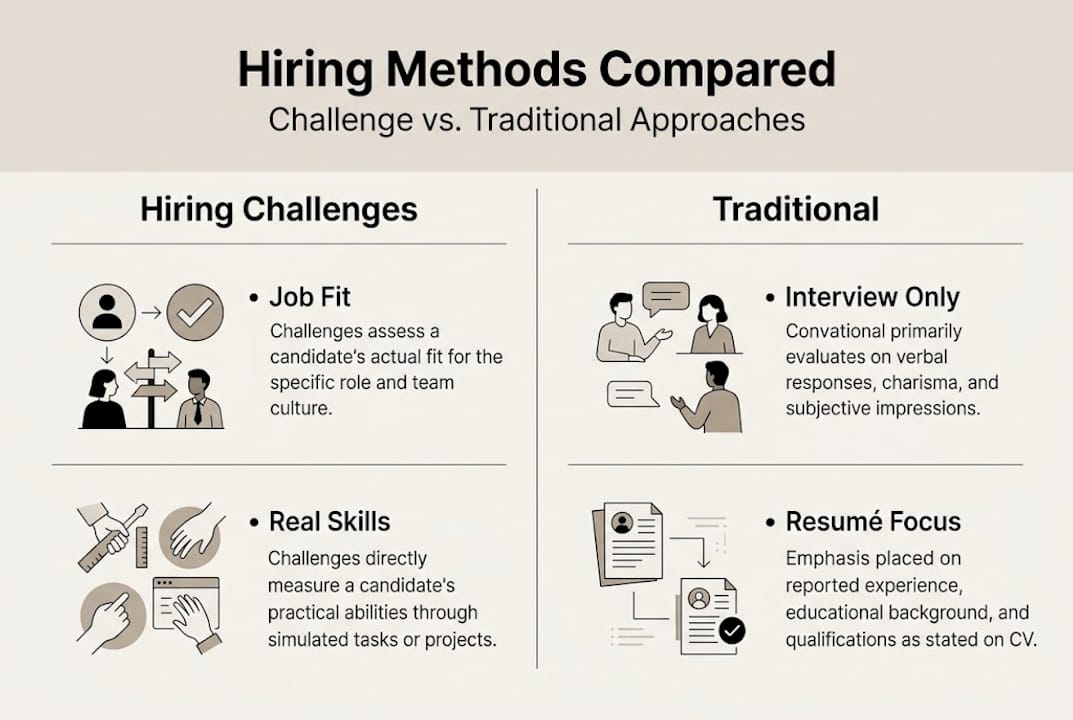
So how do hiring challenges stack up against traditional methods? The evidence is encouraging. Assessments outperform unstructured interviews in predicting job performance, with validity scores of r=0.54 versus 0.38. That’s a meaningful difference when you’re making decisions that affect your team and your business.
| Factor | Hiring challenges | Traditional assessments |
|---|---|---|
| Predicts job performance | High | Moderate |
| Reduces credential bias | Yes | Often no |
| Candidate engagement | High | Variable |
| Time investment | Moderate | Low to moderate |
| Fairness and structure | High (if designed well) | Variable |
Compared to structured interviews in hiring, hiring challenges add a layer of real-world evidence that interviews alone simply cannot provide. Together, they create a much stronger picture of who a candidate truly is.

When and why to use hiring challenges
Hiring challenges are not a one-size-fits-all solution, and that’s perfectly fine. Knowing when to deploy them makes all the difference.
They work brilliantly for technical roles, creative positions, and any job where problem-solving is central. If you’re hiring a software engineer, a content strategist, or a product manager, a well-designed challenge will tell you far more than a polished CV ever could. They’re also excellent for roles where cultural contribution matters, because you can observe how someone thinks and collaborates, not just what they claim to value.
Why bother? Because skills are teachable but behaviour is far harder to shift, and hiring challenges surface both. They reduce over-reliance on credentials, which is especially valuable when you’re trying to build a more diverse team.
That said, there are real pitfalls to watch out for:
- Making the challenge too long or complex, which drives away strong candidates.
- Leaving tasks unstructured, which introduces evaluator bias.
- Failing to give candidates feedback, which damages your employer brand.
- Using challenges for roles where practical tasks aren’t relevant.
- Neglecting to pilot the challenge internally before rolling it out.
In high-volume hiring, short situational judgement tests or screening tasks work well, but lengthy or unstructured processes risk significant candidate drop-off. Keep that in mind as you design.
Pro Tip: Use blind scoring and assign multiple raters to each challenge submission. This simple step dramatically reduces unconscious bias and makes your process far more defensible.
| Sector | Typical completion rate | Drop-off risk | Effectiveness |
|---|---|---|---|
| Technology | 78% | Low to moderate | Very high |
| Marketing and creative | 72% | Moderate | High |
| Finance and operations | 65% | Moderate to high | Moderate to high |
| Retail and hospitality | 58% | High | Moderate |
For teams looking to move faster without sacrificing quality, faster hiring through AI assessments is well worth exploring.
Balancing skills, behaviour and cultural fit
This is where things get genuinely interesting. Skills can be tested and, in many cases, taught on the job. But behaviour, motivation, and values? Those are much harder to develop after someone joins. Hiring challenges give you a rare window into all three at once.
Here’s what a well-designed challenge can reveal about a candidate beyond their technical ability:
- How they handle ambiguity: Do they ask clarifying questions or make assumptions?
- Their communication style: Is their output clear, concise, and audience-aware?
- Resilience and creativity: Do they find novel solutions or default to the obvious?
- Collaboration signals: Even in solo tasks, you can see whether someone considers wider context.
- Motivation and effort: The quality of their submission often reflects genuine interest in the role.
Now, here’s a nuance that matters enormously. There’s a real difference between hiring for culture fit and hiring for culture add. Culture fit, in its traditional sense, can lead to homogeneity and bias. Traditional culture fit risks reinforcing existing patterns and reducing diversity, which is the opposite of what most forward-thinking organisations want.
Culture add, by contrast, asks: what does this person bring that we don’t already have? Hiring challenges are a brilliant vehicle for this, because they reveal how someone thinks rather than whether they look like your current team.
“The most innovative teams aren’t built by hiring people who think the same way. They’re built by hiring people who think well, in different ways.” This is the spirit behind the culture add approach gaining traction in fast-growing organisations.
For HR teams in the Netherlands, the UK, and Spain, this matters even more. Skill shortages across all three markets mean you simply cannot afford to filter out capable people on the basis of superficial fit. Innovative hiring solutions including international talent pools and employer-of-record arrangements are helping organisations widen their reach and build genuinely diverse, high-performing teams.
Designing and implementing effective hiring challenges
A brilliant idea poorly executed is still a poor outcome. Here’s how to build hiring challenges that actually work.
Step-by-step framework:
- Start with a thorough job analysis. Identify the two or three core competencies the role demands. Your challenge should test these directly.
- Select the right challenge type. Match the format to the role. A technical task suits an engineer; a strategic brief suits a marketing lead.
- Pilot it internally. Have current team members complete the challenge and time themselves. This surfaces unclear instructions and unrealistic expectations.
- Validate and refine. Pilot and validate assessments with a target of over 85% completion rates and strong inter-rater reliability before going live.
- Track outcomes over time. Compare challenge scores to six-month performance reviews. This tells you whether your challenge is actually predicting success.
For regional nuances: candidates in the Netherlands tend to value transparency and direct feedback. UK candidates often appreciate context and clear role relevance. Spanish candidates respond well to challenges that feel professionally respectful and not overly demanding of unpaid time.
Pro Tip: Keep every challenge under 60 minutes. Longer assessments correlate with higher drop-off rates, particularly among passive candidates who are already employed. Shorter, sharper challenges also signal that you respect candidates’ time.
Blind scoring is strongly recommended at this stage. Remove names, contact details, and any identifying information before distributing submissions to raters. You can see how AI interview examples are making this process more consistent and scalable. The future of AI in recruitment points firmly towards smarter, fairer, and faster assessment at every stage.
A hard look: what most HR teams miss about hiring challenges
We’ve seen a lot of enthusiasm for hiring challenges, and we’re genuinely excited about their potential. But we’d be doing you a disservice if we didn’t share some honest observations.
The biggest mistake we see is over-reliance. Teams fall in love with their challenge design and stop questioning it. Markets change, candidate expectations shift, and a challenge that worked brilliantly in 2024 might feel outdated or off-putting in 2026. Iterative improvement is not optional. Collect candidate feedback after every hiring round and actually use it.
Fairness across borders is another underappreciated challenge. What feels like a reasonable task in Amsterdam might feel invasive or disrespectful in Madrid. Cultural expectations around unpaid work, time investment, and assessment formality differ meaningfully across the Netherlands, the UK, and Spain. One size genuinely does not fit all.
Finally, AI enhances assessment significantly, but caution is needed around data privacy and the risk of gaming, particularly in technical and engineering roles. Use AI recruitment tools thoughtfully, with human oversight built in. The goal is better decisions, not faster automation.
Elevate your hiring with innovative solutions
If you’re ready to move beyond CVs and gut-feel interviews, we’re over the moon to help. Hiring challenges, when designed well and supported by the right tools, genuinely transform recruitment outcomes.
At WAOTM, we’ve built an AI candidate validation platform that brings together AI interviews, company challenges, cognitive tests, cultural matching, and video pitches in one place. You get richer candidate insight, faster decisions, and a fairer process for everyone involved. Want to see how it works in practice? Explore our approach and discover how we’re helping HR teams across the Netherlands, the UK, and Spain hire with confidence.
Frequently asked questions
How long should a hiring challenge take?
Effective hiring challenges should last under 60 minutes. Drop-off rates increase significantly when challenges exceed this threshold, particularly among strong candidates who are already in employment.
Are hiring challenges suitable for all roles?
They work best for roles where practical skills and problem-solving are central, such as technical, creative, or analytical positions. They are less effective for highly routine or very senior executive roles.
How do I minimise bias in hiring challenges?
Use structured tasks with clear criteria, apply blind scoring and multiple assessors, and remove identifying information before evaluation. This makes outcomes more consistent and defensible.
Should we pay candidates for challenge completion?
For substantial challenges, yes. Paid trial days are an increasingly respected practice that signals fairness and attracts a broader, more diverse pool of applicants.