Guide to fair recruitment: Build unbiased, inclusive hiring

TL;DR:
- Fair recruitment varies across countries, requiring structured processes, technology use, and a genuine commitment to fairness.
- Key principles include transparency, documentation, and job-relevant criteria, with legal frameworks guiding practice in each market.
Fair recruitment looks different depending on which country you are hiring in. The Netherlands mandates transparent procedures and bans salary history questions under the NVP Sollicitatiecode, the UK’s Equality Act 2010 covers nine protected characteristics, and Spain operates under its own evolving equality frameworks. For HR leaders and talent acquisition specialists operating across these markets, true fairness goes far beyond ticking compliance boxes. It demands structured processes, thoughtful use of technology, and a genuine commitment to giving every candidate a real chance.
Table of Contents
- Understanding fair recruitment: Legal frameworks and key principles
- Designing transparent and unbiased recruitment processes
- Leveraging AI and automation responsibly in fair recruitment
- Innovative and emerging fair recruitment practices across Europe
- A fresh perspective: Fair recruitment is a continuous journey, not a checklist
- Accelerate your fair recruitment transformation with expert tools
- Frequently asked questions
Key Takeaways
| Point | Details |
|---|---|
| Know your legal baseline | Understand country-specific requirements and anti-discrimination laws to build compliant and fair recruitment processes. |
| Structure beats subjectivity | Design processes that reduce bias with structured criteria, interviews, and transparent assessments. |
| Innovate to include | Embrace new methods like Open Hiring and skills-first recruitment to increase fairness and diversity. |
| Use technology wisely | Deploy AI and automation with transparency and human oversight to avoid introducing new biases. |
Understanding fair recruitment: Legal frameworks and key principles
Now that we have set the stage, let us explore the legal and operational foundations for fair recruitment across key European markets.
Fair recruitment is grounded in legislation, but the laws are not identical across borders. Understanding the differences helps you build processes that hold up everywhere you hire.
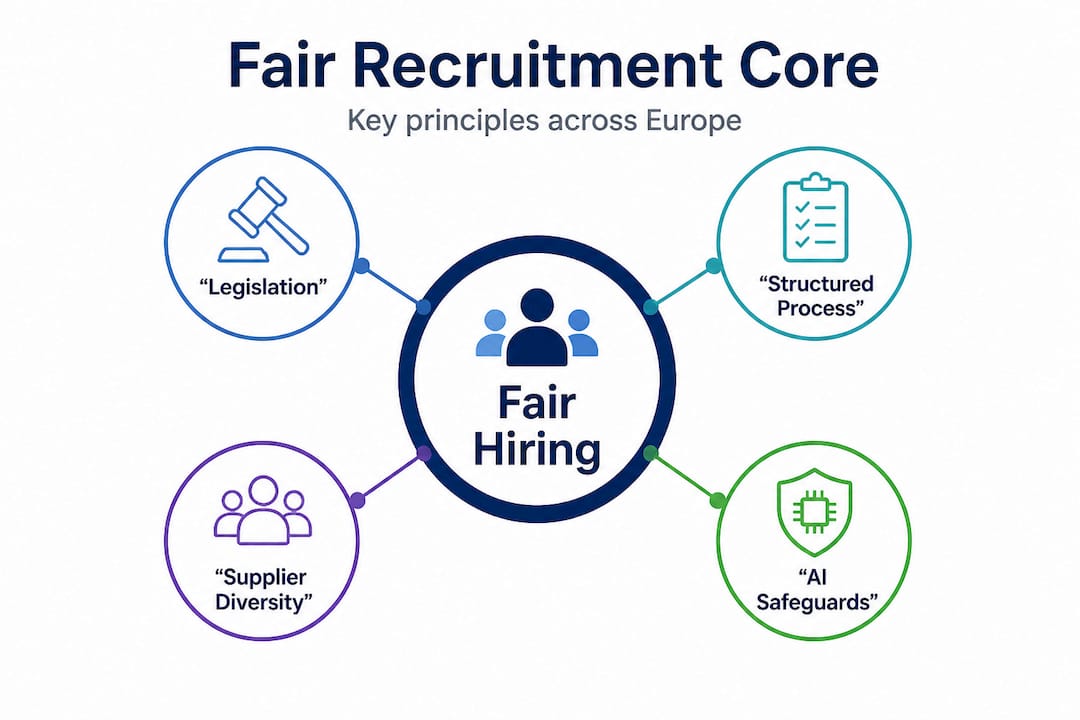
The UK Equality Act 2010 prohibits discrimination based on nine protected characteristics: age, disability, gender reassignment, marriage and civil partnership, pregnancy and maternity, race, religion or belief, sex, and sexual orientation. Structured hiring processes are strongly recommended to reduce the risk of unintentional bias at every stage. In the Netherlands, the NVP Sollicitatiecode is a refreshed code of conduct that requires employers to use only relevant candidate information, prohibits salary history questions, and now includes specific guidance on AI compliance. Spain aligns broadly with EU anti-discrimination directives, emphasising equal treatment and active equality plans for larger organisations.
Here is a snapshot of how key fair recruitment features compare across the three markets:
| Feature | Netherlands | UK | Spain |
|---|---|---|---|
| Salary history questions | Banned | Not explicitly banned | Discouraged |
| Anonymous hiring | Encouraged | Encouraged | Growing adoption |
| AI oversight requirement | Yes (NVP Sollicitatiecode) | Yes (ICO guidance) | EU AI Act applies |
| Protected characteristics covered | AWGB covers race, religion, sex, etc. | 9 characteristics (Equality Act) | Broadly aligned with EU Directive |
| Structured interview guidance | Strongly recommended | Strongly recommended | Recommended |
The core principles underpinning all three systems are remarkably consistent: be transparent, document your decisions, and base selection purely on job-relevant criteria. Where organisations go wrong is treating these frameworks as checklists rather than living practices.
Key principles every fair recruitment process should embed:
- Define selection criteria before posting the role, not during shortlisting
- Share the process openly with candidates at every stage
- Use the same scoring approach for all applicants to the same role
- Document reasons for each decision, whether to progress or not
- Review job adverts for language that could deter certain groups
Using structured interviews for fair hiring is one of the most reliable ways to bring consistency into your process and ensure that every candidate is evaluated on the same basis. We think that is genuinely exciting, because structure creates equal opportunity, and equal opportunity creates better hires.
Designing transparent and unbiased recruitment processes
Having laid out the legal requirements, the next step is to translate those principles into structured and transparent hiring practices.
Building an unbiased process is less about perfection and more about intention and system design. Dutch anti-discrimination laws, including the AWGB and WGB, prohibit both direct and indirect discrimination in job advertisements and candidate selection. Indirect discrimination is particularly tricky. It occurs when a neutral policy or practice puts people with a protected characteristic at a disadvantage. Anonymous hiring is one practical response to this challenge, and Dutch employers are actively encouraged to consider it.
Here is a practical framework for designing a fairer process from scratch:
- Write an inclusive job advert. Use gender-neutral language, focus on outcomes rather than qualifications, and remove requirements that are not genuinely necessary. Tools like augmented writing software can flag exclusionary language before you publish.
- Set objective criteria before applications open. Agree with your hiring panel on exactly what competencies, skills, and behaviours the role requires. Write these down and score against them.
- Implement blind CV reviews. Remove names, addresses, universities, and graduation years from applications before shortlisting. This reduces affinity bias and name-based discrimination significantly.
- Use standardised application forms. Rather than relying on free-format CVs, ask all candidates the same structured questions. This levels the playing field from the very first step.
- Brief your hiring panel. Share the criteria, scoring rubrics, and an overview of common cognitive biases before any interview or review session. A short briefing can dramatically reduce in-the-moment snap judgements.
- Document every decision with a rationale. If a candidate is not progressed, note the specific, job-related reason. This protects your organisation and builds a culture of accountability.
“The best recruitment processes are not the ones with the most steps. They are the ones where every step has a clear purpose, and every candidate knows what to expect.”
Pro Tip: Introduce a diverse shortlisting panel for senior roles. Having multiple perspectives during shortlisting catches blind spots that a single reviewer would miss, and it strengthens the quality of your candidate pool, not just the fairness of it.
Supplier diversity is another area worth considering. If you use recruitment agencies, ask them for evidence of their own fair hiring practices. An agency that defaults to homogeneous candidate pools will undermine your internal diversity efforts before a single interview happens. Transparency with candidates about your supplier relationships also builds trust and signals that you take fairness seriously at every level of the process.
Using structured interviews across every hiring panel consistently reduces both unconscious bias and interviewer variability. When everyone asks the same questions and scores against the same rubric, the data you collect is genuinely comparable, making it far easier to defend your decisions and identify the strongest candidate on merit.
Leveraging AI and automation responsibly in fair recruitment
With structured processes in place, many organisations turn to technology for efficiency. Here is how to ensure AI advances, rather than hinders, fairness.
AI tools can be transformative when used thoughtfully. Skills-based shortlisting, AI-powered video interviews, and automated scheduling reduce time spent on administrative tasks and can actively reduce human bias in early screening. However, the technology is only as fair as the data and design behind it.

The UK’s Information Commissioner’s Office (ICO) has published specific guidance on automated decision-making (ADM) in recruitment. It states that organisations must carry out Data Protection Impact Assessments (DPIAs) before deploying AI tools that influence hiring decisions, and that human oversight must be built into the process. This is not optional. It is a legal requirement under UK GDPR.
Key considerations when introducing AI into your hiring process:
- Conduct a DPIA before deployment. Assess what data the tool uses, what decisions it influences, and what risks it creates for candidates.
- Audit for bias regularly. Request bias audit reports from your AI tool providers. Ask specifically whether the tool has been tested across different demographic groups.
- Never let AI be the final decision-maker. A human must review and approve every shortlist or rejection that an AI tool generates.
- Communicate transparently with candidates. Tell applicants if AI is used in your process and give them the opportunity to request a human review.
- Document the algorithm’s logic. You should be able to explain, in plain language, why your AI tool ranked or rejected a candidate.
Here is a quick reference for responsible AI use at different hiring stages:
| Hiring stage | AI application | Human oversight needed |
|---|---|---|
| Job advert creation | Language bias detection | Yes, final approval |
| Application screening | Skills-based shortlisting | Yes, shortlist review |
| Candidate assessment | AI interviews, cognitive tests | Yes, score review and decision |
| Reference and background checks | Automated verification | Yes, flagged items reviewed |
Understanding how AI reduces bias in recruitment helps HR leaders separate genuine innovation from hype. And learning about the broader role of AI in agency recruitment gives useful context for how the technology is being adopted across the industry.
Pro Tip: Build an AI audit trail from day one. Store records of which AI tool was used, what version, when, and what decisions it influenced. If a candidate ever challenges a hiring decision, this documentation is invaluable and it demonstrates your commitment to accountability.
The exciting reality is that well-designed AI tools genuinely level the playing field for candidates who might otherwise be overlooked. A first-generation university student with no network connections has the same shot as a well-connected candidate when skills and performance are what get measured.
Innovative and emerging fair recruitment practices across Europe
Beyond well-established frameworks, real-world innovation is shifting the goalposts of fairness. Here are the approaches leading the way.
The Netherlands has become something of a laboratory for bold fair hiring experiments. Open Hiring is perhaps the most striking example. Pioneered by companies like Buurtzorg and the Toilet Paper Factory (De Wc Eend), Open Hiring removes CVs, interviews, and background checks entirely for certain roles. The first person who meets basic requirements gets the job. Full stop. It is designed to give vulnerable groups, including people with gaps in employment history, those with disabilities, and those affected by long-term unemployment, faster and more dignified access to work.
A SHRM survey of 1,268 HR professionals found that skills-first recruitment, championed by practitioners known as Talent Architects, leads to measurably better hiring outcomes, including higher retention and improved team performance. Skills-first means assessing what candidates can actually do rather than where they studied or who they worked for previously. It is a mindset shift as much as a process change.
Dutch universities have trialled a four-step D&I (diversity and inclusion) pilot framework for academic hiring that is worth examining as a model for other sectors:
- Anonymous first-round review. All applications are stripped of identifying information before the initial academic committee review.
- Structured competency panels. Interview panels are trained and use identical question sets for all candidates.
- Proactive diverse sourcing. Vacancies are actively shared through networks that reach underrepresented groups before broader publication.
- Post-hire outcome tracking. Data on the diversity of hired candidates is collected and fed back into the next hiring cycle to identify persistent gaps.
“Fairness in recruitment is not something you achieve once. It is something you practise, measure, and improve continuously.”
Practical steps for piloting an innovative fair hiring method in your organisation:
- Choose one role or department to pilot the new approach, rather than rolling out organisation-wide from the start.
- Set clear baseline metrics before the pilot, including diversity of applicants, time to hire, and candidate satisfaction scores.
- Brief your hiring team on the rationale and give them space to raise concerns or questions before the pilot begins.
- Run the pilot for a defined period, ideally covering at least five to ten hires to generate meaningful data.
- Review outcomes against your baseline, gather feedback from candidates and hiring managers, and decide whether to scale, adjust, or try a different approach.
A fresh perspective: Fair recruitment is a continuous journey, not a checklist
We want to be honest with you about something. The majority of fair recruitment guides end with a tidy list of actions and the implication that once you have completed them, the job is done. We do not believe that.
No process is ever fully fair. Every hiring system reflects the assumptions, blind spots, and priorities of the people who designed it. What felt progressive three years ago may already be outdated. Society changes. Technology changes. Your workforce changes. Your recruitment process has to change with it.
The most effective HR leaders we work with do two things consistently. First, they gather feedback from candidates at every stage, including those who were unsuccessful. Rejected candidates often have the sharpest insights into where your process felt opaque, inconsistent, or unfair. That feedback is gold. Second, they schedule biannual audits of hiring outcomes. Not just diversity statistics, but patterns in who gets to interview, who gets offers, and who accepts them. Patterns reveal systemic issues that individual decisions hide.
Pro Tip: Schedule biannual audits of your hiring outcomes and candidate feedback. Compare data across roles, departments, and hiring managers. Look for patterns in progression rates by demographic group. The data will tell you where to focus your energy next.
Staying curious about the future of AI-driven recruitment is part of this mindset. New tools and new research emerge constantly, and the organisations that stay ahead are the ones that treat fair hiring as an ongoing learning project, not a one-time implementation.
We genuinely believe that fair recruitment produces better businesses. Diverse teams make better decisions, innovate more effectively, and represent their customers more authentically. The fairness agenda is not a cost centre. It is a competitive advantage.
Accelerate your fair recruitment transformation with expert tools
If you are energised by what you have read here and ready to move from theory to practice, we are over the moon to help you get there.
At WAOTM, we have built a platform that replaces CV screening with real-world assessments, including AI-powered interviews, company challenges, cultural matching, cognitive tests, and video pitches. Every tool is designed with fairness at its core, giving candidates the chance to show what they can genuinely do rather than who they happen to know. Our skills-first recruitment platform is used by HR teams across the Netherlands, UK, and Spain to build hiring processes that are both fair and remarkably effective. You can learn more about our team and mission or explore AI-powered candidate validation to see how the technology works in practice.
Frequently asked questions
What is the NVP Sollicitatiecode and why is it important?
The NVP Sollicitatiecode sets out mandatory fair recruitment practices in the Netherlands, covering transparency, a ban on salary history questions, and AI compliance requirements. It is important because it creates a binding standard that goes beyond general anti-discrimination law.
How can structured interviews improve fairness in recruitment?
Structured interviews ensure every candidate is asked the same questions and scored against the same criteria, which significantly reduces unconscious bias and interviewer variability. They also make it much easier to justify hiring decisions if they are ever challenged.
Are AI-driven hiring tools allowed under European recruitment law?
AI tools in hiring are permitted, but they must be used with robust safeguards. In the UK, the ICO requires organisations to conduct DPIAs and maintain human oversight for any automated decision-making that affects candidates.
What is Open Hiring and where is it used?
Open Hiring is a recruitment model that removes CVs and interviews entirely, offering positions to the first eligible applicant who applies. It is particularly popular in the Netherlands as a way to give vulnerable groups faster and more dignified access to employment.