Future of pre-employment testing: 2026 trends

TL;DR:
- AI-powered assessments and immersive methods are transforming pre-employment testing with greater nuance and engagement.
- The EU AI Act enforces strict compliance, requiring transparency, human oversight, and bias audits by 2026.
- Combining innovative testing with robust oversight and fair practices builds future-proof, compliant recruitment processes.
Pre-employment testing has long been seen as a reliable, objective way to find the right person for the job. But that assumption is being challenged fast. New AI tools, immersive assessment formats, and sweeping EU regulation are reshaping what fair, effective hiring actually looks like. 2026 is a pivotal year, with the EU AI Act introducing binding compliance requirements for firms across Europe. Whether you are excited about the possibilities or uncertain about the risks, this guide will walk you through the key trends, the compliance essentials, and the practical steps that will keep your recruitment ahead of the curve.
Table of Contents
- What is driving the future of pre-employment testing?
- Innovative testing methods: Gamification, VR, and behavioural AI
- Compliance in 2026: Navigating the EU AI Act and privacy rules
- Challenges and risks: Cheating, bias, and practical solutions
- Why embracing human oversight is the crucial advantage most miss
- Future-proof your recruitment with advanced, compliant testing
- Frequently asked questions
Key Takeaways
| Point | Details |
|---|---|
| AI and regulation reshape hiring | Innovative platforms and strict EU rules will define recruitment best practices from 2026 onward. |
| Gamified tests boost effectiveness | Cutting-edge tools like gamified and VR assessments improve engagement and reduce hiring time. |
| Compliance is mandatory | Human oversight, bias audits, and transparency are legally required for all high-risk assessments. |
| Active risk management needed | Proactive measures reduce cheating and compliance breaches, protecting your organisation. |
What is driving the future of pre-employment testing?
The landscape of pre-employment testing is shifting because of two powerful forces pulling in the same direction: technology and regulation. And right now, they are pulling harder than ever.
On the technology side, AI-driven assessment tools are making it possible to evaluate candidates at scale, with far greater nuance than a traditional multiple-choice test allows. On the regulatory side, the EU AI Act is raising the bar for what responsible use of those tools looks like. Both forces together are creating a genuinely exciting, if occasionally nerve-wracking, moment for HR leaders across Europe.
The EU AI Act becomes enforceable in August 2026 for high-risk AI systems. Crucially, AI-driven assessments including CV screening, candidate ranking, and interview analysis are considered high-risk under this legislation. That places a significant portion of modern recruitment technology directly in the regulatory spotlight.
At the same time, candidate expectations are evolving rapidly. Job seekers in 2026 expect digital, engaging, and transparent processes. A clunky, paper-style assessment is not just outdated; it actively puts off strong candidates. Employers who offer AI in recruitment in 2026 that feels meaningful and engaging gain a real edge in competitive talent markets.
Here is a quick summary of the main forces reshaping pre-employment testing right now:
- Technology acceleration: AI tools can assess cognitive ability, personality, and situational judgement far more accurately and efficiently than legacy tests.
- Regulatory pressure: The EU AI Act introduces mandatory transparency, human oversight, and bias auditing for high-risk AI tools used in hiring.
- Candidate experience: Digital-native applicants expect dynamic, interactive assessments that respect their time and reflect a company’s values.
- Market competition: Firms that adopt innovative, compliant testing methods attract more candidates and make better hiring decisions.
“The EU AI Act does not ban AI in hiring. It simply demands that you use it responsibly, with rigorous oversight and genuine transparency. That is a good thing for everyone.”
Understanding these forces is the foundation for everything that follows. Let’s explore what the most innovative organisations are actually doing.
Innovative testing methods: Gamification, VR, and behavioural AI
With the driving forces identified, let’s explore the most impactful and innovative testing methods now available to HR teams in Europe.
Gamified assessments are arguably the most talked-about innovation in recruitment right now, and for good reason. Rather than asking candidates to rate their own skills on a scale of one to five, gamified scenarios put them in realistic situations and observe how they actually behave. This approach is far better at revealing soft skills like teamwork, adaptability, and creative problem-solving. It is also, frankly, more enjoyable for candidates.

Virtual reality (VR) takes this a step further. VR environments simulate real workplace scenarios, from managing a difficult customer interaction to navigating a fast-paced operational challenge. Candidates respond to what they experience rather than what they imagine, giving you far richer data. Gamified assessments and VR scenarios increase candidate engagement by up to 40% and greatly reduce time-to-hire.
Behavioural AI adds another dimension entirely. Rather than simply scoring answers, AI systems analyse how candidates respond: their pacing, their confidence signals, their reasoning patterns. This kind of analysis, seen in examples of AI interviews, reveals things a standard test simply cannot.
One well-known real-world example is Unilever, who reduced their time-to-hire from four months to just four weeks after introducing AI-powered assessment tools. That is a transformational result, and it demonstrates what is possible when innovative methods are implemented thoughtfully.
| Assessment method | Key benefit | Engagement boost |
|---|---|---|
| Gamified scenarios | Reveals real behaviour, not self-reporting | Up to 40% higher |
| VR simulations | Authentic situational responses | High immersion |
| Behavioural AI analysis | Deeper insight beyond answers | Consistent objectivity |
| Video pitches | Showcases communication and personality | Faster shortlisting |
Pro Tip: Before rolling out gamified or VR assessments organisation-wide, pilot them with a small cohort of internal volunteers first. This helps you identify technical issues, refine scoring criteria, and gather honest feedback before candidates experience them.
Compliance in 2026: Navigating the EU AI Act and privacy rules
While these innovations excite, they also bring urgent compliance duties all European HR leaders must understand.
The EU AI Act classifies certain AI tools under what it calls Annex III, Area 4, which covers AI systems used in employment, worker management, and access to self-employment. Any AI tool you use for pre-employment screening, scoring, or ranking falls squarely into this category. The implications are immediate and significant.
Failure to comply is genuinely costly. AI-driven assessment tools require human oversight, bias testing, and candidate transparency under EU law, and non-compliance risks a fine up to 7% of global turnover. For a mid-to-large European employer, that figure alone justifies urgent action.
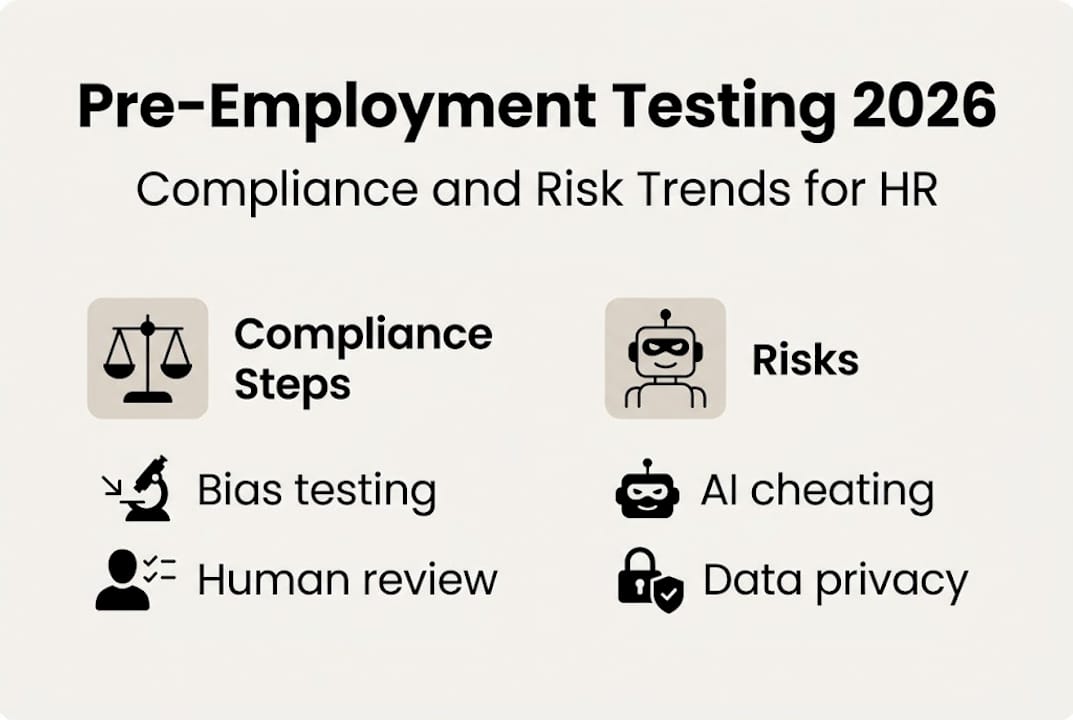
It is also worth understanding why many hiring tools are high-risk under the Act. Automated rejection, for instance, is one of the most commonly missed compliance pitfalls. If your system can eliminate a candidate without a human ever reviewing that decision, you are likely in breach.
Here is a comparison of what compliance looked like before 2026 versus what is required now:
| Compliance area | Pre-2026 standard | 2026 requirement |
|---|---|---|
| Human oversight | Recommended | Mandatory for high-risk AI |
| Bias auditing | Optional | Required, documented |
| Candidate notification | Best practice | Legal obligation |
| Vendor accountability | Informal | Contractual and auditable |
To get your team on solid footing, here is a practical compliance checklist:
- Identify every AI-powered tool in your recruitment process.
- Classify each tool against Annex III, Area 4 criteria.
- Establish documented human review checkpoints for all AI-assisted decisions.
- Commission bias audits of your assessment algorithms.
- Update candidate communications to explain AI use and their right to a human review.
- Review vendor contracts to confirm audit transparency and compliance support.
Pro Tip: When evaluating new vendors, ask them directly for their EU AI Act compliance documentation. A vendor who cannot clearly explain their audit trail and human oversight protocols is a vendor worth avoiding. Understanding AI’s role in recruitment success also helps you ask the right questions about how tools are designed to reduce rather than amplify bias. Firms that are already working to ensure AI reduces hiring bias are naturally better placed for compliance.
Challenges and risks: Cheating, bias, and practical solutions
Compliance alone is not enough. Leading teams also prepare for and mitigate the practical threats that come with digital assessment.
One of the most pressing concerns is AI-assisted cheating. Candidates can now use generative AI tools to produce polished, seemingly impressive responses to written or verbal assessments in real time. This is not a hypothetical risk; it is happening. The good news is that AI cheating via generative tools can be mitigated by benchmarking and behavioural simulation, which makes it much harder to fake genuine competence.
Beyond cheating, bias remains a persistent challenge. Even well-designed AI systems can inadvertently favour certain demographic groups if trained on historically skewed data. Regular audits are essential, not just for compliance but for fairness. The benefits of AI assessments are only realised when the tools are genuinely fair, and understanding the pros and cons of AI hiring gives your team a clearer picture of where to focus attention.
Here are the practical steps we recommend:
- Use behavioural simulations that require candidates to demonstrate skills in context, not just describe them.
- Implement liveness checks to confirm the person completing the assessment is the actual applicant.
- Set individualised benchmarks based on role-specific success data rather than generic population norms.
- Schedule regular algorithmic audits at least twice a year to catch and correct emerging bias.
- Build human checkpoints into every stage where AI makes or influences a decision.
- Update HR policies annually to account for the evolving regulatory and technological landscape.
“The organisations that thrive in AI-driven recruitment are not those with the most advanced tools. They are the ones with the most robust processes for reviewing what those tools actually do.”
Future-proofing your recruitment is less about selecting the perfect technology today and more about building the organisational muscle to adapt as the landscape continues to evolve.
Why embracing human oversight is the crucial advantage most miss
Here is something worth sitting with. Most conversations about AI in recruitment focus on what the technology can do. Fewer focus on what happens when HR teams trust it too much.
We have seen organisations invest in sophisticated assessment platforms, tick the compliance boxes, and still end up with poor hiring outcomes. Why? Because AI transforming candidate screening works brilliantly as a filter, but it cannot replace the informed, experienced judgement of a skilled recruiter who understands the role, the team, and the culture.
The uncomfortable truth is this: vendor promises about fairness and accuracy are not the same as actual fairness and accuracy. Tools need to be tested, questioned, and continually reviewed against real-world outcomes. HR leaders who treat their AI tools as partners rather than oracles are the ones building truly future-ready recruitment functions. Continuous training of your team, combined with rigorous oversight, is what keeps both the tools effective and the process lawful. That combination is the genuine competitive advantage, and it does not come in a software licence.
Future-proof your recruitment with advanced, compliant testing
Having understood both the technological and regulatory landscape, here is how you can stay ahead and make practical improvements starting today.
We are over the moon about what modern, compliant pre-employment testing can do for your hiring. At We Are Over The Moon, we believe the best recruitment replaces guesswork with genuine evidence. That means swapping CV screening for real assessments: AI interviews, company challenges, cultural matching, cognitive tests, and video pitches that reveal who candidates truly are.
Our skills-based matching solutions are built with compliance and fairness at their core, so you can innovate confidently without losing sleep over the EU AI Act. If you want to see what compliant, engaging, forward-thinking assessment looks like in practice, we would love to show you. Visit our team’s approach and request a demo today. Let’s build something brilliant together.
Frequently asked questions
What makes pre-employment testing high-risk under the EU AI Act?
Any AI-driven tool that influences CV screening, scoring, ranking, or interviews is considered high-risk if used for employment decisions, and must have documented human oversight by law.
How can we reduce AI cheating in digital assessments?
Use behavioural simulations, individualised success benchmarks, and liveness checks. Benchmarking and behavioural simulations make it significantly harder for candidates to generate convincing but inauthentic AI-assisted responses.
Are gamified or VR assessments really more effective than traditional tests?
Gamified and VR assessments boost candidate engagement by up to 40% and significantly reduce time-to-hire, as demonstrated in real-world organisational trials.
What new compliance steps must be followed by August 2026?
You must ensure human review at every AI-influenced decision point, commission bias testing, and provide transparent candidate notifications explaining how AI is used in your assessment process.
What is the penalty for failing EU AI Act compliance in recruitment?
Firms may face fines up to 7% of global annual turnover for major breaches, making compliance not just a legal obligation but a significant financial priority.