Candidate suitability score explained: improve hiring accuracy

Choosing between candidates who look nearly identical on paper can feel like guesswork. Many HR teams struggle to objectively compare applicants when qualifications, experience, and even interview performance seem evenly matched. Candidate suitability scores offer a structured, data-driven way to evaluate fit for a role, bringing clarity where intuition falls short. This guide will explain what the score represents, how it works, and how you can use it to hire with more confidence.
Table of Contents
- What is candidate suitability score?
- How are suitability scores calculated?
- Benefits of using candidate suitability scores
- Nuances, risks, and best practices
- Tips for using suitability scores effectively
- Upgrade your hiring with smarter assessment tools
- Frequently asked questions
Key Takeaways
| Point | Details |
|---|---|
| Definition and scope | Candidate suitability scores measure how well an applicant matches a role across skills, experience, and cultural fit. |
| Scoring methods | Modern HR tools use weighted factors and AI to generate transparent, comparable assessments. |
| Benefits for HR | Suitability scores help teams make faster, more consistent, and less biased hiring decisions. |
| Risks and fairness | Human oversight is essential to avoid the pitfalls of algorithmic bias or data quality issues. |
| Practical application | Scores are a support tool—combine them with structured interviews and local hiring knowledge for best outcomes. |
What is candidate suitability score?
A candidate suitability score is a quantitative metric that summarises how well a candidate matches a job role across multiple dimensions. Rather than relying on gut feeling or subjective impressions, suitability scores combine skills, experience, personality traits, motivation, and cultural fit into a single, comparable number. This brings consistency to your hiring process, saves time, and supports fairer decisions.
Scoring systems typically use scales like 0-100, 0-5 stars, letter grades, or categories such as “highly suitable” and “not recommended.” The exact format varies by platform, but the principle remains the same: translate complex candidate profiles into a clear, actionable metric.
Why does this matter? Because modern hiring demands speed and accuracy. When you’re reviewing dozens or hundreds of applications, a well-designed suitability score helps you focus on the candidates most likely to succeed in the role. It also makes it easier to explain hiring decisions to stakeholders and ensures that every applicant is evaluated against the same criteria.
Here’s a quick comparison of common scoring scales:
| Scale type | Range | Best for |
|---|---|---|
| Percentage | 0-100 | High-volume roles, detailed breakdowns |
| Star rating | 0-5 | Quick visual comparison, shortlisting |
| Letter grade | A-F | Familiar format, stakeholder communication |
| Category | High/Medium/Low | Simple triage, early-stage screening |
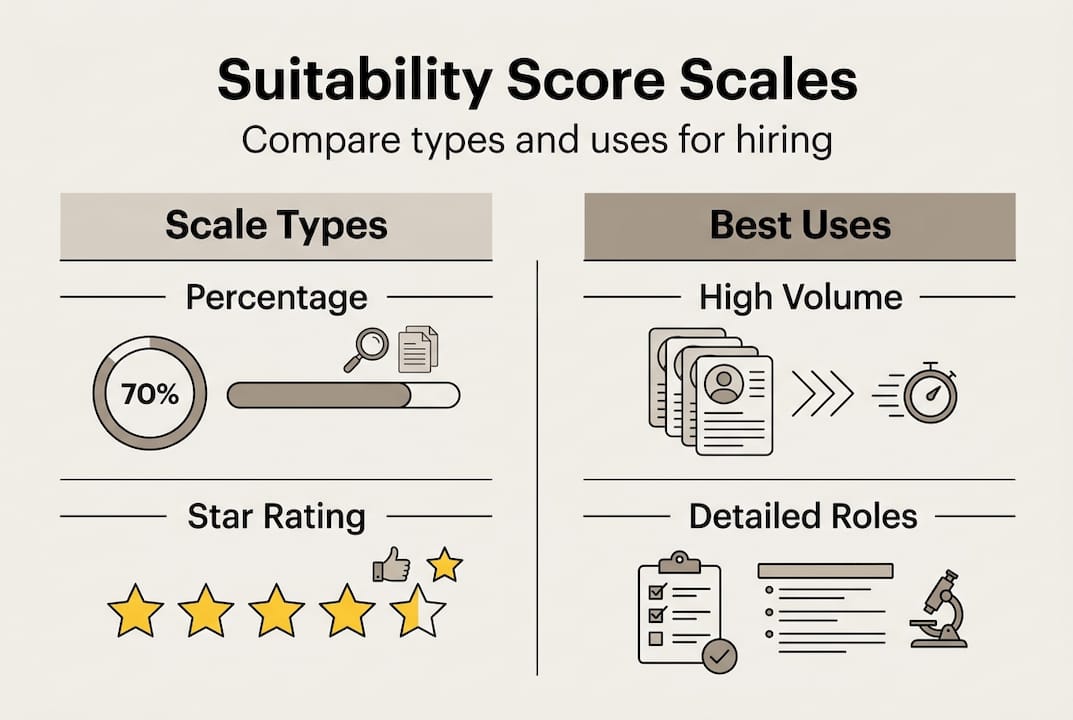
Using assessment tool efficiency means you can process more candidates without sacrificing quality. The score becomes a shared language across your hiring team, reducing misunderstandings and aligning everyone on what “good fit” actually means.
How are suitability scores calculated?
Behind every suitability score is a weighted calculation that combines multiple data points. Modern systems typically prioritise skills match at 40-60% of the total score, with experience and outcomes contributing 20-30%. Cultural fit, personality traits, and motivation make up the remainder. This weighted aggregation ensures that the most job-critical factors carry the most influence.
Here’s how the process works:
- Define job requirements: HR teams or hiring managers specify must-have skills, experience levels, and cultural attributes.
- Collect candidate data: The system pulls information from CVs, assessments, structured interviews, and sometimes portfolio work.
- Apply weights: Each factor is assigned a percentage based on its importance to the role.
- Calculate match: The platform compares candidate data to job requirements, scoring each dimension.
- Generate total score: Weighted scores are summed to produce a final suitability metric.
Advanced platforms use AI in recruitment to go beyond simple keyword matching. Semantic embeddings understand the meaning behind skills and experience, while learning-to-rank models improve accuracy over time. Some systems even analyse AI interview examples to assess communication style and problem-solving ability.
Pro Tip: Always review the weighting formula used by your scoring tool. If your role demands deep technical expertise, ensure skills are weighted heavily. For leadership positions, consider increasing the weight of cultural fit and motivational factors.
Human oversight remains essential, especially for nuanced decisions. Imagine you’re hiring a senior developer. Candidate A scores 88, with exceptional technical skills but limited team leadership experience. Candidate B scores 82, with strong collaboration skills and a track record of mentoring juniors. The score helps you see the trade-off clearly, but you still need to decide which qualities matter most for your team.

AI-driven screening accelerates this process, but the final call should always involve human judgement. Scores are decision support tools, not replacements for thoughtful evaluation.
Benefits of using candidate suitability scores
Suitability scores bring objectivity to a process that’s often dominated by gut feeling. When you’re comparing candidates side by side, a structured metric helps you focus on evidence rather than intuition. This is especially valuable for high-volume or remote roles, where you might never meet candidates face-to-face.
Here are the key advantages:
- Reduced unconscious bias: When protected attributes like age, gender, and ethnicity are redacted, scores improve hiring accuracy by focusing purely on job-relevant factors.
- Faster shortlisting: Instead of reading every CV in detail, you can prioritise top scorers and spend your time on the most promising candidates.
- Better cultural alignment: By factoring in values, motivations, and working style, suitability scores help you identify candidates who’ll thrive in your organisation, not just fill a seat.
- Easier stakeholder communication: Hiring managers and executives appreciate clear, comparable metrics. A score makes it simple to explain why one candidate advanced over another.
- Improved retention: When you hire for fit as well as skills, new employees are more likely to stay and succeed.
Consider this: traditional CV screening focuses heavily on credentials and past job titles. But a candidate with a non-traditional background might bring exactly the problem-solving mindset your team needs. Suitability scores can surface these hidden gems by evaluating skills and potential, not just pedigree.
“Scores improve hiring accuracy and cultural fit by providing objective, explainable rankings, reducing bias when designed with fairness.” — Domain-specific AI research
Using AI and cultural fit tools, you can assess alignment with your company’s values and working style. This goes beyond technical qualifications to predict long-term success. For example, a cultural fit assessment might reveal that a candidate thrives in collaborative environments, making them ideal for a team-based role.
Research shows that cultural matching cuts tech turnover significantly, saving you the cost and disruption of rehiring. When you’re improving candidate matching, suitability scores become a strategic advantage, not just an administrative convenience.
Nuances, risks, and best practices
While suitability scores offer clear benefits, they’re not without risks. Poorly designed systems can amplify bias, over-rely on flawed data, or create a black-box effect where HR teams don’t understand how scores are generated. Here’s what to watch for and how to mitigate these challenges.
Data quality matters: Scores are only as good as the information they’re based on. If your job descriptions are vague or your candidate data is incomplete, the output will be unreliable. Invest time in defining clear, specific requirements for each role.
Black-box risks: Some AI-powered systems don’t explain how they calculate scores. This makes it hard to spot errors or bias. Choose platforms that offer transparency and allow you to review the factors influencing each score.
Social media influence: Negative online presence can disproportionately impact scores, even when it’s not relevant to job performance. Ensure your system focuses on professional qualifications and avoids over-weighting personal social media activity.
Bias mitigation: To achieve fairness, your scoring system must exclude demographic and protected data. Regularly audit outcomes to spot patterns that suggest bias. For example, if candidates from certain backgrounds consistently score lower despite similar qualifications, investigate the weighting and data sources.
Pro Tip: Document every hiring decision, especially when you override the algorithm. This creates an audit trail and helps you refine your scoring model over time.
Here’s a practical checklist for fair, effective suitability scoring:
- Review factor weights: Ensure they align with your company’s priorities and the specific role.
- Exclude protected attributes: Age, gender, ethnicity, and other personal data should never influence scores.
- Audit regularly: Check for patterns that suggest bias or unfair outcomes.
- Combine with interviews: Use scores to shortlist, then conduct structured interviews to validate fit.
- Train your team: Make sure everyone understands how scores are calculated and when to trust or question them.
When you’re screening without CVs, suitability scores become even more important. They provide a consistent baseline for evaluating candidates based on skills and potential, not just credentials. Pairing this with a cultural fit checklist ensures you’re assessing both competence and alignment.
Tips for using suitability scores effectively
Getting the most from suitability scores requires more than just turning on a feature. You need to integrate them thoughtfully into your hiring workflow and calibrate them to your organisation’s unique needs. Here’s how to do it.
Customise weights for each role: A sales position might prioritise communication skills and motivation, while a technical role emphasises hard skills and problem-solving. Adjust your scoring model accordingly.
Calibrate for local context: Hiring in the Netherlands, UK, and Spain means navigating different labour laws, cultural norms, and candidate expectations. Make sure your scoring system reflects these regional differences.
Use scores as a discussion tool: Share candidate scores with hiring managers and use them to structure conversations. Instead of debating vague impressions, you can focus on specific strengths and gaps.
Combine with structured interviews: Scores help you shortlist, but interviews reveal nuances that no algorithm can capture. Use both to make well-rounded decisions.
Track outcomes: Monitor whether high-scoring candidates actually succeed in their roles. If not, revisit your weighting and data sources.
Research shows that domain-specific models outperform general LLMs, achieving AUC scores of 0.85 compared to 0.77 for generic systems. This means investing in purpose-built recruitment tools pays off in accuracy and fairness.
When you’re improving candidate matching, remember that suitability scores are a means to an end, not the end itself. They help you identify promising candidates faster, but the final decision should always involve human insight and context.
Upgrade your hiring with smarter assessment tools
Ready to move beyond gut feeling and CV screening? Modern assessment platforms combine suitability scoring with AI interviews, skills challenges, and cultural matching to give you a complete picture of each candidate. Instead of guessing who’ll succeed, you’ll have data-driven insights that support fairer, faster hiring.
Discover how domain-specific solutions address challenges unique to your region, whether you’re hiring in the Netherlands, UK, or Spain. Our skills-based matching platform replaces traditional CV screening with real assessments, helping you identify top talent based on what they can do, not just what they’ve done. Explore AI candidate validation tools that bring clarity and confidence to every hiring decision.
Frequently asked questions
How does candidate suitability scoring improve cultural fit?
Suitability scoring combines job-related factors, including values and motivations, leading to better cultural alignment and lower turnover. By assessing fit alongside skills, you hire candidates who’ll thrive in your organisation.
Do suitability scores replace human judgement in hiring?
No. Suitability scores support, but do not replace, HR professionals’ decisions. They should always be combined with interviews and context, as human oversight remains essential for nuanced evaluation.
What data sources are used for calculating suitability scores?
Scoring systems use CV details, skills assessments, experience records, and sometimes structured interview results. They should avoid personal demographics and focus on job-related inputs only to ensure fairness.
Are AI-powered suitability scores fair?
They can be, if models are designed to focus only on job-relevant inputs and regularly audited for bias. Bias mitigation requires excluding demographics and conducting regular fairness checks to ensure equitable outcomes.