Candidate benchmarking: a guide for better hiring

TL;DR:
- Candidate benchmarking provides an objective, standardized approach to assessing top applicants.
- It compares candidates against performance-based standards derived from high performers or role frameworks.
- Ongoing evaluation and bias monitoring ensure benchmarks remain fair, dynamic, and aligned with organizational needs.
Most HR leaders and talent acquisition professionals believe they already know how to spot a great candidate. Years of experience, a sharp eye for a strong CV, and a gut feeling honed over hundreds of interviews. But here’s the thing: instinct alone is not a hiring strategy. Candidate benchmarking is the structured, evidence-based approach that separates high-performing teams from those stuck in a cycle of costly mis-hires. It adds rigour, reduces guesswork, and gives you something your competition may lack: a repeatable, objective standard for what “great” actually looks like in your organisation.
Table of Contents
- Understanding candidate benchmarking: core concepts
- Methods and tools: how candidate benchmarking works
- Avoiding pitfalls: bias, fairness, and real-world challenges
- Turning benchmarks into hiring decisions: best practices
- What most advice on candidate benchmarking misses
- Connect with expert tools for candidate benchmarking
- Frequently asked questions
Key Takeaways
| Point | Details |
|---|---|
| Benchmarking raises hiring quality | It gives structure, evidence, and fairness to candidate selection decisions. |
| AI and psychometric tools matter | Modern platforms support benchmarking with both data and insight beyond CVs. |
| Bias and benchmarks require vigilance | Fairness, regular audits, and not overfitting are crucial to successful benchmarking. |
| Success is dynamic, not static | Benchmarks and metrics must be updated as roles and industry standards evolve. |
Understanding candidate benchmarking: core concepts
With misconceptions out of the way, let’s break down what candidate benchmarking really means in practice.
Candidate benchmarking is the process of comparing job applicants against a defined standard. That standard might be a profile of your top performers, a set of role-specific competencies, or a composite model built from your most successful hires. It is not simply about filtering out weak candidates. It is about understanding where each person sits relative to what excellence looks like for that role.
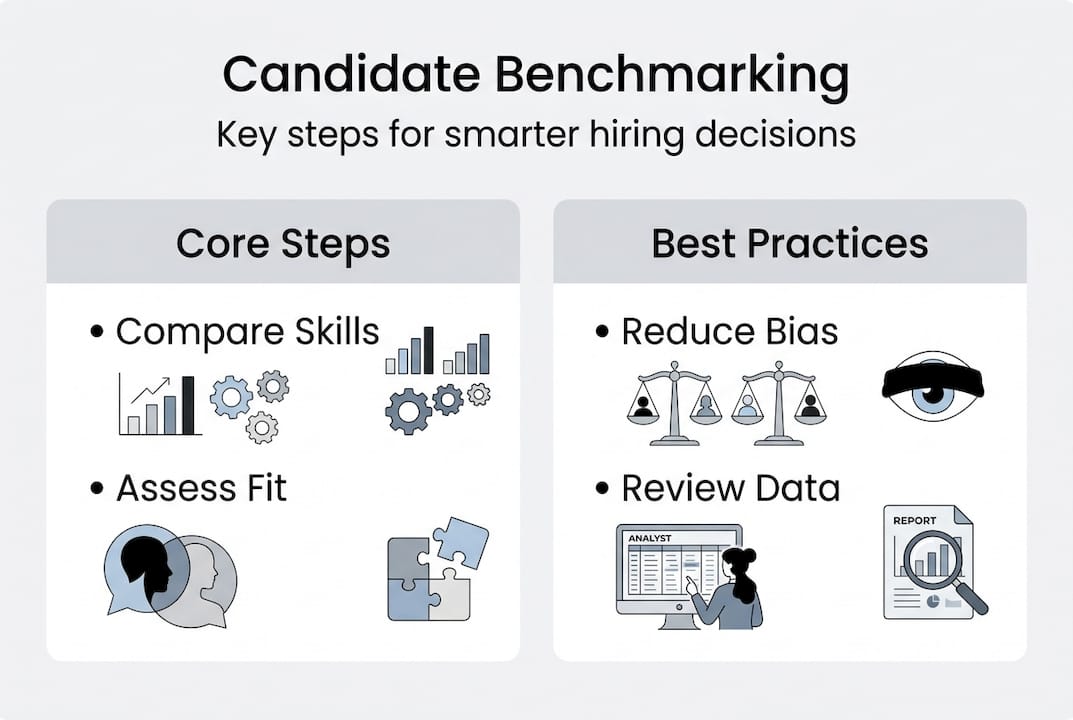
This is fundamentally different from traditional screening. Traditional screening asks, “Does this person meet the minimum requirements?” Benchmarking asks, “How does this person compare to the best we have seen?” That shift in framing changes everything about how you evaluate talent.
So where does a benchmark come from? There are three common sources:
- Top performer profiles: Analyse your highest-performing employees and identify the skills, behaviours, and traits they share.
- Competency frameworks: Use role-specific or industry-standard competency models as your reference point.
- Role models or archetypes: Build a composite profile from multiple high performers or from validated research into what predicts success in a given function.
The benefits are significant. Better benchmarks lead to better hires. They reduce the influence of unconscious bias because decisions are anchored to objective criteria. They also make recruitment outcomes more predictable, which matters enormously when you are scaling across multiple markets like the UK, Netherlands, and Spain.
“The best benchmarks are not static documents. They are living standards that evolve as your organisation and the market around it change.”
As our guide to talent screening explains, the mechanics of effective benchmarking involve skills assessments, psychometric tests, AI-driven ranking, and comparison to human baselines or top performers. These tools work together to give you a complete picture of each candidate, not just a snapshot.
When you invest in candidate assessment tools that are built around benchmarking principles, you stop relying on proxies like prestigious university names or polished CVs and start measuring what actually predicts performance.
Methods and tools: how candidate benchmarking works
Now that you know what candidate benchmarking is, let’s unpack how it’s actually done and what tools are shaping the field.
There are two broad approaches: manual and AI-powered. Manual benchmarking relies on human judgement, structured interviews, and assessments scored by trained evaluators. It works well for senior roles where nuance matters enormously. But it is time-consuming and difficult to scale.
Here is a step-by-step overview of how a typical benchmarking process unfolds:
- Define the benchmark profile based on top performers or competency frameworks.
- Select assessment tools that measure the relevant skills, traits, and behaviours.
- Administer assessments consistently across all candidates.
- Score and rank candidates against the benchmark.
- Review results alongside structured interview data before making decisions.
Popular psychometric platforms like Saville Wave and Hogan are widely used for personality and cognitive benchmarking. For technical roles, coding assessments and communication exercises are common. Emerging AI-powered approaches use advanced ranking metrics, including coding and communication assessments, psychometric tests, and precision-based ranking algorithms to surface the strongest candidates faster.
| Approach | Speed | Scalability | Bias risk | Best for |
|---|---|---|---|---|
| Human-driven | Slower | Low | Higher | Senior or niche roles |
| AI-powered | Fast | High | Lower (if audited) | Volume or technical hiring |
| Hybrid | Moderate | Moderate | Lowest | Most recruitment contexts |
AI tools that assess AI and cultural fit alongside skills are particularly exciting. They allow you to benchmark not just technical ability but also how well a candidate is likely to align with your team’s values and ways of working.
If you want to see what this looks like in practice, our collection of examples of AI interviews shows how structured, AI-supported conversations can generate consistent, comparable data across every candidate. For those hiring in technical disciplines, reviewing screening methods for tech hiring will help you match the right tool to the right role.
Pro Tip: Do not choose your benchmarking tool based on features alone. Choose it based on whether it generates data that is directly comparable across candidates and directly linked to the outcomes you care about.
Avoiding pitfalls: bias, fairness, and real-world challenges
Understanding the tools and approaches is key, but benchmarking is only as effective as it is fair and realistic, so what are the main challenges to avoid?

The most common pitfall is building a benchmark that unintentionally reflects historical bias. If your top performers all share certain demographic characteristics, a benchmark built purely on their profiles may screen out equally capable candidates from different backgrounds. This is not a hypothetical risk. It is a documented pattern in organisations that skip the auditing step.
Another trap is overfitting your benchmark to a narrow set of conditions. A benchmark built on your top performers from three years ago may not reflect the skills your business needs today. Markets shift. Roles evolve. Your benchmark must keep pace.
Here are the key risks to monitor:
- Unintentional bias from homogeneous top-performer profiles
- Overfitting to outdated or narrow performance data
- Lab-versus-reality gaps where assessment scores do not translate to on-the-job performance
- Binary thinking that treats benchmarks as pass/fail rather than a spectrum
On the fairness side, the four-fifths rule is a widely used guideline. It states that if one group’s selection rate is less than 80% of the highest-performing group’s rate, there may be adverse impact worth investigating. This is a practical, measurable standard you can apply to your own processes.
It is also worth noting that real-world variability breaks lab metrics. A 70% skills match is often a realistic and healthy target, because no candidate perfectly mirrors a composite benchmark. Expecting 100% is not just unrealistic; it narrows your talent pool unnecessarily.
Our fair assessment checklist is a great starting point for auditing your current approach. And if you are using or considering AI in recruitment, make sure your chosen tools include built-in bias detection and regular auditing capabilities.
Pro Tip: Run a retrospective audit on your last 50 hires. Compare their benchmark scores to their actual performance ratings after six months. This one exercise will tell you more about your benchmark’s validity than any vendor claim.
Turning benchmarks into hiring decisions: best practices
Having tackled fairness and obstacles, let’s turn to actionable steps for using candidate benchmarks to make confident, data-driven hiring decisions.
The goal is not to let the benchmark make the decision for you. It is to let the benchmark inform and structure your judgement. Here is how to do that well:
- Define your benchmark clearly before you open a role. Do not build it on the fly.
- Select metrics and tools that are validated for your specific role type and industry.
- Measure consistently. Every candidate should go through the same process.
- Review and adjust your benchmark at least annually, or after every major organisational change.
- Decide with context. Use benchmark data alongside structured interviews and reference checks, never in isolation.
One of the most important shifts you can make is moving from binary outcome metrics to rank-aware ones. A pass/fail score tells you who clears a threshold. A rank-aware metric tells you who is most likely to succeed relative to everyone else in your pipeline. That distinction matters enormously when you are choosing between several strong candidates.
Linking your benchmarking data to quality of hire and long-term retention is where the real value emerges. When you can show that candidates who scored above a certain benchmark threshold are 40% more likely to still be with the organisation after two years, you have a genuinely powerful business case for the investment.
Scaling across multiple roles and markets requires a modular approach. Build a core benchmark framework, then adapt it for local context. A sales role in Spain may require different communication competencies than the same role in the Netherlands, even if the core skills overlap.
Our resources on building an effective screening workflow, improving candidate matching, and how to screen without CVs will help you put these principles into practice across your organisation.
Pro Tip: Start with one role type, build a strong benchmark, validate it against real performance data, and then expand. Trying to benchmark everything at once is a fast route to inconsistency.
What most advice on candidate benchmarking misses
With concrete practices explored, here is a perspective most guides do not share, focusing on what really drives value beyond the data.
Most benchmarking advice is obsessed with tools and metrics. And yes, those things matter. But the organisations we see getting the best results are not the ones with the most sophisticated AI stack. They are the ones asking a simpler question: is our benchmark still predicting the hires we actually want?
That question requires human judgement. It requires someone to sit down with real performance data, real manager feedback, and real retention numbers, and ask whether the standard is still right. No tool does that for you.
The uncomfortable truth is that a benchmark can become a liability if it is left unchanged for too long. It starts to reflect the past rather than the future. It rewards familiarity over potential. And it quietly narrows your talent pool in ways that are hard to spot until the damage is done.
We are over the moon about what good benchmarking can achieve, but only when it is treated as a dynamic advantage, not a fixed formula. Smart HR leaders use assessment efficiency tools as inputs to their thinking, not replacements for it. That blend of data and lived experience is what separates genuinely great hiring from hiring that merely looks rigorous on paper.
Connect with expert tools for candidate benchmarking
Ready to move from understanding to action? We are genuinely excited to help you build a candidate benchmarking framework that works in the real world, not just in theory.
At Over The Moon, our AI candidate validation platform replaces CV screening with real assessments: AI interviews, company challenges, cultural matching, cognitive tests, and video pitches. Everything you need to benchmark candidates fairly, consistently, and at scale. Whether you are hiring across the UK, Netherlands, or Spain, we have the tools and the expertise to help you set up and grow your benchmarking approach. Find out more about Over The Moon and discover how we can support your team’s next hiring breakthrough.
Frequently asked questions
How does candidate benchmarking differ from normal interviewing?
Benchmarking systematically compares candidates to top performers or pre-defined standards, using skills and psychometric assessments rather than gut feeling alone. Traditional interviewing relies heavily on subjective impression, which varies between interviewers.
Which candidate benchmarking metrics are most predictive?
Rank-aware metrics like precision@k and NDCG@k outperform traditional pass/fail rates because they show how candidates compare relative to one another, not just whether they clear a threshold.
How can I detect and reduce bias in benchmarking tools?
Apply the four-fifths fairness rule, monitor for group-level variance in scores, and audit your benchmarks regularly against real-world hiring and retention outcomes.
Is 100% skills match required for a candidate to meet benchmarks?
No. A 70% skills match is common and realistic in practice, because no candidate perfectly mirrors a composite benchmark and role requirements naturally vary across teams and contexts.