AI-driven sourcing: boost recruitment quality and speed

TL;DR:
- AI-driven sourcing transforms recruitment by improving speed, quality, and diversity of candidate pools.
- It uses AI technologies to automate candidate identification, ranking, enrichment, and engagement at scale.
- Human judgment remains essential, with AI acting as a force multiplier in a human-AI partnership.
Many HR professionals assume AI-driven sourcing is simply about automating the dull, repetitive parts of recruitment. That assumption undersells it enormously. AI-driven sourcing reshapes how you find, evaluate, and engage talent at every stage, delivering measurable gains in speed, quality, and fairness. Whether you are hiring in the UK, the Netherlands, or Spain, the technology is already transforming results for teams just like yours. This guide walks you through what AI-driven sourcing actually is, the outcomes it produces, where it has real limits, and how to implement it confidently. Let’s get into it.
Table of Contents
- What is AI-driven sourcing?
- Key benefits and outcomes of AI-driven sourcing
- Limitations, risks, and the human element
- How to implement and scale AI-driven sourcing
- Why AI-driven sourcing works best as a human-AI partnership
- Explore AI-driven sourcing with We Are Over The Moon
- Frequently asked questions
Key Takeaways
| Point | Details |
|---|---|
| AI sourcing defined | AI-driven sourcing uses advanced technologies to automate and optimise how candidates are identified, ranked, and engaged. |
| Faster, better, fairer hiring | Evidence from the UK, Spain, and Netherlands shows AI cuts hiring times, boosts candidate satisfaction, and improves diversity. |
| Limits and safeguards | AI sourcing requires human input for nuanced judgement, compliance, and continuous bias audits. |
| Practical rollout roadmap | A 90-day pilot, clear KPIs, and ongoing audits are key to successful AI sourcing adoption. |
| AI as partner, not replacement | The biggest wins come when recruiters and AI tools work together, blending scale with human insight. |
What is AI-driven sourcing?
AI-driven sourcing is far more than a smarter job board search. According to the clearest definition available, AI-driven sourcing is the use of artificial intelligence technologies, including machine learning, natural language processing, and large language models, to automate the identification, ranking, enrichment, and initial engagement of qualified candidates from vast talent pools such as public profiles, job boards, internal databases, and professional networks.
In plain terms, it means the system reads, interprets, and acts on candidate data at a scale no human recruiter could match. It does not just keyword-match CVs. It understands context, infers skills from career history, and ranks candidates by genuine fit.
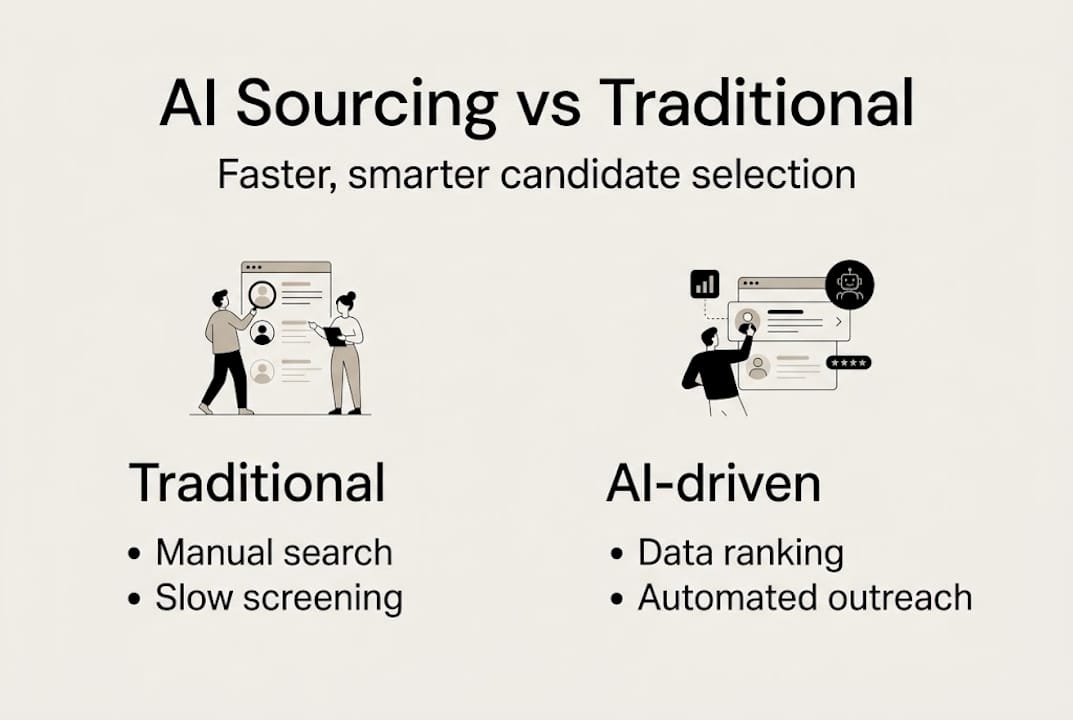
Here is a quick look at how AI-driven sourcing compares to traditional methods:
| Feature | Traditional sourcing | AI-driven sourcing |
|---|---|---|
| Speed | Days to weeks | Minutes to hours |
| Candidate pool size | Limited by recruiter bandwidth | Millions of profiles |
| Consistency | Variable | Standardised |
| Bias risk | High (unconscious) | Managed (with audits) |
| Engagement | Manual outreach | Automated, personalised |
The core capabilities of a modern AI sourcing system include:
- Identify: Scanning public profiles, job boards, and internal databases simultaneously
- Rank: Scoring candidates by skills, experience, and role fit
- Enrich: Adding context such as inferred skills, career trajectory, and contact data
- Engage: Sending personalised outreach at scale without recruiter involvement
“AI-driven sourcing does not replace the recruiter’s eye for talent. It gives that eye a telescope.”
Traditional sourcing relies on individual recruiters manually searching databases, posting adverts, and reviewing CVs one by one. That approach is slow, inconsistent, and often misses strong candidates who simply do not use the right keywords. Understanding the broader role of AI in recruitment helps clarify why this shift is so significant for modern hiring teams.
Now that you understand the broader power of AI-driven sourcing, let’s break down its impact compared to conventional recruitment practices.
Key benefits and outcomes of AI-driven sourcing
After defining AI-driven sourcing, it is vital to examine practical outcomes. The measurable advantages seen across Europe are genuinely exciting.
The headline numbers speak for themselves. Time-to-source drops by up to 75%, time-to-hire falls by 26 to 43%, and recruiter time per hire reduces by up to 70%. Capita in the UK achieved a 43% reduction in hiring time using AI tools. Those are not projections. They are live results.
Across Europe, the picture is equally compelling. Ribera in Spain hired 115 people through an AI agent and reported 98% candidate satisfaction alongside 63% more pre-selections. Transavia in the Netherlands saw 99% of hires come from AI recommendations, with 42% recruiter time saved. UK agencies now report 48% AI adoption, with 77% of candidates rating the experience positively.

| Metric | Before AI | After AI |
|---|---|---|
| Time-to-hire | Baseline | 26 to 43% faster |
| Recruiter time per hire | Baseline | Up to 70% less |
| Candidate satisfaction | Variable | Up to 98% |
| Diversity of shortlist | Limited | Significantly broader |
| Pre-selections completed | Baseline | Up to 63% more |
The core benefits for your team include:
- Faster time-to-fill across high-volume and specialist roles
- More diverse talent pools through broader, bias-aware searching
- Higher quality matches through skills-based ranking rather than CV skimming
- Dramatically improved recruiter productivity, freeing time for relationship-building
Exploring the benefits of AI assessment alongside sourcing gives a fuller picture of how the entire hiring funnel improves. And if you want to see how this connects to the screening stage, transforming candidate screening is worth a read.
Pro Tip: When presenting results to senior stakeholders, lead with time-to-hire and quality-of-hire data. These two metrics resonate most with boards and finance teams, and they are the easiest to benchmark before and after implementation.
Limitations, risks, and the human element
While the advantages are clear, it is important to grasp the boundaries of what AI-driven sourcing can achieve alone.
AI is brilliant at scale. It is less brilliant at nuance. Here are the key limitations every HR leader should understand:
- Contextual and cultural fit: AI struggles with non-linear career paths, career changers, and roles where personality or cultural alignment matters most. Human judgement is still essential here.
- Data bias: If historical hiring data reflects past biases, the AI can learn and replicate them. This is a real risk, not a theoretical one.
- Compliance complexity: Under the EU AI Act, AI recruitment tools are classified as high-risk systems. That means audits, transparency, and documented human involvement are required.
- Persuasive engagement: AI can send outreach, but it cannot build genuine rapport. Warm, personalised human contact still converts passive candidates more effectively.
- Edge cases: Unusual profiles, niche skills, or roles requiring deep domain knowledge often need a recruiter’s instinct to assess properly.
The solution is a human-in-the-loop model. This means AI handles identification and ranking while recruiters review shortlists, conduct interviews, and make final decisions. Reducing bias in recruitment requires active effort, including demographic masking, adverse impact audits using the four-fifths rule, and inclusive job descriptions.
“The growing role of AI in HRM is clear: AI augments human recruiters rather than replacing them, and the best outcomes come from teams that design their workflows with that truth at the centre.”
Pro Tip: Set up adverse impact monitoring from day one. Review shortlist demographics monthly and adjust your AI configuration if you spot patterns that disadvantage any group. Pair this with inclusive job descriptions that avoid coded language.
How to implement and scale AI-driven sourcing
Having explored both the promise and limits of AI-driven sourcing, HR leaders need a practical roadmap for successful adoption.
The good news is that a structured 90-day rollout works extremely well. Here is the plan:
- Days 1 to 30, pilot phase: Select 2 to 3 roles that represent your typical hiring volume. Define success metrics upfront. Run AI sourcing alongside your existing process so you can compare results directly.
- Days 31 to 60, formalise workflows: Document the guardrails. Decide which decisions require human sign-off. Train your recruiters on how to review and act on AI-generated shortlists. Establish your adverse impact audit process.
- Days 61 to 90, scale with KPIs: Expand to more roles and departments. Review your key performance indicators weekly. Adjust configurations based on real data. Report findings to leadership.
Here are the KPIs worth tracking throughout:
| KPI | Why it matters | |—|—|—| | Time-to-slate | Measures sourcing speed | | Diversity ratio on shortlist | Tracks inclusion progress | | Candidate satisfaction score | Reflects experience quality | | Quality-of-hire (90-day retention) | Confirms match accuracy | | Recruiter time per hire | Shows efficiency gains |
It is also worth noting that AI sourcing agents can standardise and objectify processes in ways that actively support diversity goals, but only when properly governed. Without oversight, they can perpetuate systemic bias. Governance is not optional.
For a broader view of where this is all heading, AI in recruitment in 2026 covers the emerging trends shaping hiring strategy. And if you want to understand how sourcing connects to later-stage decisions, candidate assessment tools explain how the full picture comes together.
Pro Tip: Start with 2 to 3 roles and set clear guardrails before scaling. This builds recruiter confidence, generates internal proof points, and makes it far easier to win buy-in from sceptical stakeholders.
Why AI-driven sourcing works best as a human-AI partnership
With implementation in mind, it is essential to distinguish hype from reality and understand what truly drives results.
Here is something we have seen consistently: the organisations that get the most from AI-driven sourcing are not the ones with the most sophisticated technology. They are the ones with the clearest human strategy around it. AI is a force multiplier. It amplifies what your recruiters already do well, and it also amplifies gaps in your process if those gaps exist.
Teams that create genuinely AI-augmented recruiter roles, where humans focus on relationships, judgement, and culture while AI handles scale and matching, see the fastest and most sustainable improvements. Cultural fit and genuine candidate engagement still require human interviews and real conversations. No algorithm replaces that.
The best organisations also relentlessly audit their AI outcomes. They do not set and forget. They treat AI sourcing as a living system that needs regular tuning. Faster hiring with AI assessments shows what is possible when the human and AI elements are genuinely aligned.
“AI-driven sourcing is not a replacement for great recruiting. It is what great recruiting looks like at scale.”
Explore AI-driven sourcing with We Are Over The Moon
Ready to move from theory to action? We are over the moon to help you get there.
At We Are Over The Moon, we believe recruitment should be built on real evidence, not CV guesswork. Our skills-based matching platform replaces traditional screening with AI interviews, cognitive tests, cultural matching, company challenges, and video pitches. You get a clearer, fairer picture of every candidate before they even reach the interview stage. If you are ready to future-proof your hiring strategy and see what genuinely fair, fast, and high-quality recruitment looks like in practice, explore AI candidate validation and book a demo with our team today.
Frequently asked questions
How does AI-driven sourcing improve diversity and reduce bias?
AI-driven sourcing broadens talent pools and removes some unconscious bias from initial screening, but it must be paired with demographic masking and audits to genuinely reduce bias rather than replicate it.
Is AI sourcing compliant with European regulations?
AI sourcing tools are classified as high-risk under the EU AI Act, which means regular audits, documented transparency, and meaningful human involvement are all required for full compliance.
What is the first step for implementing AI-driven sourcing?
Begin with a 90-day pilot covering 2 to 3 roles, track time-to-hire and quality-of-hire from the start, and use those results to build your internal business case before scaling.
Does AI sourcing replace recruiters?
No. AI-driven sourcing augments recruiters by handling scale and matching, but human judgement remains essential for interviews, culture fit assessment, and relationship-building with candidates.
Recommended
- AI in Recruitment – Transforming Candidate Screening and Fit | We Are Over The Moon
- Role of AI in Recruitment Agency Success | We Are Over The Moon
- How to Improve Candidate Matching for Better Hires | We Are Over The Moon
- Benefits of AI Assessment: Boosting Recruitment Quality | We Are Over The Moon